• MN Housing board update: resources for supportive housing, a rental pilot program and the 2018 Affordable Housing Plan

    At its June meeting, the board of the Minnesota Housing Finance Agency discussed resources for supportive and workforce housing, a rental pilot program aimed to help exploited families suffering gender-based violence, and suggestions for the 2018 Affordable Housing Plan. 

    To start the meeting Commissioner Mary Tingerthal introduced the newest addition to the Minnesota Housing board: Damaris Hollingsworth. An architect and native of Sao Paulo, Brazil, Hollingsworth shared that she studied in this country and worked for several firms before her current position as Vice President for THOR Design Plus. Hollingsworth said she values affordable housing for the stability it brings families and communities.

    Resources for supportive and workforce housing

    From its consent agenda, the board approved $3 million in operating subsidies for supportive housing units. In its annual budget the Agency sets aside a portion of Housing Trust Fund resources to cover revenue shortfalls and unique costs associated with operating supportive housing. Applicant agencies are required to show that they have first sought funding from other sources, such as foundations. Agency funds are joined with $2.1 million from the Department of Human Services (DHS), providing funding for 44 supportive housing developments and amounting to $1,738 per unit per year of assistance.

    A workforce housing project being developed by CommonBond in Mankato is receiving $5.7 million in short term tax exempt bond funding; this enables the project to obtain $2.7 million in equity from the sale of 4% federal housing tax credits. The 50-unit project will also receive $5.8 million in Agency deferred loans and 15 units will have project based rent assistance.   

    Rental pilot program through the Hmong American Partnership

    The board agreed to a staff recommendation to commit $210,000 for a pilot program funded by the legislature in 2016. This program provides rent assistance for exploited families where there is gender-based violence. The legislature further specified that the assistance should be delivered through an “emerging community” agency, one unfamiliar with mainstream resources. The recipient of the awarded funds is Hmong American Partnership (HAP). Their program should be up and running in October.

    Board member Stephanie Klinzing asked about funding for the social services that would be needed with the pilot program. Staff responded that DHS funds were being sought, but HAP would commit its own resources to cover service costs should outside funding not be available. Board member Terri Thao asked why the legislature wanted Minnesota Housing to administer the program since Public Safety and Human Services already have domestic violence programs. Staff said it was because Minnesota Housing has expertise in rent assistance.

    Commissioner Tingerthal said that the legislature appropriated a total of $500,000 for the pilot program. The Agency would wait six to nine months to see how HAP performs before determining how to award the remaining $290,000. If the concept does not prove viable, the Agency would likely return to the legislature and ask that the remaining rental assistance funds to be used in a different manner.

    2018 Affordable Housing Plan

    The major focus of the June meeting was providing board members the opportunity to have input in the development of the Agency’s 2018 Affordable Housing Plan (AHP). This plan specifies how resources distributed by the Agency will be allocated during the year beginning October 1, 2017. A draft of the plan will come to the board at its August meeting, and staff will ask the board to approve the final version in September.

    In introducing the planning topic, John Patterson, Director of Planning, Research and Evaluation, reviewed for the board a number of documents. These included “2017 Key Trends for Affordable Housing,” a report on a partner and stakeholder survey (conducted in May of this year), a report from outreach to 16 agencies representing historically underrepresented communities, and a report on major themes coming out of the 2016-17 Housing and Community dialogues. [Note, all these materials are included in the June 2017 board packet found on the Agency’s website.]

    In addition to the need for affordable housing as the economy continues to grow, Patterson identified a number of key themes for the Agency as it develops its plan.

    1. Housing costs will likely continue to increase with limited supply available, but rent increases may slow.
    2. Incomes may struggle to keep pace with expected housing cost increases.
    3. Millennials’ decision to own or rent will be a key driver of the housing market.
    4. Affordable housing is needed in areas with a growing workforce.
    5. Disparities in homeownership are significant.
    6. The number of people experiencing homelessness is declining, but more work is needed.
    7. The aging Baby Boom generation will create new housing needs and challenges.
    8. Minnesota has a large stock of affordable housing that needs to be preserved.
    9. New resource constraints are emerging.

    In response to the staff overview board members made a number of comments.

    • Stephanie Klinzing comments:
      • Senior and manufactured housing are very important and need to be in the mix. 
      • Small communities need help rehabbing older homes. For example, the one contractor who did that in Elk River (where Klinzing was mayor at one time) retired and new contractors are hard to find. 
      • We need to look at needs of each community individually. Central MN Housing Partnership (CMHP) used to do housing studies they helped the communities become aware of their current needs and what new needs would be coming.
      • Small rental buildings are needed in Greater Minnesota. 
    • Terri Thao comments:
      • Older market rental housing is not being maintained, leading to a situation where new buyers come in to do the rehab but substantially increase the rents. 
      • There is the opportunity to consider how Minnesota Housing can and should influence the overall rental market. 
    • Damaris Hollingsworth comments:
      • Production of modular housing could be promoted as both a means to produce quality housing at lower costs and to provide living wage jobs. 
    • Joe Johnson comments:
      • The cost of construction continues to outpace incomes, with ever-more people needing help. Can we get contractors to reduce up front costs?

    In response to board comments, Patterson said that controlling costs has been a major focus. However, the Agency found through the Minnesota Challenge effort of a few years ago that they were only addressing the problem around the edges. In response to a question, Tingerthal added that the federal effort to reduce costs by combining federal/state inspections had little impact when HUD departments could not agree on protocol.

    Staff and board also discussed the challenge of maintaining the quality and safety of existing rental housing, particularly the increasing numbers of single family homes being rented short term or permanently. They agreed that this was a local issue, but that it was very hard for local governments to overcome community opposition to more effectively regulate this housing.

    Rebecca Otto, State Auditor, asked about senior housing, saying it’s very important throughout Minnesota though she’s wary of pitting the needs of one population group against another. Tingerthal said that research shows a growing need among low-income seniors, especially since the demise of the federal 202 program. She added that developers, however, are promoting a financial model that focuses on serving middle-income seniors in suburban communities; this is a need but not to the extent of low-income seniors. Patterson spoke about the Agency pilot program for low-income seniors, noting that construction is expected to start later this year, but it does not look like any great innovations have been found. The greatest senior need is to help people stay in their homes, Patterson added. Otto asked, if funding appears, are there developers who would want to house low-income seniors? Tingerthal responded affirmatively, pointing to work of Episcopal Homes and Presbyterian Homes.

    MHFA administration discussion

    The final board meeting items were presentations on staff structure and the Agency’s administrative budget. Single Family and Multi-family lead staff described new organizational charts for their divisions. These changes are to both increase efficiency and facilitate inter-departmental work. For example, on the multi-family production side, led by Diana Lund, the staff leads are Ann Heitinger, preservation manager; Susan Thompson, chief underwriter; Devon Pohlman, manager of housing programs (including the QAP and the Consolidated RFP), and Julie Tarlizzo, manager for closings.

    Deputy Commissioner Barb Sporlein presented the Agency’s operating budget for the year starting July 1. Sporlein said some additional staffing (one new position and three contract positions are being converted to payroll at lower costs) is required as the Agency now distributes $1 billion annually and is responsible for $3.5 billion in assets. The big new expenditures for the coming year are space and technology costs associated with the move to new offices in September. The Agency’s cost of operation is about 3.7% of housing assistance distributed by the Agency, and none of this, except for the cost of the Olmstead Office, is paid by legislatively appropriated funds.

    Learn more and access the Agency’s board records here.
  • MN Housing board update: Workforce affordable homeownership grants approved, 2019 tax credit QAP discussed

    At its April meeting, the board of the Minnesota Housing Finance Agency discussed the tax credit allocation process, as well as tax credit prices. The board also received an update on the 2017 legislative session, approved grants for the Workforce Affordable Homeownership Development Program, and considered changes to the process of formulating the tax credit Qualified Allocation Plan for 2019.

    The board met for an additional April meeting by phone to discuss the Agency’s debt management policy governing use of tax exempt bonds for conduit purposes.

    Tax credits

    In her opening remarks, Commissioner Tingerthal informed board members that Agency staff had reached out to recent tax credit awardees regarding the impact of the recent drop in tax credit prices. Staff are now developing recommendations for increased funding or changes in financing terms to help developers keep their projects on track. These recommendations will come before the board in May, although investors for a couple of projects might need earlier action and therefore necessitate a special board meeting via conference call.

    Also related to tax credits, Tingerthal announced that the governor had recently signed the 2018 Qualified Allocation Plan amendments, now making them official. These requirements will be effective for development applications submitted mid-June. Starting with this year’s application cycle, Tingerthal said that the Agency will use an electronic “portal,” enabling on-line submission of applications for the Agency’s consolidated RFP.

    State legislative session

    Regarding the state legislative session, Tingerthal remarked that it was still unclear which conference committee would oversee housing appropriations. She also said that it continues to be a challenge to have major bonding and appropriations requests before the legislature during the same year.

    Frontline program

    Tingerthal concluded her remarks with a heads up to board members that a PBS Frontline documentary airing May 9 is expected to put the housing tax credit program in a harsh, negative light. The network bills the documentary as an examination of “Poverty, Politics, and Profit” in the affordable housing industry. In part, the documentary will focus on some serious fraud cases in Florida, she said. Tingerthal added that she was interviewed on-camera by the program producers on behalf of the National Council of State Housing Agencies. She was unsure whether that interview would appear in the program.

    Workforce Affordable Homeownership Development Program

    The board approved grants for the new “Workforce Affordable Homeownership Development Program,” which provides one-time grants for the development of workforce and affordable homeownership projects across Minnesota. This program received a one-time $750,000 appropriation during the 2016 legislative session. Staff received letters of interest for $6.4 million in project funding. Staff invited five of 27 applicants to submit full applications, and recommended four of the five to receive a funding commitment. Staff invited most of the other applicants to apply for project funding under the Agency’s Impact fund, which is part of the consolidated RFP. Staff selected two Greater MN and two Metro applicants for funding, consistent with the appropriations language requirement for fund distribution. One of awardees, Rebuilding Together Twin Cities, requested a grant for an apprenticeship program. Board member Craig Klausing asked if that was something the Agency could fund. Staff responded that Agency dollars would only be used for materials, not the training.

    Landlord risk mitigation fund

    Another program coming out of the 2016 legislative session is the landlord risk mitigation fund. The board agreed to staff’s recommendation to combine the $250,000 appropriated by the legislature with $100,000 in Agency funds freed up due to a change in administration of the Homeless Management Information System. The added funding would enable awardees to include housing navigation services, thereby increasing the likelihood of client success in securing housing. Following the legislative directive, the program will focus on individuals with difficult rental histories and/or criminal records. Staff provided an example of a program at Lakes and Prairies CAP, viewed as a model for a successful integrated reentry program. Funding requests are due May 31, after which the Agency expects to make 3-5 funding awards.

    2019 Qualified Allocation Plan

    The board heard staff-suggested changes for the formulation of 2019 tax credit Qualified Allocation Plan. These suggestions included discussing proposed changes to the QAP earlier in the process, prior to a formal adoption of a draft plan by the board. Minnesota Housing will host a webinar and meetings with stakeholder groups prior to developing the final draft. This final draft will likely come to the board at its May meeting and then go out for formal public comment. Staff is looking to streamline and simplify the application process in response to comments received over multiple years that the scoring structure for tax credits was overly complicated. Staff emphasized that the priorities would not be altered in any material way. Staff modeled their proposals using the 2017 applications and found that the proposal ranking would change for only one of 13 projects reviewed. One new criterion, however, would provide scoring points if the affordability period is extended to 35 or 40 years. Furthermore, the Agency would require that internet access be included all projects, and the maximum amount of credits per project would increase from $1 million to $1.2 million. Staff highlighted scoring simplifications made in these areas: greatest need targeting and duration, Greater Minnesota location efficiency, preservation, and leveraging of resource. The proposal also clarified what is meant by “planned community development.”

    Report on Minnesota Housing Special Board Meeting

    MHP’s report is based on a review of minutes from this meeting, minutes adopted without change at the regular April board meeting.

    On Wednesday, April 5, the board held a special meeting, by phone, to discuss the Agency’s debt management policy governing use of tax exempt bonds for conduit purposes. Conduit bonds are those sold by the Agency where repayment is the obligation of and made by another party.

    The review of the debt management policy comes after the March Agency board meeting when a number of presentations were made asking that conduit bonds be issued to support redevelopment by Dominium of the Fort Snelling Upper Post.

    Staff told the board that the Agency rarely issues conduit bonds because it is not in the Agency’s best financial interest. Conduit bonding provides Minnesota Housing a one-time fee rather than a continuing income stream as is typical with other bond issuances.

    Minnesota Housing’s debt management policy was adopted in 2009, and at that time the Agency had only authorized conduit bonds one time for the preservation of federally assisted housing (one of the criteria for use of these bonds). Since adoption of the policy, the Agency authorized the issuance of conduit bonds on one occasion when tax exempt bonding authority was plentiful.

    Board members Rebecca Otto and Stephanie Klinzing stated that when resources are scarce there is a need to ensure the Agency’s financial security. Klinzing added that the Fort Snelling project would require several waivers from the Agency’s debt management policy.

    Minnesota Housing attorney Tom O’Hern said that there is pending legislation that may materially affect the financial operations of the agency. (Author’s note: This was an apparent reference to the HAVEN proposal.) O’Hern asked what the board wanted staff to take into account in order to bring a waiver request to the board.

    In closing the meeting, board chair John DeCramer asked board members whether they were in favor of retaining the conduit bond threshold condition that such bonds only be used for preservation projects. All board members in attendance (Otto, Thao, Johnson, Klinzing and DeCramer), stated that the policy should be left in place.

  • Sold Out: New documentary shares tenant stories, lifts up solutions to loss of affordable housing

    Sold Out: New documentary shares tenant stories, lifts up solutions to loss of affordable housing

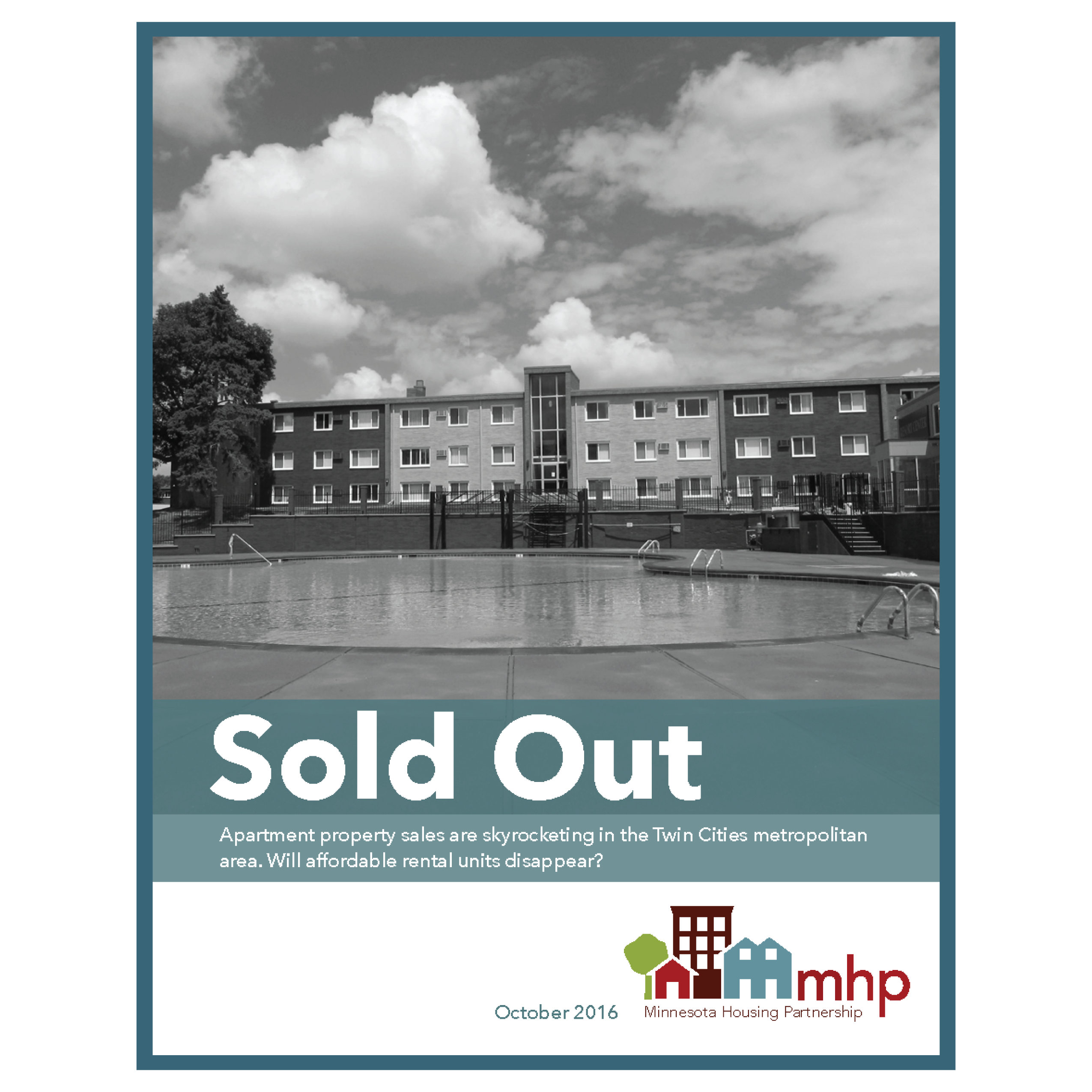
    The voices of tenants and owners, advocates and elected officials raise the urgency and opportunity to address the loss of affordable housing in a new documentary. Produced by Twin Cities PBS, in partnership with local advocates and funders, “Sold Out: Affordable Housing at Risk” reveals the price we all pay when families are pushed out of our communities as modestly priced units are replaced with upscale developments.
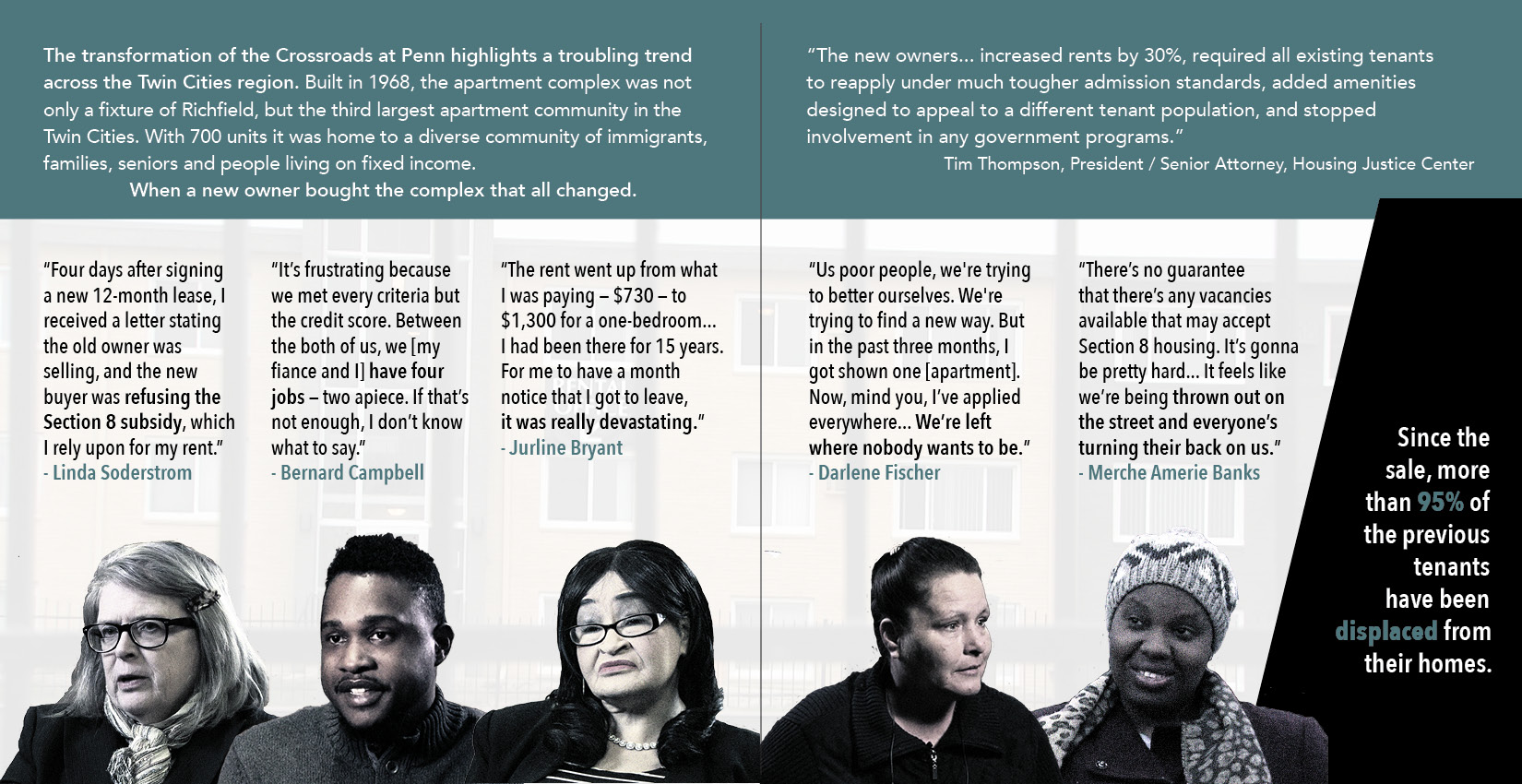
    It’s been more than a year since the ultimatum given to hundreds of tenants at the Crossroads at Penn: Pay massive rent hikes, pass stringent tenant requirements — or be forced out into a white hot rental market with very few options for low-income households or those on government assistance. A year later, more than 95% of the tenants are gone — but it’s not just the families who’ve suffered.

    Watch the full film online now!

    “We all pay the price when low-cost rental housing is upscaled for higher income households and families are displaced,” says Chip Halbach, executive director of the Minnesota Housing Partnership. “How we answer this challenge in the near term will impact our region’s economic strength and the resilience of our social fabric. But we must act soon. Unlike cities like San Francisco and Seattle, where housing affordability has spun out of control, we still have time to make the Twin Cities a place where people at all income levels can live and contribute.”

    As evidenced in MHP’s 2016 report by the same name, strong growth among renter households with higher incomes — above $50,000 per year — has created a strong incentive to re-position older properties with diverse populations for younger, more affluent households. The new 60-minute documentary provides first-hand accounts from numerous former residents of the Crossroads at Penn, sharing the devastating impacts of being pushed from a place where some had resided for decades.

    “It was a wonderful place for all of us families,” says a former Crossroads tenant. “We had neighbors, we had relationships, our community, and also the schools, the transportation, even employment. It was a good place for all of us.” But when residents were forced out by new standards and increased rent, they were dispersed from the support systems and services that made ends meet.

    “It’s greatly compounded the difficulties of their lives, figuring out how to get so much farther to their job, to their doctor, to the grocery store,” says Tim Thompson, President and Senior Attorney at the Housing Justice Center. The film also lifts up the work of tenant organizing and highlights a landmark legal suit brought by the Crossroads residents under the Fair Housing Act.

    The impacts of apartment upscaling, like the Crossroads, ripple far beyond the individuals and households forced to move. Through interviews with elected leaders, researchers, educators and employers, the films reveals how the uprooting of families negatively impacts area businesses and local schools as well as the social fabric and economic functioning of our communities. It makes clear that the current housing market fails residents struggling to make ends meet — and all of us pay the price.

    There is no single or simple solution but there is one certainty: Ensuring adequate affordable homes impacts the lives of every single resident of the region. From tenant organizing to social impact investing, community and elected leaders are putting forward strategies to keep low-cost rental housing safe, stable and available to the workers and families who play a critical role in the economy and life of the region. By hearing directly the voices of those impacted and understanding the trends driving this upscaling, “Sold Out” aims to set the stage for a community-wide conversation focused on enacting policy and lifting up solutions from the grassroots, grasstops and public-private partnerships to stem the loss of affordable housing in the Twin Cities.

    Now is the time to act. We hope you will join us in this critical discussion.

    Follow the hashtag #SoldOutRenters on Twitter for ways to engage!

  • From the Field: Minnesota Advocates Win New Housing Funding

    In collaboration with our partners at the National Low Income Housing Coalition, we crafted this recap and reflection on this year’s state legislative session. Learn more at NLIHC at http://nlihc.org/.
    After a tense state legislative session, a $46 billion budget has passed in Minnesota with $77 million in bond funding for housing and more than $5 million in expanded support for homeless programs. The state legislature and Governor Mark Dayton (D) approved funds to support Housing Infrastructure Bonds (HIBs), General Obligation (GO) Bonds, the Centering Learning Around Student Stability (CLASS) Act, and the Catholic Charities’ Dorothy Day Center.

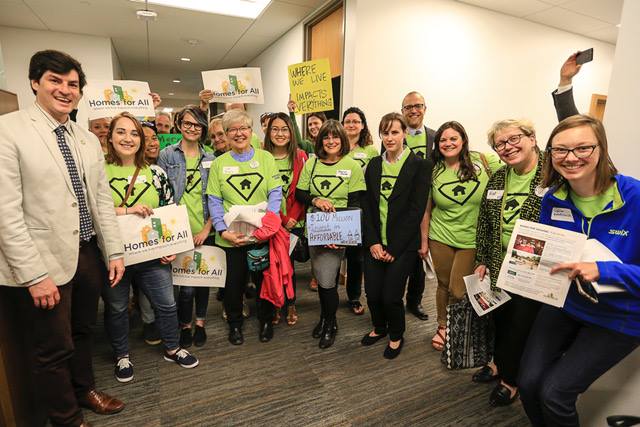
    The expanded funding is largely the result of ongoing advocacy by the Homes for All coalition, a network of Minnesota groups working to end homelessness and the affordable housing shortage.

    Despite a budget surplus of more than $1 billion, the Republican-controlled House and Senate proposed extensive budget cuts and tax reductions. This approach resulted in a special session because of the vast difference between the budget as passed and what Gov. Dayton was willing to sign. The contentious tone of the session makes the significant success of housing advocates more hard-earned and surprising than in previous years.

    The 2018 state budget allocates $55 million for HIBs, bonds used for construction and preservation of affordable housing. They can be used to build and rehabilitate supportive housing for those at risk of homelessness and to preserve affordability of federally subsidized housing. HIBs can also be used to buy land for community land trusts and for foreclosure prevention. Minnesota’s budget included an additional $10 million for GO bonds, which are used to improve health, safety, and energy conditions in existing public housing. In 2016, $80 million in state bonds leveraged $300 million in private and local funding. Finally, the budget included $12 million for the Catholic Charities Dorothy Day Center located in St. Paul, which provides essential emergency assistance services such as shelter, job search guidance, meals, and access to basic medical care.

    Beyond victories in housing bonds, various Department of Human Services programs see expanded support in the new budget. Housing with Support for Adults with Serious Mental Illness increases by $2.15 million, Long-Term Homeless Support Services Funds increase by $750,000, transitional housing programs increase by $400,000 and emergency services programs increase by $200,000. The CLASS Act, one of Governor Dayton’s priority initiatives, received $2 million. The CLASS Act provides secure, stable housing for highly mobile school children and their families to promote academic success. The program provides rental assistance in Saint Paul, Minneapolis, and Moorhead to keep students and their families in the same school and neighborhood.

    Homes for All advocates at a 2017 rally, including team MHP!

    The final budget also includes important language enabling local communities to establish local housing trust funds, a priority for MHP. Unfortunately, the local housing trust fund language did not establish a dedicated funding mechanism and did not provide for a state funding match to incentivize the creation of trust funds. The enabling legislation does, however, provide MHP with momentum leading to introduction of legislation next year to secure funding sources.

    While Gov. Dayton signed all nine budget bills, he removed $130 million in state funding by line-item vetoing the funding for the Minnesota House and Senate operations. He did this because he opposed many provisions in the tax bill, such as tobacco tax breaks, estate tax exclusion increases, property tax freezes, and other allocations. The legislature had added a provision to one of the budget bills which would have cut funding to the Department of Revenue if Gov. Dayton had vetoed the tax bill. Essentially, this left Gov. Dayton with no department to collect taxes if he did not go along with the legislature’s tax cut priorities, leaving him with little choice but to sign the tax bill. By vetoing the funding to operate the House and Senate, Gov. Dayton stated he is hoping to bring the Republicans back into negotiations. Republican lawmakers are now suing the governor with a court date likely in the upcoming week. It is not clear which side will prevail in court.

    The $77 million in bonds falls short of the $100 million goal for the Homes for All coalition. Advocates are developing strategies to further expand housing investment in future budget sessions. “This was a difficult budget session, but we are proud to see a modest expansion of resources for affordable housing,” said Chip Halbach, Executive Director at Minnesota Housing Partnership. “This was only a partial victory, but we will be able to avoid a drop off in housing activity at a time when low-income people are being displaced through upscaling occurring in the private unsubsidized market.”

    For more information about housing priorities in the recent Minnesota legislative session, contact Jeremy Schroeder, Policy Director at Minnesota Housing Partnership at [email protected].

    Read more about the Homes for All campaign at: http://www.homesforallmn.org/.

  • Investors Council Recap: Cities Step up for Affordable Housing

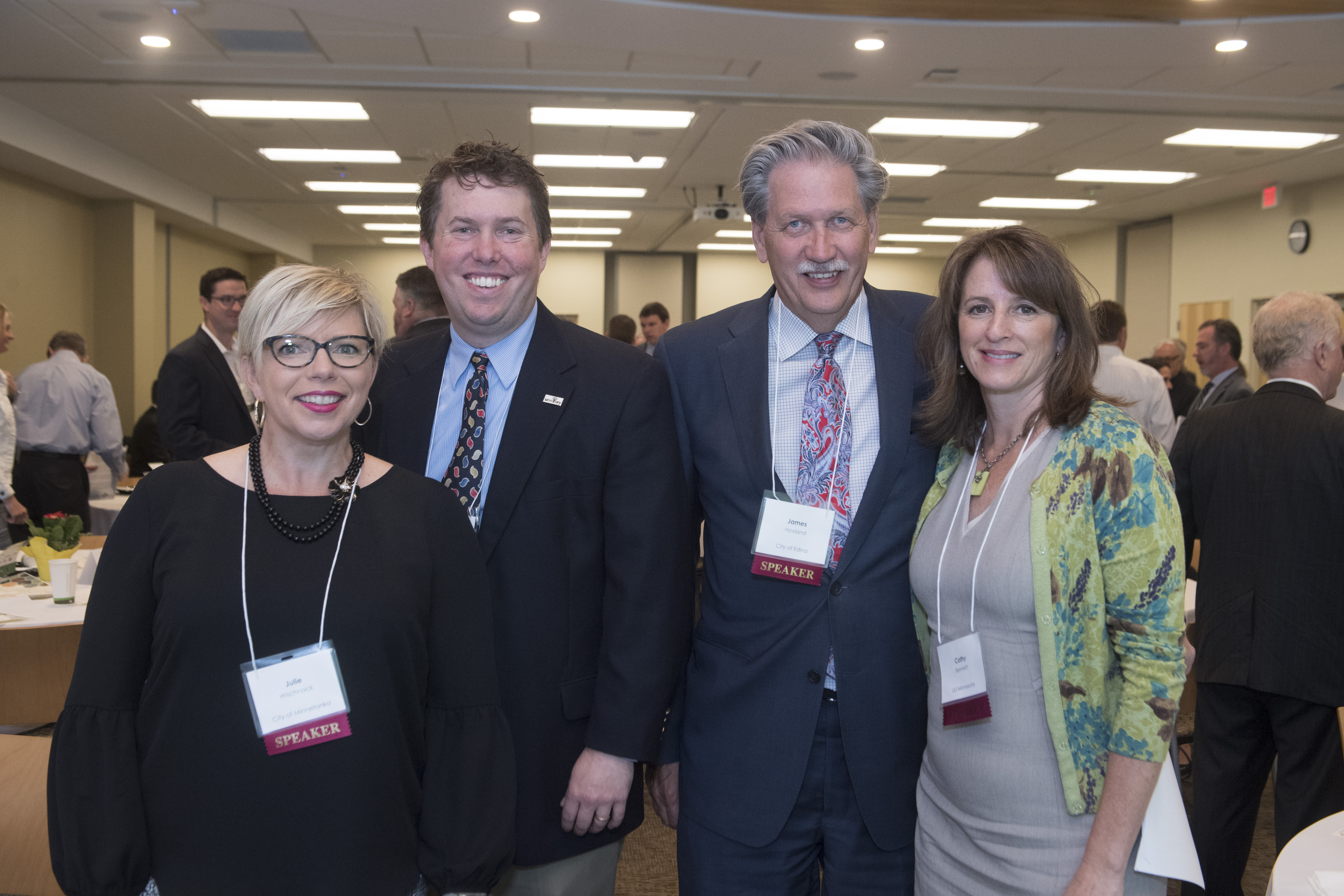
    On May 17, Investors Council members and guests convened to discuss how cities are stepping up to support affordable housing development. Nearly 100 attendees learned about regional trends and progress made by the cities of Woodbury, Minnetonka, and Edina.

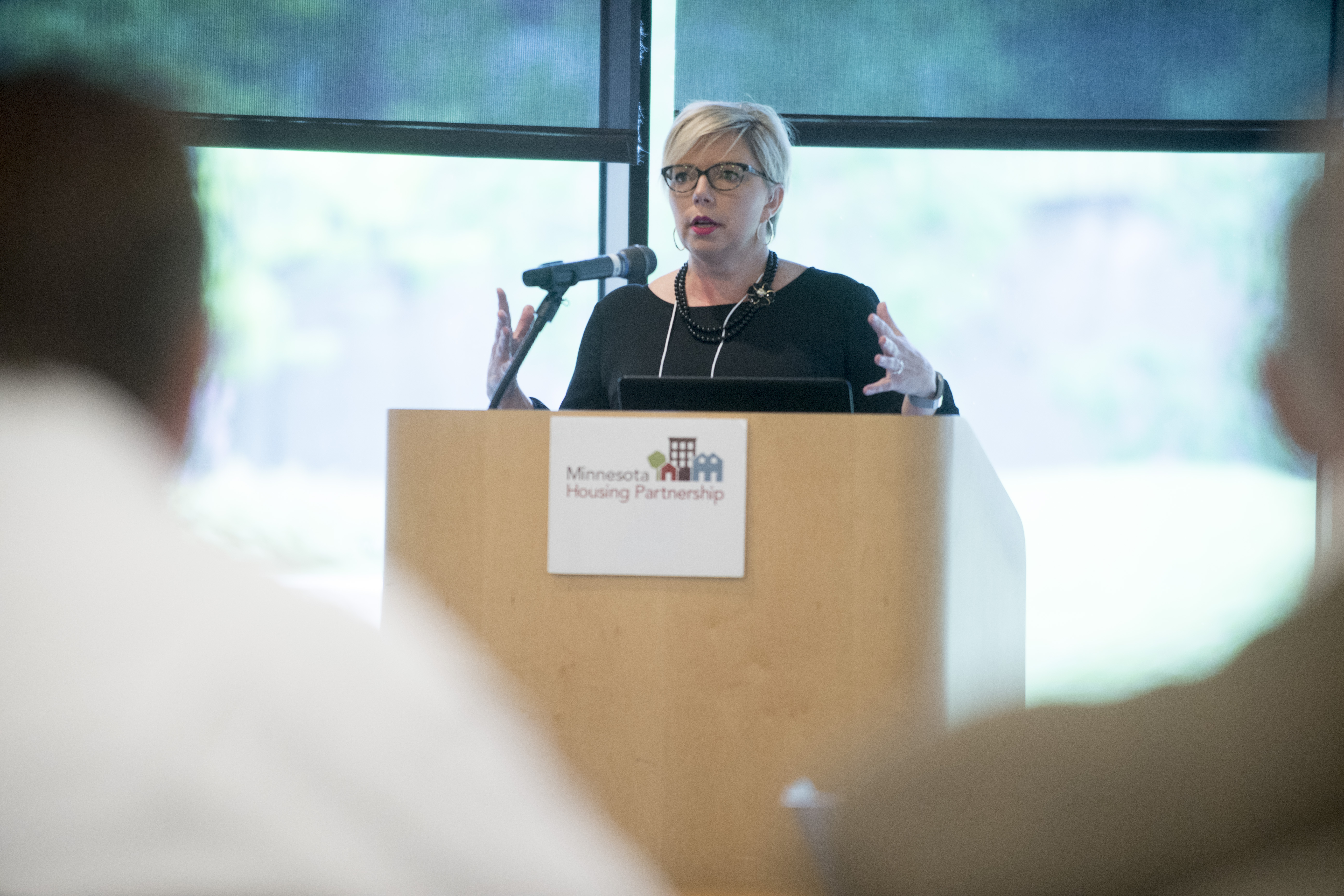
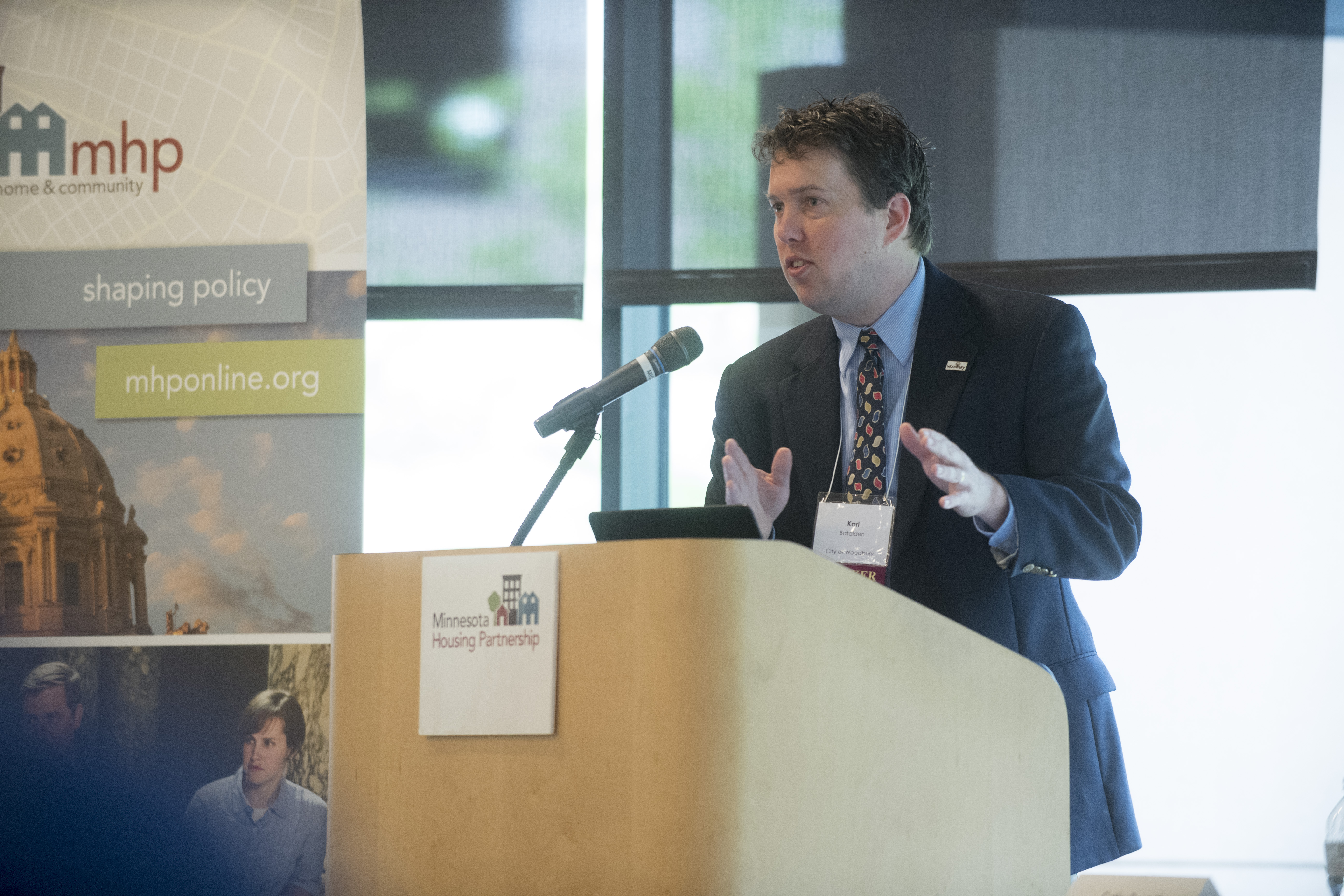
    Cathy Bennett of the Urban Land Institute of Minnesota (ULI MN) and the Regional Council of Mayors kicked off the event with a regional overview (pictured far right). A panel discussion followed with insight from (pictured from left) Julie Wischnack, Community Development Director in Minnetonka; Karl Batalden, Housing and Economic Development Coordinator in Woodbury; and Jim Hovland, Mayor of Edina.

    Bennett explained that more and more cities are realizing that the creation of quality affordable housing is “critical to the economic competitiveness of the region.”

    According to Bennett, the Metropolitan Council estimates that 20 communities in the Twin Cities metro region have implemented affordable housing policies, many of which are triggered by financing mechanisms. For example, Minneapolis utilizes public finance, city subsidy, mixed income, and housing assistance policies, along with density bonus and planned unit development measures, to create affordable housing.

    Cathy Bennett of the Urban Land Institute of Minnesota (ULI MN)

    From her perspective, Bennett suggested “the number one thing a city can do [to support affordable housing development] is declare that affordable housing is important to them.” Cities can do this by making a commitment to affordable housing in their comprehensive plans and by implementing an affordable housing policy. According to Batalden, this “belt and suspenders” approach is important because it sets up a broad vision, while creating a mechanism that holds cities accountable to their goals. It’s also important to create a policy that cities can amended as they adjust their strategy.

    Wischnack said that Minnetonka is making an effort to visibly and effectively prioritize affordable housing development in the community. “I suppose [Minnetonka] doesn’t scream affordable housing,” she said. “We’re trying to change that perception.”

    According to Wischnack, Minnetonka has been making progress toward the creation of affordable housing for decades. Thirty years ago, Minnetonka started the region’s first community land trust, “Homes Within Reach.” Since then, the city has utilized approaches like planned unit development to create affordable senior housing and is currently exploring new strategies such as tax increment pooling.

    Julie Wischnack, Community Development Director in Minnetonka

    Batalden explained that, in Woodbury, affordable housing has been part of the land use plan since the late 1970s. “We’ve wanted to have a diversity of housing stock since day one,” Batalden said. Like Minnetonka, Woodbury has also utilized planned unit development to develop affordable housing along with density transfers and density bonuses. “Density is worth money, and if we can add density to a project, that can help us close the gap,” Batalden added.

    All three panelists conveyed that support for affordable housing development looks different in each community. Wischnack said that in Minnetonka, stigma around affordable housing among community members continues to be a major hurdle to development. On the upside, the Minnetonka city council has expressed strong support for affordable housing.

    Batalden emphasized that design is key to countering the “not in my backyard” attitude of some community members. “When you take the time to design [a project] well, that NIMBY-ism falls apart,” Batalden suggested.

    Karl Batalden, Housing and Economic Development Coordinator in Woodbury

    Mayor Hovland said that right now in Edina, support for affordable housing is strong. In 2015, Edina passed an affordable housing policy, and last year, residents rallied around the recently opened 66 West development, 39 units of housing for formerly homeless youth. However, to address the need for affordable housing in Edina, the city first had to realize that they possessed the tools to make developments happen.

    “We’d wring our hands and look at our property values and wonder how we’re going to do this,” Hovland said.

    (At podium) Edina Mayor, Jim Hovland

    Edina is now looking to create a tax increment financing district around Southdale Mall that will generate six to $10 million in revenue for affordable housing over the lifetime of the district. “Our community is right behind us,” Hovland said. “We’re not getting any pushback on these affordable housing goals. It’s a fabric for a town that you want.”

    MHP hosts three exclusive Investors Council breakfasts each year. The next Investors Council event, an advocacy happy hour, will take place this June. Join the Investors Council today to be part of these timely discussions! Click here to see more photos of the event. For additional information on how cities can step up to advance affordable housing, check out ULI MN’s online platform, Housing Counts, which provides access to data, toolkits, and more.

    Photos by Scott Streble

  • MN Housing board update: Major policy change proposed for 2019 QAP

    At its May meeting, the board of the Minnesota Housing Finance Agency discussed a major policy change in the draft 2019 tax credit Qualified Allocation Plan (QAP), extending affordability for 9% tax credit projects; the reach and impact of the Family Homeless Prevention and Assistance Program (FHPAP); a move to forgive the debt on a foreclosure response initiative; the latest developments at the state legislature and more.

    In her opening remarks, Minnesota Housing Commissioner Mary Tingerthal reported to the board on the PBS Frontline program, “Poverty, Politics and Profit.” She said that, contrary to industry expectations, reactions to the program were muted. To ensure that any questions or concerns that may have surfaced as a result of the program were addressed, Agency staff contacted Minnesota Congressional delegation offices. She also noted that, the Agency’s office move to the former St. Paul Macy’s store will occur over a several week period in September.

    2019 Qualified Allocation Plan (QAP)

    The board voted to release for public comment the draft 2019 tax credit Qualified Allocation Plan (QAP). Staff highlighted numerous changes from the 2018 plan, however they reminded the board that most of the changes were intended to simplify and clarify the tax credit application process, and the draft QAP included very few policy changes.

    A major policy change in the QAP, staff said, was to encourage longer term affordability for 9% tax credit projects — longer than the 30 years of income and rent restrictions now required as a minimum. Seven competitive scoring points were added for projects promising 40 years affordability, with three points for 35 years affordability. Staff said that the 2019 QAP would also further encourage large family housing over single room housing for homeless people. Greater Minnesota will be divided into two geographies for access to transit points: one for the larger cities and the other for small communities. The points given for minority- and women-owned businesses are proposed to extend to nonprofits whose executive directors are people of color and/or women.

    Board member Craig Klausing asked about the balance between awarding credits to projects being located in areas of higher opportunity versus areas of concentrated poverty. Staff responded that the scoring system encourages development in areas with high performing schools and other attributes of opportunity; however, this would be balanced with support for projects that preserve affordability of existing affordable housing regardless of location.

    Board chair John DeCramer asked who paid for the required appraisals. Staff responded that they would ultimately be covered by the funding sources supporting a project. Tingerthal concluded the discussion by saying that comments on the proposed 2019 QAP would be accepted until June 14, and the QAP would be back to the board for adoption at its July meeting.

    2017 housing tax credits

    In action related to 2017 housing tax credits, the board accepted staff’s recommendation to award $3.9 million in supplemental deferred loans to six stalled projects. This action reflected the Agency’s interest in advancing projects selected during the Agency’s 2016 RFP that were subsequently impacted by the reduction in tax credit pricing following the presidential election and announcement of the Trump Administration’s tax reform proposals. The pricing on one dollar of tax credits had dropped between 4 and 15 cents on the six properties receiving extra assistance. Greater Minnesota Housing Fund and Minnesota Housing would assist eight properties through loan increases. Commissioner Tingerthal said that when staff reached out to the developers of these projects using 2017 tax credits, she thought the need for Agency assistance would have been a lot higher than it turned out to be.

    Family Homeless Prevention and Assistance Program

    Contingent upon the governor signing the Agency’s funding bill, the board awarded 2018-19 grants under the Family Homeless Prevention and Assistance Program (FHPAP). Staff said that they expect about 14,000 households to be assisted by FHPAP grantees. This will either prevent a family from becoming homeless or support the rapid rehousing of families losing their homes. Tingerthal highlighted the great savings to the state from keeping these families from becoming homeless. She said that program grantees report that 80% of participating families become stably housed. Starting with this funding round, tribal nations have become eligible program administrators. This year Minnesota Tribal Collaborative, representing five northern Minnesota tribal entities, is being awarded funds. Because of concerns about the accuracy of Census data on reservations, Agency staff said that they relied on the Wilder survey of homeless persons to provide data on need within reservations. Funds were also awarded for the Bridges rental assistance program for persons with severe mental illness.

    Family Housing Fund

    The board gave staff the go-ahead to negotiate forgiveness of $3.4 million in debt owed by the Family Housing Fund. This initiative was taken in response to losses that surfaced in loans that the Fund had provided Greater Metropolitan Housing Corporation (GMHC) as part of a foreclosure response initiative in the wake of the 2006-2008 financial crisis. Agency Chief Financial Officer Kevin Carpenter stated that because of initiatives taken here by groups such as the Fund and GMHC, the Twin Cities recovered from the crisis better than the recovery experienced in other communities around the country. Carpenter said that the Agency had three objectives when considering the debt forgiveness.

    • First was to help revitalize the two organizations (Family Housing Fund and GMHC).
    • Second was to provide a conceptual framework for how it would consider similar support to other organizations that invest in affordable housing.
    • And third, was to develop a prudent and reasonable standard for the Agency to employ when considering similar requests.

    Carpenter said that before recommending the forgiveness, the two organizations would need to meet seven conditions. The Family Housing Fund would need to forgive its loan of like amount to GMHC, and GMHC would need to take a number of steps to strengthen its management and reach agreement with other lenders. Board member Stephanie Klinzing encouraged staff to be very clear in identifying the extraordinary circumstances in which the Agency would consider this type of debt forgiveness.

    Legislative session update

    Agency policy staff, Ryan Baumtrog and Katie Topinka, updated the board on the status of housing proposals being considered during the almost completed legislative session. Housing was included in one of three budget bills passed by the legislature at the time of the board meeting and awaiting the governor’s signature. However, the governor is not expected to sign any funding bill until all of the major bills reach the governor’s desk and the session-ending agreement between the governor and legislative leaders is realized. At this juncture, staff was happy with the outcome — all Agency programs were funded at their full base budget. The legislature also funded two additional initiatives, increasing the Agency’s budget over base by $6 million, or 6 percent.

    One of these additional initiatives passed by the legislature is a workforce housing program ($4 million), formerly housed in DEED. In moving the program to Minnesota Housing, the legislature eliminated the prohibition of combining state workforce housing funds for any property also using funds that require income and rent restrictions. The other $2 million initiative was for Homework Starts with Home, a program providing rent assistance to homeless and highly mobile families with school age children.

    Staff said that while a bonding bill was not yet completed, the legislature was considering a bill that included $77 million in bonds for housing and related projects. This includes $35 million in Housing Infrastructure Bonds (HIB), $10 million in General Obligation bonds for public housing repairs, and $12 million for non-residential portion of the St. Paul Dorothy Day project. The final $20 million are Housing Infrastructure Bonds with bond repayment coming from previously committed debt service appropriations.

    Housing Infrastructure Bonds

    Tingerthal concluded the meeting by asking for board concurrence on a proposal to commit up to $20 million in HIB using prior approved debt service to projects on an early award basis. Tingerthal believed that there might be a few stalled projects that would have gone forward had a bonding bill passed in 2016. To enable any such projects to start construction this season, the Agency would provide up to $20 million in advance of the current year’s consolidated RFP funding awards (which will be made this October). To qualify, these projects must meet the requirements for HIB, have all other funding and approvals secured, demonstrate that they would lose other funding commitments if they could not start early and demonstrate that they can close and start construction by October. Developers would let the Agency know whether they would seek such funding by June 1 when the upcoming consolidated RFP multifamily “intent to apply” form is due, and then make full application with other RFP applications by June 15.


  • Making the Cut(s): Trump FY18 budget eliminates key housing programs

    On Tuesday, the Trump administration released its highly anticipated Fiscal Year 2018 budget proposal. To fund tax cuts that benefit America’s wealthiest residents, President Trump’s budget plan slashes key programs that allow families to keep roofs over their heads and food on the table.

    Of course, no one believes these cuts will become reality. Many sources in Washington, including members of the president’s own party, say the budget proposal is “dead on arrival.” But members of Congress do see the President’s budget as a set of goals — and analysis from the National Low Income Housing Coalition emphasized that “advocates are deeply concerned that Congress could try to pass deep – but less severe –
    cuts as a compromise.”

    Below is a summary of cuts contained in the budget proposal and the Trump administration rationale for those cuts. Look for a Minnesota-specific analysis on the impact of the Trump budget on housing soon.

    Reduces rental assistance by $1.9 billion. Also proposes policies that include administrative relief, streamlining for grantees, policies that encourage work and self-sufficiency, including increases to tenant rent contributions (at the discretion of Secretary Carson).

    • Rationale: The Administration recognizes that rent and utility inflation is increasing costs every year, making it more difficult to assist the same number of households. States and local governments and the private sector need to contribute more to help address affordable housing needs among low-income households.

    Eliminates CDBG (Community Development Block Grants)

    • Rationale: The program is not targeted to the poorest population and has not demonstrated results. The budget devolves community and economic development activities to the state and local level. Studies have shown that the allocation formula poorly targets funds to the areas of greatest need. Many aspects of the program have become outdated. Also, decreasing appropriations combined with more localities qualifying for allocations has reduced the size of individual grants over time, making CDBG less impactful.

    Eliminates funding for HOME

    • Rationale: Housing for low-income families is a fragmented system with varying rules and regulations that create overlap and inefficiencies, as well as challenges to measuring success. The Administration devolves affordable housing activities to state and local governments who are better positioned to address unique market challenges, local policies, and impediments that lead to housing affordability problems.

    Eliminates funding for Choice Neighborhoods

    • Rationale: Reports suggest that many of the funds leveraged by Choice grantees were existing commitments and appear as if they would have occurred in the absence of a Choice grant. Also, examples of grants catalyzing additional resources beyond housing finance were infrequent. State and local governments are better positioned to fund locally driven strategies for neighborhood revitalization.

    Eliminates funding for the Self-help Homeownership Opportunity Program (SHOP). SHOP includes the Capacity Building for Community Development and Affordable Housing program (Section 4) and the rural capacity building program.

    • Rationale: The program is duplicative of other federal, state, and local efforts. The non-profit organizations that receive these grants should have the capacity to substitute dollars with more flexible funding from the private sector and philanthropy.

    Eliminates allocations to the Housing Trust Fund and the Capital Magnet Fund

    • Rationale: Housing for low-income families is provided by a fragmented system with varying rules and regulations that create overlap and inefficiencies.

    Public housing capital fund cut by 68%.

    Eliminates the single family housing direct loans in USDA. Beginning in 2018, USDA will offer home ownership assistance only through single-family housing guaranteed loans.

    • Rationale: Financial markets are more efficient, increasing the reach of mortgage credit to lower credit qualities and incomes. Therefore, homeowners can utilize private banking industry to provide this service. Current low mortgage rates often result in average 30 year fixed commercial mortgage rates at or below the average borrower rate for the USDA single family direct loan. Rural areas once isolated from easy access to credit have shrunk as broadband internet access and correspondent lending have grown. USDA is in a position to utilize the guarantee program and still achieve its homeownership goals for rural areas.

    Eliminates the Rural Business and Cooperative Service – not a housing program but critical to rural development

    • Rationale: The program is improperly managed. The Administration’s tax, regulatory, and infrastructure policies are expected to be more effective at improving rural economies and job growth.

    Eliminates Rural Water and Waste Disposal Program Account – not a housing program but critical to rural development

    • Rationale: Duplicative. Also, elimination of the program might stimulate infrastructure lending from rural lenders.

    Cuts Native American Housing Block Grant program $108 million

    • Rationale: The Administration recognizes that the program is fulfilling its mission, yet, improved data collection is necessary to assess grantee performance on efficiency metrics.

    Eliminates the Indian Community Development Block Grant

    • Rationale: Unauthorized and duplicative.

    Eliminates FEMA’s Emergency Food and Shelter Program

    • Rationale: The Emergency Food and Shelter Program is proposed for elimination because it is duplicative of federal housing programs administered by HUD and emergency food and shelter is primarily a state and local responsibility.

    Reduces the Neighborhood Reinvestment Corporation (NeighborWorks) by $148 million

    • Rationale: A strong return on these funds has not been documented. NeighborWorks is not a unique provider of housing and community services. It cannot document that its federal funding leads to higher performance or better outcomes compared to the work of similar organizations.

    Eliminates Weatherization Assistance Program (EPA)

    • Rationale: Reduces federal intervention in state-level energy policy and implementation.

    Eliminates new grants for CDFIs and cuts funding for oversight of existing commitments by $10 million

    • Rationale: The CDFI industry has matured, and these institutions should have access to private capital needed to extend credit and provide financial services.

    Eliminates the Low Income Home Energy Assistance Program (Dept. of Health and Human Services)

    • Rationale: The program is known for fraud and abuse. Also, all 50 States have imposed regulations that prevent utility companies from disconnecting energy needs from their residents under certain circumstances (for example, Minnesota’s “Cold Weather Rule”)

    Again, these cuts are wildly unlikely to pass muster in either chamber of Congress. “The president’s budget, as we all know, is a recommendation,” said Senate Majority Leader Mitch McConnell, reminding reporters that he didn’t endorse President Bush’s budget either. Rep Leonard Lance, R-NJ told reporters “there’s an old adage in Washington: the president proposes, the Congress disposes.” And Rep. Mark Meadows, the chairman of the House Freedom Caucus, told the New York Times that “even for some of us who are considered fiscal hawks” cutting Meals on Wheels “may be a bridge too far.”

    But MHP, and our national partners, will remain vigilant as the budget process progresses — and share the potential impacts these cuts could have in Minnesota soon. 

  • Take Action: Tell your state lawmakers we need bonds for housing!

    This week, the Minnesota House released a $600 million bonding bill. The bill includes only $10 million general obligation bonds for public housing and no new Housing Infrastructure bonds. While the bill does reauthorize $20 million in housing infrastructure bonds (HIB) from 2014 and 2015, these are not new investments.

    Pipeline projects across the state will continue to be delayed if there are no new HIB in this year’s bonding bill.

    Please take a moment to urge Speaker Daudt and your House Representative to include $100 million in bonds for housing: $80 million in Housing Infrastructure Bonds and $20 million in General Obligation bonds.

    Speaker Daudt and your House Representative need to hear from you today! Email Speaker Daudt at [email protected] or call at 651-296-5364. Find your lawmaker here. 

    Here’s a script for your call or email.


    Dear [insert Speaker Daudt/your Representative’s name here]

    [Insert brief paragraph on your company/organization. If possible, include the number of units you have developed or manage and how many households you serve. Briefly mention your geographic scope]

    Right now, H.F. 892 does not include new bonds for housing. I urge you to include $100 million in bonds for housing: $80 million in Housing Infrastructure Bonds and $20 million in General Obligation bonds.

    This resource is critical to expanding housing opportunities across the state. Between 2012 and 2015, $120 million in Housing Infrastructure Bonds (HIB) has led to the development of 1,873 units and $25.5 million in General Obligation Bonds (GO) has maintained 3,388 units. Without HIB, thousands fewer units will be developed or preserved and without GO, HRAs across the state will not be able to perform necessary maintenance to ensure safe housing for their tenants.

    Now is the time to invest in bonds for housing. Never before has the opportunity to leverage private capital investment been so great. Even with private investment, many of the current projects require partnership with the state to help fill the gap between what it costs to construct the project and the rents that households can pay.

    [If you have a development in the pipeline seeking HIB or GO, mention what that project will mean for your community. Or a project you’ve recently completed. If a preservation project, please include how much in federal funding was maintained. If you leveraged significant private capitol, please mention.]

    Time is running out this session and Minnesotans deserve a decent, safe and affordable place to live. Please act now to ensure adequate funding for housing.

    Thank you, 

    [Name]
    [Organization]
    [Address]
    [Email or phone contact information]


  • Chip Halbach to retire after 40 years of leadership

    From tenant organizing to founding and leading a nonprofit advocacy and community development organization, the Minnesota Housing Partnership (MHP), Chip Halbach has dedicated his life to advancing stable, affordable housing in Minnesota and beyond.

    This September, he’ll end his tenure as Executive Director, making way for new leadership at MHP and new outlets for his deep commitment to homes for all.

    “Before Google, the answer to your affordable housing questions was usually found in Chip Halbach,” says Warren Hanson, Executive Director of the Greater Minnesota Housing Fund. “As the founder of MHP, Chip created and built and led MHP to become the go-to housing organization to respond to housing demands and create strategic solutions.”

    Throughout his 40-year career in affordable housing, Chip has shown a keen instinct for identifying opportunities — and convening other leaders to develop creative ways to seize them. In his early work, Chip saw that few housing groups were engaged in statewide advocacy efforts, community development assistance, or communications around housing. In the late 1980s, Governor Rudy Perpich established a commission to promote affordable housing in Minnesota. In this convening of advocates, Chip recognized an opportunity to create an organization for statewide housing advocacy — and MHP was born.

    “Chip’s level of dedication and technical knowledge in affordable housing matters are unmatched,” says Jeff Koerselman, ‎Attorney / Shareholder at Winthrop & Weinstine. “He has shown me that, to be an effective advocate for this industry, one needs to have both technical knowledge and deep relationships.”

    Over the next three decades, MHP became a respected advocacy, community development, and housing communications leader. Chip and his staff advocated for — and achieved — key housing policy goals such as establishing a tax credit for affordable rentals and securing funds for a national housing trust. Chip positioned MHP as a resource for other housing organizations through timely research reports, and he convened a skilled team to deliver technical assistance to rural communities not only in Minnesota, but in nearly every U.S. state.

    “Chip has represented Minnesota at meetings with HUD Secretaries and White House officials, and he has always led effective delegations of Minnesota residents when meeting with Members of Congress,” says Ed Gramlich, Senior Advisor at the National Low Income Housing Coalition. “And, he’s always done this with a wry sense of humor.”

    Because MHP’s work encompassed a broad constituency, Chip was well aware that MHP played an important role in bringing the affordable housing community together. By instigating the convening of the Homes for All Coalition, Chip helped housing advocates align their efforts. And, by founding the MHP Investors Council, Chip created a strong, engaged network of nonprofit, for-profit, and government housing leaders to advocate on behalf of affordable housing. Chip’s ability to foster partnerships allowed him to bring innovative ideas to fruition.

    “Chip’s creative approaches and strategies help to open up our industry’s thinking about the possibilities of how we might increase investments to address housing needs,” says Anne Mavity, Director of New Projects at Beacon Interfaith Housing Collaborative. “MHP is part of the glue that holds the stakeholders in the affordable housing community together.”

    Under Chip’s leadership, MHP has constantly evolved, responding nimbly to the changing housing landscape. Through that change, Chip’s passion and high integrity as a leader held steady. “One of our hallmarks is figuring out what holds different stakeholders together and how do you manage the conflicts that always develop,” Chip says. “I’m energized by that. Some people would say I’m conflict-averse but to me conflicts arise because there’s really a hidden bridge that can create a common ground or a resolution.”

    Now, as MHP seeks a bridge to new leadership, Chip says MHP is well positioned to continue to grow and thrive. “While it is hard to leave an organization that has been such a significant part of my life, I feel a foundation has been laid that will enable MHP to advance equitable communities with homes for all through the years ahead,” he says. “We have in place a seasoned and accomplished board and staff, and many terrific partnerships in Minnesota and nationally. It is the strength of these relationships that is MHP’s greatest resource.”

    Paul Sween, a Managing Partner at Dominium and chair of the MHP board, agrees. “Chip’s leadership shines in both his detailed understanding of a highly technical, complex field — and his capacity to convey that expertise in a way that fosters consensus and inspires people to coalesce around an issue,” Sween says. “These strengths have proven to be a powerful combination throughout Chip’s career — and have positioned MHP for a bright future. Thanks to his leadership and vision, MHP is more relevant than ever and looking forward to finding a capable Executive Director that will bring new energy to our critical work while also building on Chip’s incredible legacy.”

    If you’re interested in the position — or know someone who can lead MHP — click here for the Executive Director Position Profile.

    Photos by Scott Streble


  • Why invest in #Bonds4Housing? Good jobs and safe homes

    This week, the Minnesota House released an $600 million bonding bill that includes only $10 million general obligation bonds for public housing and no new Housing Infrastructure bonds. On Wednesday, nearly 70 people attended the House Capital Investment Committee hearing to testify against the bill.
    Chad Olson (pictured right) was one of them. As a co-owner of Frerichs Construction Company in St. Paul, Olson directly employs more than 90 people — and subcontracts many more. As he told lawmakers, Housing Infrastructure Bonds are a critical resource in building and rehabilitating multi-family housing, providing work for his employees and changing the lives of families stuck in aging units in need of rehab.

    Here’s what he said.


    My name is Chad Olson, and I’m the co-owner of Frerichs Construction Company located here in St. Paul. Our company was founded in 1983, and we are a medium-sized General Contractor. We do about $75 million in revenue each year and currently employ 91 people, primarily carpenters, laborers and equipment operators. In addition to our own employees, we also hire numerous subcontractors.

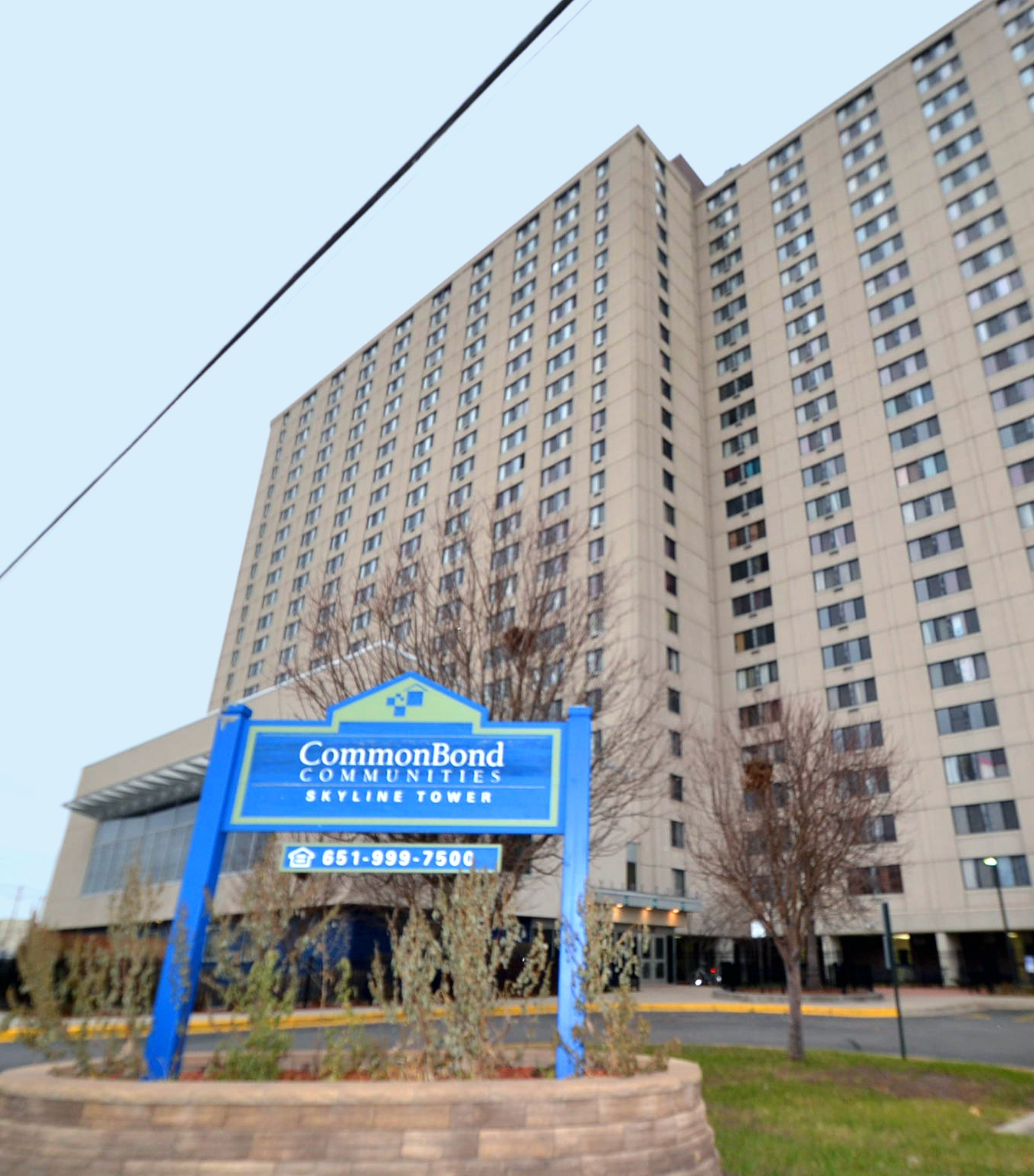
    Frerichs’ forte is constructing and rehabilitating multifamily housing. To date we have completed more than 12,000 units of multifamily housing in our history. In this past year we were able to renovate 504 units in Skyline Tower for CommonBond Communities (pictured right). This project was possible because of Housing Infrastructure Bonds (HIB). HIB is a critical resource for maintaining and developing new housing stock for very low-income households.

    I wish you could see the conditions some of these people are forced to live in, and the life changing transformation after their building can be renovated. A lot of the units are in very poor shape when we start. It is very eye opening to see the conditions some people and families are living in. Often, when we enter a unit, the bed bugs will be so bad we have to leave for a few days because the exterminator needs to make multiple applications to get them all. Roaches are another big problem.  

    A majority of the projects, like Skyline Towers, are occupied rehab. Initially, residents are often wary of our presence because our work is a disruption to their daily lives. But once we’ve completed our work, I often see obvious transformation in residents. By the end of the project we often have residents baking cookies for the crews. We get thank you cards and letters. At the end of one project, residents even threw the crew a “going away party” with a theme of “Happy Trails… It’s hard to say goodbye.” It was a powerful thing for us because each resident in the building wrote a personal note to our crews thanking them.

    Housing Infrastructure Bonds are a necessary and critical component of the work we do. The impact isn’t just on the success of my business, but also the success of my employees, my subcontractors, and the thousands of residents either living in the buildings, or on waiting lists trying to simply have a place to call home. It is kind of mind boggling all of the layers of people that are positively impacted by funding projects like this.

    Why do we need HIB? Financing on these projects is very complex and complicated. Projects often take years to become reality. When developers apply for anticipated funds that don’t materialize because the legislature makes cuts or doesn’t pass bills, it has very real and very dire consequences for businesses like Frerichs Construction. In addition, these consequences are not only felt by the company itself, but by all of the families of our 91 employees and additional subcontractors, who ultimately suffer due to not having work. With no bonding bill last year and a miniscule one this year, people ultimately will lose their jobs and be out of work.

    When the legislature approved $100 million in bonds for housing, Housing Infrastructure Bonds helped finance over 1,200 new and rehabbed units. If this year the legislature only reauthorizes $20 million in pre-authorized bonds, the agency may be able to fund only 340 units.

    Stay tuned to MHP for updates on the bonding bill and other legislative developments!