• Tax exempt bond allocation committee agreements and next steps

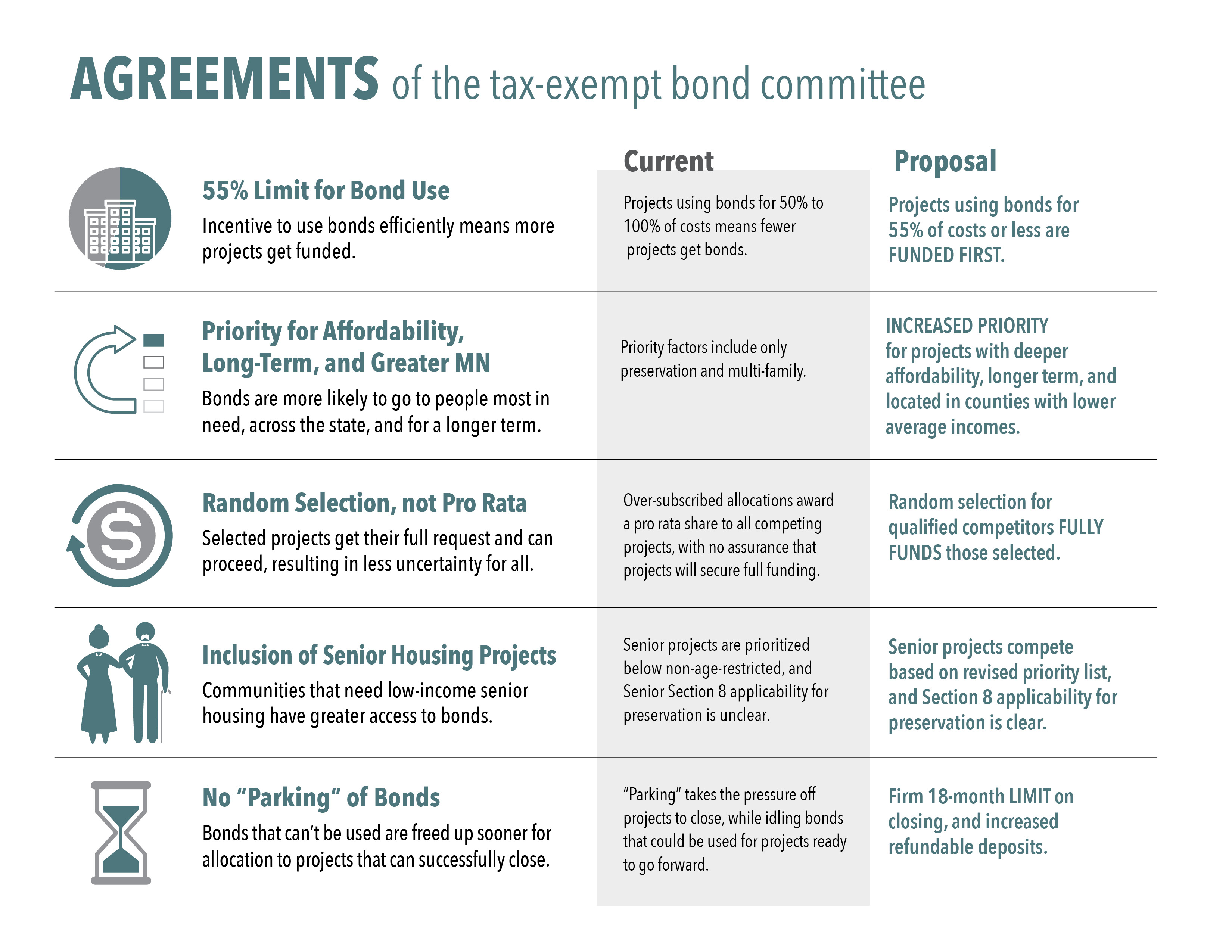
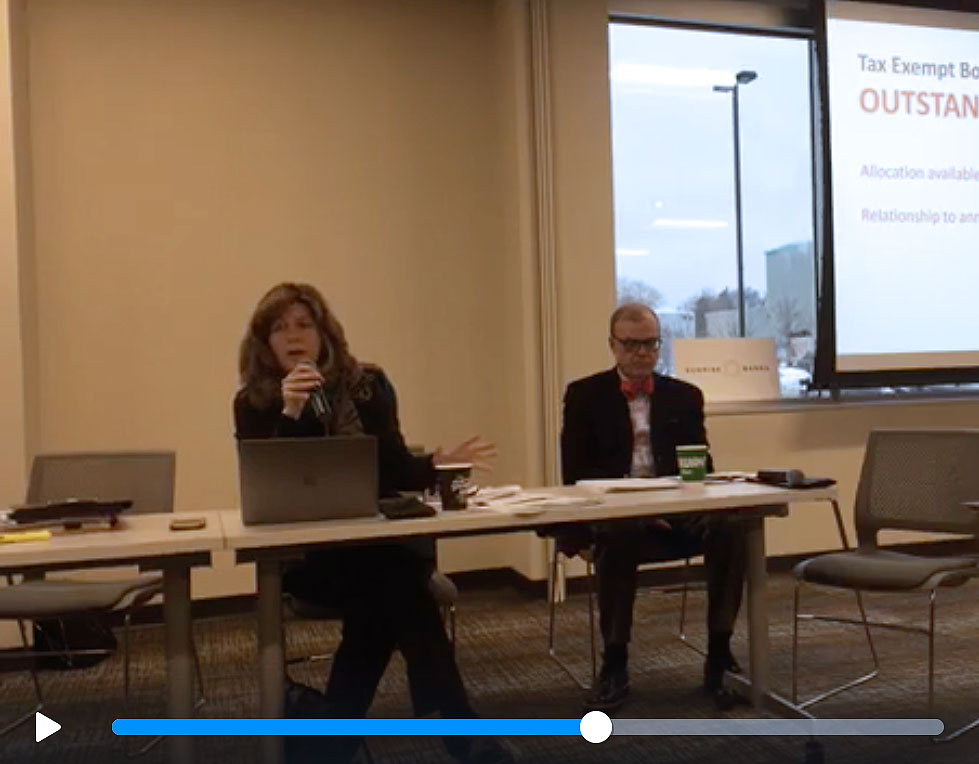
    Over the past several months, a group of housing stakeholders met to discuss how to improve the efficiency and effectiveness of the tax exempt bond process. Convened by MHP, Greater Minnesota Housing Fund and Family Housing Fund, the group included representatives from 15 different organizations representing the public, private and nonprofit sectors. On December 13, the group shared an update on its work, including agreements and outstanding issues. Click below for the overview of agreements reached and the Powerpoint presentation shared at the stakeholder meeting.

    Download the steering committee agreements

    Download the Powerpoint presentation

    Watch the video of the project update event

  • New report highlights key housing issues facing immigrant communities in the Twin Cities

    For many Twin Cities immigrants even today, the dream of securing a safe, healthy affordable home is out of reach.

    A new study reveals that the three largest immigrant populations in the Twin Cities — the Hmong, Latino, and Somali communities — carry a heavier burden and specific challenges when it comes to securing safe, stable housing in the communities that benefit from their essential contributions.

    The Twin Cities immigrant population has grown rapidly in recent decades. Between 2000 and 2015, the number of foreign-born residents living in the region spiked by 74 percent, rising from 206,500 to 359,500. Today, 12 percent of all Twin Cities metropolitan area residents are foreign-born. Immigrants play an increasingly significant role in the Twin Cities community — but too many face significant and systemic barriers to finding and maintaining adequate and affordable housing.

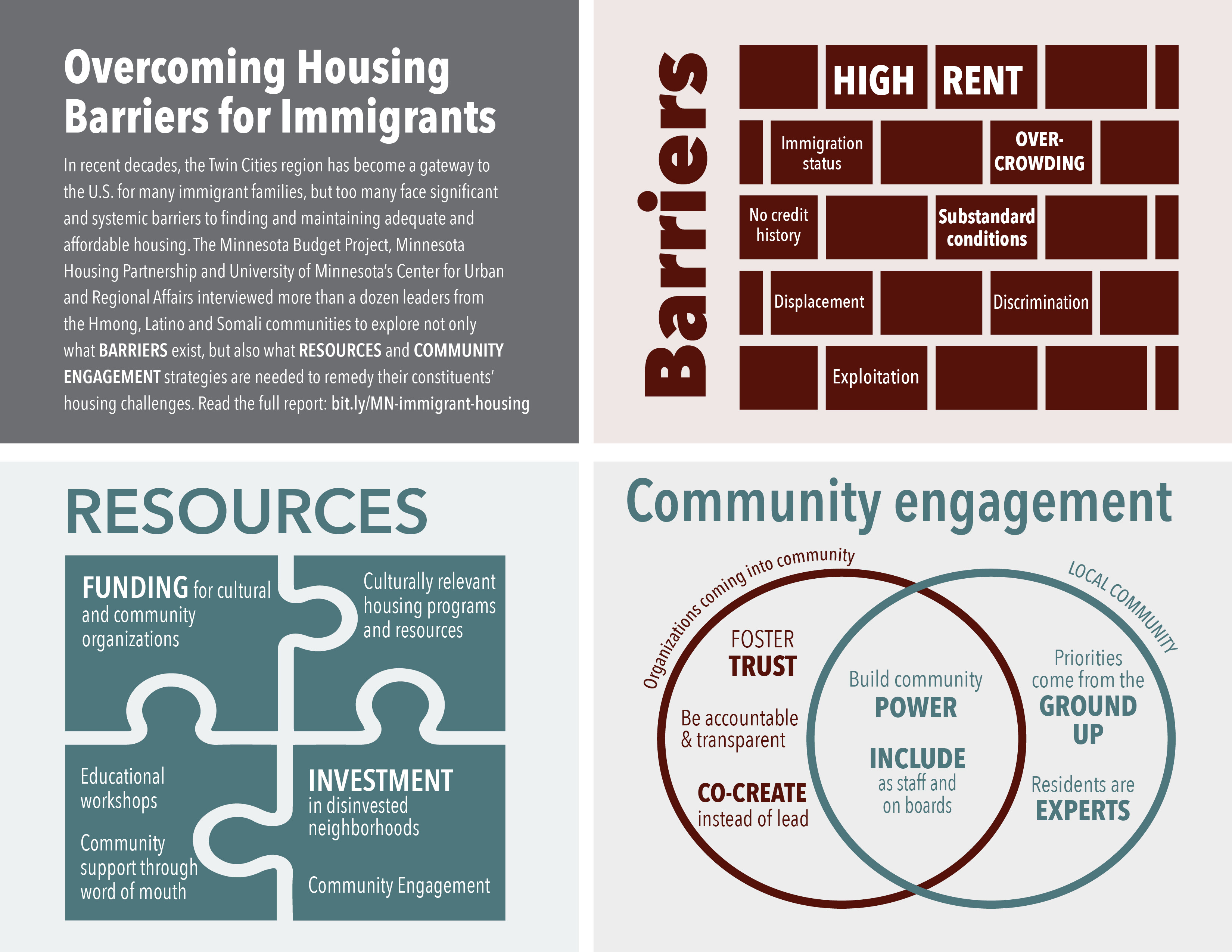
    Given the urgent need to identify lasting solutions for the growing immigrant community so that all of our region’s residents can thrive, the Minnesota Housing Partnership, Minnesota Budget Project and the University of Minnesota’s Center for Urban and Regional Affairs conducted interviews with more than a dozen leaders from the Hmong, Latino, and Somali communities to explore not only what barriers exist, but also what resources and community engagement strategies are needed to remedy their constituents’ housing challenges.

    Key takeaways from the report:

    Barriers to safe, healthy, affordable housing

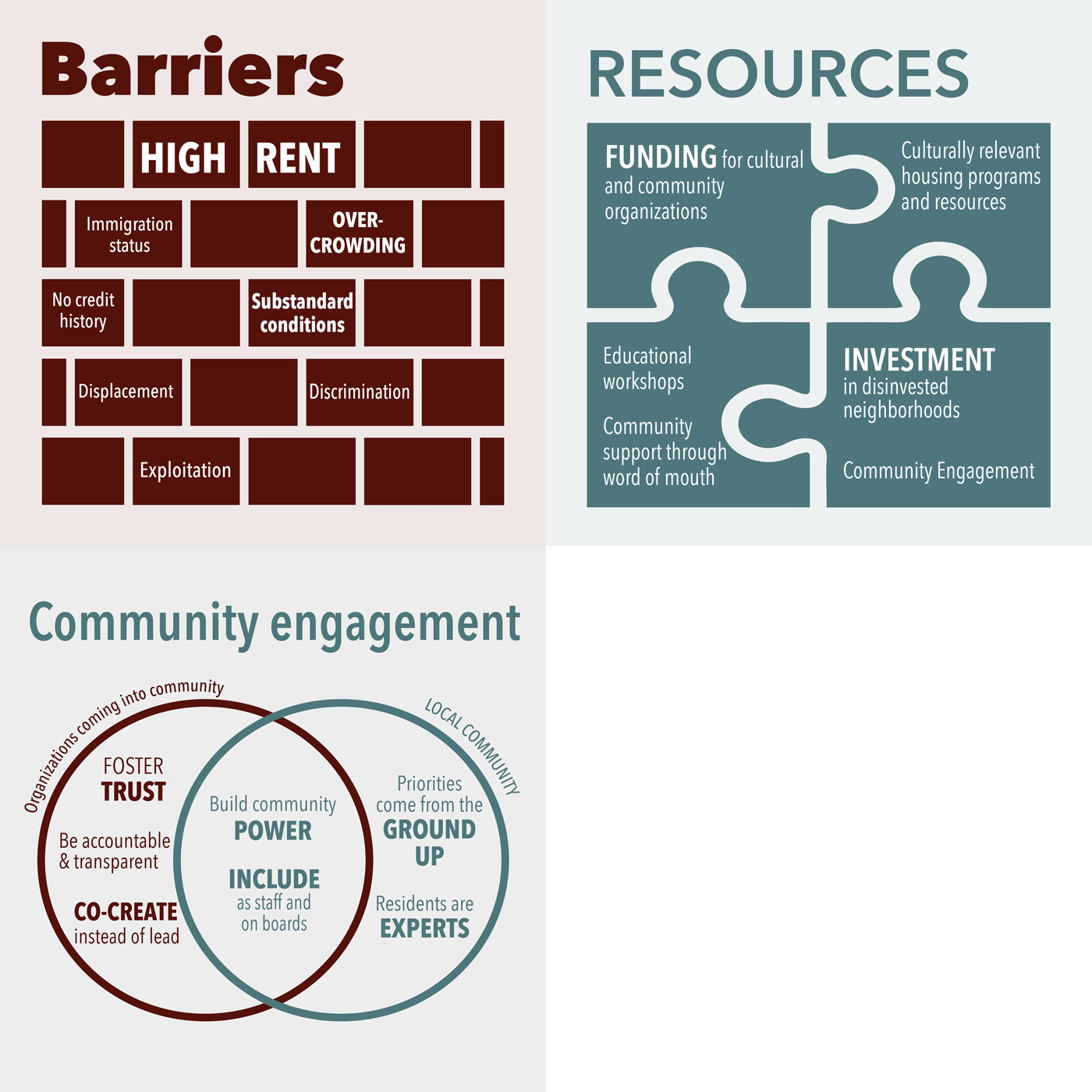
    • Barriers to securing quality housing include cost, a lack of credit history, discrimination, displacement, and immigration status.
    • Immigrant groups — such as the Hmong, Latino, and Somali communities — bear some of the greatest burden when it comes to affordable housing shortages. Almost 40 percent of immigrant households in the Twin Cities pay more than 30 percent of their income on housing.
    • Immigrants are often forced to occupy substandard housing. Additionally, a shortage of affordable units and units that can accommodate large families regularly leads to overcrowding.

    Existing resources within immigrant communities

    • Even in the midst of settling in a new country, many immigrant families are able to reestablish themselves because of the strong support from their communities. Often, immigrants rely upon family members and word of mouth and for information and accommodations upon arrival.
    • Many immigrant families secure support from community organizations to provide housing supports such as financial assistance with rent, Section 8 applications, moving expenses, and legal services.

    Solutions suggested by community leaders

    • Establish and enforce a more fair housing market, create and enforce policies that provide for landlord accountability, and reallocate housing funds to invest in historically disinvested neighborhoods.
    • Provide more culturally sensitive housing programs and services, encourage housing authorities and building contractors to build more houses and apartments to accommodate larger household sizes, and invest in community organizations that already offer customized housing services to immigrant communities.
    • Promote and provide more educational workshops to immigrant families, and develop a reference guide or a directory of affordable housing units that can be easily accessible to immigrant communities.
    • Increase the agency of immigrant populations by establishing more grassroots efforts that encourage immigrant families to be involved in the political process where housing decisions are made and by expanding opportunities for immigrants to secure and maintain employment and achieve financial stability.

    Strategies for responsive community engagement

    • As advocates and agencies seek feedback, they must put the priorities of immigrant communities first rather than “pushing their own agenda.” They must also approach communities with the goal of building power rather than extracting information. Authentic community engagement, leaders emphasized, is predicated on trust — and in many communities trust has not been developed between housing advocates or agencies and immigrant populations.
    • Leaders in the Somali, Hmong and Latino communities stressed that verbal communication is critical. Their community engagement typically includes face-to-face dialogue, including networking, door knocking and frequent in-person gatherings at places populations typically congregate, like apartment buildings, religious and cultural institutions.
    • Meaningful engagement approaches are grounded in the understanding that community members are experts of their own lived experiences and that there are distinctions not only between immigrant groups but also within broad cultural communities.
    • The depth of relationships can change the nature of the work, dramatically shifting the priorities and perspectives on the true problems and possible solutions. Transparency and accountability are crucial.

    Download the report here and the infographic here. 

    Organizations interviewed

    ACER — African Career and Education Resources, Inc

    African Immigrants Community Service

    CAPI USA

    CAPM — Council on Asian Pacific Minnesotans

    CLUES — Comunidades Latinas Unidas en Servicio

    HACER — Hispanic Advocacy and Community

    Empowerment through Research

    Inquilinxs Unidxs por Justicia

    Neighborhood House

    Somali American Parent Association

    Tapestry (Bi-lingual Spanish church)

    Voices for Racial Justice

  • Mora senior housing complex breaks ground as tax reform threatens similar projects

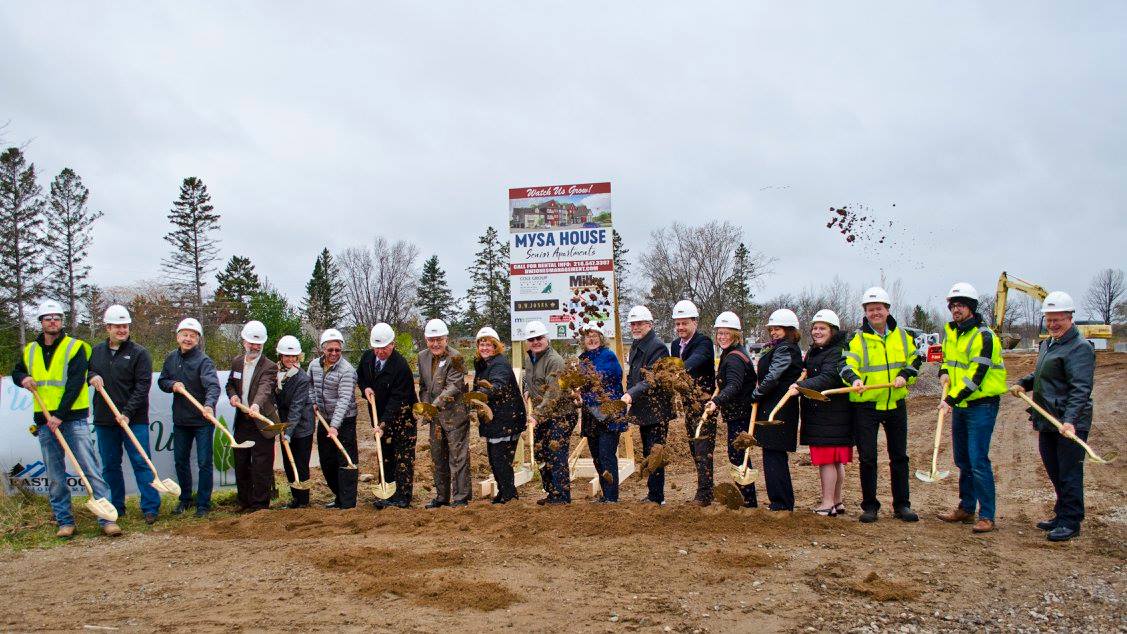
    Despite a biting cold wind and October snowflakes, Mysa House project partners were all smiles in their hard hats and winter coats as they drove golden shovels into the ground to mark a tangible step forward in meeting Mora, Minnesota’s urgent need for affordable senior homes.

    Over 50 people gathered to celebrate the 24-unit complex for which construction is now underway. Mysa House will be the latest addition to a senior living campus established in 2009 that includes a memory care complex, independent senior apartments, and space for gatherings and community events.

    “Mysa House is a new chapter in a thriving senior community,” says Rose Dunn, Executive Director of the Mora HRA.

    The construction of affordable senior housing has been a top priority of the Mora HRA for years. A 2014 housing study identified a need for nearly 70 affordable senior units through 2025 in the City of Mora. A regional study found that area seniors will need 2,761 units through 2025.

    To chip away at that need, Dunn and her team at the Mora HRA partnered with local developer D.W. Jones and submitted an application for funding to Minnesota Housing last year. Mysa House was one of two projects in Minnesota to receive funding through Minnesota Housing’s Senior Pilot Program — and the first in the state to begin construction.

    But Dunn says the project has faced a few major roadblocks. One of them was for the election of President Trump.

    “We were holding our breath and thinking, ‘Oh fantastic, we’ve got these funds committed, and everybody’s in and can do this,” but then with the election and the unknown proposed changes to tax laws, the sale of tax credits is really difficult,” Dunn explains. “Honestly, I think the Mora HRA got really lucky. I know we have a really skilled developer that has great connections and was able to get them sold. We could not sell them for what we had anticipated, but I understand there’s a lot of projects that did not sell their tax credits, so that was huge.”

    Tax reform continues to threaten projects like Mysa House across the country. If passed in its current form, tax reform would make similar projects virtually impossible by eliminating private activity bonds, a key tool for the development of affordable housing.

    “Mysa House was funded with 4% tax credits and private activity bonds and would not have happened without these tools,” says Skip Duchesneau, President of D.W. Jones, the developer for Mysa House. “Without private activity bonds the current bill will hinder our economic development, and stop needed infrastructure investments of cities and towns in Minnesota as well as further plunge the United States into an affordable housing crisis.”

    From left: Mora HRA Board Chair Paul Larson shakes hands with Skip Duchesneau of D.W. Jones as Rose Dunn, Mora HRA Executive Director, looks on. Pictured above: MHP Community Development Manager Cherre’ Palenius

    Already, Mysa House has a waiting list of 45 seniors. Dunn says it’s critical that communities come together to understand and address the need for affordable housing.

    “We feel it every day — the great need,” Dunn explains. “And sometimes the challenge is from those who don’t understand the need, or see the need, or think that it’s important or that it can be done. We just feel so strongly about serving the people that we do that we’re all the more committed and determined to find ways to make this happen and make it work.”

    Cherre’ Palenius, Community Development Manager at Minnesota Housing Partnership met Dunn in 2013, and since then, has provided guidance and insight as Dunn and her team work to develop more affordable senior housing in Mora. She’s seen firsthand their deep commitment.

    “I know Rose and her team aren’t done yet,” Palenius says.

    Mysa House is scheduled to open in summer 2018. From there, Dunn says the HRA will work to add a complex similar to Mysa House, senior townhomes, and perhaps a senior cooperative. They’re also considering expanding the existing senior living facility, the memory care facilities, and the senior center.


    See more photos of the Mysa House groundbreaking here! 

    Mysa House project partners include Mora HRA, the City of Mora, D.W. Jones, Miller Architects & Builders, Cole Group Architects, Minnesota Housing, Federal Home Loan Bank of Des Moines, Cinnaire, Greater Minnesota Housing Fund, and Minnesota Equity Fund.

  • Call direct to staffers working on federal tax reform!

    As MHP has been reporting over the past month, federal tax reform legislation is moving fast — with potentially devastating impacts on affordable housing production in Minnesota and beyond.

    According to our partners at the National Low Income Housing Coalition: 

    The Senate will vote as soon as later today on tax reform legislation that puts federal investments in affordable housing at risk of deep cuts.

    Call your senators as soon as possible and tell them to vote NO on the disastrous GOP tax reform bill. 

    It is critical that your senators hear from you about the impact of the tax bill in your community. If approved, the Senate version could be voted on in the House as soon as Friday and be sent to the president’s desk for his signature.

    To make our efforts more effective, the Housing Partnership Network has created this helpful resource providing the direct line to staffers who are working on tax reform for members of Congress.

    Click here to find staffers working on tax reform for Minnesota members of Congress and tell them that the final tax reform bill must retain critical tools for affordable housing and community development, including the Housing Credit and Housing Bonds. 

    And stay tuned to @followMHP on Twitter for ongoing updates! 

  • Desmond: “We can’t fix poverty in America without fixing housing”

    The stories were set in Milwaukee, nearly a decade ago, but for Barb Jeanetta the narrative was all too familiar — and all too current.

    When the Executive Director of Alliance Housing read Matthew Desmond’s award-winning book, Evicted: Poverty and Profit in the American City, she saw the challenges local tenants face each and every day here in the Twin Cities.

    “I immediately recognized the families Desmond profiles,” she said. “They could easily have been tenants of Alliance Housing.”

    To inspire and energize local stakeholders, MHP and Alliance Housing hosted Matthew Desmond for a presentation and panel discussion in Minneapolis this weekend, highlighting the wide and lasting impacts caused by evictions, homelessness and housing instability in our community.

    A MacArthur Genius, Princeton professor and nationally recognized researcher, Desmond spent more than a year living alongside and following the evictions of several low-income families in Milwaukee. While embedded in the complex and vibrant lives of those families, Desmond analyzed eviction court data and surveyed thousands of renters to craft a Pulitzer Prize-winning book that has galvanized attention around an often overlooked housing crisis.

    His visit to Minneapolis came with a clear message: “We can’t fix poverty in America without fixing housing.”

    “America’s strange,” Desmond said to the assembled crowd of more than 600 attendees on Saturday night. “It’s the richest democracy with the worst poverty… That’s always bugged me, and I wanted to understand the role housing plays in that story.”  

    He came to understand that story through the lives of people like Arlene, a mother of two who paid more than 80 percent of her monthly income on barely habitable housing and whose family got pushed into more tenuous and dangerous living situations with each subsequent eviction. But Arlene, Desmond emphasized, is not a hard-luck case; she’s like the majority of low-income renters in America.

    “Today, the majority of poor renting families spend at least 50 percent of their income on housing — and 1 in 4 pay 70 percent of their income just on rent and utilities,” he said. “Under those conditions, you don’t need to have a big emergency wash over your life to invite eviction. It’s more inevitability than personal responsibility.”

    In the Twin Cities, more than 80,000 families pay more than 50 percent of their income on rent and nearly half pay more than 30 percent. So it’s not surprising that research from the City of Minneapolis Innovation Team found that, of the 3,000 evictions filed each year, more than 90 percent are for non-payment of rent. And, as Desmond eloquently laid out through the lives of families he came to know so well, those evictions cause deep and long-lasting wounds.
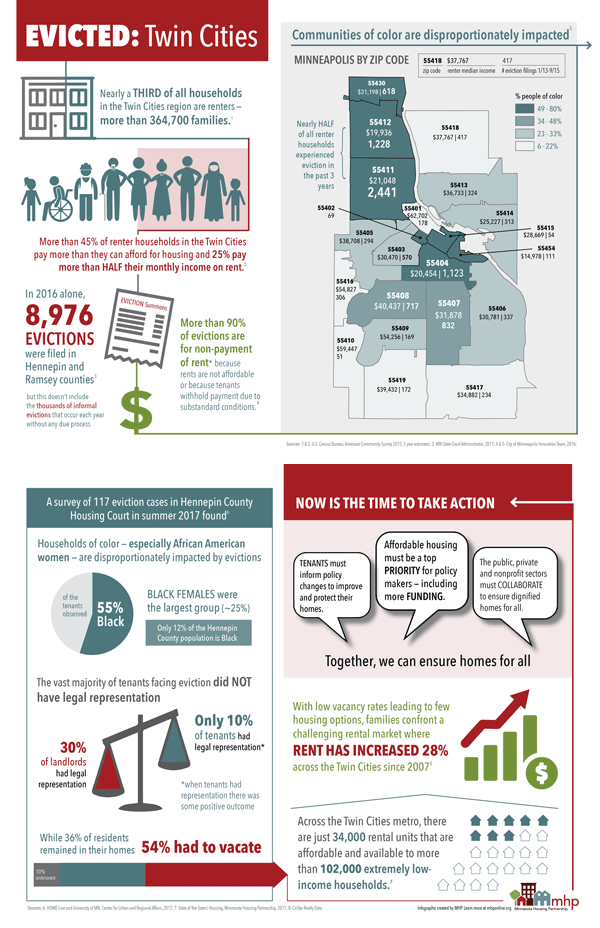
    Download the infographic!

    “Eviction causes loss,” Desmond explained. “Families lose their home, their community, their stuff. Kids lose their schools. Evictions come with this mark or blemish, which can prevent you from moving into good housing in a safe neighborhood — and can also keep you out of public housing… We have a study that shows eviction causes job loss, because eviction is such a consuming, stressful, drawn-out event that can cause you to lose work, lose your footing in the labor market. And eviction affects your soul, your mental health. When you add all that up, evictions, which used to be rare in this country, are not just a condition of poverty, they’re a cause of it, too.”

    And that repeated loss and trauma disproportionately impacts communities of color. In 2016, the City of Minneapolis found that nearly half of all renters in North Minneapolis had experienced eviction in the past three years. A survey this summer conducted by HOME Line and the University of Minnesota’s Center for Urban and Regional Affairs showed that Black women were the largest demographic group of the more than 115 cases observed in Hennepin County Housing Court and African Americans, male and female, made up more than 55 percent of tenants facing eviction.
    According to Desmond, that matches a national — and deeply troubling — trend.

    “In Milwaukee, 1 in 5 black women report being evicted in their lifetime compared to 1 in 15 white women,” he said. “That should trouble us because it means that eviction is the feminine equivalent of incarceration. We know that many of our poor African American men are being swept up by the long arm of the criminal justice system and are being locked up. Many of our poor African American women are being locked out and are disproportionately bearing the brunt of the eviction crisis.”

    “So the face of the eviction epidemic is moms and kids,” he continued. “Studies have found that half of families face discrimination in their housing searches… And kids are a big part of the equation. They can prolong the time you’re homeless after an eviction, and they can be the cause of your eviction… When we analyzed court data we found that the difference [between being evicted or not] wasn’t gender or race or even how much owed your landlord, it was kids. Your chance of eviction tripled when you had kids.”

    That recurring and unrelenting stress of simply maintaining shelter takes a toll, Desmond emphasized, undermining the ability for both children and adults to achieve even their most basic goals.

    “Just think about the brainpower and creativity and potential that we squander because we ask someone like Arlene to spend so much of hers figuring out where she’s going to live after she’s inevitably, predictably evicted,” he said. “Poverty reduces people born for better things. A stable, affordable home gives people a shot at realizing their full potential.”

    And yet, even as the data and daily lives of our neighbors confirm that truth, our housing policies and resources do little to address that crippling reality. Desmond pointed out that only a tiny fraction of those in need of housing support get any assistance from the government through Section 8 or public housing.   

    “It’s like turning away 3 out of 4 families that need food stamps,” he suggested. “It’s like saying, ‘I’m sorry, you’re going to have to go hungry.’ That’s exactly how we treat low-income families looking for shelter.”

    For Desmond, that active oversight is an affront to our American values.

    “We’ve affirmed provision in old age, access to 12 years of education, basic nutrition to be rights in this country, because we believe those things are fundamental to human flourishing and economic vitality,” he said. “There’s not an argument that has any legs that says housing isn’t fundamental to human flourishing. I think housing should be a right in this country and the reason is really simple: Without stable shelter, everything else falls apart.”

    So what do we do? Desmond emphasized that there’s no silver bullet and community expertise and lived experience need to drive local change. But at the federal level, he advocated for universal housing vouchers for low-income families — an expansion of the Section 8 program that would ensure everyone below the poverty line would only have to pay 30 percent of their income on rent.

    “That would fundamentally change the face of poverty in America,” he suggested. “It would drive down family homelessness and make evictions rare again. Families would get that sigh of relief. They’d be able to buy their kids enough food and understand what a home really is, to root in a community.”

    Certainly, that type of program would be costly — by Desmond’s estimate, as much as $22 billion per year. But, he argued, we have the money, we’re just spending it on the rich through subsidies like the Mortgage Interest Deduction rather than on the poor.

    “The kind of program I’m advocating for would cost us $22 billion a year, though that doesn’t account for the savings we’d get from driving down homelessness and residential insecurity in our cities,” he explained. “It’s not a small figure, but it’s well within our capacity. We have the money, we just make decisions about how to spend it.”

    For instance: “The year Arlene was evicted [2008], we spent $41 billion on direct housing assistance to poor families, through public housing and Section 8. That same year we spent $171 billion on homeowner tax subsidies, a number that was equivalent to entire budgets of the departments of Education, Homeland Security, Veteran Affairs, Justice and Agriculture combined. That’s a rather large number — and most of that benefit goes to families with six-figure incomes [through the mortgage interest deduction]. Most white families own their home and are eligible for one of the most generous deductions in the tax code. Most Black and Latino families do not because of our legacy of racial discrimination and are left out of this bargain. It’s hard to imagine a social policy that more unblushingly magnifies our racial and economic inequality than our current housing policy does… If we’re going to spend the bulk of our public dollars on the rich, let’s just be honest about that rather than repeating this lie that the richest country on the planet can’t afford to do more.”

    “If poverty persists here, it’s not for lack of resources. We lack something else.”

    So Desmond called on all of us to take action in our institutions and communities to create the public and political will to make the right to housing an American value.  

    Stay tuned for a recap of the panel discussion tomorrow!

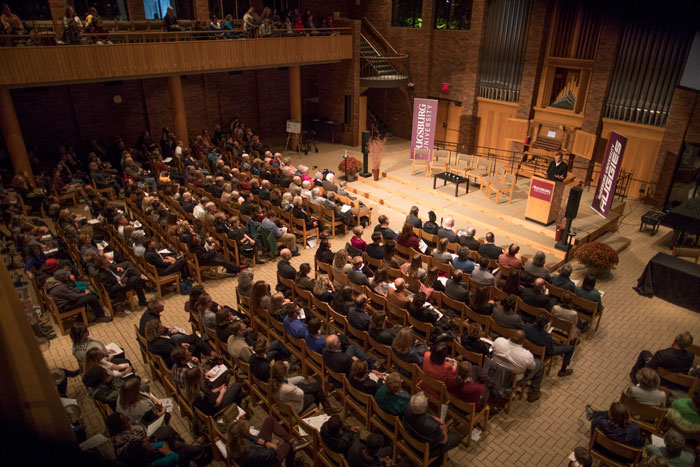
    Photos by Chris Juhn. Images from top: Matthew Desmond, author of Evicted; a crowd of more than 620 attendees; Desmond with Antonia Alvarez, housing advocate and founder of Asamblea de Derechos Civiles; Desmond with housing advocate Jewelean Jackson.

  • Panel: “The way we change values around housing is sharing the stories of tenants”

    This month, MHP and Alliance Housing hosted Matthew Desmond, Pulitzer Prize-winning author of “Evicted: Poverty and Profit in the American City” for a presentation and discussion in Minneapolis. Desmond shared a bold call to action, pronouncing “We can’t fix poverty in America without fixing housing.”

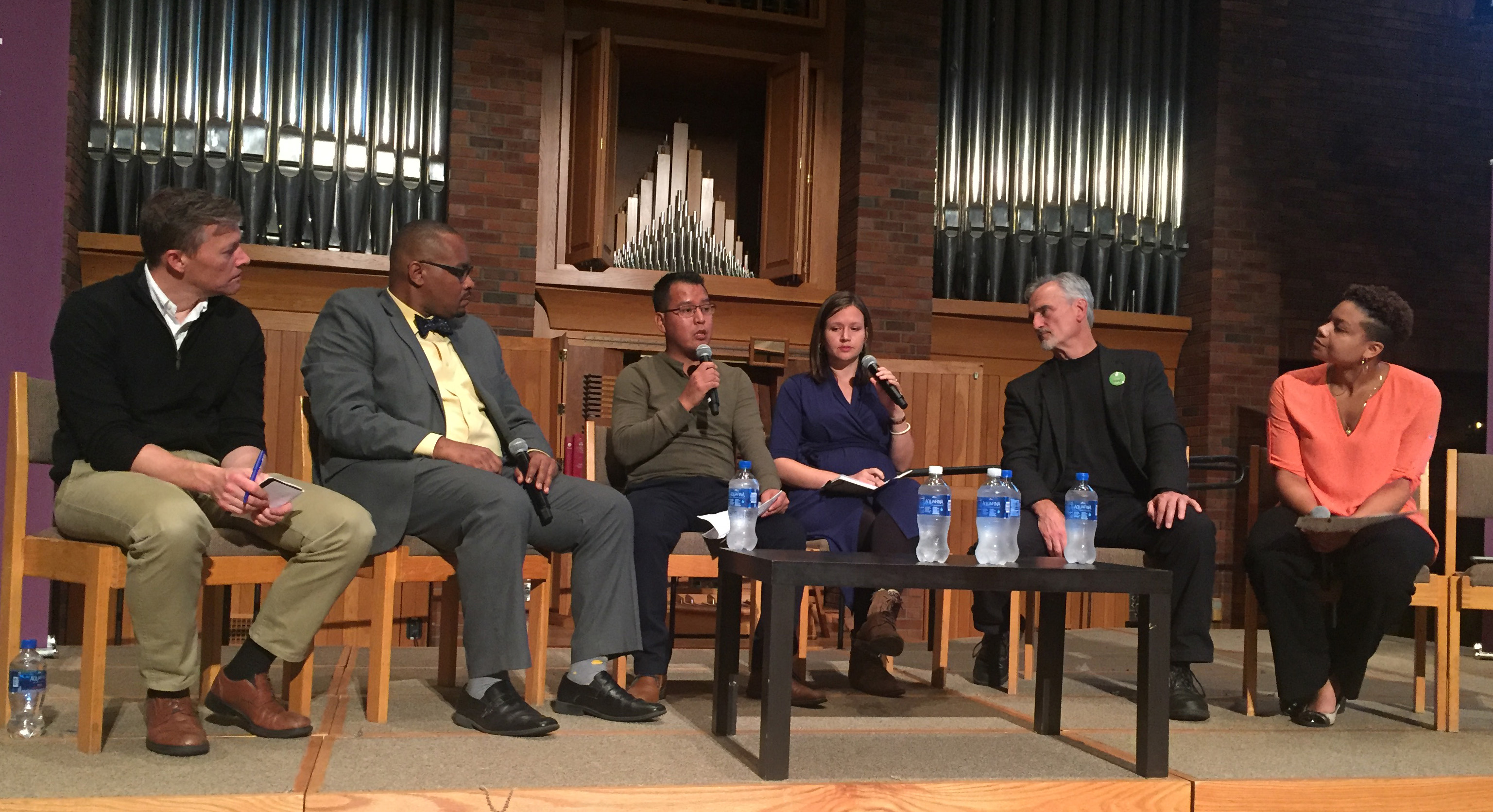
    Building on the MacArthur Genius’ powerful presentation and proposed federal solutions, a local panel of housing experts weighed in with their perspectives and ideas to address local housing challenges.

    Moderated by Dr. Brittany Lewis, Research Associate at the University of Minnesota’s Center for Urban and Regional Affairs, the discussion underscored the need for cross-sector collaboration, led by tenant voices, if we hope to end evictions, homelessness and housing instability in the Twin Cities.

    Carlos Palma Rios, Board president and campaign organizer for Inquilinxs Unidxs por Justicia

    As a tenant organizer, Rios shared a sobering perspective on the challenges faced by many Twin Cities renters. “Many tenants are victims of discrimination, eviction or intimidation,” Rios explained. “The majority of the people we work with are immigrants, people of color or people with low income and we know the system is not in their favor. As tenants, they face barriers day after day.”

    To address those barriers, Inquilinxs Unidxs centers the experiences and solutions proposed by renting families. “We organize with people so they are the ones that ask for their rights,” Rios said. “More than anything, we’re trying to get something like rent control, which would help people who have low income have affordable rent.”

    As they have fought for systemic policy solutions, they’ve achieved many positive outcomes through grassroots pressure and organizing, as well. “We truly have had many success stories,” he said. “We have won people’s ability to stay in their homes after receiving a letter of eviction. We’ve worked with people that have received rent increase letters and we’ve won that those increases have not happened. We’re now part of a lawsuit against one of the biggest landlords in Minneapolis, which is one of the biggest class actions we’ve seen in the United States [and which won the largest fine in housing court history—more than $187,000].”

    Rios agreed with Desmond that widespread changes will require much broader public awareness. “The way we change values around housing is we need to share the stories of tenants,” he suggested. “There are a lot of stories you don’t know, that you wouldn’t believe if I told you. The other thing is we have to value housing as a home more than we value money. And that is something, as an organization, we are working to win.”

    Referee JaPaul Harris, Fourth Judicial District
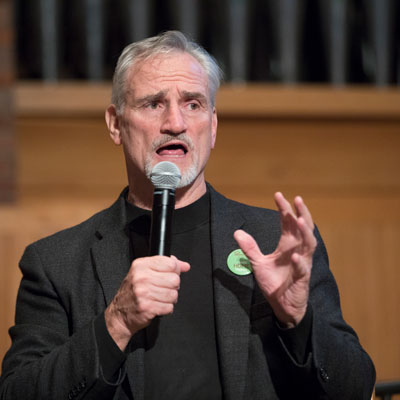
    JaPaul Harris, who presides over eviction court, emphasized the need to shift from simply processing people to providing due process. “This shouldn’t be eviction court, but housing court,” he said. “Tenants should be able to assert their rights, as well as landlords… Lots of folks believe eviction happens when the sheriff comes. But it’s a process from when they get the paper [eviction summons] to when the sheriff comes and, if they miss out on any part of that process, they’re missing out on their rights.” 

    But current policy favor swift disposition. “Statutes create a[n eviction] process that is fast; from start to finish it’s no more than 3 weeks to a month,” he said. “We have to follow the law, and sometimes that’s a barrier for us to keeping people housed.”

    As new research released this month showed, far too many households are facing that process without any legal assistance. “When you’re represented by an attorney you get better outcomes, because attorneys know the laws and statutes and know what to look for in raising defenses,” he said. “In Hennepin County, we have the Housing Court Project where attorneys give advice to tenants before they come into the mass calendar.”

    But that’s not enough, he emphasized. The public needs to hold judges and policymakers accountable for creating a system that ensures justice not expediency. “For example,” Harris pointed out, “there’s a threat to LSC [Legal Services Corporation] money that fund Legal Aid. If that funding goes away we’ll see more people in housing court without representation.”

    Harris agreed that we need to understand the personal stories of tenants and landlords — and take those stories to heart. “I don’t think it’s a question around values,” he said. “Values change and can be manipulated. It’s a question of morals. A lot of housing policies are set back in a time gone by and have not moved to address where we’re at now in terms of an increasingly diverse society as relates to race and class. The policies need to move. But we need the moral courage to say, ‘This is just not right.’”

    Alan Arthur, President and CEO of Aeon, a nonprofit affordable housing developer

    Arthur stressed the urgent need to preserve and protect “naturally occurring affordable housing (NOAH):” properties where rents are still affordable to lower-income families but in buildings that are older and in need of capital reinvestment. Many of those properties are being purchased and upscaled — renovated for higher-income demographics. While Arthur said that Aeon is trying to acquire such properties to preserve affordability, “I project we’re losing 100 affordable units a week, just based on properties we’re seeing and not getting ourselves.”

    While there are many technical barriers and financial constraints to providing dignified housing for all, Arthur emphasized that “the fundamental problem is one of values. Who do we want to be as a country? Until that gets figured out, I don’t think this will be solved.”

    And Arthur emphasized now is the time to shift that narrative. “I believe we’re one year into a five-year attention span paid to affordable housing,” he explained. “It comes and goes in cycles, and we’re at the front end of a cycle. We have four years to make strides. We need to be organized.”

    A call to action

    To close out the evening, Anne Mavity, MHP’s Executive Director, issued a call to action to the more than 600 people in the room.

    “I’m personally feeling challenged, inspired and determined that we can do a lot better here in our community,” she said. “In this room alone we have a lot of power and agency to actually change the situation. So I’d challenge all of us to ask ourselves, what can we all do as individuals and within the institutions we’re involved in.”

    “There have been a lot of great ideas we’ve heard tonight about managing this problem of eviction,” she continued. “But we also need to move upstream to prevent this from happening in the first place. One thing that’s clear is we need to increase the supply of affordable housing, and we’re in a moment now that this is on the radars of a lot of elected officials. Let’s make sure that it stays a priority.” 

    In that regard, Mavity pointed to the upcoming state legislative session — and funding for housing in a bonding bill — as well as policy changes created through dialogue between tenants, advocates and landlords. “We need a lot of collaboration,” she emphasized. “We need to make sure we’re all marching in the same direction.”

    Thank you again to the generous sponsors who made this event possible: Aeon, CommonBond Communities, Minnesota Coalition for the Homeless, and Twin Cities Habitat for Humanity.

    Photos by Chris Juhn

  • Urgent: Take action to preserve critical tool for affordable housing

    A critical federal tax credit that has produced 13,000 units of affordable housing in Minnesota in the past 10 years alone could be eliminated — bringing future production to a virtual standstill.

    Please take action TODAY.

    This morning, members of the U.S. House of Representative will have their first hearing on a sweeping tax reform bill that could wipe out tax-exempt status for Private Activity Bonds (PABs), a move that would have a devastating impact on the development of affordable housing.

    The bill also:

    • Proposes sensible changes to the mortgage interest deduction — but directs the benefits to billionaires and corporations rather than redirect savings back into affordable housing.
    • Eliminates the Historic Tax Credit that has been used to renovate more than 40,000 structures and leveraged $117 billion in private investment over the past 25 years.

    We still have time to make our voices heard and tell our members of Congress that we won’t accept a tax reform bill that deepens the affordable housing crisis in Minnesota and beyond.

    Click here to find your member of Congress and tell her / him to preserve tax-exempt status for Private Activity Bonds.

    If you live in Minnesota’s 3rd Congressional District — we need you now. Congressman Erik Paulsen is on the House Ways and Means Committee, which will play a central role in shaping the final bill.

    Please call Rep. Paulsen at (202) 225-2871​ before the committee’s first hearing at 11 a.m. Central this morning and tell him to preserve tax-exempt status for Private Activity Bonds and reject provisions that would could cripple the development of affordable housing in Minnesota.

    Read more analysis from the National Low Income Housing Coalition here.

    Thank you for your support.

    Learn more about how MHP shapes policy and supports community developers across Minnesota and the nation by subscribing to our blog, MHP Connect!

  • MN Housing board update: 2017 Funding Selections Announced

    Taking over from Chip Halbach, MHFA board meeting minutes will now be reported by MHP’s new Executive Director, Anne Mavity.

    At its October meeting, the Minnesota Housing Finance Agency (MHFA) board approved $126 million in funding for 60 developments that will provide more than 1,800 housing opportunities throughout the state. It also approved program guides for its Workforce Housing Development Program and Publicly Owned Housing Program (PHOP), and provided concept approval for a new limited partner buy-out loan product.

    MHFA recognized at national conference

    In her opening remarks, Commissioner Mary Tingerthal announced three awards the agency had recently received at the October 2017 National State Housing Agencies Annual Conference. 

    One of those awards was a first place received in the category of Special Needs: Combatting Homelessness, and known as the “The Step-Down Pilot Project.” About 25% of Minnesota’s permanent supportive housing units are occupied by individuals and families who no longer need the same level of intensive services that were required when they first moved in.  In order to free up those units and services for new families in need of such intensive services, Minnesota Housing worked with Hearth Connection to create “The Step-Down Pilot Project”. It provides a flexible, cost efficient model that helps individuals and families transition to the next level of affordable housing with minimal services, and frees up scarce resources for individuals and households who need higher levels of services and interventions. 


    Funding awards 2017

    The agency approved $126 million in funding for 60 developments that will provide more than 1,800 housing opportunities throughout the state. Together, these housing investments will leverage additional private and local resources that will result in nearly $350 million in total development costs. 

    Wes Butler and Kasey Kier introduced this year’s funding awards report, noting that Minnesota is unique across the country in offering a Consolidated RFP, that includes other funding entities, with the goal of streamlining the application process, and reducing burdens on applicants, by using a single application process.

    The agency provided an overview of market conditions, noting that low vacancy rates, low interest rates and higher median incomes have contributed to robust construction in this market. Nearly all of MHFA’s funded projects open with 100% occupancy, indicating a need for much more housing that is affordable to Minnesota residents. In fact, more than 248,000 lower income renters are cost burdened, paying more than 30% of their income for housing. After a few years of more affordable homeownership opportunities, the market is seeing housing prices increase, which is reducing the supply of affordable homes for sale. 

    In the multifamily competition, proposals were received for 55 developments, including requests for $164 million in deferred loan funding. Of that, only 25 developments were funded, including $66 million in total deferred loan funding. Demand for these scarce resources is far outreaching the agency’s ability to fund projects. The agency’s awards also include $9.1 million in tax credits to 10 projects that are expected to leverage over $86.9 million in equity at the current level of $0.89 investor credit pricing. 

    In the single family competition, 35 of 38 proposals were funded for a total of $15 million. Of that, 14 awards, or 32% of the total, serves communities in Greater Minnesota and 21 awards, or 68% of the total, serves the 7-county Twin Cities metro area.

    Staff noted that the use of modular building materials was resulting in cost savings, quality homes, and use of Minnesota businesses, noting that on average it cost 24% less than impact fund high subsidy cost thresholds. Board member Stephanie Klinzing asked about the impacts on costs and availability of materials for these funded projects, in light of the recent disasters  around the country that will be demanding these same materials and labor. Commissioner Tingerthal noted that the agency was cognizant of that potential and did not allocate the maximum amount available, knowing that project funding gaps may arise later from these conditions.

    Workforce Housing Development Program Guide

    The Board approved the Workforce Housing Development Program Guide, a program previously administered by DEED that is funded by $4 million in state appropriations for the 2018-19 biennium. An RFP will be issued in the next few weeks. The program was established for small and mid-sized communities in Greater Minnesota with workforce rental housing needs.

    The program differs from other Minnesota Housing initiatives in that awards are provided to communities — e.g., cities or other governmental entities — and there is a statutory preference given to projects with the highest percentage of market units. The Board discussed these requirements and Commissioner Tingerthal noted that when the program was at DEED, they were prohibited from investing any of the funds in rent restricted or affordable projects. Minnesota Housing advocated for changes to that in the 2017 legislative session and now it may include mixed income housing so that communities can combine this funding in the agency’s annual Consolidated RFP.

    Discussion on defining “workforce housing” clarified that applicants must have an employer letter and data of need, which will be added to staff’s internal research team and profiles of communities and need.

    Publicly Owned Housing Program (PHOP) RFP and Program Guide

    The Board approved the PHOP RFP and program guide. Commissioner Tingerthal explained that this PHOP program was made possible by a $10 million government obligation (GO) bond, as noted in the 2017 capital investment report. This program has supported HRAs/PHAs since 2005 through the sale of GO bonds. Up to $12 million will be made available based on 2017 POHP RFP, with no minimum or maximum loan amounts, but the property must remain in public ownership for the duration of the 35-year compliance period. Eligible activities are capital expenditures such as major roof and window replacement, heating and cooling, elevator upgrades, and other one-time expenditures on improvements that add value or life to a building.

    Limited Partner Buy-Out Loans

    Finally, the Board provided concept approval for a new limited partner buy-out loan product. This is a newly proposed multifamily loan product to be used by owners of affordable rental property to buy out the interests of exiting investor limited partners in low income housing tax credit (LIHTC) projects. This would be a short-term, secured loan product funded with Pool 2 dollars, and competitive pricing, with loan periods typically 18-24 months. Commissioner Tingerthal explained that when the 15-year compliance period ends, certain LIHTC partners may wish to exit the investor partnership. With significant Minnesota Housing deferred loans in the deal, Tingerthal said they are looking to encourage developers to use Minnesota Housing instead of commercial lenders. The agency anticipates it likely would close on one loan for $5 million this year, and anticipates two to three additional loans per year going forward.

    Learn more about MHFA.


  • Tax reform update: Keep phones ringing to #PreservePABs

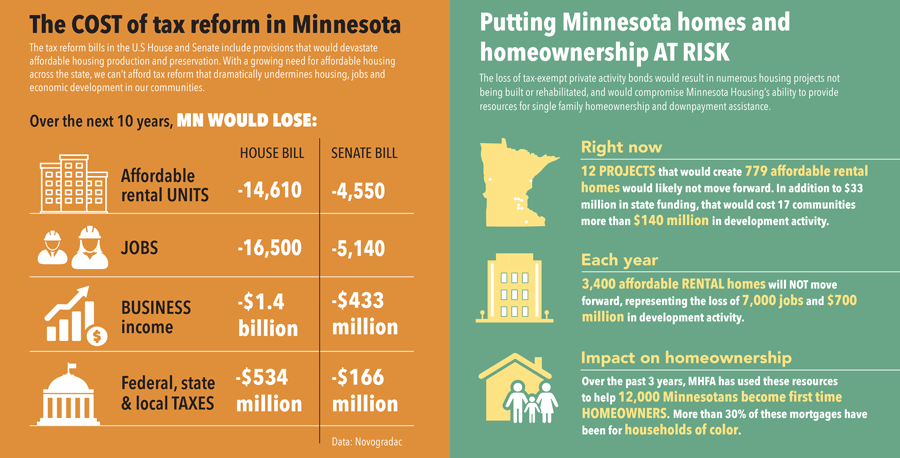
    What would Minnesota lose if the House tax reform bill passes in its current form? Nearly $2 billion in economic development, the construction of more than 14,500 affordable rental homes and the creation of 16,500 jobs over the next 10 years alone*.

    Please call TODAY and tell your members of Congress to support a tax reform bill that advances affordable housing and contributes to community development.

    The current House bill specifically hurts housing programs by eliminating tax exempt private activity bonds, which have been essential to the creation of more than 15,000 units of affordable housing in Minnesota over the past decade. Just this morning, House Ways and Means Committee Republicans voted 24 to 16 along party lines against amendments to save private activity bonds from being terminated after this year.

    According to Minnesota Housing Finance Agency, 12 projects in 17 communities could lose funding of more than $33 million. That means 779 units at risk of not being constructed or rehabilitated, and $140 million in development activity stalled. And that’s just the prospect for the remainder of 2017. Without tax exempt private activity bonds, thousands of affordable homes will never break ground — at a moment when every part of the state is seeing increased need.

    If you live in Districts 2, 3, or 6, please call your Congressman TODAY and tell them to vote against legislation that fails to preserve tax-exempt status for Private Activity Bonds and would deepen our local and national housing crisis. A script and contact information are included below.

    “Congressman [Paulsen, Emmer, Lewis], my name is [your name] and I live in [city/state]. I am calling to ask that you vote NO on legislation that does not reinvest housing dollars into affordable rental homes for individuals and families with the greatest needs. Tax exempt private activity bonds are one of the most important tools we have to fund affordable housing and this legislation would mean an estimated 1 million affordable homes will be lost. Please vote NO and reject provisions that would harm the development of affordable housing. Thank you.”

    • Rep. Erik Paulsen | DC: 202-225-2871 | MN office: 952-405-8510
    • Rep. Tom Emmer | DC: 202-225-2331 | MN office: 763-241-6848
    • Rep. Jason Lewis | DC: 202-225-2271 | MN office: 651-846-2120

    Our efforts are working. Because of feedback from constituents, Republicans are voicing support to protect private activity bonds in the House bill and there are indications that the Senate bill will not eliminate this critical tool.

    Let’s keep it up; please call Senators Klobuchar (202-224-3244) and Franken (202-224-5641) and tell them to support affordable housing in the Senate bill!

    Join the conversation on Twitter using the hashtag #PreservePABs and read more analysis from the National Low Income Housing Coalition here and *Novogradac here.

  • Real impact of #TaxReform: Homes for MN families and homeless seniors at risk

    Last month, working families in Princeton, homeless seniors in Minneapolis and Minnesota residents across the state got hope for a better future when the Minnesota Housing Finance Agency (MHFA) announced its latest round of funding to create and preserve more than 1,800 affordable housing opportunities throughout the state.
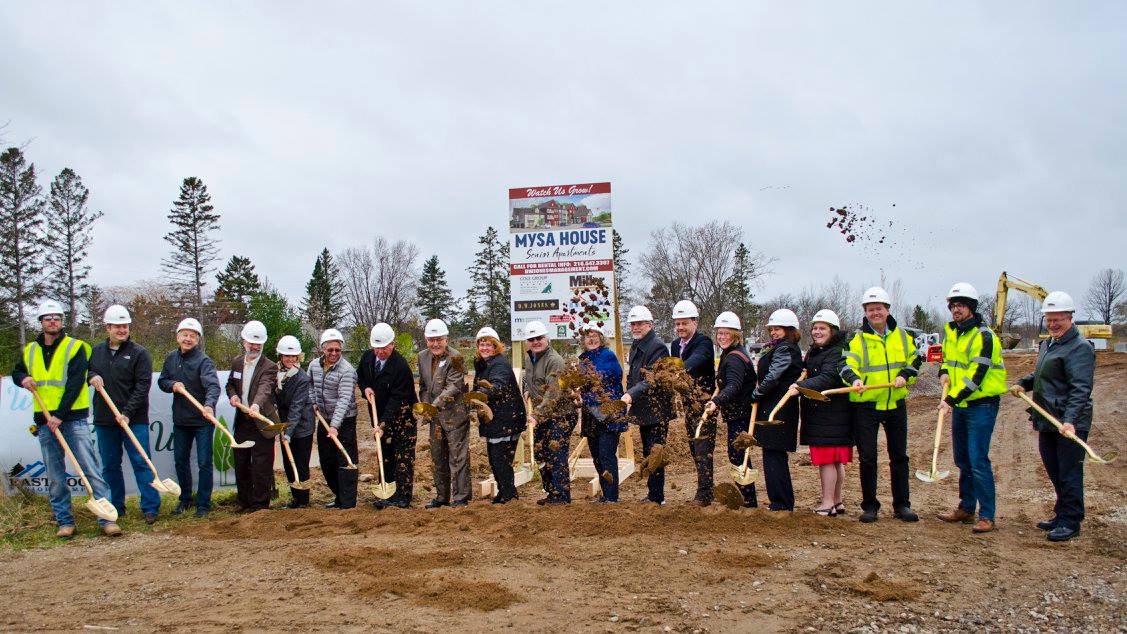
    Now, nearly 800 of those homes are at risk — because of a tax reform bill that could cripple the development of affordable housing in Minnesota and across the nation.

    Over the past 10 years alone, nearly $2 billion in private activity bonds have supported the construction of more than 15,000 affordable rental units across the state. But the tax reform bill introduced in the U.S. House of Representative last week eliminates that vital tool. If signed into law, the bill could effectively kill projects like West Birch Estates in Princeton and Minnehaha Commons in Minneapolis, leaving hundreds of families out in the cold and millions of dollars of economic development untapped.

    Please take action TODAY!

    Alliance Housing has been working for more than five years to secure a site and financing for Minnehaha Commons to house the growing number of very low income seniors who are homeless. “The federal tax bill would delay this project further, while need continues to increase and the cost of NOT housing them does, as well,” says Barbara Jeanetta, Executive Director of Alliance Housing.

    In Princeton, West Birch Estates would also be forced back to the drawing board rather than moving toward breaking ground. “The impact of removing the 4% tax credit program would be detrimental to all communities, especially rural communities that do not have a lot of other resources,” says Deanna Hemmesch, Executive Director of Central MN Housing Partnership. “We need to keep the 4% tax credit program as a way for communities to help address their growing housing need.”

    Just a few weeks ago, MHP celebrated the groundbreaking of Mysa House in Mora, a project that will provide homes for two dozen seniors — many of whom have been on housing waiting lists for years. If passed in its current form, tax reform would make future developments like Mysa House virtually impossible.

    See more photos of the Mysa House ground breaking here!

    “Mysa House was funded with 4% tax credits and private activity bonds and would not have happened without these tools,” says Skip Duchesneau, President of D.W. Jones, the developer for Mysa House. “Without private activity bonds the current bill will hinder our economic development, and stop needed infrastructure investments of cities and towns in Minnesota as well as further plunge the United States into an affordable housing crisis.”

    The proposed changes by Congress will also impact state investments in affordable housing. MHFA uses Housing Infrastructure Bonds (HIB) in place of or in addition to traditional tax-exempt bonds to provide eligibility for 4% credits. Under the proposed changes, HIBs will no longer make a project eligible for 4% credits. As a result, projects will need to find new sources of equity. Because equity sources are already extremely scarce, the proposed changes will make it nearly impossible to use HIB to preserve existing federally subsidized housing without other agency funding. Preserving existing federally subsidized housing is essential to maintaining our affordable housing stock and retaining existing federal investments in Minnesota.

    Other provisions in the tax reform bill that would deepen the affordable housing crisis, include:

    • Eliminating the Historic Tax Credit that has been used to renovate more than 40,000 structures and leveraged $117 billion in private investment over the past 25 years.
    • Proposing sensible changes to the mortgage interest deduction — but directing the benefits to billionaires and corporations rather than redirect savings back into affordable housing.
    • Reducing the corporate tax rate without modifications to the Housing Tax Credit, which will likely negatively impact the value of the 9% Low Income Housing Tax Credit (LIHTC). Novogradac & Co. estimates the net result will be $1.2 billion fewer dollars in equity annually.
    • The proposed use of an alternative inflation measure that will decrease inflation adjustments in LIHTC allocations and, over 10 years, result in the loss of 8,200 affordable rental homes, according to Novogradac & Co. analysis.

    Stay updated by following us on Twitter and by subscribing to MHP publications.