• MN Housing Board Update: $2 Million in Workforce Housing Development Funds Awarded

    At its March meeting, the Minnesota Housing Finance Agency board discussed updates on state and federal legislation, additional funding for the Homework Starts with Home program, $2 million in awards through the Workforce Housing Development Fund, and changes to the Annual Action Plan based on expected increases in federal funds.

    State Legislative Updates

    In her opening remarks, Commissioner Mary Tingerthal provided an update on various priorities of Minnesota Housing at the state legislature. Tingerthal praised the release of Governor Dayton’s supplemental budget and tax bill, which includes supplemental funding for the Homework Starts With Home program. The proposal includes $4 million for the next year, and also proposes that HWSH be included in the base budget moving forward. Tingerthal added that the program had its first hearing in the House, where it received very strong support from the advocates of the program, including Northside Achievement Zone, St Paul Promise Neighborhood and Clay County.

    Conversely, Tingerthal cited concern about a bill in the House Ways and Means Committee related to revisions to the allocation of tax exempt bonds. She explained that the bill includes the five points of agreement of the working group convened over the summer and fall but adds a provision that would essentially eliminate the City Participation Program for single family housing, which, earlier this year, awarded $60 million to assist 38 cities, counties and multi-county areas to meet local housing needs. Tingerthal also expressed concern that the bill would remove the board’s authority under the QAP with regard to 4% tax credits, and allow developers to bypass the QAP for deals that receive bonds through MMB allocation funds. Tingerthal noted that the agency is supporting the “Consensus Bill” that includes only the five agreements from the tax exempt bond committee.

    Federal updates

    On the federal front, Tingerthal provided an update on the omnibus spending bill that [has since passed and been signed by the President] includes a temporary increase in 9% LIHTCs for the next four years, which will make up for some of the purchasing power lost due to tax reform and tax credit prices going down. It also includes an income averaging provision that allows rents to be set up to 80% AMI as long as the average rents are affordable at 60% AMI, which provides more flexibility for mixed income projects using LIHTC. 

    Tingerthal also shared that the Department of Housing and Urban Development has withdrawn its proposal to require regional proposals for project-based Section 8 contracts until further notice.

    Homework Starts with Home

    As discussed in previous board meetings, Minnesota Housing received appropriations of $2 million in 2017 to support the Homework Starts with Home (HSWH) program, an initiative focused on addressing homelessness among students and their families. In partnership with the Office to Prevent and End Homelessness, the Minnesota Department of Education, the Minnesota Department of Human Services, and the Heading Home Minnesota Funders Collaborative, the agency will initiate the grantee selection process for the HSWH pilot program in May 2018.

    Since approving the program concept, including the original available funding amounts, in December 2017, Minnesota Housing identified an additional $1.75 million from the Housing Trust Fund (HTF) and $150,000 from the Family Homeless Prevention and Assistance Program (FHPAP) that it will make available under the HSWH RFP. These resources represent returned funds to Minnesota Housing from previously committed grants under these programs. With these increases, the HSWH RFP will now make available up to $3.5 million in HTF funds and up to $400,000 in FHPAP funds.

    Workforce Housing Development Program funding

    In 2017, the Minnesota Legislature authorized Minnesota Housing to establish the Workforce Housing Development Program: a competitive funding program that targets small to mid-size cities in Greater Minnesota with rental workforce housing needs. The program makes available grant funds or deferred loans to build market-rate residential rental properties in communities with proven job growth and demand for workforce rental housing.

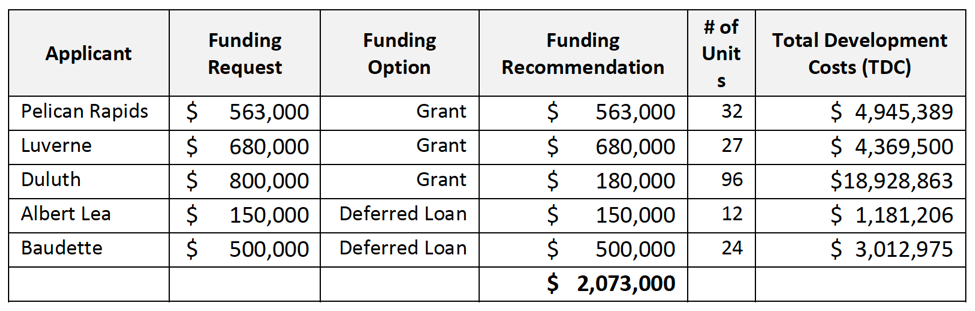
    The first RFP was released in October 2017 and Katie Moore, workforce housing program manager, reported that the agency received seven applications and recommended funding five of those applications, resulting in the creation of 191 new units of workforce housing in Albert Lea, Baudette, Duluth, Luverne and Pelican Rapids.

    She noted that all of the applications recommended for funding had demonstrated vacancy rates as low as 2%, new job creation or pressure from current employers for additional local housing options. She added that the agency would award the other half of the $4 million biennial budget through an RFP in the fall of 2018. She also shared that the program has the additional benefit of providing an opportunity for Minnesota Housing to engage with communities with which it has not previously had previous contact. 

    Annual Action Plan

    Jessica Deegan, Director of Federal Affairs, shared an update to the 2018 Annual Action Plan based on changes to anticipated funding levels from the federal government.

    Based on the latest information, Minnesota Housing expects to receive $5.8 million in allocation from the HOME program and anticipates an additional $1 million in program income from that program to be utilized in 2018. The agency also expects $3.1 million in National Housing Trust Fund (NHTF). The HOME program serves low and moderate income renters while the National Housing Trust Fund serves extremely low income renters (with incomes less than 30 percent of area median income). The agency anticipates constructing or rehabilitating 200 units of affordable rental housing with these funds.

    The agency also expects to receive $172,000 for the Housing Opportunities for Persons With AIDS (HOPWA) programs, which will be administered in partnership with the Minnesota AIDS Project to provide short term rent, mortgage, and utility assistance in Greater Minnesota to 180 persons.

    Until a final 2018 budget is passed in Congress, the agency won’t know final funding amounts. These figures are based on current status in House and Senate appropriations bills.

    The full board packet can be found here and the next meeting of the board will be April 26. 

  • Work with us: MHP seeks Community Development Director

    Minnesota Housing Partnership seeks to fill a key senior leadership position with a candidate who will create and drive strategies to address housing and community needs in communities in Minnesota and across the United States.

    The Director of Community Development will direct and oversee a team of national technical assistance (TA) staff and consultants with expertise in a broad array of housing, community development and economic development. S/he will develop, coordinate and facilitate Regional and Native Development Housing Institutes. As the spokesperson for MHP’s overall mission and capacity department goals, this leader will create and sustain effective partnerships with diverse communities, philanthropic partners, and government funders.

    Responsibilities

    Direct and manage the administration of multiple complex, multiyear federal, state and private capacity grants and contracts, including staffing, budgeting, reporting, and compliance. 

    Establish and maintain communications with the HUD staff in Washington DC and promote MHP as a national TA Provider with federal agencies, partners, other government entities, and communities. 

    Lead the strategy and team effort in the preparation of federal grant proposals, determining budget and work plan outcomes. 

    Oversee Capacity team’s internal and grant management activities, program administration, policies and procedures. Work strategically and collaboratively across internal departments, including Fund Development, Finance, and Communications & Research. 

    Responsible for the effective implementation of MHP’s Housing Institutes; includes identifying regional teams and collaborative partners, securing funding, managing budget, curriculum, speakers and facilitating team activities resulting in housing or community development projects. 

    Secure outside, private consulting contracts as needed, to meet financial goals. 

    Recruit, develop, manage and inspire a team of highly qualified capacity staff and MHP network partners to deliver federally regulated technical assistance and capacity building in community, economic and affordable housing development. 

    Participate in MHP’s Executive Leadership Team; support and contribute to the overall organizational goals and mission of MHP. 

    Experience

    Bachelor’s Degree in business or public administration, housing management, non-profit administration, public policy or other related field. Master’s Degree preferred. 

    At least 10 years leadership and supervisory experience in community and economic development, and affordable housing development. Proven experience and success in supervising, planning, scheduling, assigning, coordinating and monitoring the work of professional technical staff (includes hiring, workplan development, annual reviews, professional coaching, discipline and terminations).

    Experience in nonprofit operations and management; preferred experience in community development and affordable housing. 

    Exceptional ability to create authentic and effective partnerships and collaboration across many cultures (urban, rural, Native, etc), with particular expertise in working with Native communities desired. 

    Extensive knowledge and experience working with federal, state and local government entities as well as community collaborative partners on housing, economic development, community development and workforce housing. 

    Experience developing and maintaining robust partnerships with community partners and community leaders. 

    Effective and confident public speaker and facilitator, with both large and small audiences. 

    Ability to travel 10-30% time per month. 

    Additional information  

    MHP offers a dynamic, collaborative and flexible work environment, where we value work – life balance, and offer a competitive salary and benefits package. 

    Learn more about our Community Development programs here.

    Relocation benefits considered. Budgeted salary range $90-110,000. 

    How to apply 

    Exceptional candidates are invited to apply to [email protected]. Please submit a cover letter and resume detailing how your experience and strategic vision will contribute to MHP’s work and organization. Open until filled. 

  • #Bonds4Housing story: “I couldn’t find any better place to be.”

    At the Capitol, MHP and our Homes for All MN partners have been advocating for a historic $140 million in bonds for housing. Thirty million of that bonding request would go to preserve public housing through initiatives like Minnesota Housing’s Publicly Owned Housing Program (POHP). Public housing is a key state asset supporting hundreds of older Minnesotans, people with low or fixed incomes, and individuals with mental or physical disabilities. Nada, a longtime resident of a public housing complex in Red Wing, shared her story to underscore the positive impact public housing has had on her life and her community. Join Nada in sharing your housing story here.   

    When Nada Peters thinks about the day she arrived in the U.S. from Yugoslavia 60 years ago, she still gets goosebumps. “There’s no other country like this one,” she says.

    Nada came directly to Minnesota from New York. Though she spoke four languages upon her arrival, English wasn’t one of them. She taught herself to speak English by watching television. For the past two decades, Nada’s called Jordan Tower I — a 101-unit public housing community in Red Wing, Minnesota — home.

    “I love it,” Nada says. “They’ve been so good to me here. I couldn’t find any better place to be.”

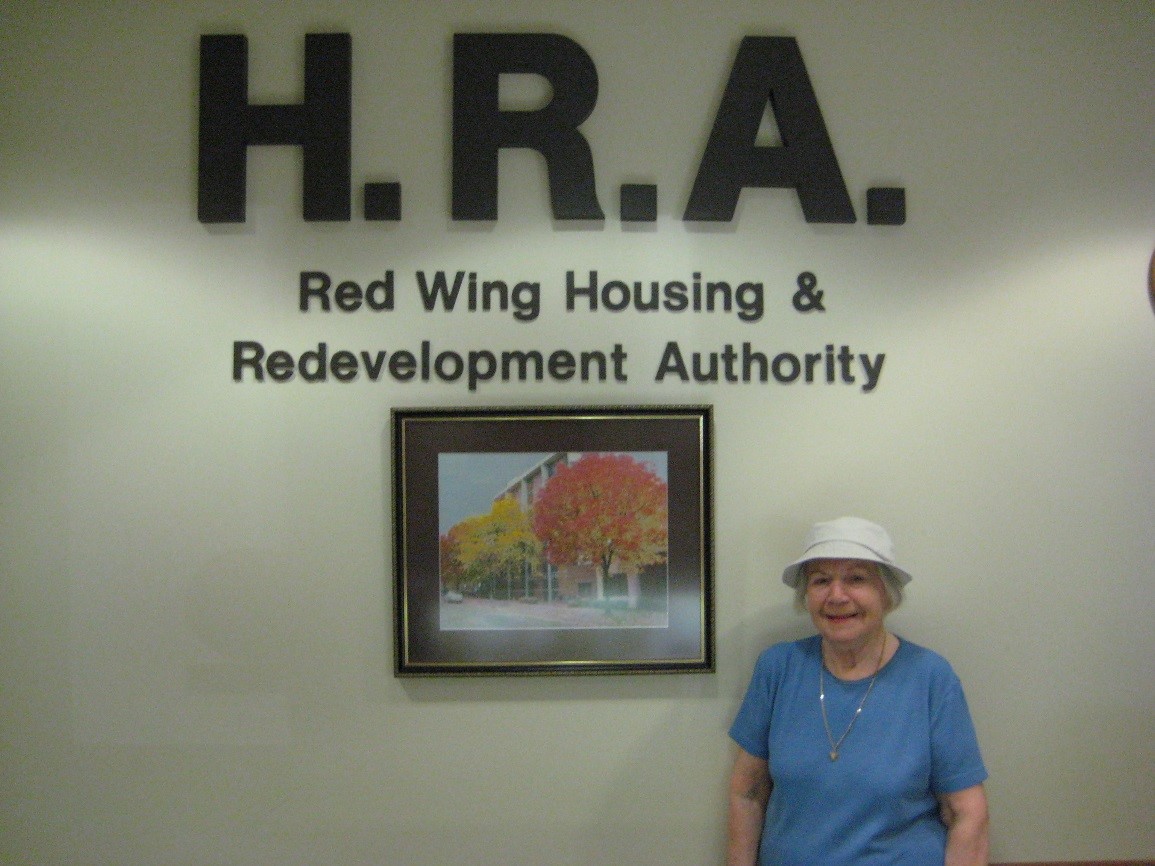
    Photo: Nada poses with a photorealistic cross-stitch she made of the Red Wing HRA office.

    Nada is 93 and a half years old. She appreciates that, at Jordan Tower, her income-based rent helps her budget for essentials like groceries.

    Nada had to wait two years to get a spot at Jordan Tower I when she applied 20 years ago. Today, apartments are still in high demand, with 60 households on the waiting list for Jordan Tower I. A 2014 housing study identified a 0% vacancy rate for subsidized housing in Red Wing and 1.9% vacancy rate for market rate housing. Clearly, Jordan Tower is a critical community resource. However, with tightening federal funding, it’s a resource at risk.

    “Our operating subsidy from the federal government continues to drop and drop,” Hemmerlin explains. In recent years, that subsidy has plummeted from $140,000 annually — to less than $70,000.

    Nada stands in front of a collection of her photorealistic cross-stitch work, as she’s interviewed by KARE 11. 

    Without additional funds to fill this widening gap, Hemmerlin says, it’s nearly impossible for the HRA to complete critical upkeep at Jordan Tower, which was constructed more than 40 years ago. The Red Wing HRA applied for the most recent allocation of Publicly Owned Housing Program (POHP) funds, distributed by Minnesota Housing and funded with General Obligation (GO) bonds allocated by the State Legislature, to replace key heating infrastructure at Jordan Tower including boilers and air handling units. The HRA requested $644,000 for an $859,000 project, and will pull together the remaining $215,000.

    Red Wing HRA has utilized POHP funds in the past to replace outdated elevators and inefficient, malfunctioning windows. Both projects had a direct impact on the safety of Jordan Tower residents and the bottom line to operate the building. HRA staff member Ronnelle Jaeger said that she and the residents were nervous about riding in the elevators before they were replaced. “When I rode in them, I’d make sure I had my phone on me,” she says. “Our biggest concerns driving these projects were security and ensuring that our residents could feel safe.”

    To Hemmerlin, the impact of capital investments goes beyond maintaining buildings. “We’re not talking about buildings,” Hemmerlin says. “We’re talking about the impact of preserving affordable housing on people’s lives and on the communities that go along with these buildings.”

  • MN Housing Board Update: Changes to 2020 Qualified Allocation Plan

    At its January meeting, the board of the Minnesota Housing Finance Agency (Minnesota Housing) discussed the allocation of 2018 funds for the Minnesota City Participation Program, potential changes to the 2020 Tax Credit Program Qualified Allocation Plan (QAP), highlights from the recently released Key Trends in Housing, work plan priorities for the coming year and the progress of the Governor’s Task Force on Housing.

    Opening remarks

    In her opening remarks, Commissioner Mary Tingerthal shared that the Governor had released his public works proposal, which includes $100 million for Housing Infrastructure Bonds and $15 million for General Obligation Bonds. The most ever requested for housing by the Governor, Tingerthal said it was a good place to start and that Minnesota Housing will be carrying that strong recommendation into the session. (The Homes for All coalition is asking for $140 million in HIB and GO bonds this session; read the full agenda here.)

    Tingerthal also noted one policy item in the Governor’s package: a change to the Manufactured Home Trust Fund, which levies an assessment on owners of manufactured home parks of $15 per lot per year that goes into a trust fund that is then available for relocation costs for low-income households that have to move when parks are closed. Previously, that fund was capped at $1 million, but, with two parks’ closing nearly wiping out the whole fund, the proposal is to increase the cap to $3 million.

    Allocation of 2018 funds for the Minnesota City Participation Program

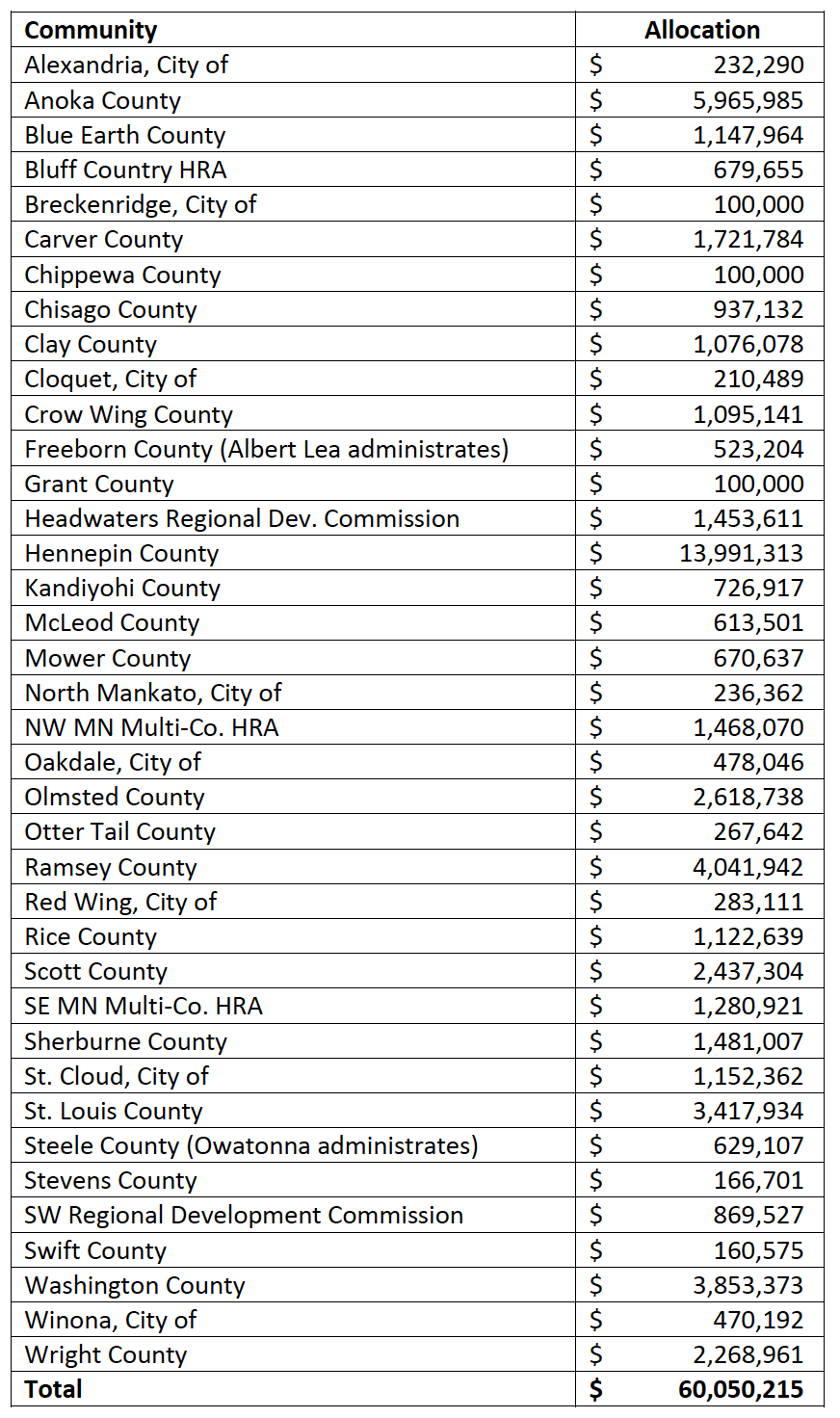
    Under the Minnesota City Participation Program (MCPP), Minnesota Housing sells tax-exempt private activity bonds on behalf of local governments to assist them to meet local housing goals. Cities, counties and consortia of local government units applied for 2018 participation in MCPP by January 15 and the total amount available — $60.1 million — was allocated on a pro rata basis according to the population of each community that applied and met the program requirements.
    Changes considered in the 2020 Housing Tax Credit Program Qualified Allocation Plan (QAP)

    Devon Pohlman, Supervisor of the Multifamily Programs Team at Minnesota Housing, opened discussion about changes considered in the 2020 Housing Tax Credit Program Qualified Allocation Plan (QAP) by emphasizing that the agency understands that developers are already thinking about 2020 and beyond, and wanted to ensure that the concepts and changes considered in the QAP were brought forward earlier in the process. She also noted that given the significant changes in the 2018 QAP, the agency is taking a “focused approach” with proposed changes for the 2020 QAP only recommended for critical policy or clarification purposes.

    Key changes are identified below in three categories based on their impact on: projects with 9% tax credits allocated through the competitive RFP process; tax-exempt bond/4% projects selected through the competitive RFP process; and projects receiving tax exempt bonds through the Minnesota Department of Management and Budget (MMB) and seeking an allocation of tax credits through the 4% only (42M) process.

    {slider 9% Housing Tax Credits (HTC) Allocated Through the Competitive RFP|closed}

    Clarify the tie breaker criteria by making long-term affordability a preference priority, which is given weight in the first round of a tie breaker. This change is in line with Internal Revenue Code preferences. Cost containment is removed as a preference priority and will become a selection priority.

    Increase the per-developer or general partner tax credit limit to the greater of: the amount representing 10 percent of the state’s per capita volume limit in tax credits, or the amount needed to support two developments in the case that two developments selected are being developed by the same developer or general partner. Such projects are subject to the per development limit shown below.

    Increase the per-development tax credit limit from $1.2 million to $1.25 million, based on an annual inflation factor.

    Increase the rural development/small project set-aside from $300,000 to $350,000. This set-aside was last adjusted in the 2013 QAP. Minnesota Housing intends to apply an annual inflation adjustment factor in future QAP rounds.

    {/sliders}

    {slider Competitive RFP (9% and 4% HTC) and 4% Only (42M)|closed}

    Revise the State Designated Basis Boost to apply to developments that meet one of the following two strategic priority policy thresholds: Supportive Housing or Preservation. Allocating agencies are allowed to award a basis boost of up to 30 percent to HTC buildings, and allocating agencies are authorized to determine their individual policy objectives for projects eligible for the basis boost. Minnesota Housing seeks to ensure that the boost continues to advance critical state housing priorities through targeted and strategic use. Note that many projects qualify under more than one strategic priority; for example, many projects meet the Greater Minnesota Workforce Housing strategic priority policy threshold in addition to the Supportive Housing strategic priority threshold.

    Reform the Planned Community Development Strategic Priority into the Community Development Initiative Strategic Priority to streamline this strategic priority and to facilitate use of the priority by communities with active community development initiatives that include affordable housing as a key strategy. Clarify what additional information is required by federal regulations for developments in a Qualified Census Tract (QCT) for a plan to be considered a concerted community revitalization plan.

    Clarify and Revise Unacceptable Practices, as outlined in the 2019 Housing Tax Credit Program Procedural Manual, which result in negative points on future application submittals or the inability to apply for future HTC rounds in severe cases. Minnesota Housing is recommending clarifications or changes that impact three areas: transfer of ownership, cost containment and compliance.

    • Transfer of Ownership: Clarify that approval for transfer of ownership (more than 50 percent interest in a general partner or member, or a change in a nonprofit partner) is required for the duration of the Land Use Restrictive Agreement (LURA), and that if a transfer of ownership occurs, a fee is required throughout the term of the LURA. Also clarify that a failure to notify Minnesota Housing of a transfer of ownership constitutes an unacceptable practice for which a negative point penalty is assessed.
    • Cost Containment: Clarify how penalties will be assessed for future projects. The penalty will be assessed against a future tax credit request of the same type of funding round for which the points were initially awarded. Specifically:
      • Projects awarded cost containment points in a competitive funding round (HTC Round 1 or Round 2) would receive a penalty on the next competitive HTC funding round application if costs exceed the benchmark.
      • Projects requiring points to reach the minimum score and that are awarded such points under the 4% Only (42M) allocation process would receive a penalty on the next 4% Only (42M) application if costs exceed the benchmark.
    • Compliance: Add an unacceptable practice provision for failure: to comply with critical life, safety and/or compliance and monitoring procedures; or to correct or submit an acceptable timeline for correction of non-compliance after repeated notices.

    {/sliders}

    {slider Selection categories and selection criteria|closed}

    Community Development Initiative: This selection category is being streamlined to better clarify the eligibility criteria. Developments seeking these points must continue to provide evidence of a targeted geographic area for the initiative, a current implementation plan with goals or outcomes specific to the need identified by the initiative, and developments should demonstrate that affordable housing is a key strategy and there is active local stakeholder involvement.

    • In addition, in order for a plan to be considered a concerted community revitalization plan, as defined in federal guidance, for purposes of the statutory preference, plans in a QCT should include a demonstrated strategy for obtaining a commitment of public or private investment (or both) in non-housing infrastructure, amenities or services.

    Greater Minnesota Workforce Housing: Currently, to meet this strategic priority, projects must demonstrate need based on a low vacancy rate, have employer support and have a cooperatively developed plan. Minnesota Housing proposes to change one of these requirements and clarify a second:

    • Cooperatively Developed Plan: Remove the cooperatively developed plan requirement because it is redundant of the existing strategic priority and scoring criterion focused on community development initiative efforts.
    • Employer Support: Clarify that a letter of employer support is required. An employer with 20 or more Full-time Employees (FTEs) must provide a description of the difficulty employees have had obtaining affordable housing in the jurisdiction of the proposed project. A description of local wage levels and affordable rent levels must be provided. Minnesota Housing will provide a sample letter that applicants can use.

    Supportive Housing: High Priority Homeless and People with Disabilities. Both of these scoring criterion are being modified to specify that, for units occupied by households without rental assistance that are seeking these points, the gross rent, including an allowance for tenant-paid utilities, cannot exceed the greater of 30 percent of the household’s monthly income or the most current supportive housing standard for the unit size as published by Minnesota Housing. Owners must establish and implement policies and procedures to specify the calculation method used to determine the appropriate rent amount and the periodic income recertification used when adjusting rents.

    Preservation: Threshold Requirement: Risk of Loss Due to Market Conversion. We currently require projects that meet this threshold requirement to provide proof of a market for conversion as evidenced by a low physical vacancy rate (4% or lower) for market rate comparable units and one of three of the following: a market study commissioned by Minnesota Housing, an appraisal commissioned by Minnesota Housing or a Rent Comparability Study (for properties with project-based Section 8 contracts).

    • Clarify that one option for demonstrating a market for conversion is a market study as deemed acceptable to Minnesota Housing instead of one commissioned by Minnesota Housing.

    Preservation Scoring: Critical Affordable Units at Risk of Loss. Preservation projects are currently eligible for points under this scoring criterion only if the development also satisfies the Serves Lowest Income Tenants/Rent Reduction criteria, which requires that rents be restricted to 50 percent Multifamily Tax Subsidy Projects (MTSP) limits. Properties that convert through RAD 1 may not satisfy the 50 percent MTSP rent restriction as the project-based Section 8 contract on the converted property may be above that limit.

    • Minnesota Housing proposes to modify this scoring criterion to provide that a RAD 1 development is eligible for these points if 50 percent or more of the units in the development are covered by a project-based Section 8 rental assistance contract.

    {/sliders}

    John Decramer, board chair, asked for clarification on the cost containment penalties; specifically if they would fall in the next application from that developer. Commissioner Tingerthal confirmed and explained that the reason for the proposed change is that, in a competitive process (or in a noncompetitive process that requires a score of 40 points or higher) cost containment points could result in a project getting funded and, if those costs are exceeded, that funding might have gone to another project, constituting a serious error.

    Staff emphasized that there may be additional modifications to the 2020 QAP, including addressing concerns and suggestions that arise from public comments. Public comments will be received from February 22 to March 14 with an in-person session at Minnesota Housing on March 5 and public hearing on March 14. More information will be released soon. In the meantime, questions or comments can be directed to Tamara Wilson at [email protected] or 651-296-4451.

    Housing Trends

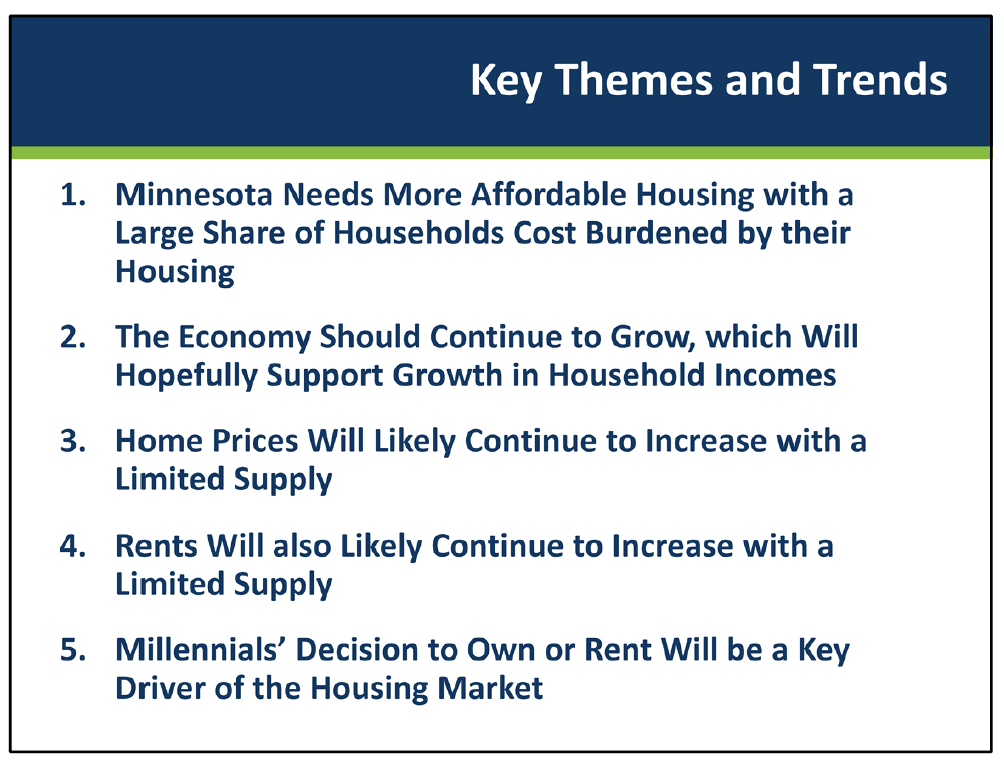
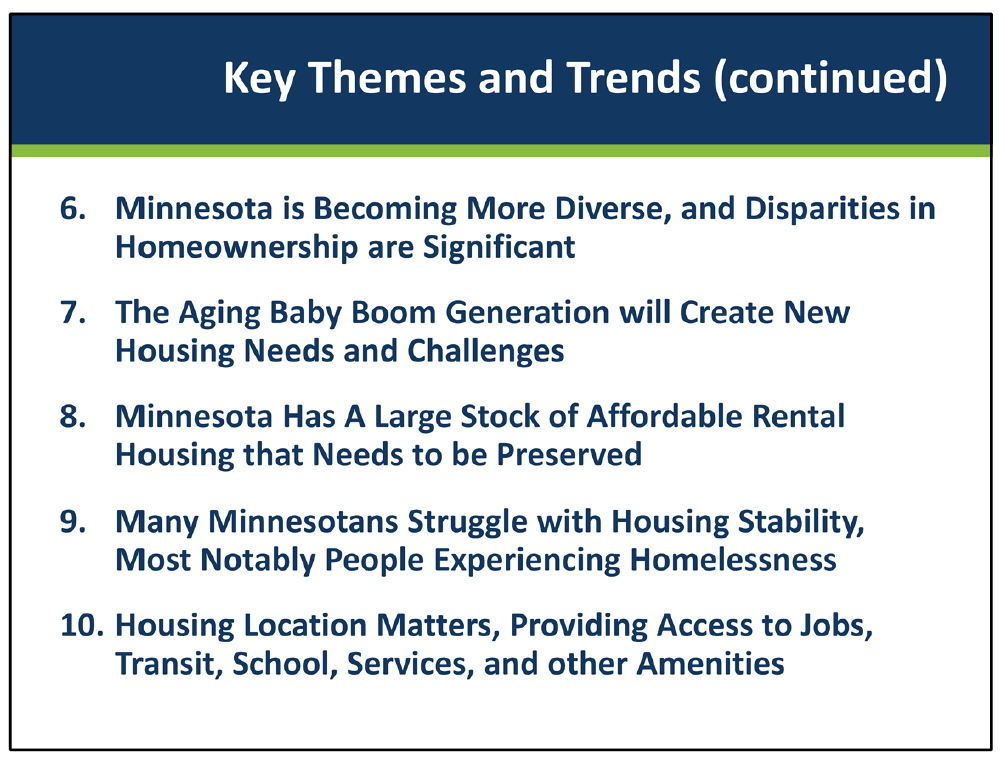
    John Patterson, Director of Planning, Research and Evaluation, presented on the agency’s recently released Key Trends in Housing, which included data points in the following areas:
    Members of the board reflected on several areas of the report, including:

    • Concern that the state is losing affordable units as fast, if not faster than, new units are being built
    • Cities are using the frequency of police reports at a particular property as a rationale for upscaling
    • In addition to accessibility and availability, there needs to be more focus on affordability, especially as property taxes trend upwards
    • More production and increasing the inventory of multi-family units is imperative
    • More attention needs to be paid to the “missing middle” — households making $50,00 or $60,000 who can afford market rate but only at the lower price range

    Read the full report here.

    Work Plans

    As part of Minnesota Housing’s 2016-2019 Strategic Plan, each division develops an annual work plan that identifies funding and production levels, key division/section activities, responsibilities, expected outcomes and program level measures. While not an exhaustive list, highlight for 2018 for each division include:

    {slider Single Family|closed}

    • Complete evaluation of the Agency’s Home Improvement Programs and implement program changes;
    • Maintain strong production of low-interest mortgages and enhancements (Start Up, Step Up, Deferred Payment Loans, Monthly Payment Loans) to support $630 million of lending and an estimated 3,663 households;
    • Achieve the goal of 35% of first-time homebuyer loans going to households of color or Hispanic ethnicity;
    • Continue implementation of the new single‐family loan origination system to improve operations and customer service;
    • Develop a new single-family compliance management system in accordance with Consumer Financial Protection Bureau and other regulations.

    {/sliders}

    {slider Multifamily|closed}

    • Implement revised multifamily underwriting standards and program guidelines to respond to customer needs, and increase first mortgage production (goal is 10 first mortgages in addition to loans generated through the consolidated RFP);
    • Assess the loss of naturally occurring affordable housing, identify Minnesota Housing’s role in addressing the issues, and build partnerships;
    • Investigate strategies for preserving and improving manufactured home parks, including a potential new pilot program to augment existing agency activities;
    • Address workforce housing through Economic Development and Challenge Fund and Greater Minnesota Workforce Housing Development Programs;
    • Continue carrying out the Multifamily Remodel Project, a multi-phased business process and technology improvement effort, focusing on the post-selection-to-closing processes and implementing a new business development function; and
    • Secure the new HUD PBCA contract once a procurement process is announced.

    {/sliders}

    {slider Finance|closed}

    • Pursue a larger $115 million request for Housing Infrastructure Bonds (and include senior rental housing as an eligible use along with supportive housing, rental preservation and community land trusts) and General Obligations Bonds to improve publicly-owned housing;
    • Manage the Agency’s cash, debt, investments and liquidity;
    • Continue pursuing a best-execution policy that weighs the costs of selling tax exempt mortgage revenue bonds compared with selling mortgaged-backed securities backed by Agency mortgages; and
    • Monitor and manage issues and activities related to tax-exempt bond cap allocation and capacity.

    {/sliders}

    {slider Collaborations and Partnership Actions|closed}

    • Serve in multiple key roles for the Governor’s Task Force on Housing that will recommend policies and practices to help alleviate Minnesota’s housing challenges;
    • Complete and begin implementation of the new State Plan to Prevent and End Homelessness, with a focus on a multi-sector, multi-organizational approach to implementation and on families and youth when financing supportive housing;
    • Continue to implement the Olmstead Plan to provide increased housing options for persons with disabilities in integrated community settings;
    • Assess Minnesota’s rural delivery networks for housing resources and work with partners to support and improve those networks;
    • Participate in the Homework Starts with Home Initiative to support community partnerships that create targeted responses to end homelessness for students and their families;
    • Continue to work with DHS to develop and implement strategies to more effectively serve housing-related needs of seniors; and
    • Continue to support and strengthen the Homeownership Opportunity Alliance, an industry-wide collaboration to reduce the homeownership disparities in Minnesota.

    {/sliders}

    {slider Community Engagement, Diversity, Capacity Building|closed}

    • Release new Analysis of Impediments to Fair Housing Choice, and develop and begin implementation of its action plan;
    • Build the capacity of local organizations to identify, create and implement housing solutions through technical assistance, capacity building grants, and other efforts;
    • Continue to strengthen the capacity to work in partnership with Minnesota’s Indian tribes and urban Indians to meet their housing needs through consultation, work sessions, training, technical assistance, program development and housing investments; and
    • Implement the approved work plans related to the Governor’s Diversity and Inclusion Executive Order, including procurement practices, State workforce, and civic engagement.

    {/sliders} 

    Update on Governor’s Task Force on Housing 

    Commissioner Tingerthal updated the board on the progress of the Governor’s Task Force on Housing, noting that the first full meeting occurred on January 22 (pictured right) but the engine of the process will be the three work groups on Home Ownership, Rental Housing and Housing Stability (description and co-chairs below). Over the next several months, those group will be seek public input, conduct analysis on opportunities and gaps, and explore and form consensus opinions on recommendations that will come back to the larger task force for consideration.

    Terri Thao, board member and co-chair of the Task Force Work Group on Home Ownership, shared that the first meeting had good attendance and creative engagement, featuring a mapping exercise with a visual facilitator who helped the group sketch out the landscape and come to shared problem definitions. The meeting also included individual stories from impacted community members, she added, which helped to put a name and face to the urgency and immediacy of the work ahead. She emphasized that people are really hungry to get to solutions and strategies given the short six-month timeframe, but also eager to do a lot of learning along the way. 

    All meetings of the task force are public and listed here.  


    The next meeting of the Minnesota Housing board will be February 22 at 1 p.m. More information here.
  • MHP welcomes new board members!

    MHP is excited to welcome three new board members in 2018: Erin Mathern of Winthrop & Weinstine, Nick Place of Bridgewater Bank, and Pam Wheelock of Twin Cities Habitat for Humanity. “MHP is lucky to have board members like Erin, Nick, and Pam, who bring deep experience and a fresh perspective to our work,” said MHP Executive Director Anne Mavity. “I look forward to working with them, and with their fellow board members, to set ambitious goals for MHP as we strive toward our mission of improving home and community.”

    Erin Mathern

    A shareholder in Winthrop & Weinstine’s Real Estate Development and Tax Credit Financing group, Erin Mathern brings a deep understanding of the business side of real estate development to the MHP board. She considers it a privilege to contribute to the construction and rehabilitation of well-planned and thoughtful housing developments that provide tangible benefits to families and communities. Nationwide, Mathern represents for profit and nonprofit real estate developers with a focus on the development of affordable, multifamily housing utilizing low-income housing tax credits, historic rehabilitation tax credits and other forms of structured finance. Prior to private legal practice, Mathern spent more than a decade as development director of a Twin Cities-based builder / developer, focusing on urban, adaptive re-use projects including multifamily condominiums and apartments and mixed-use projects. Mathern uses her significant, first-hand experience in project planning, entitlements and approvals, agency finance, acquisition and disposition, and resolution of title matters to help move her client’s development projects forward. Outside of her legal practice, Mathern and her family own a specialty real estate development and design business.

    Nick Place

    As Senior Vice President and Chief Lending Officer, Nick Place brings more than a decade of banking experience to the MHP board. At Bridgewater Bank, he directs a talented team of lenders while managing one of the bank’s most complex and most productive portfolios. Under Place’s leadership, Bridgewater Bank has seen consistent growth exceeding $400 million in new production through each of the last two years. In addition to his managerial responsibilities, Place is actively engaged in loan originations, primarily focusing on real estate lending in the Minneapolis/St. Paul metro area. He has been instrumental in strategically developing specialty loan products in response to market demands. Place is often a guest speaker on numerous commercial real estate panels throughout the Twin Cities. Prior to joining the Bridgewater Bank, he was employed at Ameriprise Financial. He started his career in banking at Wells Fargo. Place received his B.A and B.S. from the University of St. Thomas and is an alumnus of the Graduate School of Banking at Colorado, Boulder.

    Pam Wheelock

    Pam Wheelock brings extensive philanthropic, private, and public sector experience to MHP’s board. She currently serves as Chief Operating Officer of Twin Cities Habitat for Humanity, where she expands affordable homeownership opportunities for families by working to doubling the number of families that Habitat serves each year. “I like complexity,” Wheelock says. “I like trying to solve problems by working with people who are passionate about a topic. I like doing work where you can understand what the outcomes are and see them. At Habitat, that means more families living in homes.”

    Before joining Twin Cities Habitat in 2017, Wheelock was Vice President of University Services at the University of Minnesota. She has also served as Interim President and CEO at Blue Cross Blue Shield of Minnesota, a Vice President at the Bush Foundation, and Executive Vice President and Chief Financial Officer for Minnesota Sports and Entertainment, the Minnesota Wild’s parent company. Wheelock brings deep public service experience to MHP, acting as Director of Planning and Economic Development for St. Paul, and later was Commissioner of Finance for the State of Minnesota under Governor Jesse Ventura. Pam earned her Bachelor’s degree in history from St. Catherine University and a Master’s in applied economics from Marquette University in Milwaukee.

  • Capitol Connect: Support the MN Tax Credit Contribution Fund

    It’s hard to believe, but we’re already one month into the legislative session, which will end no later than May 21. This week is the first deadline for first committee hearings on bills, and legislators are preparing for spring recess the first week in April, which is a popular time to set in-district meetings or tours.

    While we have a special update on MHP’s bill for a Tax Credit Contribution Fund, MHP is also working to support Homes for All Coalition priorities, including $140 million in bonds for housing: $110 million Housing Infrastructure Bonds (HIB) and $30 million General Obligation Bonds (GO), with senior and manufactured housing as new eligible uses.

    As the session moves forward and legislators focus on a smaller number of bills, we will turn up the heat with legislator outreach and advocacy — and your voice is critical to our success! MHP makes it easy for you to advocate for affordable housing and influence decision makers. Reach out to Libby Murphy at [email protected] with any questions and/or to indicate your interest. Continue reading for all the latest updates from the capitol(s)!

    Photo: Libby Murphy, MHP Deputy Policy Director, with Rep. Alice Hausman (DFL- District 66A), chief author of the Homes for All bonding bill in the House


    Support the MN Tax Credit Contribution Fund

    A proven tool to incentivize private investment and promote community and economic development, MHP is advancing a bill (S.F. 3301), introduced last week at the Minnesota Legislature, to create the Minnesota Tax Credit Contribution Fund, modeled after North Dakota’s Housing Incentive Fund. 

    Capitalized by contributions from taxpayers that have state income, corporate, or insurance premium tax liabilities, the fund will encourage local businesses and neighbors to invest in their community by creating housing opportunities. Participating taxpayers will receive credit against their state income tax liability equal to their contribution to a specific development or the general loan pool. A flexible, simple tool, the fund would boost local business and attract public and private funding to communities of all sizes across the state.

    **Get involved!** Add your name or organization to a support letter, and read more about the MN Tax Credit Contribution Fund. Stay tuned for more information, as the bill will likely be heard this Thursday in the Senate Agriculture, Rural Development, and Housing Policy Committee. 

    Photo: Sen. Carla Nelson (R-26) signs on to bipartisan bill S.F. 3301 as chief author. Additional authors include Sen. Mark Johnson (R-1), Sen. Jeremy Miller (R-28), Sen. Paul Anderson (R-44), and Sen. Kari Dziedzic (DFL-60). 


    Bill modifying tax exempt bond allocation may move forward

    A bill amending Minnesota tax exempt bond statute may be heard in the Senate Agriculture, Rural Development, and Housing Policy Committee this Thursday. Growing out of the agreements of the tax-exempt bond steering committee, convened by MHP, the bill seeks to change statute to develop more rental housing. 


    Homes for All bonding and appropriations bills meet deadlines

    The Homes for All bonding request has been presented in the House and Senate, and Homes for All advocates continue to advance the bonding bill (H.F. 3125 | S.F. 2939) with more bipartisan support than ever before. See a full list of Homes for All 2018 bill authors here. 

    On the appropriations side, the Minnesota Housing (H.F. 3474 | S.F. 3238) and Health and Human Services (H.F. 3402 | S.F. 3175) bills have been introduced, successfully meeting this Thursday’s committee deadline.

    Photo: Homes for All Co-Chair Allison Streich testifies in support of the Homes for All Bonding request at Homeless Day on the Hill on March 6. 


    Governor’s Task Force on Housing update

    On March 14, the Governor’s Task Force on Housing hosted the first of six regional community forums in Austin. Dozens of residents representing faith-based organizations, housing advocates, business, nonprofits and government turned out to share their thoughts on housing needs in Southeast Minnesota.  At least 15 communities were represented, from Albert Lea, to Mankato, to Dodge Center and Red Wing, and many more. Panelists from Albert Lea, Austin, Faribault and Red Wing both inspired and asked hard questions as they talked about housing needs in their communities. Join the Task Force for the next community forum on April 5 in Little Falls, MN.

    Graphic by Amy Batiste, graphic facilitator, drawn at the first Task Force meeting.


    Governor Dayton’s Supplemental Budget and final State of the State address

    On Wednesday, Governor Dayton delivered his last State of the State speech, releasing his Supplemental Budget a few days later. Governor Dayton made two important housing-related recommendations in the supplemental budget, page 14:
    • Increasing funding for Homework Starts with Home, which provides housing assistance to families with school-age children at risk of homelessness. The Governor’s recommendation of $4 million for 2019 and ongoing funding of $8 million per biennium will expand the program to 500 more families, including 1,000 children.

    • Increasing the maximum level of the Manufactured Home Relocation Trust Fund be increased from $1 million to $3 million, a change sought by key stakeholders. The Trust Fund, funded from fees paid by park owners for every homeowner-occupied lot, ensures that relocation resources are available to owners of manufactured homes in the event that their manufactured home park closes.

    Read the full summary of the Supplemental Budget here.

    Photo: Pioneer Press


    FEDERAL

    Congress negotiates omnibus spending bill, potentially impacting the Housing Credit

    From the National Low Income Housing Coalition: Congress is currently negotiating an omnibus spending bill, which is likely to include a tax component, and must pass on or before March 23 when the current continuing resolution expires. This bill may be the last potential vehicle for the Affordable Housing Credit Improvement Act for quite some time, making the Housing Credit and Housing Bonds more streamlined and flexible. The Senate version of the legislation also includes a 50 percent increase in Housing Credit resources, which would finance approximately 400,000 more affordable homes over the next decade. To take action in these final days please check here for recommended action steps.


  • 10 Key Findings from Market Watch Minneapolis

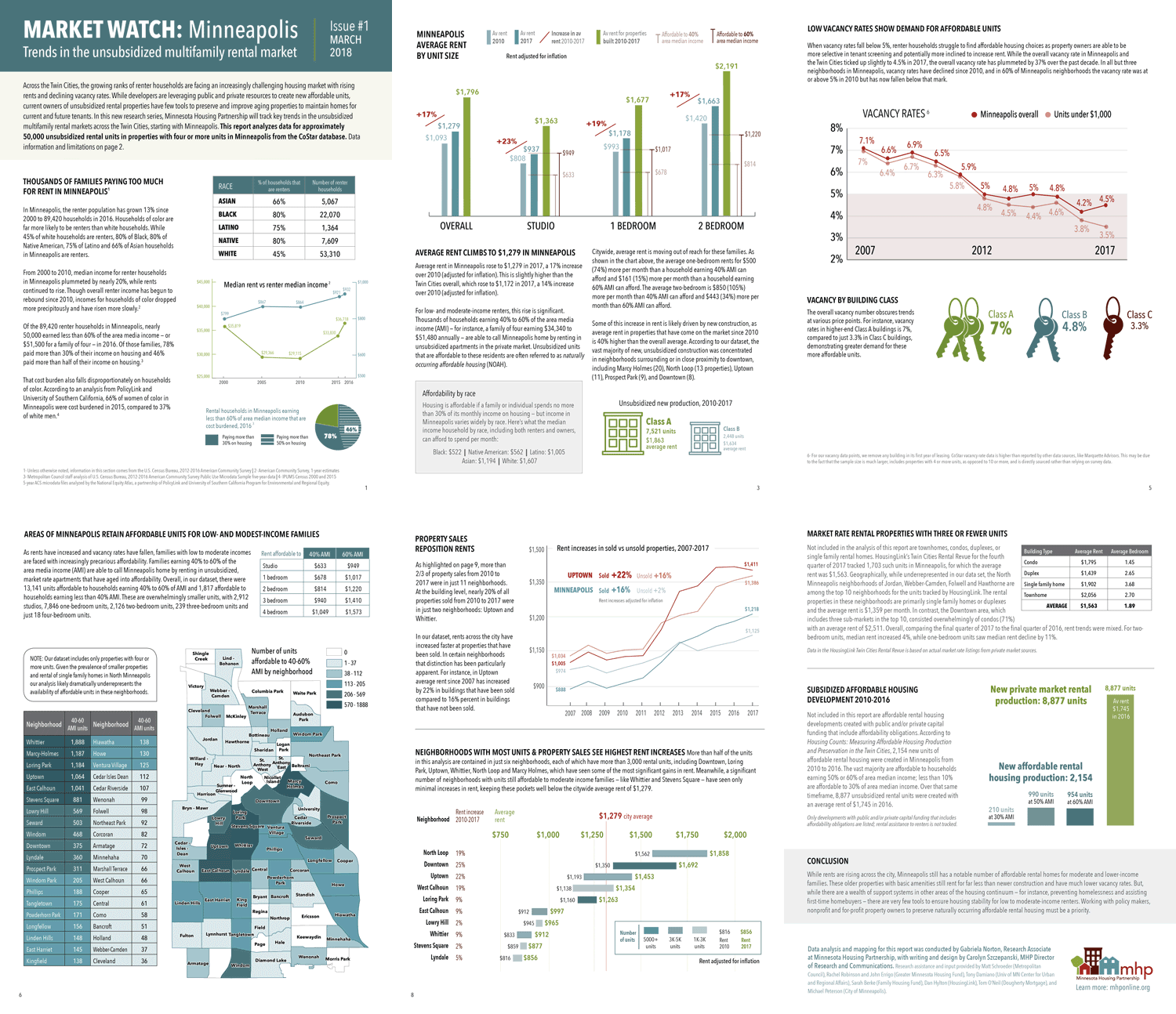
    Across the Twin Cities, the growing ranks of renter households are facing an increasingly challenging housing market with rising rents and declining vacancy rates. While developers are leveraging public and private resources to create new affordable units, current owners of unsubsidized rental properties have few tools to preserve and improve aging properties to maintain homes for current and future tenants. 

    Building on its 2016 “Sold Out” report, Minnesota Housing Partnership is launching a new research series tracking key trends in the unsubsidized multi-family rental markets across the Twin Cities.

    This first report, published in March 2018, analyzes data for approximately 50,000 unsubsidized rental units in properties with four or more units in Minneapolis from the CoStar database. Read the full report — and download graphics from our research.

    10 Key Findings

    Minneapolis, like much of the Twin Cities region, has a wealth of older apartment buildings that provide affordable housing for thousands of families in the private market — without any public subsidy.

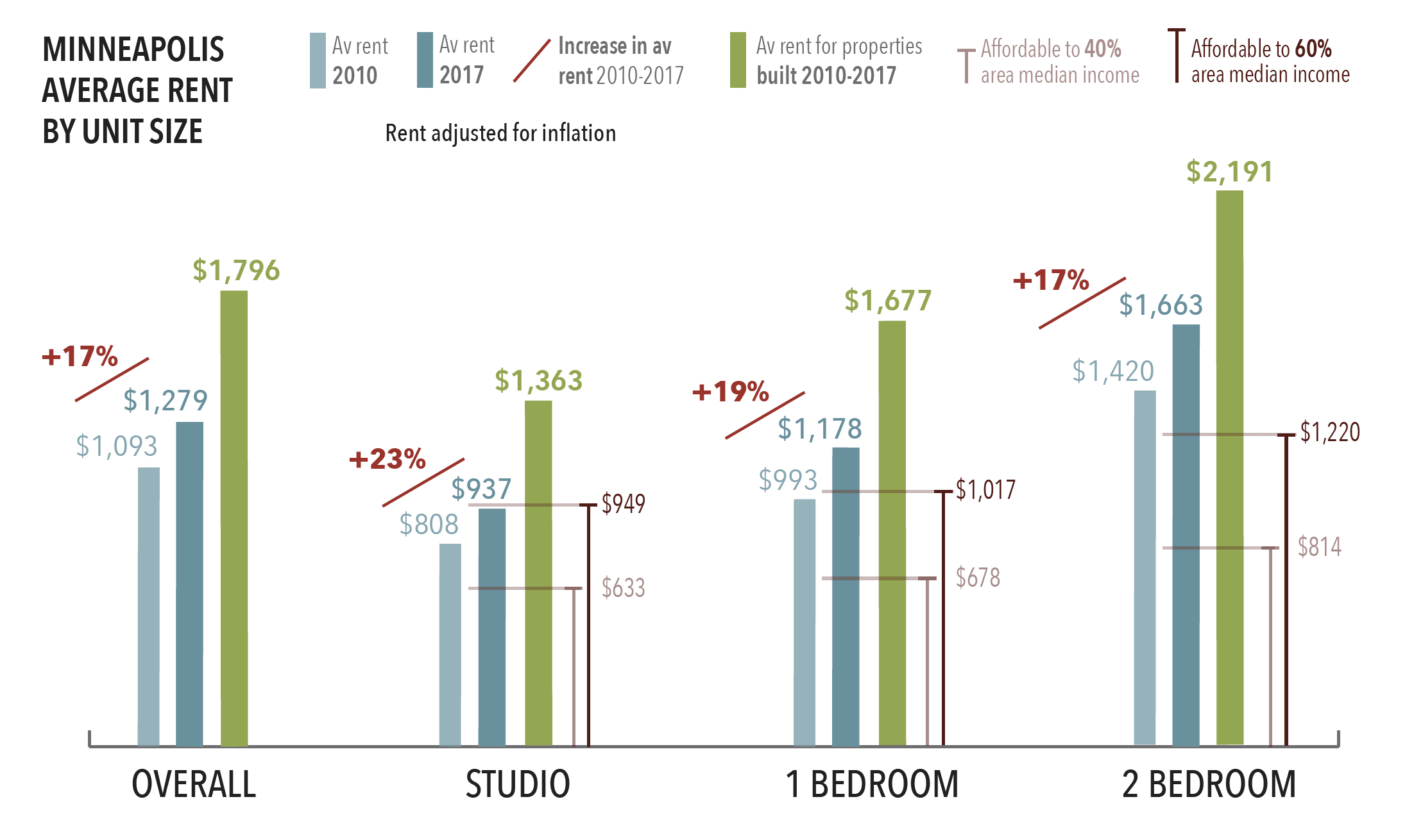
    Rents are increasing faster than inflation — and far faster than largely stagnant incomes for families renting in Minneapolis. Even for households earning 60% of area median income, average rent is hundreds of dollars more than they can afford.

    New supply in the Minneapolis rental market has been almost exclusively at the higher end so the market is not producing units that are affordable to the lower income families who must compete in the rental market without rental subsidies. More than 70% of the new unsubsidized apartment buildings in Minneapolis constructed since 2010 have average rents starting at nearly $1,400 for a studio.

    There’s a sizable gap between rents in Class C and Class B properties, providing potential incentive for new developers to purchase and upscale. Average rent in Class C buildings is $937 — 49% below the average rent for Class B buildings and 37% below the overall city average.

    From 2010 to 2017, 512 apartment properties — representing 12,350 units — were sold in Minneapolis. After a dip in sales in 2016, the pace continued to climb in 2017 with 124 properties (representing 4,005 units) sold, or 8% of all apartments in our dataset.

    After buildings are sold the rent typically increases faster than in buildings that haven’t been sold. For instance, in Uptown average rent since 2007 has increased by 22% in buildings that have been sold compared to 16% percent in buildings that have not been sold. Citywide, rent increased by 16% in properties that were sold compared to just 2 percent on buildings that were not sold.

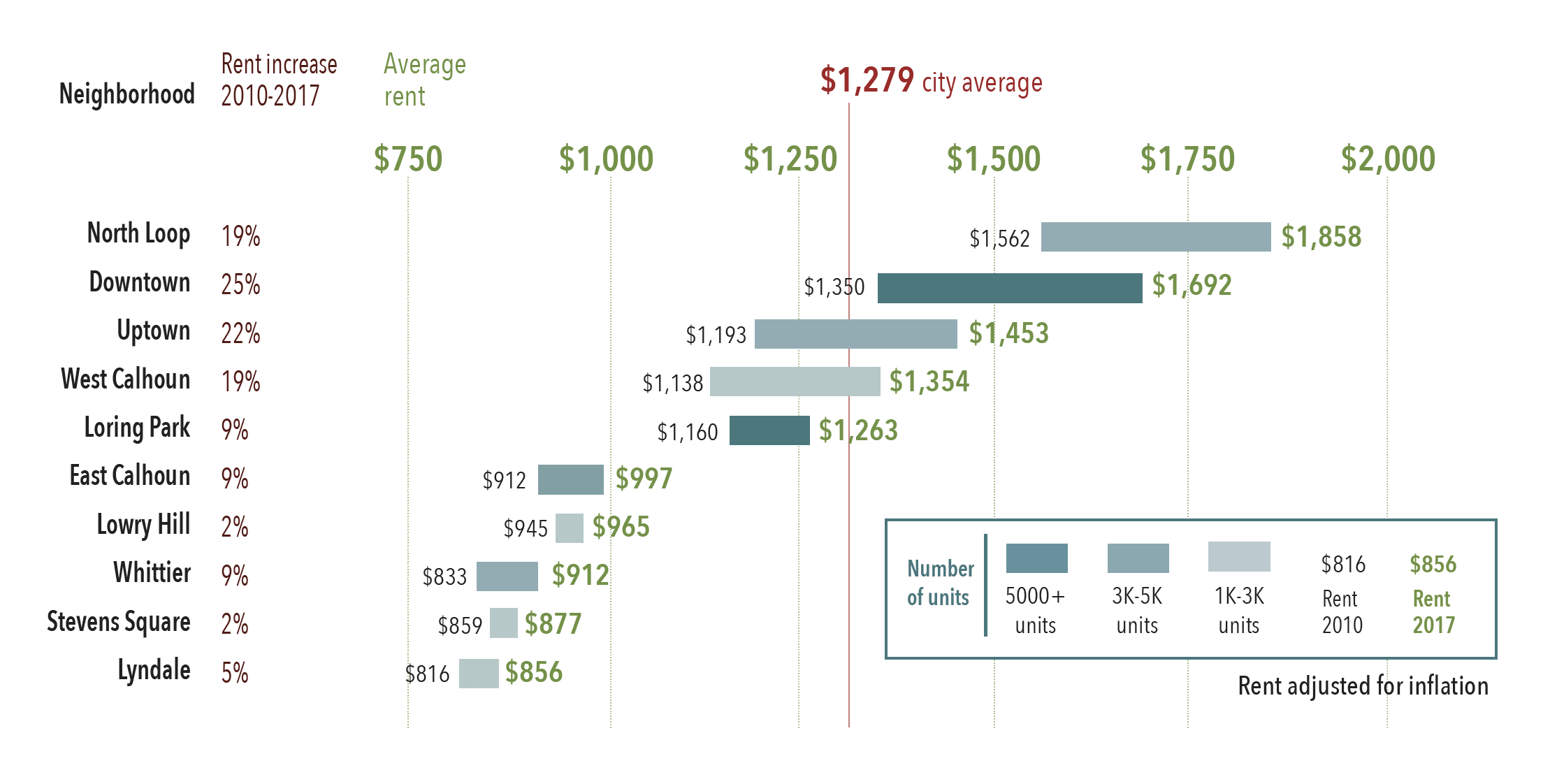
    In many of the neighborhoods where there is the most multi-family rental housing, rents are increasing rapidly, with more than 20% rent growth (adjusted for inflation) from 2010-2017 in areas like Uptown and Downtown. Meanwhile, in some neighborhoods there are still significant numbers of affordable units, given minimal rent growth over the past seven years.

    In all but three neighborhoods in Minneapolis, vacancy rates have declined since 2010, and in 60% of Minneapolis neighborhoods the vacancy rate was at or above 5% in 2010 but has now fallen below that mark.

    In neighborhoods like Whittier, there are thousands of apartment homes with modest rents affordable to low income renter households. These are well positioned for current NOAH preservation efforts that partner with private investors and nonprofit developers. Now is the time to invest in these programs to ensure these units stay affordable.

    Whether the upscaling trend continues or is just a moment in time, we are in a critical moment to preserve affordability. There are many neighborhoods in Minneapolis where factors like increasing rent, decreasing vacancy, older apartment buildings and distinctions between Class C and Class B rents are putting affordability at risk for thousands of households that are already struggling to make ends meet.

    Read the full report — and download graphics from our research.

  • “The Gap” in Affordable Housing in Minnesota

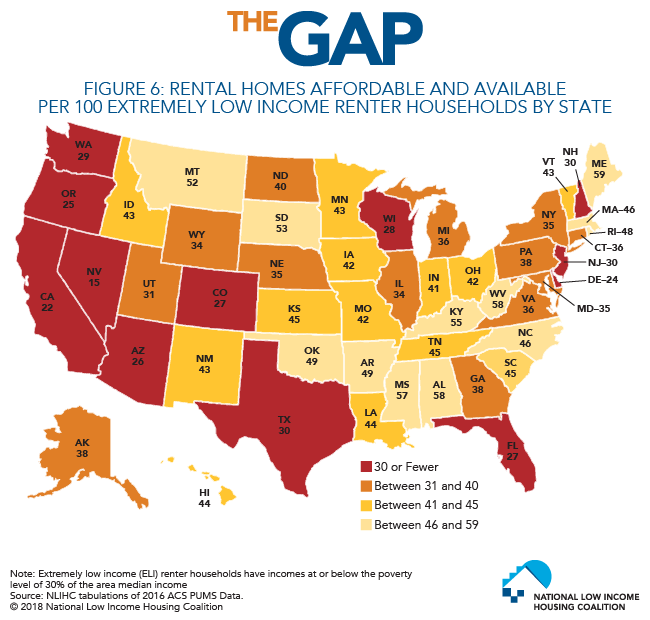
    Today, the National Low Income Housing Coalition (NLIHC) released The Gap: A Shortage of Affordable Rental Homes, outlining both state and metro shortages in affordable homes, especially for low-income families. 

    According to the report, which relies on 2016 ACS PUMS data, 43 percent of all renters in the Minneapolis – St. Paul – Bloomington metro area are cost burdened (paying more than 30 percent of their income on housing) and 22 percent are severely cost burdened (paying more than half of their income on housing). 

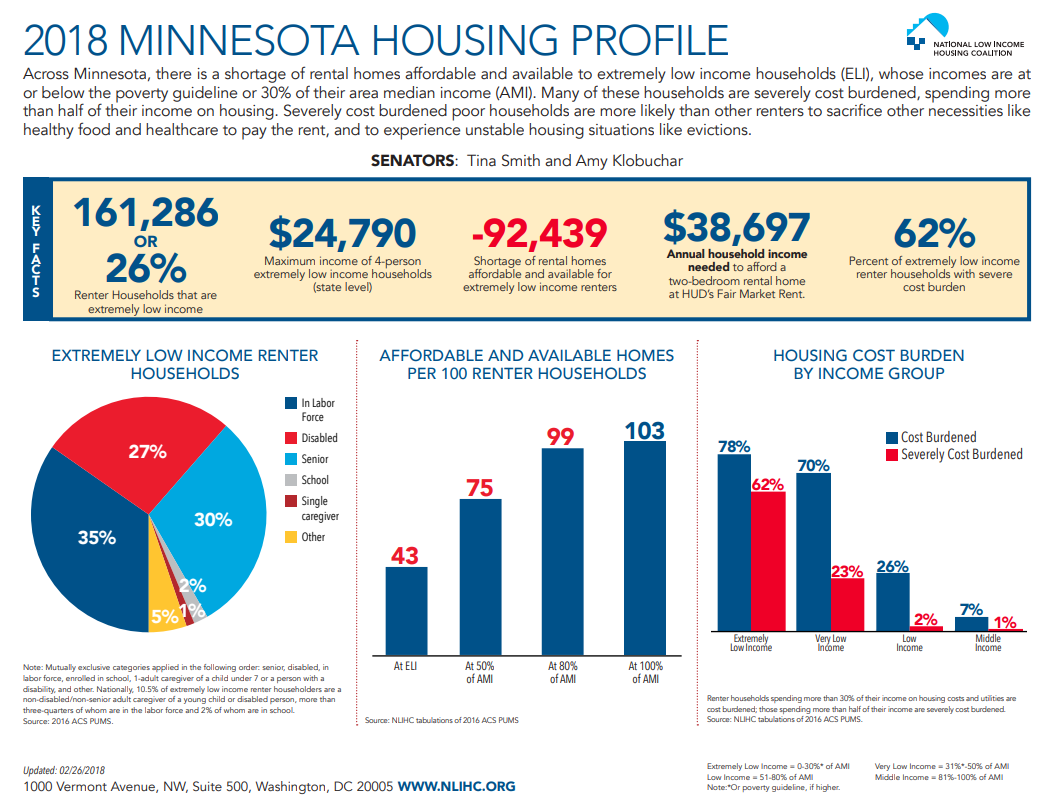
    Those numbers are even more stark for extremely low-income (ELI) families. More than 107,500 households earn less than 30 percent of area median income (AMI), or less than $25,750 for a family of four. A striking 78 percent of households in this income bracket are cost-burdened, with 63 percent paying more than half of their income on housing. 

    Not surprisingly, households earning less than 30 percent AMI face extreme challenges in finding affordable housing options. In the Minneapolis metro area, there is a deficit of nearly 65,000 affordable and available housing units for ELI households. While Minneapolis ranks in the top 10 in the nation for metro areas that have the least severe shortage of affordable housing, there are still only 40 affordable and available units for every 100 ELI households that need them. Meanwhile, there is an excess of 6,220 units available to those earning at or above the area median, or $85,800 annually.

    At the state level, there are 161,286 extremely low-income renter households, with 78 percent experiencing cost burden, and 62% paying more than half of their income on housing. For extremely low-income renter households, there is a deficit of 92,439 affordable and available units across the state; in contrast, for those at or above median income, there is a surplus of 12,438 units. Many of these ELI renters are among our most vulnerable populations: 27 percent are disabled and 30 percent are seniors.

    While progress has been made in addressing the gaps of housing for households at the 50 and 60 AMI levels, more resources and tools are urgently needed to address the shortage of housing for ELI households. Especially as unsubsidized rental housing is moving out of affordability for many low-income renters, robust rental assistance programs and the creation of more deeply affordable housing are essential to providing adequate housing to sustain our local economies and provide for our most vulnerable populations like seniors and people with disabilities. Commitment to capital investments and federal funding are vital to protecting affordable housing and the overall health of our communities, as well as new, sustainable solutions at the state and local level.  

    Click here for more information on the NLIHC’s The Gap report.

  • #Homes4AllMN housing story: “It’s like when you’ve fallen off a boat and someone throws you a life preserver.”

    The blog below is cross-posted from Homes for All MN. Homes for All MN collects and shares housing stories to to show lawmakers the challenges Minnesotans are facing when it comes to having a safe, stable and affordable home. By sharing your story, you play a key part in gaining the support and understanding of elected officials and furthering Homes for All’s mission to advance housing stability for all Minnesotans. Sue’s story is part of that effort. Join Sue in sharing your story, and thanks for supporting Homes for All!

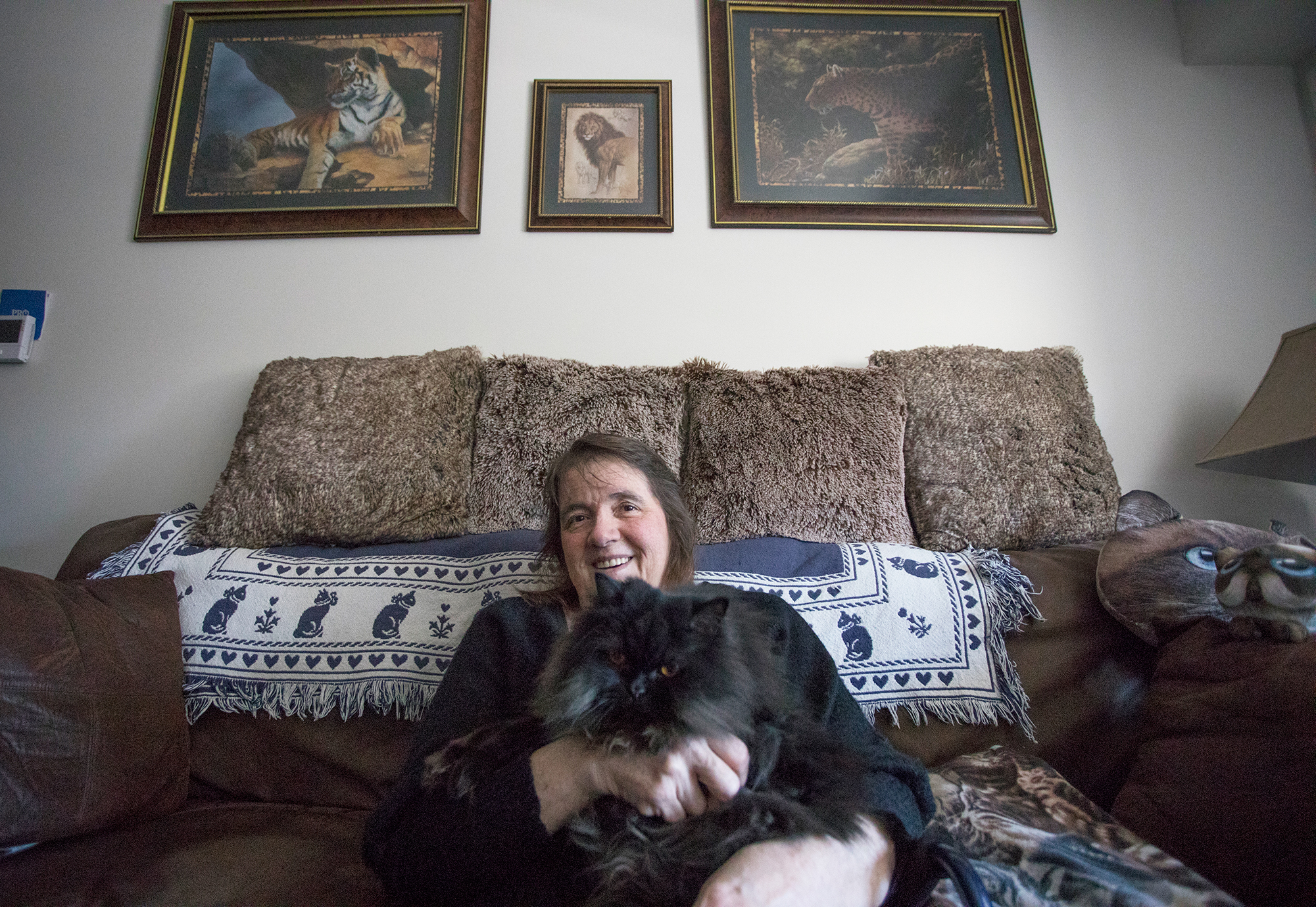
    Sue’s apartment at 1st Avenue Flats is a monument to her love of felines. Paintings of lions and tigers hang on the walls, and pillows shaped like Siamese cats perch next to their living, breathing counterparts on the couch: Susie Q Susette, Daisy Susette and Little Joey Cupcake Kiki Jr. (a name bestowed by her granddaughter Abby).
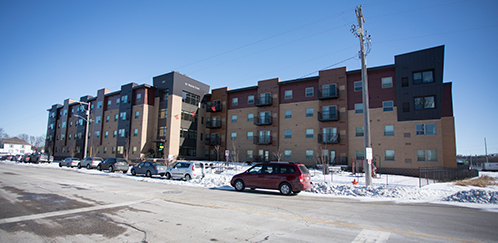
    Opened in 2017, 1st Avenue Flats has been home to Sue and her three furry companions for nine months. Four percent tax credits and Challenge Funds from Minnesota Housing made the complex possible and affordable to a wide variety of Rochester residents — from Mayo Clinic employees and part-time students to people like Sue, who lives on a fixed income. A Section 8 voucher helps make rent and other daily necessities affordable for Sue, who says places like 1st Avenue are key to supporting community members with disabilities or limited incomes.

    Photo: Sue poses with one of her three cats at her home at 1st Avenue Flats.

    “There’s a lot of people on social security and disability, and we need help,” Sue says. “I’m broken from the tip of the toe to the top of my head. At 16, I was run over by a truck twice. I was lucky because I was young, but it crushed my pelvis to pieces. I lost eight years of college education when a woman hit me, zooming backwards onto the highway in a blizzard, which traumatized my short-term memory.”

    She knows the trauma of having no place to turn. Nearly 30 years ago, Section 8 helped Sue and her two children keep a roof over their heads after Sue left an abusive relationship. Sue felt alone and afraid. “I had that horrible feeling of not knowing how to be on my own,” she recalls.

    First Avenue Flats in Rochester was made possible by four percent tax credits and Challenge Funds from Minnesota Housing.

    Sue didn’t want to rely on her parents, who were retired from IBM and living in another state, for help. She saw a social worker in Dodge County who helped her secure a voucher. “When I got my Section 8 voucher, you wouldn’t believe the relief,” she says. “It’s like when you’ve fallen off of a boat into the water and someone throws you a life preserver.”

    The complex provides access to amenities key to Sue’s health including an elevator, covered parking, close access to Mayo Clinic and the YMCA, and a responsive property manager and maintenance professional. Sue feels lucky to have found a spot at 1st Avenue and feels strongly that communities like Rochester need more housing for disabled people.

    “At times, people are cruel if they find out you’ve got help to pay your rent, but where would we be if we didn’t have that?”

  • Capitol Connect: Bonding and appropriations bills introduced!

    We enter week three of a short 13-week legislative session going full steam.  With the energy of a positive February forecast, increased bipartisan interest in housing, and Governor’s Task Force on Housing beginning to host regional forums throughout the state, MHP’s policy team continues to gain legislator support for our 2018 policy priorities.

    Earlier this week, we were delighted to participate in Homeless Day on the Hill, which set a record of 850 registrants. Advocates from all over the state took over the Capitol for meetings with legislators, and packed hearing rooms on bonding and housing policy hosted the same day. Thank you to all who participated!

    Photo: (clockwise from right) Libby Murphy, MHP Deputy Policy Director, Fatima Moore of MN Coalition for the Homeless, Pam Johnson from Twin Cities Habitat for Humanity and Kari Johnson from Metropolitan Consortium of Community Developers dropping off the Senate Homes for All bonding bill

    STATE UPDATES

    Homes for All Bonding and Appropriations Bills Introduced

    With strong bipartisan support, the Homes for All bonding bills have been introduced in the House (H.F. 3125) and Senate (S.F. 2939). On Tuesday, advocates packed a hearing in the House Capital Investment Committee, urging lawmakers to support the $140 million in bonds for housing — $100 million for Housing Infrastructure Bonds and $30 million for General Obligation bonds.

    MHP’s Local Housing Trust Fund bill is included in the Homes for All Minnesota Housing Finance Agency appropriations package. Rep. Dave Baker (R- District 7B) is the chief author and a handful of other co-authors have been secured. Yesterday, Homes for All dropped that bill into the hopper for introduction today. 

    The Homes for All appropriations package to fund programs to prevent and end homelessness in the Department of Human Services was also introduced in the House and Senate.


    Heading Home Together: New Action Plan on Homelessness Released 

    ​At Homeless Day on the Hill, dozens of partners and participants released “Heading Home Together,” a 2018-2020 action plan to end homelessness in Minnesota. The new plan reflects local practitioner knowledge, the insights of people with lived experience of homelessness, federal policy requirements and guidance, and extensive input from stakeholders all across Minnesota. MHP is proud to support this new effort! Watch a video of the public release and read the full plan.
     

    Positive February Forecast

    Last month, Minnesota Management and Budget released its February forecast, showing a $329 million surplus for the current budget cycle and $303 million for FY 2020-21. In contrast to the November forecast that showed a deficit for the 2018-19 biennium, the February forecast means legislators aren’t scrambling to fill a budget hole, but instead managing modest growth. This is a positive sign for the MHP and Homes for All legislative agendas, as we continue to work hard during the 2018 legislative session. Read more here.
     

    Tax Credit Gains Momentum

    Big news: Senator Carla Nelson (R- District 26) has offered to chief author MHP’s tax credit bill, which will go “in the hopper” this week for introduction. The tax credit, modeled on a successful tax credit program in North Dakota, encourages local businesses and neighbors to invest in their community by creating housing opportunities. Thank you to Senator Nelson for her leadership!
     

    2018 Committee Deadlines

    Stay on top of deadlines! House and Senate leadership have set deadlines for committees to complete their business this session. 

    • March 22: Committees must act favorably on bills in the house of origin. 
    • March 29: Committees must act favorably on bills, or companions of bills, that met the first deadline in the other body. 
    • April 20:Committees must act favorably on major appropriation and finance bills. The deadlines do not apply to the House or Senate Capital Investment or Taxes, Ways and Means (House), Finance (Senate), or Rules and Legislative Administration committees in both bodies.
       

    Governor’s Task Force on Housing Opens Call for Ideas; Hosts Regional Forums Starting March 14

    Submit your ideas on how to promote homeownership, rental housing, and housing stability for households with the lowest incomes or facing the largest barriers to securing housing to Governor Dayton’s Task Force on Housing by March 15. Click here to learn how to submit your ideas. The Task Force is also launching a series of regional housing forums, starting in Austin on March 14. Learn more and register. 
     

    Notes from February Minnesota Housing Board Meeting

    At its February meeting, the board of the Minnesota Housing Finance Agency heard highlights from the 2017 Program Assessment, approved the release of the proposed Housing Tax Credit 2020 Qualified Allocation Plan (QAP) for public comment, discussed the implications of a potential change to the administration of the project-based Section 8 program, and received an overview of the state’s Draft Analysis of Impediments to Fair Housing Choice. Read the full meeting notes.
     

    Comments Due March 14 on Proposed 2020 QAP 

    While the Housing Tax Credit 2020 Qualified Allocation Plan is not billed by the Minnesota Housing Finance Agency as a major change, there are proposed changes in three categories based on their impact on: 1) projects with 9% credits allocated through Super RFP; 2) tax-exempt bond / 4% projects selected through the competitive RFP process; and 3) projects receiving tax exempt bonds through MMB and seeking an allocation of tax credits through the 4% only process. Comments are due March 14; more information and ways to provide feedback here.
     

    MHP Comments on State Fair Housing AI Draft

    In response to the state’s Draft Analysis of Impediments to Fair Housing Choice, MHP submitted comments commending the state for being proactive in utilizing the new Affirmatively Furthering Fair Housing tool, while elevating key priorities like incorporating more of the action steps from the Twin Cities Regional AI Addendum, recognizing displacement and loss of affordable units as a fair housing issue, and placing additional focus on housing that serves the needs of household earning 30% AMI or less. Read the full comments.
     

    FEDERAL UPDATES 

    Tell Congress to Fund Federal Housing Programs

    National Rural Housing Coalition: Once again, the president’s budget zeroes out funding for USDA Rural Housing programs for Fiscal Year 2019. The National Rural Housing Coalition is calling on rural advocates and organizations to ask Congress to protect rural Americans by supporting the rural housing programs which are essential to their communities. Sign on by March 12, 2018.

    National Low Income Housing Coalition: NLIHC is circulating two letters urging Congress to ensure affordable housing and community development programs receive the highest allocation of discretionary funds possible for FY19; and oppose any proposals that would cut housing benefits by increasing rents and imposing onerous and administratively wasteful work requirements on current and future tenants. Learn more and sign on to these letters by March 16.

    Change to HUD Mission

    Secretary of Housing and Urban Development (HUD) Ben Carson announced a change to the agency’s mission statement: removing “promises of inclusion and discrimination-free communities.” The new mission statement promotes “self-sufficiency.” MHP has signed on to a letter opposing this change.
     

    UPCOMING EVENTS

    March 14: Regional Housing Forum in Austin

    The Governor’s Housing Task Force wants to hear from you! Join the first Regional Forum hosted at Riverland Community College in Austin, Minnesota to share your ideas, and help craft housing strategies that will work for your region. Learn more and register here.

    March 15: Homes for All monthly meeting

    Get updates from the capitol and learn how to get involved in the Homes for All coalition this legislative session! Join us from 10 a.m. to 12 p.m. at Lutheran Social Services in St Paul. More information (and call-in directions for remote participation) here.

    March 15: Twin Cities Housing Speakers Bureau

    Have you been directly impacted — or do you work with communities that have been directly impacted — by the lack of affordable housing in the Twin Cities? Please join us on March 15 to learn more about the mission and goals of the Speakers Bureau and to co-create its principles and structure. More information here!