• White Earth Team Works to House the ‘Hidden Homeless’

    Homelessness is often hidden. On the White Earth Reservation — where one-third of the population is homeless — people without a place to call home don’t sleep on sidewalks or in abandoned vehicles.

    “We tend to not kick our people out on the street,” says Ben Bement, Director of Human Services for the White Earth Nation. Instead of going outside, people crowd together in homes meant for far fewer residents.

    “It’s not uncommon in White Earth to find a three-bedroom house with about 18 people living in there,” Bement says. “And there are a lot of problems associated with overcrowding. One in three of our kids living in a homeless situation are subject to domestic violence, and one in five are subject to sexual violence.”

    According to Dawn Sherk, Economic Development Planning Coordinator for the White Earth Nation, many homeless community members find shelter with relatives. “You find hidden homelessness on a lot of reservations because folks are camping on the couch at their sister’s mother’s aunt’s place,” Sherk says.

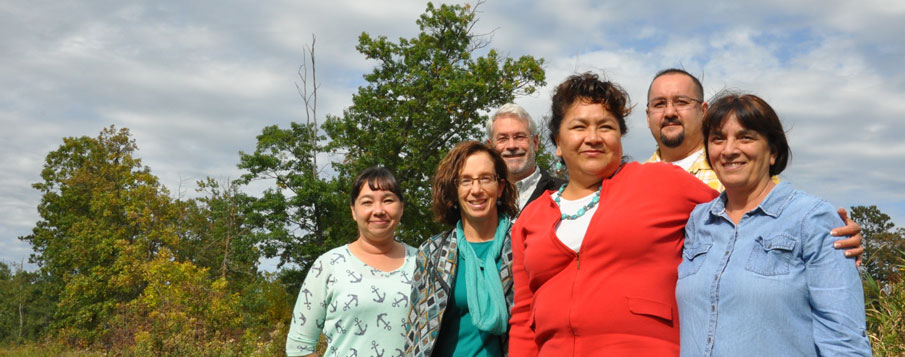
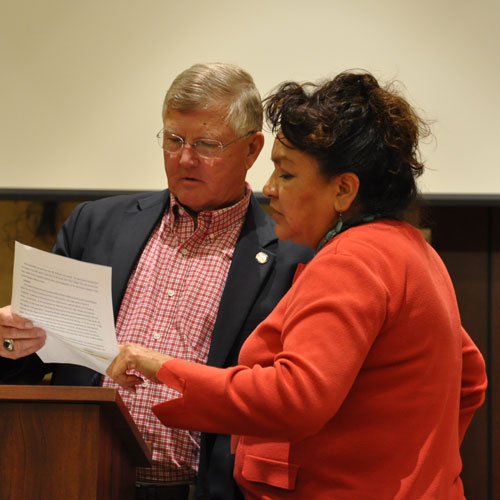
    Sherk and Bement, along with four other members of the White Earth Nation (pictured above), formed a team to address homelessness in their community as part of MHP’s first-ever Native Communities Development Institute, an 18-month peer-to-peer learning program focused on building project management and community development skills. The team chose to build a supportive housing complex with a “housing first” approach.
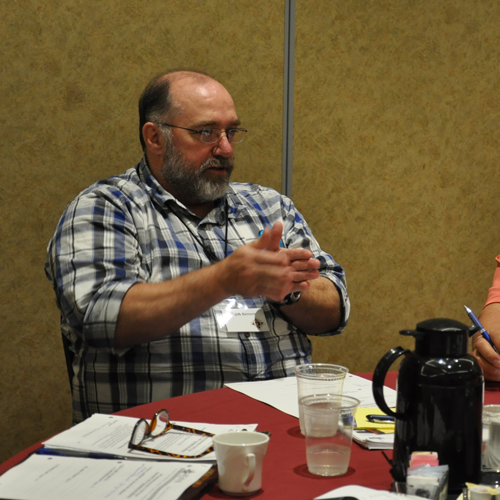
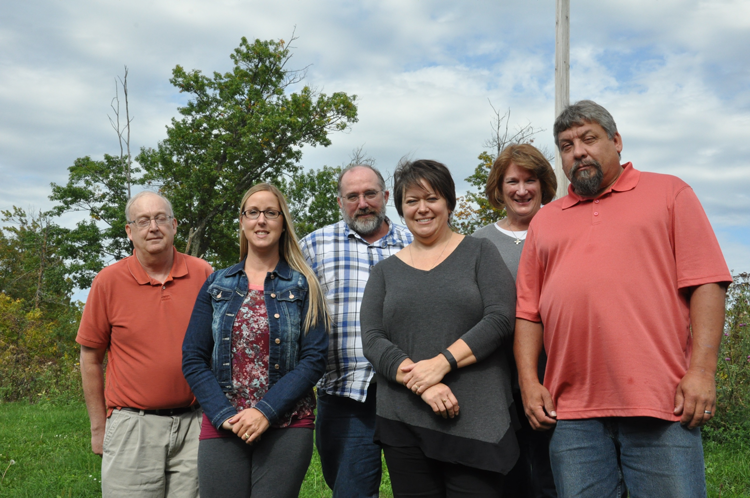
    According to Bement (pictured right), the “housing first” approach is simple. No matter an individual’s background or familial status, the first priority is to provide that person with housing. This philosophy places few restrictions on requirements to qualify for housing to ensure that community members don’t fall through the cracks.

    Team member Liz Foster-Anderson, CEO of White Earth Enterprises, explained that, over the course of her career, she’s seen firsthand the need for a housing first approach. While White Earth has some homelessness programs, these programs target specific populations, such as single parents, people without chemical dependency or a criminal record, or people who are employed.

    “I spent a greater share of my career working with the tribal membership that was single and didn’t meet the definition of help,” Foster-Anderson says. “A year ago, I got a call [from someone who] said, ‘Hey Liz, I’ve got somebody sleeping on a loading dock, seriously, what can you do? Can you figure out how to get them a room at the casino?’”

    Foster-Anderson reserved a room for that person at the casino for two nights, and paid for it with money from her own pocket. That individual faced several barriers to securing housing because they had a criminal record and no job — two common barriers to securing safe and stable housing in the White Earth community.

    “I used to hear [my colleagues] saying, ‘No, you’re not eligible, no you’re not eligible,’” Foster-Anderson says. “I thought, how can you just turn that person away? It’s because they have guidelines.”

    For struggling community members, providing a stable home is the first step toward a better future.

    “In order to move forward, you really need a place to call home,” Bement says. “That’s what motivates me is this dream of giving a person a place to put their head down; someone who wouldn’t normally find housing because of their criminal record, because of their track record, maybe because of their drug abuse, maybe just because they’re homeless and there’s not a lot of options out there for them. Let’s give them an opportunity for a place so they can grow and stabilize — and that’s success.”

    The White Earth housing first complex will include a range of individualized supportive services including case management services, mental health support, chemical dependency interventions, home health care and more. The team envisions a building comprised of two arms of efficiency units joined in the center by a community gathering place. Currently, the team is identifying a site for the complex and hopes to submit an application for Minnesota Housing Finance Agency funding in 2018.

    Foster-Anderson says NCDI helped the team narrow their focus when choosing a project.

    “I truly believe if we didn’t have this Institute, I don’t think we’d be focusing on this project — even though we know the need is there,” Foster-Anderson says. “I think we’re all so busy with other priorities that if you hadn’t brought us to this table, I’m not sure when this project would have been considered, even though the need is substantial.”

    Bement said that working with a team has been one of the most beneficial aspects of the NCDI experience, and is impressed by the commitment and drive of his teammates, who go above and beyond their daily duties to work on the supportive housing project.

    “This is not our full-time job,” Bement says. “This is something extra. It’s a big learning curve when it comes to supportive housing and development, so it’s a benefit that we have a team working on it. It’s not just myself doing it.”

    Bement knows this type of project is possible. Eight years ago, he developed Dreamcatcher Homes in Ogema, Minnesota, the first permanent supportive housing complex for Native Americans on tribal lands. And in 2014, he helped develop a second complex in Naytahwaush — Giwanikimin, which means “we live in harmony” in Ojibwe. Each development has 20 townhomes and a community center designed to look like a house. Bement explained that it’s easier to coach and guide residents over a cup of coffee or while making muffins — and he wants to bring the same community feel to the complex he and NCDI team develop.

    Bement is already looking ahead to what’s next for him and for his teammates after they finish their NCDI project.

    “The thing I’m most excited about is having the team look at how to do this so that they can do it again,” Bement says. “Rather than just one person creating a couple projects or something like that, you have a team that can go at it and say, hey, we could tackle this. I think it’s very very promising.”
  • MN Housing board update: Bridges program modified, conversion of Fort Snelling buildings considered

    At its March meeting, the Minnesota Housing board discussed changes to the Bridges program and the use of Agency tax exempt bonding to convert 26 historic Fort Snelling buildings into affordable apartments, the Upper Post Flats.
    In her opening remarks Commissioner Mary Tingerthal informed the board that Minnesota Housing will move its office location this coming August. The Agency will be located in the renovated former Macy’s building in downtown St. Paul.

    Modifications to the Bridges program

    The board supported modifications to the Bridges Rental Assistance program. Bridges provides a transitional rent subsidy for people with serious mental illness who have applied for Section 8 or some other form of permanent housing assistance. A significant change approved by the board provides greater flexibility in the priority given for those experiencing homelessness. The criterion changed from people experiencing homeless for one year or more or multiple times in the prior three years, to people experiencing homelessness who require supportive housing. In response to a board question, Commissioner Tingerthal said that there were multiple funding sources for the Bridges program, including state appropriations and Minnesota Housing Pool 3 funds.

    Restoration of Upper Post Flats at Fort Snelling

    The board also considered potential use of Agency tax exempt bond funding to restore the Upper Post Flats. The proposal converts 26 historic buildings at Fort Snelling into 176 apartments. The board report stated that the project does not meet several threshold conditions of the Agency’s debt management policy. The board agreed to hear comments from several individuals who support the project.

    DNR Commissioner Tom Landwehr explained to the board that the Upper Post 140-acre property has been owned by the state since 1971 and under the management responsibility of his agency. Five state and local agencies have jurisdiction for the Upper Post. After a failed first RFP to find a developer for the property, they issued a second RFP and awarded development rights to Dominium Corporation. Dominium was seen as the only entity with the experience and financial wherewithal to successfully restore the historic buildings.

    A number of other speakers spoke to the historic significance of the Upper Post, its value as a location for affordable housing, and the urgency of moving forward with the Dominium proposal. Speakers included David Kelleher (policy director for the Minnesota Historical Society), Mary Lu Seidel (Chicago field officer director for the National Trust for Historic Preservation), Kyle Makarios (policy director for the Carpenters Union), Cara Letofsky (Metropolitan Council member and president of the Hennepin History Museum), and Hennepin County Commissioner Peter McLaughlin.

    Minnesota Housing board member Rebecca Otto asked whether state or federal resources were available to fund the redevelopment of the property. It was later pointed out that, in addition to state funds already spent to stabilize the Upper Post buildings, there would be significant state and federal investment through their respective historic tax credit programs.

    Paul Sween and Owen Metz of Dominium and attorney John Herman concluded the presentation by speaking to concerns about the cost of converting the property into rental housing. They presented materials stating that costs of the project on a per-square-foot basis and on a per-bedroom basis were comparable to the nearby CommonBond adaptive reuse to veterans housing of a nearby Fort Snelling building. They stated that this project is ready to go, and that they must act before potential federal tax reform eliminates substantial federal resources now available for the redevelopment.

    After the presentations ended, Commissioner Tingerthal informed the board that the Agency’s potential role would be to issue conduit tax exempt bonds on behalf of the developer. While the developer has submitted initial application materials to the Agency for the project, many due diligence items would need to be completed before a complete application could be processed and presented to the board for its consideration.

  • Threat to Challenge Fund could undermine workforce housing

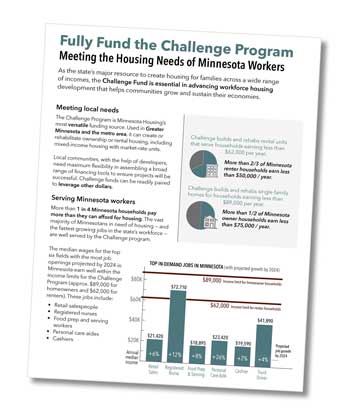
    The entire community gains when sensible, effective investments in housing benefit employers, workers and lower-income Minnesotans. As the state’s major resource to create housing for families across a wide range of incomes, the Challenge Program is essential in advancing workforce housing development that helps communities grow and sustain their economies.

    Though the demand for workforce housing and Challenge funding are great, leaders in the Minnesota House of Representatives have proposed deep cuts to this essential resource — and MHP is working with lawmakers and advocates to ensure those cuts are restored and the Challenge program is fully funded.

    Here’s why.

    As Minnesota Housing’s most versatile funding source, the Challenge Program gives local communities and developers maximum flexibility in assembling a broad range of financing tools to ensure projects will be successful. Used in Greater Minnesota and the metro area, it can create or rehabilitate ownership or rental housing, including mixed-income housing with market-rate units.

    Local communities, with the help of developers, need maximum flexibility in assembling a broad range of financing tools to ensure projects will be successful. Challenge funds can be readily paired to leverage other dollars.

    Serving Minnesota Workers

    The need for housing affordable to the Minnesota workforce is clear. More than 1 in 4 Minnesota households pay more than they can afford for housing. The vast majority of Minnesotans in need of housing — and the fastest growing jobs in the state’s workforce — are well served by the Challenge program.

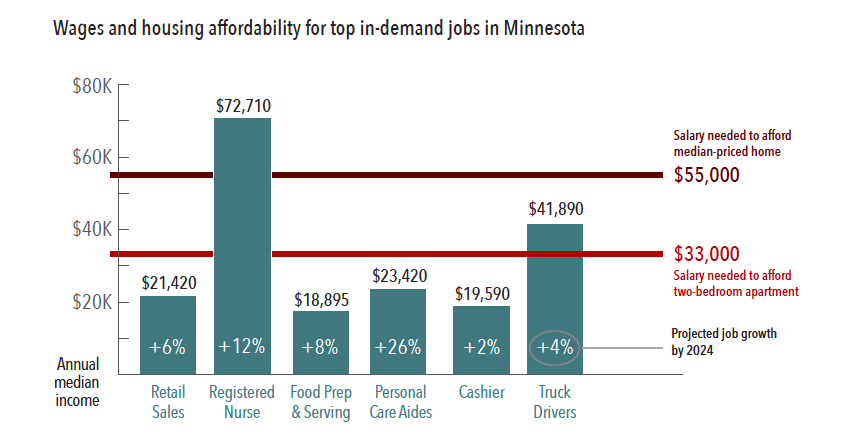
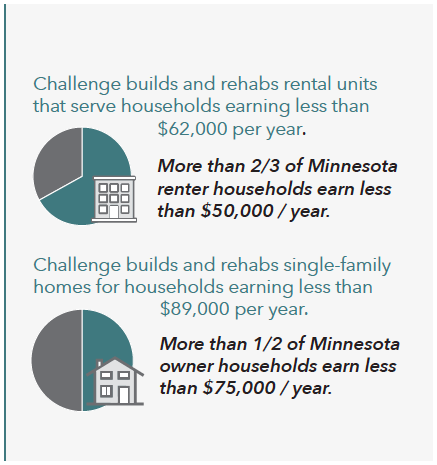
    The median wages for the top six fields with the most job openings projected by 2024 in Minnesota earn well within the income limits for the Challenge Program (approx. $89,000 for homeowners and $62,000 for renters). These jobs include: retail salespeople; registered nurses; food prep and serving workers; personal care aides; and cashiers.

    A Proven Tool

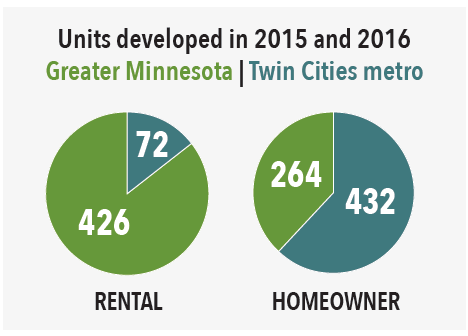
    The Challenge Program has proven highly effective in advancing housing projects that meet the diverse needs of communities across the state. In 2015 and 2016 alone, the Challenge Program contributed to the development of 498 multifamily units and 696 single family units — providing stable, affordable housing to support a productive workforce. The Challenge Program is widely used — and oversubscribed. In 2016 alone, 56 projects requesting $177 million in deferred loans did not get funded.

    Working in Greater MN

    The Challenge Fund is a proven resource for the development of workforce housing. Since 2013 Challenge funds have advanced projects throughout the state — from Jackson to St. Peter to Thief River Falls — addressing needs in communities seeing significant shortages in workforce housing.

    RIVER POINTE TOWNHOMES IN THIEF RIVER FALLS received $555,000 from the Challenge Program in 2013, which leveraged $900,000 in additional funding. In 2016, 24 units, including two- and three-bedroom townhomes, filled to capacity, serving predominantly working families with children.

    TRAVERSE GREEN IN ST. PETER received $100,000 in Challenge funding in 2016 to construct affordable homes to serve workforce households earning up to 80 percent of the area median income.

    EAGLE RIDGE TOWNHOMES IN JACKSON was developed in response to a tight rental market driven by job growth and employer expansion. With $850,000 in Challenge funding, 48 rental units — a mix of income-restricted and market rate — were developed.

    Leveraging additional dollars

    The Challenge Program is unique in its focus on providing housing that is affordable to the local workforce. Projects with Challenge Funds require contributions from non-state resources, including employers, local units of government, or private philanthropic or charitable organizations. This means state funds leverage substantial non-state resources to produce housing that meets local needs.

    Fully fund the Challenge Program

    For FY19, H.F. 2209 cuts funding to the Challenge Grants by $11.7 million and the Housing Projects for American Indians by $1.2 million. Nearly all affordable and workforce housing developments require gap financing — and obtaining gap financing has become increasingly difficult. A cut as severe as the one proposed in H.F. 2209 would result in the production of hundreds of fewer units in FY19.

    H.F. 2209 also includes restrictive language that prohibits pairing workforce housing funds with resources for rent- or income-restricted apartments. Local communities and developers need maximum flexibility in assembling a broad range of financing tools to ensure projects will be successful. The need to combine different financing sources is particularly true for mixed-income developments, housing intended to further a variety of community objectives. If many of the sources developers now employ are excluded, the intent of the Workforce Housing Development Program will be compromised — and it’s probable that fewer market rate units will be developed.

    Download our Challenge Fund one-pager here.

  • Trump’s defense-first budget puts need of Minnesotans last

    In framing the merits of his dangerous budget, President Trump stated that “without safety, there can be no prosperity.” He’s right. Without a safe, affordable place to call home, families and communities cannot thrive. And Trump’s budget puts thousands of vulnerable Minnesotans in additional peril.  In a sense, the Trump budget provides for a wall but many fewer roofs.
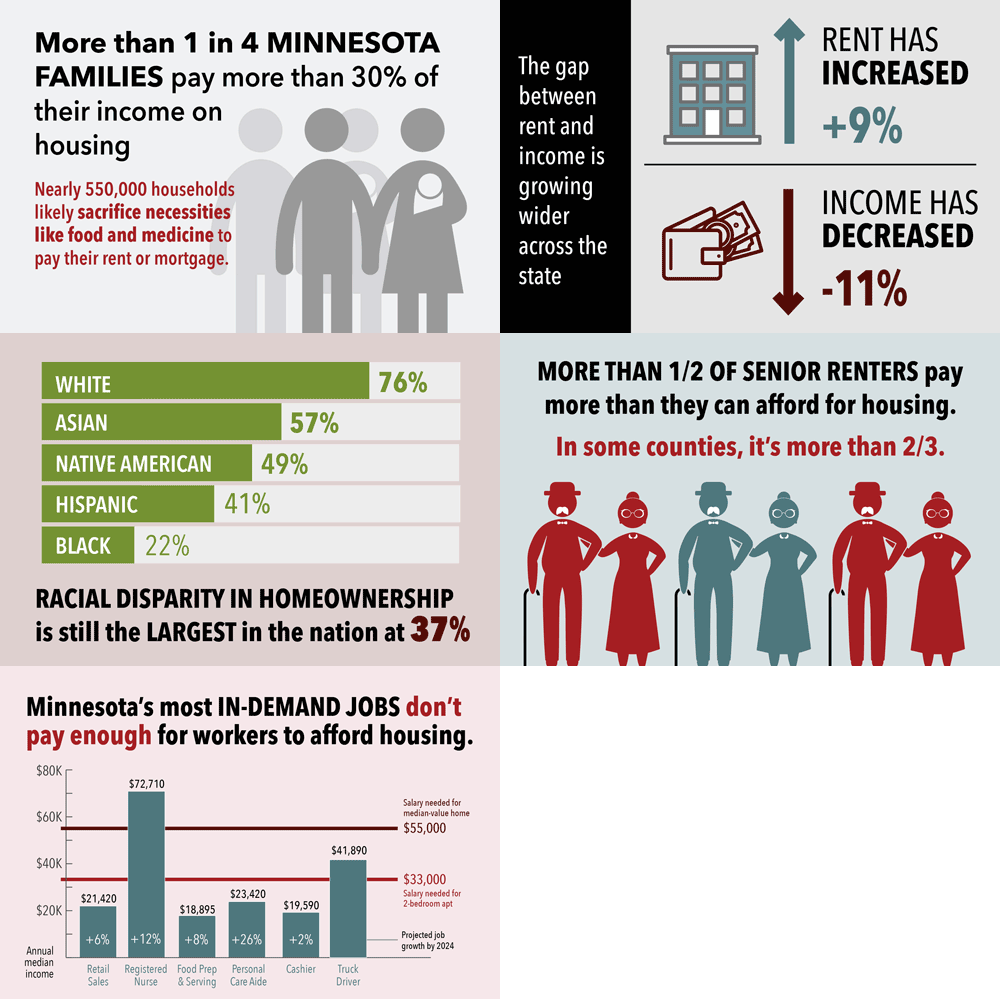
    Minnesota Housing Partnership’s recently released study, State of the State’s Housing 2017, provides context for the proposed budget cuts.  We report that across Minnesota one in four households is lacking housing affordability — a percentage that will surely increase as resources for this critical need are siphoned away under Trump’s defense-first budget.

    More than one-quarter of Minnesotans already face difficult tradeoffs to pay the rent

    While many homeowners are struggling to keep up with mortgage payments, the greater challenge is one facing low-income renters. More than one-quarter of renter households are now severely cost burdened, paying more than 50 percent of their income toward housing, likely making painful sacrifices for food, health care and other needs simply to pay the rent.

    These tradeoffs aren’t hypothetical. National research has found that low-income households paying more than half their income on housing spend 41 percent less on food and 74 percent less on healthcare than similar families that are affordably housed.

    The need for affordable housing resources is growing

    Despite years of strong economic growth, rents are still increasing far faster than incomes. Between 2000 and 2015, the median rent in Minnesota increased 9 percent while the income of the average renter decreased 11 percent.

    These challenges are likely to persist — or grow. Our report shows that four of the six top in-demand job types in Minnesota do not pay enough to cover rent on a modest two-bedroom apartment. Over the next several years Minnesota will add tens of thousands of retail sales workers, food preparers, cashiers, and personal care attendants, most of whom will not be able to cover their housing costs.

    Then there is the aging baby boom. Our population is expected to add 39,000 seniors per year over the next 20 years. Nearly one-third of that growth will be seniors living primarily on social security, providing nowhere near the income necessary to cover the cost of housing.

    Trump’s budget in Minnesota

    This is why Congress cannot accept the housing budget proposed by President Trump. According to projections from Center on Budget and Policy Priorities, with this budget Minnesota would:

    • Receive a cut of $24 million in funding to maintain the state’s public housing. With a preexisting backlog of $300 million in needed repairs, much of this housing primarily serving elderly and disabled people will no longer be viable.
    • Lose $61 million in federal block grants that Minnesota communities use to fix streets, build affordable housing, and help low income people pay for home repairs.
    • Be unable to continue to provide rent assistance to 2,800 Minnesotan households, families who on average have annual incomes of $14,000, and will have few other housing options.

    To prioritize safety and prosperity, prioritize stable, affordable housing 

    President Trump’s budget may put military might first, but it puts the true safety and prosperity of Minnesotans last. Housing is just one area in which Trump’s proposal undermines this country’s bipartisan efforts to create a foundation of opportunity. We call for our Congressional delegation to loudly resist this budget and defend Minnesota.

  • MN Housing board update: HAVEN proposal, partially funded bond projects, and falling value of housing tax credits

    During it’s February board meeting, the Minnesota Housing Finance Agency (MHFA) discussed the possibility of allocating Agency resources to “top off” partially funded bond projects, the drop in value of housing tax credits, how the HAVEN proposal could change the way the state’s tax exempt bonding authority is allocated, potential administrators for the Bridges rental assistance grants, and amendments to the 2018 tax credit Qualified Allocation Plan (QAP). 

    Partial bond allocations

    Housing Commissioner Mary Tingerthal began by explaining that the Agency was not yet moving forward on a proposal to make available tax exempt bond financing to developers whose projects received partial allocations through MMB (the state budget office). Because a developer had obtained a temporary restraining order against MMB regarding a bond allocation, MMB was holding back on allocating the contested bond amount until the court acts. Minnesota Housing would not know whether projects need more funding until the court action has concluded and the Agency learns what MMB does with the held back allocation.

    $20M funding gap

    Tingerthal expressed concern about project viability due to the approximate 15 percent drop in prices now being paid for federal housing tax credits. From Agency staff’s review of 2016 awarded projects, this price decline could create a new funding gap of up to $20 million. The Agency is working with developers to determine if there are gaps, and the board might receive a request to provide supplemental funds for some of these projects at its March meeting. Tingerthal said she hopes to close the gap for these stalled projects so that they would not have to reapply in the 2017 funding round.

    HAVEN proposal

    Tingerthal alerted the board to proposed legislation that would amend the state’s tax exempt bond statute. The proposal is being sponsored by a group called HAVEN. Tingerthal said that Agency staff has discussed the proposal extensively and concluded that the proposed legislation would be unnecessary. While the current statue does not allow senior projects to apply for bonds until May, Tingerthal noted that these projects are getting their requested allocations.

    Bridges rental assistance grants

    The board adopted the staff recommendation to fund White Earth Nation as an administrator for Bridges rental assistance grants. These grants cover a portion of rents for individuals affected by mental illness while they wait to be approved for mainstream rental assistance programs such as Section 8. Board chair John DeCramer said that it was worth noting that this was the first time a Bridges grant was awarded to a tribal nation.

    2018 tax credit QAP amendments

    The board also adopted proposed amendments to the 2018 tax credit QAP (Qualified Allocation Plan). Initially Agency staff brought a set of proposed QAP amendments to the board in October 2016. The proposal was in response to significantly increased demand for tax exempt bonds to fund rental housing projects. Incorporation of tax exempt bond financing is required to leverage federal 4 percent tax credits. The amendments to the QAP would raise the bar on requests for the 4 percent credits and therefore ensure tax exempt bonds were used in rental developments that are more consistent with the Agency’s tax credit ranking structure than had been required previously.

    In response to staff’s presentation on the QAP proposal, board member Craig Klausing asked when the board would want to approve a development whose cost exceeded the Predictive Cost Model threshold (compliance with the cost model would be one of the new requirements of 4 percent tax credit projects). Tingerthal responded that it would be a situation where there were “unusual expenses.” She added this could be where unexpected soil correction expenses were required, or materials of exceptional durability were used in a supportive housing development. Tingerthal added that, if asked to approve a waiver to the Predictive Cost Model, the board would be provided with rationale from staff explaining why the costs were in excess.

    In passing the QAP amendments board chair DeCramer noted that with this round of comments, as compared to what occurred in response to the Agency’s initial QAP proposal, there were only eight comments and most of them were positive. Board member Klausing added that in this situation it would be easy for the Agency staff to be defensive, and he was impressed how the comments were accepted and changes to the initial proposal had been proposed by staff based on those comments. 

  • 10 Graphics that Reveal the State of the State’s Housing

    Minnesota is recognized as a national leader for its commitment to helping families with affordable ownership and rental homes. But while significant progress has been made in areas like homelessness, housing is still becoming too costly for growing numbers of Minnesotans — especially low- to moderate-income families and households of color.
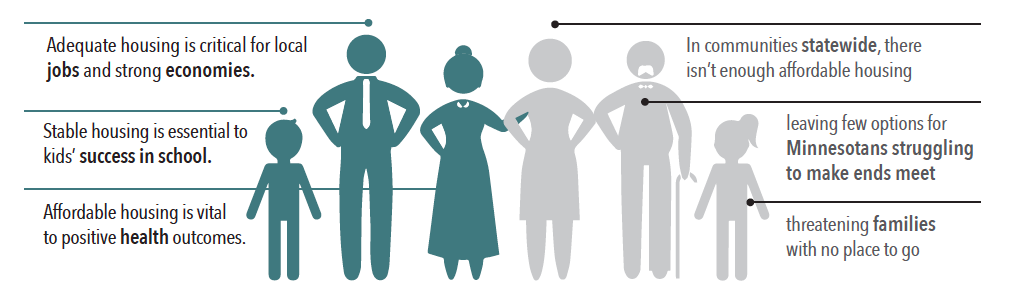
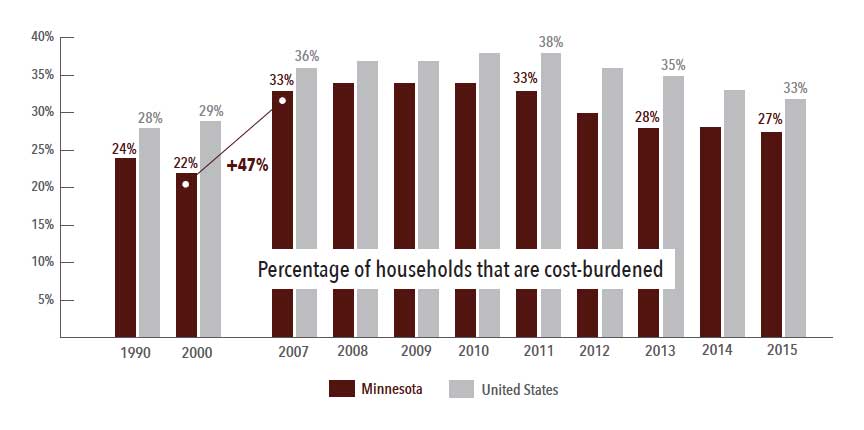
    Building on our County Profiles, released each year since 2009, MHP created the State of the State’s Housing to continue to benchmark progress at the state, region and county levels in critical areas, including cost-burdened households paying more than 30% of their income for housing; changes in rent and home values; construction of multi- and single-family homes; and trends in homelessness.

    Here are 10 graphics that share the big picture on the state of housing in Minnesota.


    Why housing matters

    Where we live impacts every aspect of our lives. Where we call home affects the groceries we buy, where we send our kids to school and how we thrive in our community. At every stage of life, where we live is the foundation for our health, education, safety, and economic wellbeing. That’s why housing must be a priority at all levels of government and to all Minnesotans. To make our communities strong, we must ensure that all Minnesota families are able to find, afford and maintain safe, healthy housing.


    1 in 4 Minnesota households pay more than they can afford on housing

    A household is considered cost burdened when it spends more than 30 percent of its annual income on housing. At 27 percent of all households, the rate of housing cost burden in Minnesota is lower than the national average of 33 percent. Still, 1 in 4 Minnesota households — or approximately 546,000 families — pay more than they can afford for housing.


    There’s a growing gap between rising rents and declining income

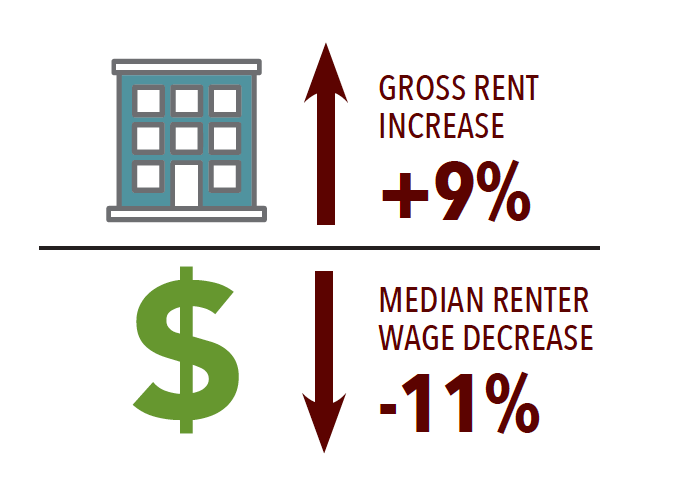
    Many renters experience housing cost burden because, for more than a decade, their wages have decreased relative to housing costs. Between 2000 and 2015, the median renter wage in Minnesota decreased by 11 percent, yet the median gross rent for the state increased by 9 percent.


    More than half of renters of color are cost burdened

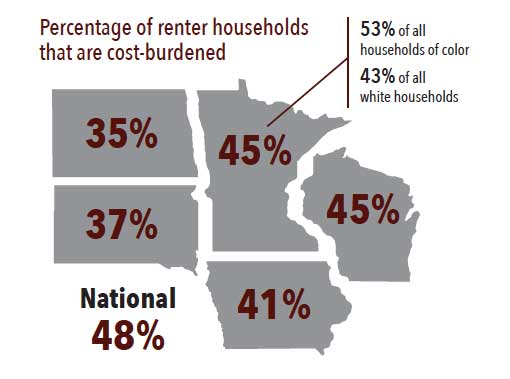
    Minnesota has one of the largest renter populations in the Upper Midwest with approximately 590,000 renter households. Of these households, almost half experience housing cost burden and nearly a quarter experience extreme housing cost burden — meaning they pay more than 50 percent of their income on rent. Renter housing cost burden is highest among households of color, with 53 percent of all households of color experiencing housing cost burden compared to only 43 percent of white renter households.


    Minnesota’s racial homeownership gap far exceeds the national average

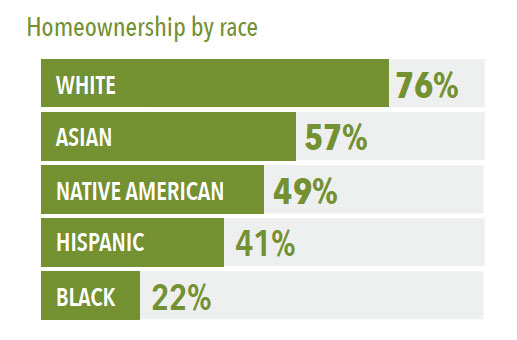
    Racial disparities in homeownership rates — widely referred to as the homeownership gap — remain a major issue in Minnesota. While 76 percent of all white households own their home, only 49 percent of Native American, 57 percent of Asian, 22 percent of Black, and 41 percent of Hispanic households own their homes. In total, only 2 in 5 households of color own their home in Minnesota. Nationally, the homeownership gap is 25 percent; in Minnesota it is far wider at 37 percent.


    The need for senior housing is urgent and growing

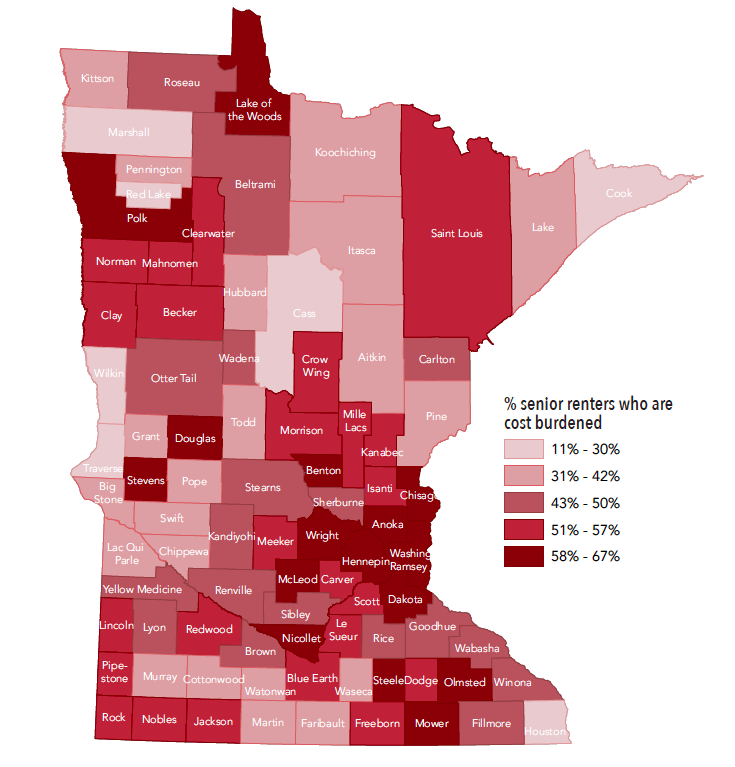
    Senior housing need is a growing issue in Minnesota. By 2035, nearly 1 in 4 Minnesotans will be 65 or older, representing a 93 percent increase in the current senior population. Across the state, more than half of all senior renters and one-quarter of all senior homeowners experience housing cost burden.


    In-demand jobs don’t pay enough for workers to afford housing

    Many of the state’s most in-demand industries only pay a fraction of what is needed to afford prevailing rents and median home prices. For the majority of the top six in-demand occupations — retail salesperson, food prep workers, personal care aids, cashiers — the median pay ranges from $19,000 to $23,500 annually, not enough to afford rent for a two-bedroom apartment or the mortgage on a median-priced home.


    Multi-family housing development is rebounding post recession

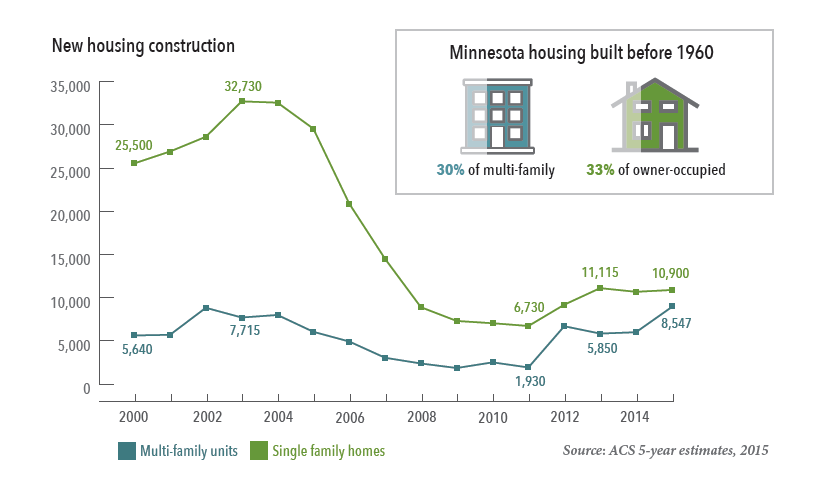
    After dipping to historic lows during the Great Recession, multifamily development continues to rise across the state. From 2011 to 2015, multifamily development more than tripled, rising to 8,547 new multifamily units developed in one year. In contrast, single family development only increased by 54 percent – well under the 340 percent increase in multifamily development. 


    For extremely low-income families, affordable housing is difficult to find

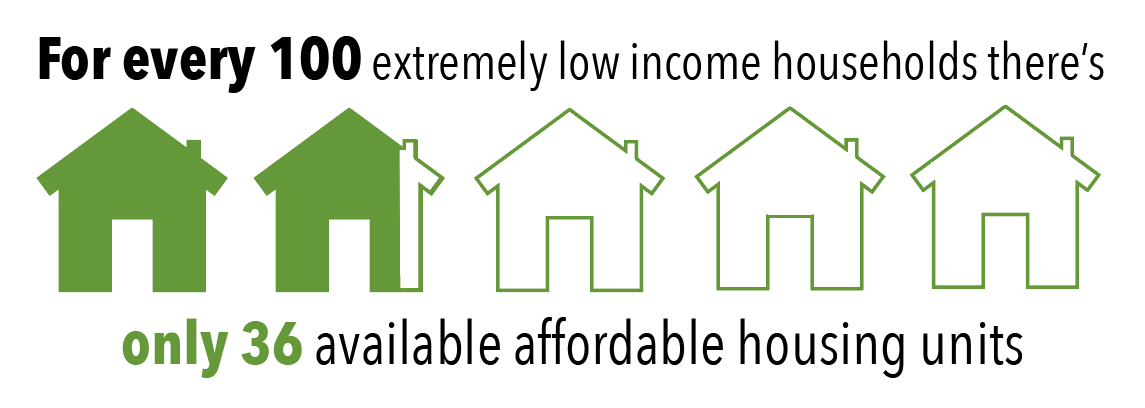
    For the nearly 170,000 Minnesota families earning less than 30 percent of median income (approximately $26,000 for a family of four) finding available affordable housing is virtually impossible, with only 36 units available for every 100 ELI households.


    Homelessness is on the decline, but thousands of children lack stable housing

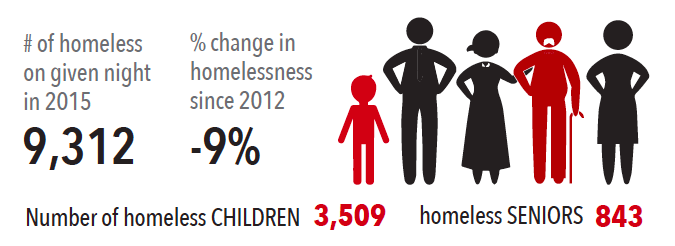
    Across the state, homelessness has declined since 2012, but too many families, seniors and children are still suffering the devastating consequences of having no place to call home.


    Read more in the State of the State’s Housing overview and profile here.

  • Public comment open: Fair Housing draft released for Twin Cities region

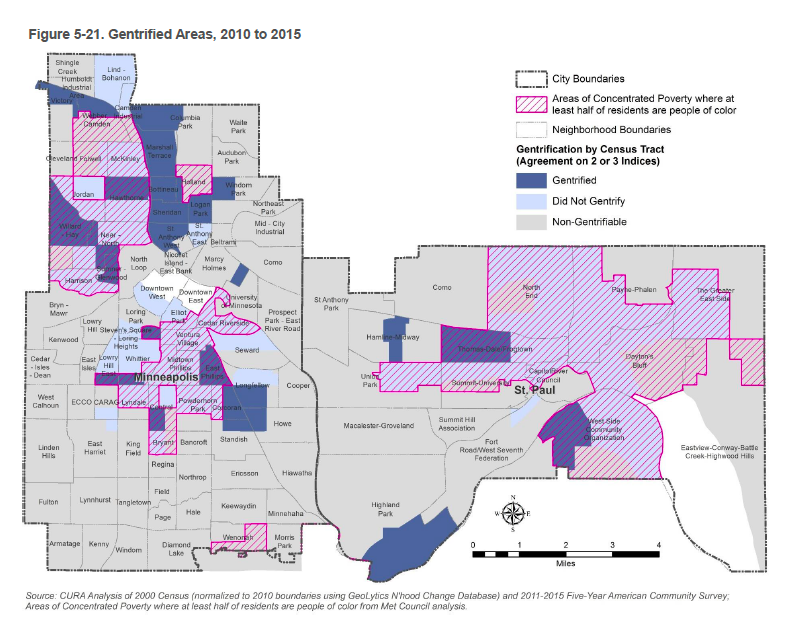
    Nearly a year ago, a group of government officials and community leaders started a process to more deeply investigate the barriers to fair housing faced by communities of color in the Twin Cities region. Last month, the first draft of recommendations to address barriers to housing in the seven-county metro area was released — and, next week, the public is invited to meetings across the region to provide its feedback.

    Precipitated by a legal complaint to the U.S. Department of Housing and Urban Development (HUD), local government agreed to create an Addendum to the 2014 Regional Analysis of Impediments to Fair Housing. The Addendum specifically addresses housing discrimination, gentrification and displacement, barriers to housing choice, and conditions of segregation and integration in Anoka, Carver, Dakota, Hennepin, Ramsey, Scott and Washington counties.

    Mosaic Community Planning was contracted to produce this addendum to consider additional fair housing issues not covered in that document, update some of its data, and provide greater analysis of fair housing issues. Click here to learn more and download the draft, and keep reading to view the public meeting schedule.

    Public Meeting Schedule:

    Tuesday, March 14

    Wednesday, March 15

    Thursday, March 16


    Written comments may be submitted to:

    Alyssa Wetzel-Moore, FHIC Chair

    Saint Paul Department of Human Rights and Equal Economic Opportunity
    15 West Kellogg Boulevard, 240 City Hall
    Saint Paul, MN 55102

    Phone: 651-266-8965
    Fax: 651-266-8962

    Written comments will be accepted March 1 through April 3, 2017.

  • MN Housing board update: Revised recommendations for 2018 QAP

    During its January meeting, the board of the Minnesota Housing Finance Agency (MHFA) discussed updates at the state legislature, the statewide Analysis of Impediments to Fair Housing, modifications to the downpayment and closing cost assistance program, proposed amendments to the 2018 housing tax credit Qualified Allocation Plan, funding for the Minnesota City Participation Program and more. 

    Legislative updates

    In her report to the board, Commissioner Mary Tingerthal focused on activity at the legislature. First, she provided an update on the housing portion of the governor’s budget. In addition to putting forward the Agency’s base budget — approximately $100 million over the two-year biennium — the governor included one-time funding for two housing initiatives.

    One housing initiative included in the governor’s budget is an $8 million proposal, “Homework Starts with Home,” to address housing instability of school children. It would be a collaborative effort with the Department of Education and enlist counties and school districts. Tingerthal added that the Heading Home Funders Collaborative pledged to raise an additional $1 million in private funds for the initiative.

    The second proposal from the governor is included in his racial equity initiative. The Agency would receive $2 million in downpayment assistance and counseling funds to promote home ownership targeted for households of color.

    Tingerthal continued with the legislative update by reporting on the governor’s bonding bill, which includes three items related to housing.

    • $70 million in Housing Infrastructure Bond (HIB), available for preservation of federally subsidized privately owned housing, supportive housing, and community land trusts
    • $20 million in general obligation bonds to maintain the state’s public housing
    • An additional $20 million in HIB, repaid through previously committed debt service appropriations connected to the previous HIB appropriations, which is available because the debt service costs on these bonds came in lower than what the state had budgeted

    Fair Housing

    Tingerthal shared that the state has contracted with BBC Research and Consulting to complete a statewide Analysis of Impediments (AI) to fair housing. This analysis is a HUD requirement of local and state agencies that receive federal housing and Community Development Block Grant funds. With HUD’s encouragement, the upcoming AI will include a more robust community engagement process than had been done with past AIs. The consultant will provide a website with information on ways for members of the community to share input for the analysis. Tingerthal promised details on this work at the board’s February meeting.

    Downpayment and closing cost assistance program

    The board agreed to modifications of the downpayment and closing cost assistance program necessitated by changing market conditions, according to Agency staff. Increased mortgage interest rates and house prices, and declining seller willingness to cover closing costs due to the tight housing market, required an increase in loan amounts available in these programs and raising the income cap for program participants. Agency staff estimated that because of the new market conditions the out-of-pocket costs for its program participants would rise to about $4,000, double what it was in 2015. The board increased program loan amounts and raised the income cap from 80% to 95% of area median. In endorsing the change, board member Joe Johnson asked for more information behind the approximately $8,000 variance in income caps between the Twin Cities/Rochester amount and that for Greater Minnesota.

    2018 housing tax credit Qualified Allocation Plan

    Staff brought back to the board its revised recommendations for amendments to the 2018 housing tax credit Qualified Allocation Plan (QAP). These changes are intended to raise the bar in terms of the type of projects that would receive 4% tax credits from the Agency in conjunction with tax exempt private activity bonds. Because the demand for these bonds is exceeding the state’s federally authorized allotment, the Agency wanted to tighten the connection to its strategic priorities for those projects receiving 4% tax credits in conjunction with tax exempt bonds. The board had first given approval of a draft set of proposed changes in October 2016, but an unprecedented level of responses during the public comment period led to Agency staff reworking this earlier set of proposed amendments.

    Staff said the Agency had received more than 250 comments. Staff responded by hosting a webinar on the proposed QAP changes and holding meetings with a variety of stakeholder groups. In the new 2018 QAP draft amendments, the Agency is requiring a minimum score of 40 points (this is the current level in the 2018 QAP, but down from 50 in the earlier draft amendment) for developments to qualify for the 4% tax credits. The developers would need to commit to 20 years’ affordability (down from 30 in the prior draft), and would have the option of receiving additional points for committing to 30 years’ affordability. Other modifications were included to ensure that a variety of developments would still qualify for 4% tax credits.

    The proposed changes will now be out for another round of public comments, with a February 9 deadline. It is the intent of staff to bring the comments and the final QAP proposal to the board for adoption at the board’s February meeting. Board member Stephanie Klinzing said that what initially seemed like a simple solution is not really all that simple. The proposed tax credit changes have many ramifications for communities and developers; to its credit Agency staff worked with those who voiced concerns to create a better document. She added that, in this case, the controversy and related public input turned out to be a good thing. The Agency maneuvered though the complications, Klinzing concluded, and came out with a great plan.

    Minnesota City Participation Program

    The board accepted the staff’s proposal for allocation of tax exempt bond-generated funding for the Minnesota City Participation Program. The state bond allocation statute sets aside 31% of the tax exempt bond Housing Pool for home ownership programs of municipalities and counties. Minnesota Housing supports these local governments by selling the bonds and making the mortgage money available to government applicants that request to participate in this program. This year, $56 million in tax exempt bonds were available for this purpose, and mortgage funds were allocated to 38 local governments located in all regions of the states. Allocation levels were based on population, with a minimum of $100,000.

    Miscellaneous notes

    • Tingerthal announced that the governor had recently reappointed Joe Johnson of Duluth to the Agency board.
    • Minnesota Housing’s lease for its office space expires in August 2017 so Agency staff are looking at options to stay and improve the current space or move to a new location.
    • “Best underwriting team in the country” was the assessment by the Agency’s financial advisor as a part of the bi-annual review of the group of companies that advises on and markets Agency loans and securities. The team led by RBC Capital Markets, also includes Piper Jaffrey and Wells Fargo Securities.


  • What is HAVEN — and why does MHP support it?

    How should the state allocate its bonding resources for housing to have the biggest impact — and take full advantage of federal funds? A new proposal, supported by MHP, seeks to amend Minnesota bond statute to develop more rental housing to meet the tremendous need among low and moderate-income Minnesotans.
    HAVEN is a newly formed Minnesota non-profit association conceived in late 2016 to promote “a full and public discussion of how best to support Minnesota’s urgent demand for affordable multifamily housing by making most efficient use of tax-exempt bonds and 4% low-income housing tax credits.” Its current proposal would amend the state’s statute that governs use of Minnesota’s allocation of the federally authorized tax-exempt bonds. Currently Minnesota is allowed to issue approximately $550 million annually in these tax-exempt bonds. The HAVEN proposal would affect the Housing Pool, which amounted to $182 million in 2016.

    What would the HAVEN proposal do?

    HAVEN would amend the priorities in state statute for allocation of tax exempt bonds. Currently a minimum 31% of bonds in the Housing Pool are required to be used for homeownership, and any use of bonds for senior housing is suspended for five months into the year. HAVEN would rank allocation of bonds for tax credit rental projects above use of bonds for homeownership, and give senior housing equal priority to general occupancy housing.

    Most notably, the HAVEN proposal would create a new priority structure regarding where and how bonds are awarded through the Housing Pool.

    • Priority 1: Projects that preserve federally assisted housing and restrict the issuance of bonds to no more than 55% of the reasonably expected eligible basis (this is a tax credit term for an amount that approximates 90% of a project’s development costs).
    • Priority 2: General occupancy and senior tax credit housing where (i) 80% of the units are at or below 60% AMI affordable, (ii) uses federal housing tax credits, and (iii) restricts the issuance of bonds to no more than 55% of the reasonably expected eligible basis.
    • Priority 3: All other rental housing projects utilizing federal tax credits.
    • Priority 4: Home ownership mortgage loans.
    • Priority 5: All other rental projects not using federal tax credits.

    Under existing law and continuing under HAVEN all rental housing developed with tax exempt financing must meet minimum rent and income restrictions of at least 20% of the units affordable at 50% AMI, or 40% at 60% AMI, and have a minimum 15-year affordability period. Minnesota also requires that at least 20% of the units be restricted to rents at or below HUD determined Fair Market Rents. Home mortgage recipients would typically need to have incomes under 80% of AMI.

    Additionally, HAVEN would:

    • Institute a lottery system for awarding bonds within a given priority level to ensure that projects either receive adequate awards to move to development or do not receive any bond allocation
    • Restrict the amount of bonds to no more than 55% of eligible project cost for Priority 1 and Priority 2 projects.

    Why does MHP support the HAVEN Proposal?

    More bonds would be available for rental housing, and with the new priorities, the rental housing developed would benefit those with lower incomes than is now taking place. With the vacancy rates at extremely low levels, Minnesota metro areas desperately need new non-luxury rental housing at a variety of price points.

    More federal tax credit resources would be brought to Minnesota. Under HAVEN hundreds of millions of dollars in new development would occur and tens of millions of additional federal subsidy dollars would be invested in Minnesota’s rental housing and economy annually. In addition, permanent and construction jobs would be created, and sales, income and property taxes would be generated for local and state government.

    Housing for seniors would no longer be penalized. Seniors lack modestly priced rental options in many communities. Because Minnesota Housing’s priorities for use of 9% tax credits make it very difficult to use that resource for senior housing, it is important that the bonding / 4% credit allocations do not also discourage affordable senior housing development.

    Limited federal bond resources would be used more efficiently. The lottery allocation and the 55% maximum bond usage priority would help ensure that bonds are not wasted, and that projects are not stalled because they receive bond amounts that are less than is needed for development.

    What needs additional consideration?

    While MHP believes HAVEN sets the right direction for an improved use of the state’s bond allocation there are a number of issues that should be vetted with the possible result of modifications being made to improve the current proposal.

    Should there be a level of greater affordability added to the HAVEN priority structure? While the affordability in Priority 2 is an improvement over current law, why not create a new, higher level priority that would bring greater affordability — for instance, 20% at 30% AMI, and a 30-year affordability requirement? To reach a deeper level of affordability developers would need more project subsidies, so for this priority to be meaningful new sources of development subsidy should be identified.

    Will homebuyers, particularly those in rural communities, maintain their access to lowest cost mortgage financing if home ownership housing falls to a lower priority than rental? Currently there is little benefit to the homebuyer whether a mortgage loan is funded with tax-exempt or taxable debt. But if interest rates increase and the spread widens between taxable and tax-exempt interest rates, the benefit to homebuyers receiving tax-exempt financed mortgage loans becomes more pronounced.

    Will state progress in helping households of color become homeowners be sustained under HAVEN? To its credit, Minnesota Housing has made significant strides in helping households of color become homeowners, and thereby incrementally reducing the racial disparity in homeownership rates. It is important that efforts to address this disparity are not impeded by amendments to bond law.

    Will Minnesota Housing stay financially strong? Minnesota Housing earns a substantial portion of its total revenue through the mortgage program interest and fees it collects. In addition to covering its own operating expenses, the Agency commits net earnings back into its programs. For many affordable housing reasons it is important that Minnesota Housing continue to be financially strong.

    Download MHP’s more detailed memo here.

  • Leech Lake: Building a Nation through Workforce Development

    Deep in the Chippewa Forest in North Central Minnesota it’s hard to get online. For the Leech Lake Band of Ojibwe, tall, thick pines and a lack of nearby providers mean steep costs for spotty service.
    “When you live in the metro, you take Internet access for granted,” Sally Fineday, a member of the tribe, says. “You don’t even realize that there are people that don’t get it and, if they do, they’ve got to pay a lot of money for service that’s not as good as the urban areas.”

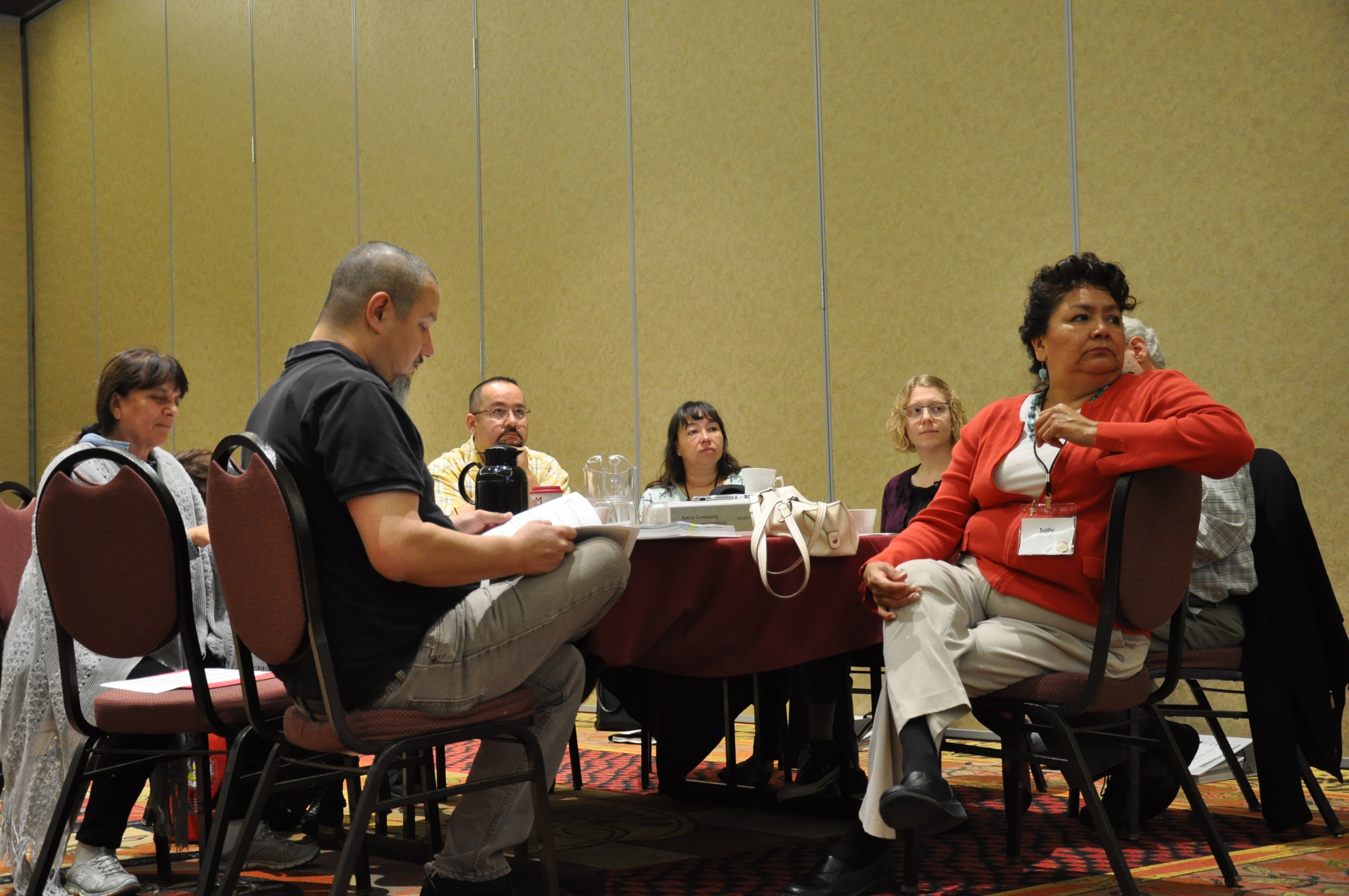
    And remoteness isn’t the only barrier preventing many Leech Lake band members from accessing reliable Internet services. For Fineday (pictured right), Internet access isn’t simply an issue of convenience — it’s an issue of equity.

    “It’s a disparity that we have just because we live on an Indian reservation in the United States of America,” Fineday says. “Indian tribes have always had the last opportunity and that’s why, for us here at Leech Lake, 48 percent of the 10,000 people within the tribal area live below the poverty level.”

    So, in 2013, the Leech Lake Band of Ojibwe took action.

    They selected Fineday to spearhead an effort to establish the tribe’s own telecommunications company — the first of its kind in the state of Minnesota — that could provide wireless Internet service at a reasonable price. The growing company now serves more than 130 customers and Fineday is on the lookout for staff.

    To keep up with fast-paced industries like telecommunications, there’s a constant need for workforce training and education. And Fineday’s not the only employer in the region looking for capable team members. That’s just one of the reasons Fineday is part of a team seeking to implement a comprehensive workforce development system to meet the needs of the Leech Lake community and the wider region.

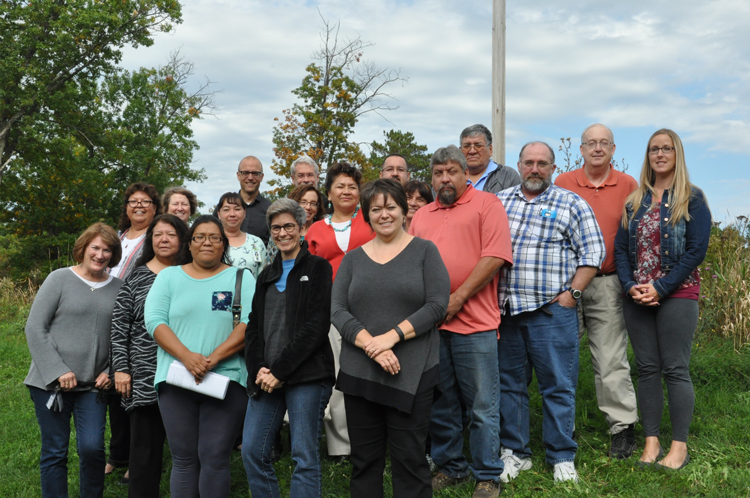
    Along with several other Leech Lake community leaders, Fineday took part in the Native Community Development Institute (NCDI) — an 18-month program created by MHP that includes peer-to-peer workshops and trainings with customized assistance from an MHP staff member. Three teams from three tribes participated in the first round of the NCDI: Red Lake, White Earth, and Leech Lake. Leech Lake formed an NCDI team to tackle workforce development, with the ultimate goal to create a comprehensive workforce development system.

    NCDI participants at the September 2016 workshop

    For years, workforce development has been a priority for the Leech Lake community, but attempts to coordinate siloed training initiatives have proven largely unsuccessful. So the Leech Lake team utilized NCDI to look at the big picture and develop a plan to create a more effective, efficient workforce development system in partnership with the Leech Lake tribal college, local employers, and funders in the region. Their goal is to create a system that impacts the lives of all community members — from capturing middle schoolers’ imaginations and building recent graduates’ skills sets to giving middle-aged community members the tools they need to make more of an impact with their work or begin a new career.

    Patricia Broker, Education Division Director for the Leech Lake Band of Ojibwe and NCDI team leader, hopes that the workforce development system will challenge people to see themselves in a context greater than their personal experiences and perspectives — and to understand that their work can positively impact the Leech Lake community.

    “I have people here who are considered good workers if they come in at 8 a.m. and leave at 4:30 p.m.,” Broker says. “But, I’m thinking, ‘Are they growing their program? Do they have a vision? Are they doing the same old thing day after day after day in order to collect a paycheck?’ From our workforce development initiative lens, we want people to look outward, to look at the bigger picture, and ask, ‘What are the services I’m providing for this reservation, and can I do more?’”

    Broker feels that a broader perspective can help people find hope and meaning in their work.

    “I really would like people to understand the big picture of what this means — connecting it to our nation building,” Broker says. “People are often in survival mode, and it’s hard to attach to anything that’s bigger and broader than just getting beyond today or next week. I think if people can see the big picture — what it is that we’re trying to develop and where we want to go with this project — then I think that gives people some hope.”

    Leech Lake team at the September 2016 workshop

    A major accomplishment by the Leech Lake team during the course of NCDI was to map out existing trainings and connect them to the tribal departments responsible to identify gaps and opportunities for interdepartmental collaboration. According to Bill Vanderwall, MHP Community Development Manager and liaison to the Leech Lake team, the way the Leech Lake team has facilitated information-sharing between tribal departments throughout the NCDI process is a major success in and of itself.

    “In the past, different departments within the tribe have kept their own information,” Vanderwall says. “Almost all [departments] are doing job training, because they have to. Now, by working together, they might be able to consolidate some of those trainings and make them better. They haven’t had a lot of history of doing that kind of thing.”

    In addition to identifying programmatic needs, the Leech Lake team is further along in building a brick and mortar workforce development center: a one-stop shop that includes space for classes, hands-on training, and access to workforce development information and resources. For Broker, Fineday, and the rest of the NCDI team, the workforce development project is about more than job training and career success. Rather, they see workforce development as a way to lift up the entire Leech Lake community. According to Broker, this view is what has propelled her team forward, even as she and her team faced challenges such as changing team members and a tribal election.

    “I am a dreamer, and I believe that there is potential on our reservation,” Broker says. “I know we have passionate people who look ahead and think we can do something here that is going to be nation building. For me, that’s the most exciting part.”

    “This is a big project —  it’s a huge undertaking — and it’s going to have ebbs and tides,” she adds. “There are going to be those frustration points, and then there will be a big surge forward, so I just learned to expect the unexpected and stay focused on our task. But our ultimate goal is building up the Leech Lake nation. That’s going to be one of the greatest tasks ahead of us.”

    While the first round of the NCDI came to a close this month, Broker says she sees the impact of her team’s NCDI takeaways continuing well into the future.

    “I don’t see us ending our relationship with NCDI,” she says. “NCDI has brought in so many wonderful resources — the training we received through our sessions, the learning that has happened, and being part of a cohort and hearing what other nations are doing, has been helpful. At the end of the 18-month period, we’ve made friendships and contacts that we can continue to call on. I think it’s been an absolutely invaluable experience.”

    Learn more about NCDI here!