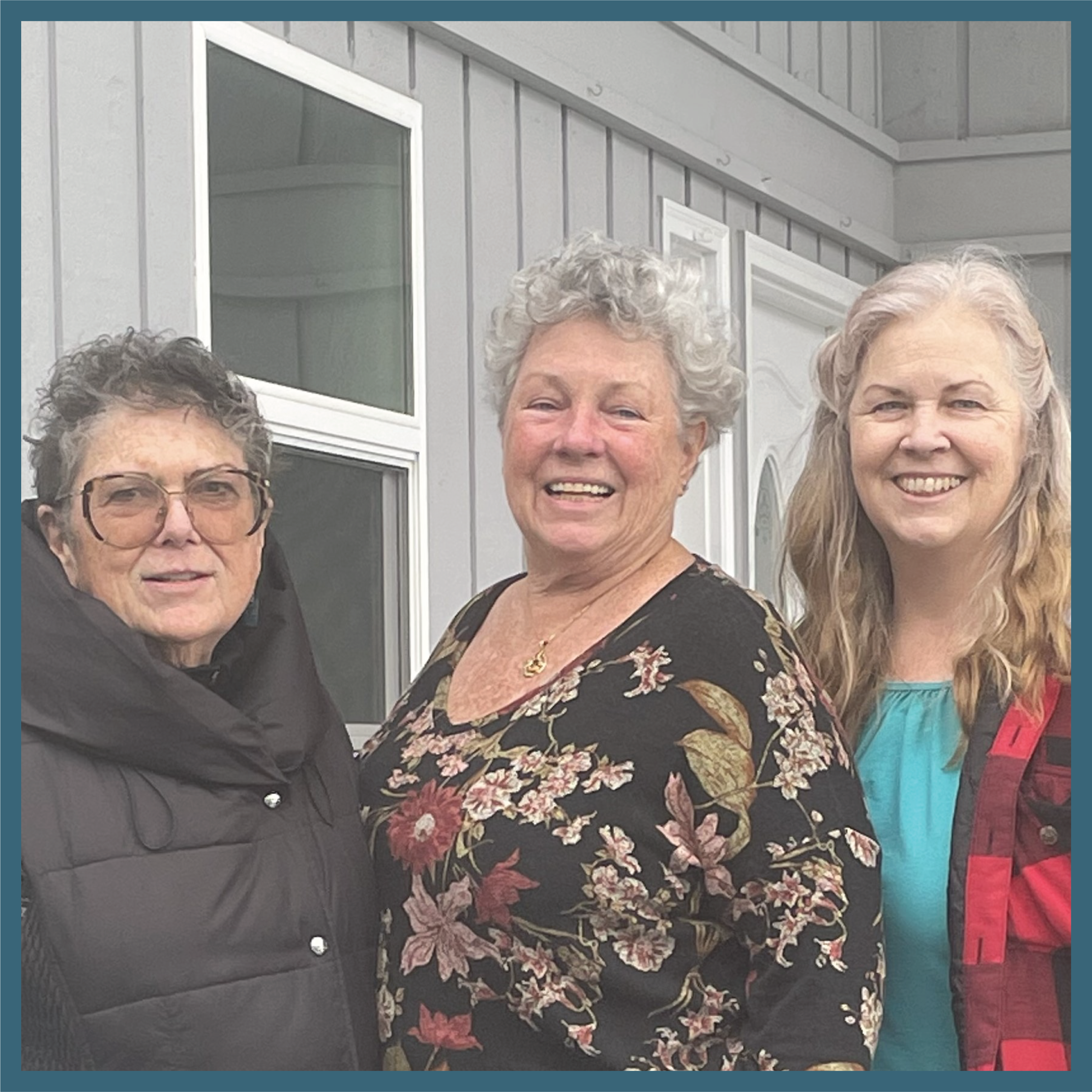
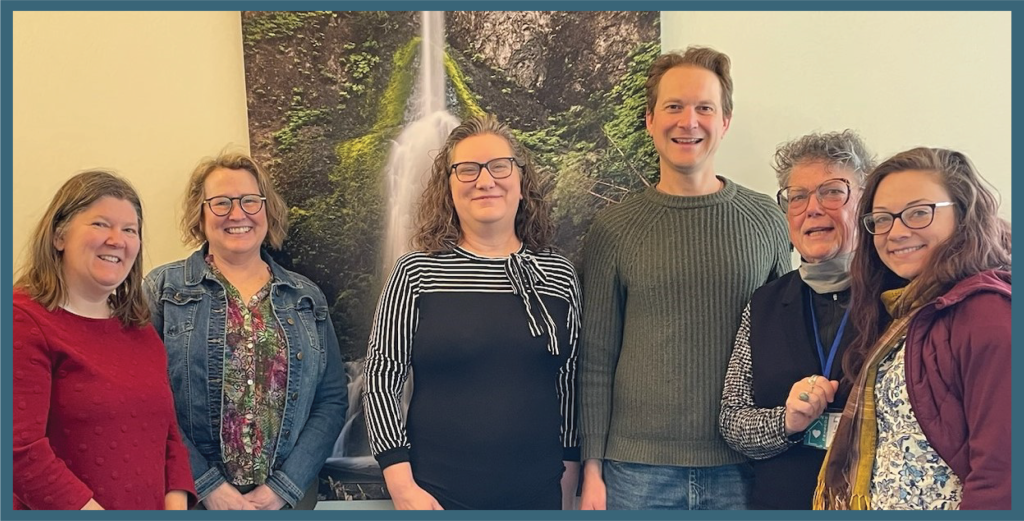
Olympic Peninsula Extended Needs Housing (OPEN Housing) spent a snowy 1.5 days in Port Angeles, WA with MHP staff members Barbara Dolan, Devon Pohlman, and Courtney Overby on a site visit to complete a needs assessment; exchanging stories, touring properties, and diving into discussions on priorities for the organization. OPEN was formally incorporated in 2019 and currently offers 14 units for rent at two properties in Sequim and Port Angeles. With a mission to “provide sustainable, secure, affordable housing for people with developmental disabilities and low-income others in a shared and integrated community so all can thrive,” OPEN Housing develops low-income housing for adults with disabilities (and other low-income neuro-typical adults) who are willing and able to live and thrive in a shared housing community.
In the US, nearly 75% of adults experiencing intellectual or developmental disabilities live in their family’s home. On the Olympic Peninsula, that number is closer to 99%. Imagine being an adult who wants to live independently, develop social skills, and learn what it means to contribute to their community with nowhere they can afford to go. Out of every four Americans, one experiences an intellectual or developmental disability. housing adults with disabilities shapes the collective future of all of us.
OPEN Housing applied for technical assistance (TA) through MHP’s online application. MHP technical and financial assistance is tailored to help build the capacity of local housing drivers and promote local housing solutions that address gaps in existing services. A needs assessment site visit is the first step for the MHP team and project partners to meet in person, view properties or sites, and build the foundation for a 24-36 month-long working relationship. MHP assesses whether an organization has the capacity and readiness and aligns with its mission in order to be successful when utilizing MHP programs and funding sources. This time together provides MHP staff with the opportunity to connect with individuals, entities, and partners involved in collaboratively crafting a living work plan. Creating affordable housing and building strong communities is complex work!
From left to right: Devon Pohlman (MHP), Barbara Dolan (MHP), Kimberly Ortloff (OPEN Board President), Lindsey Schromen-Wawrin (Port Angeles City Council) Liza Searles (Executive Director), Courtney Overby (MHP)
As part of the OPEN Housing needs assessment, MHP staff worked closely with the team to identify and prioritize organizational challenges. The project team met and heard from local Port Angeles council member Lindsey Schromen-Wawrin about the approach and systemic barriers to housing that the community-at-large faces. MHP staff also heard directly from Dorine Hunter, a former board of directors’ officer, about the significance of the acronym OPEN as a name that supporters would recognize, and about the extensive network of the mothers of those experiencing disabilities, who founded and sustain the organization’s operations and administrative success. Hearing the stories firsthand, in community, forges meaning and structure, and sets the tone for the rest of the technical assistance engagement.
The assessment revealed that OPEN’s communal single-family home model is well-positioned for organizational sustainability and the future development of new housing for IDD adults. MHP’s work plan with OPEN Housing will include board of director recruitment and training and reviewing existing and creating new policies and procedures. OPEN Housing is excited about an update to the website and a rebranding effort in addition to hiring, staff development, and strategic organizational planning.
MHP’s Community Development team delivers the resources and knowledge needed to create and preserve housing and community assets. We collaborate directly with communities, regions, and organizations across the country to achieve their housing and community development goals. From innovative community planning practices to knowledge of complex federal grants and programs, our expertise helps to create effective — and lasting — collaboration among community leaders.
Does your community need knowledge in housing, community, and/or organizational development? Looking for collaborations and partnerships to bring affordable housing to your community? To learn more, contact Devon Pohlman, Director of Community Development at devon.pohlman [at] mhponline.org.
When families pay too much for rent, they’re forced to sacrifice to make ends meet — cutting back at the grocery store or delaying a trip to the doctor. Released last week, the National Low Income Housing Coalition’s Out of Reach 2021 report highlights state and county trends to reveal that households in every corner of Minnesota are spending thousands of dollars more than they can afford each year just to pay the rent for a modest apartment. Now more than ever, as evidenced by the rippling effects of the COVID-19 pandemic, housing security is central to overall health and well-being.
The annual Out of Reach report by the National Low Income Housing Coalition provides rental affordability data for every state, metro area, and county in the US.
Some Minnesota highlights from the 2021 report include:
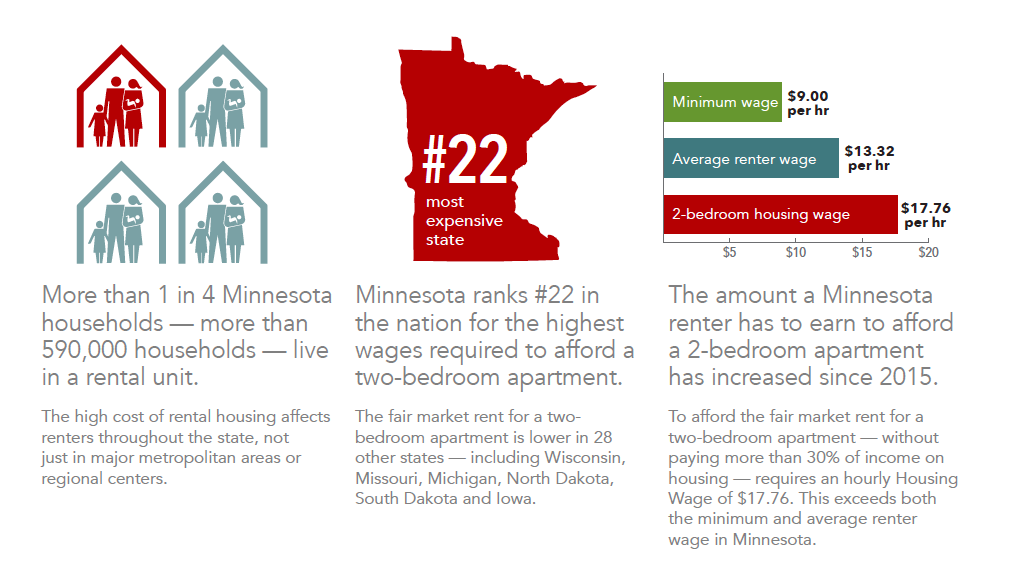
The Fair Market Rent (FMR) for a two-bedroom apartment in Minnesota is $1,133. In order to afford this level of rent and utilities — without paying more than 30% of income on housing — a household must earn $3,775 monthly or $45,301 annually.
From 2020 to 2021, the amount a renter household needs to earn to afford a modest apartment (the state “housing wage”) increased by 6 percent.
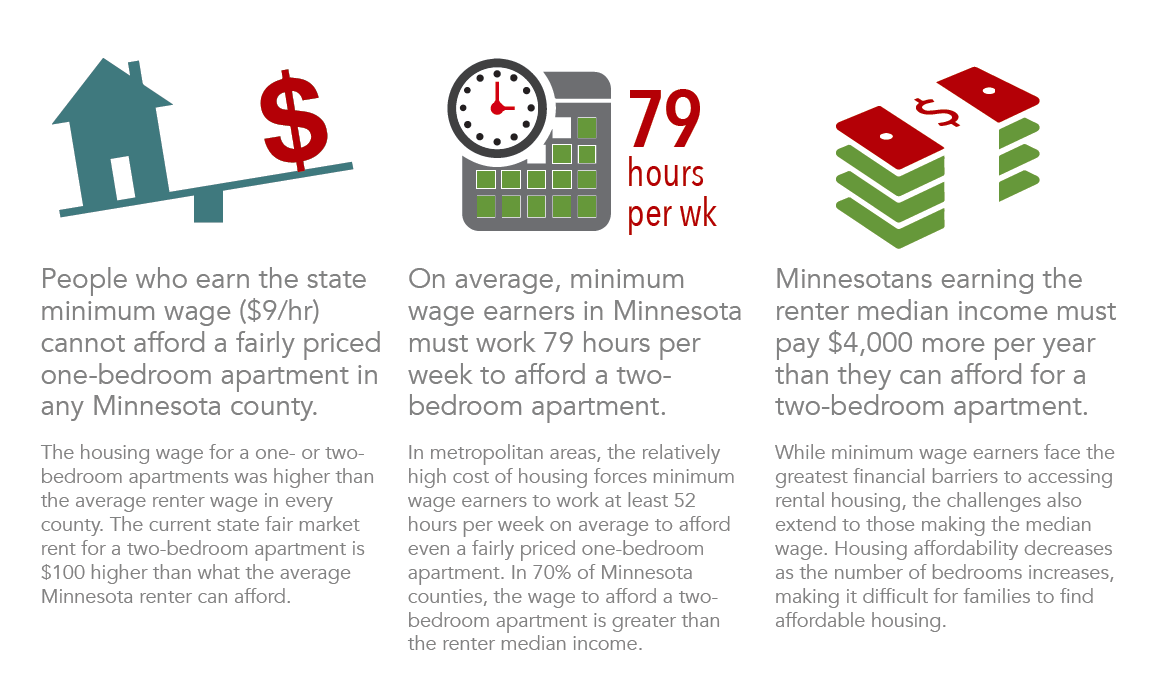
The lowest income households — those earning 30 percent or less of area median income — can afford a modest one-bedroom apartment in only seventeen of Minnesota’s 87 counties.
Minnesota ranks #23 in the nation for the highest wages required to afford a modest two-bedroom apartment: The wage required to afford a modest two- bedroom apartment in Minnesota is the most expensive in the Midwest, including $3.89 higher than the Wisconsin housing wage, and $5.17 higher than North Dakota’s housing wage.
When rent is out of reach for those who are fully employed, our communities pay the price. We cannot afford to let housing costs continue to climb, while wages remain stagnant. Currently, nearly 30 percent of Minnesota residents — more than 620,700 households — live in a rental unit.
“HOUSING WAGE” — Wage necessary to afford a two-bedroom apartment
The housing wage represents what Minnesota workers need to earn to afford rent without paying more than 30 percent of their income on housing. In 2021, a Minnesotan would need to earn an annual income of $45,301 to afford a modest two-bedroom apartment. Yet, the median renter in Minnesota earns approximately $41,414 — or is short by $3,887 annually. With the housing wage at $21.78 per hour for a modest two-bedroom apartment and $17.40 for a modest one-bedroom apartment, rent is out of reach for workers in the majority of Minnesota counties.
Compared to the state average of $21.78, the housing wage in non-metro areas is more than $7 less per hour at $14.59 for a two-bedroom apartment.
The highest housing wage in the state is located in the counties within the greater Minneapolis 5/ St. Paul metro area, at $25.15 per hour — or earning an annual salary of $52,320 — to afford a modest two-bedroom apartment.
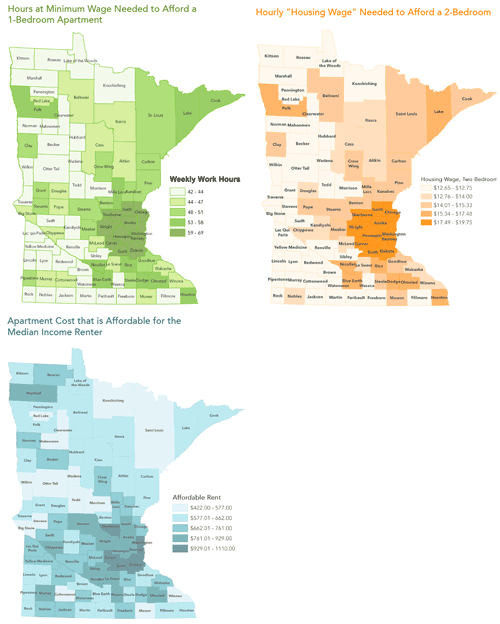
Rent affordable to median-income renter
For the median-income renter household in Minnesota, an affordable rent — one that does not exceed 30 percent of a household’s monthly income — is $1,035 per month.
Median-income renters in Washington County can afford the highest rent in the state at $1,297 per month.
Median-income renters in Itasca County can only afford $595 per month, the lowest level in the state.
In contrast to the $1,035 affordable to the median-income renter at the statewide level, the median-income renter household in non-metro Minnesota can afford far less — just $799 per month.
What lowest income Minnesotans can afford (30% AMI)
The lowest income households in Minnesota can afford just $704 per month in rent. Statewide, there is a $201 monthly gap between what a household at 30 percent of area median income earns and what would be required to pay for a modest one-bedroom apartment. Even efficiencies are out of reach; a household earning 30 percent of AMI would need to earn $936 more per year to afford a modest zero-bedroom apartment.
An individual earning 30 percent of area median income can afford a modest one-bedroom apartment in only seventeen of Minnesota’s 87 counties.
Rent for a one-bedroom apartment is too expensive for a household earning 30 percent of the area median income in all of the major metro areas in the state. The Minneapolis / St. Paul metro area contains the highest gap between fair market rent and what households earning under 30 percent of AMI can afford; these households would need to earn approximately $3,204 more per year to afford fair market rent.
Hours at minimum wage to afford 1 bedroom apartment
A minimum wage earner in Minnesota must work more than 43 hours a week in every county in the state to be able to afford rent for a one-bedroom apartment. Statewide, a one-bedroom apartment costs $381 more per month, or $4,572 annually, than a minimum wage earner can afford.
In non-metro areas, minimum wage workers must work 45 hours per week to afford a modest one-bedroom apartment, and 58 hours per week for a two-bedroom.
Minimum wage workers in the Twin Cities metropolitan area must work 80 hours per week to afford a modest one-bedroom apartment and 100 hours per week for a two-bedroom — the highest number of hours for major metropolitan areas in the state. This represents an increase in an additional 5-7 hours per week needed from just last year.
Minnesota Housing Partnership has released Rural Rental Housing: Report and Recommendations (April 2020).
The report is a culmination of stakeholder surveys and a fall 2019 convening of rural rental housing policy stakeholders in Little Falls, Minnesota. Rural housing advocates and community members met to talk about solutions to a variety of rural rental housing challenges. Even within the context of a world coping with the effects of COIVD-19, the recommendations from this group remain relevant, with identified needs magnified.
The discussion included a focus on Minnesota’s unique portfolio of USDA Rural Development 515 properties, or rural rental housing that supports residents, elders and families with very low income averaging $16,500 annually. Participants also focused on Minnesota’s manufactured home communities, 65% of which are located in Greater Minnesota.
The workshop helped identify immediate and critical needs for rural rental housing in Minnesota.
Immediate needs include:
Protect low income renters with housing assistance. In Minnesota, state leaders must provide housing assistance of at least $100 million through the Family Homeless Prevention Assistance Program (FHPAP) or another rental assistance program. At the federal level, $100 billion in emergency rental assistance ( to include renters in USDA financed rental housing) is necessary.
Additional critical needs:
Preserve the USDA rental housing portfolio, with funding to ensure ongoing safe maintenance, operations, and rehabilitation
Capacity building and technical assistance for owners and prospective owners of rural rental housing
Ensure long term affordability and opportunities for resident ownership in manufactured home communities
Engagement of people and communities in Greater Minnesota to ensure that the people most affected by our rural housing challenges are at the table when decisions are made.
Thank you to event sponsors the Housing Justice Center, Initiative Foundation, Greater Minnesota Housing Fund, Minnesota Housing, and Minnesota Housing Partnership. Appreciation to organizing partner Minnesota NAHRO.
View and download the full report here. Read the accompanying cover letter here.
Failure to include rental assistance will have dire consequences for low-income Minnesotans
The lack of rental assistance in the Minnesota Legislature’s COVID-19 relief bill will have immediate negative consequences for Minnesota’s lowest income households. Advocates pressed for $100 million for rental assistance through the Family Homeless Prevention and Assistance Program. The amount allocated by legislators? $0.
Tens of thousands of Minnesotans have housing needs right now that relief from the federal government will not cover. Though Minnesota’s eviction moratorium means renters won’t lose their homes right now; rent will continue to come due. Yet most have lost their jobs and do not have an ability to pay those rents. Without rental assistance, a cascade of evictions is likely when renters are hit with months of back rent.
Affordable housing providers — such as nonprofits and mom-and-pop landlords — will not have rental income to keep their housing maintained, pay their debts and funding obligations, and will be at risk of foreclosure or selling to low bidders. An analysis by Greater Minnesota Housing Fund and HousingLink found that these affordable housing providers would have to absorb between $86 million and $173 million in lost rent this year. Nearly 40,000 units of low-income housing could be lost, and an estimated 85,000 people displaced.
“These are the scenarios we are facing if Minnesota lawmakers don’t pass rental assistance,” said Anne Mavity, Executive Director of Minnesota Housing Partnership. “We failed to support low income families during the last economic crisis, and we lost massive amounts of affordable housing, and many Minnesotans lost their homes. We have a chance to prevent that this time around.”
Leaders from across the state and throughout the affordable housing sector urged lawmakers to do something for renters.
“We need to guarantee that our communities will not be displaced and subsequently destabilized because of non-payment of rent,” said Nelima Sitate Munene, Executive Director of African Career Education and Resource, Inc. “Most renters in the Twin Cities were already housing cost burdened and housing insecure before this pandemic. They are also the ones who have been most impacted by reduced hours and are the ones who provide the necessary services we will be depending on for our lives to recover to normal. Rental assistance today is an investment in the Minnesotan economy!”
“Families must still keep up with rent and mortgages, or risk homelessness,” said Warren Hanson, President and CEO of Greater Minnesota Housing Fund. “The emergency homeless prevention rent assistance is essential to keeping us all safe.”
“As a provider who administers housing assistance to households in crisis in Southeast Minnesota, it is devastating to know that there may not be additional assistance available through FHPAP,” said Jenny Larson, Executive Director of Three Rivers Community Action. “Families are losing income and calling us for help. We need resources to help our neighbors who are struggling, so we can keep people in safe and stable housing.”
“Rental assistance is crucial in this time of crisis where many low-income and immigrant community members are not even able to provide food for their families,” said Asad Aliweyd, Executive director of the New American Development Center. “I am hearing that people who have been working low-wage and temporary jobs are staying home, unable to pay for rent and food. It is time to act quickly on rental assistance.”
“Without rental assistance, we know people will lose their housing,” Paul Williams, President and CEO of Project for Pride in Living (PPL). “PPL manages over 1,500 units of affordable housing across the Twin Cities, and we anticipate 60% of our renters will see their wages impacted by COVID-19 job losses or changes. Many of these individuals are working in critical service sector jobs, like hospitality, trades, and financial services. Losing stable housing in this crisis will only compound what is already an uphill climb. Our community will reach a breaking point if we don’t act.”
“Affordable housing residents are more likely to lose jobs and income under current conditions,” Deidre Schmidt, President & CEO of CommonBond Communities. “Failure of some residents to pay rent (for these very good reasons), can threaten the quality and stability of housing of their neighbors. Their rent revenues pay for water and sewer, heat and electric taxes and mortgage payments.”
On Monday, Governor Tim Walz announced Executive Order 20-14 suspending evictions. Eviction moratoriums are a great first step to preventing homelessness, but much more is needed. State leaders must provide rental assistance of at least $100 million through the Family Homeless Prevention Assistance Program (FHPAP) or another rental assistance program.
According to data analysis by Minnesota Housing Partnership, many of the workers who are out of work due to COVID-19 shutdowns will experience dire financial outcomes. Workers with unemployment insurance will receive half their typical earnings. For food service, that means an income of $1,032 a month against an average Minnesota rent of $969. On average, food service workers are left with $63 after paying rent. These workers won’t be able to pay for food, medicine, and other household needs.
For specific food service jobs such as bartenders, waiters, and food counter workers, unemployment insurance will not be enough to even cover the rent. This affects an estimated 81,620 Minnesotans.
Members of the media can download a full analysis of the housing impacts of these most affected workers here.
Rental assistance is critical for supporting low-wage workers unable to pay rent, and ensuring stability in the rental market.
That same rental assistance would provide critical operating income to affordable housing providers, and helps sustain the housing system. Most housing providers have only a few months operating reserve, and even that has restrictions on spend-down.They cannot maintain basic housing operations without some type of revenue stream.
The rental income will help housing providers cover continued safe operations and additional costs of maintaining affordable housing including with enhanced cleaning and emergency repairs during the COVID-19 pandemic.
“A lack of rental assistance will have ripple effects throughout Minnesota,” said Anne Mavity, executive director of Minnesota Housing Partnership. “Even with an eviction moratorium, past-due rent will build for people out of work which just shifts this problem to a month or two from now. We need housing supports and we need them right now.”
“We’re calling on the Legislature and Governor Walz to immediately pass and sign into law $100 million in rental assistance.”
It’s not only damaging financially but damaging to your soul, to your spirit, to your self esteem, to your mental and physical health. There were so many lasting impressions and damage that there’s no way money could make you whole again. – Maria Johnson, former Crossroads resident
One night in 2015, Maria Johnson had a note slipped under her door telling her she had 30 days to find a new place to live. The Crossroads at Penn had been sold and the new owner had plans to “upscale” the property — and ultimately upend the lives of hundreds of residents, like Johnson.
On September 22, as part of the “Racism, Rent and Real Estate: Fair Housing Reframed” event series, Johnson shared her experiences on an all-tenant panel following a screening of the film “Sold Out: Affordable Housing at Risk.” The 2017 documentary produced by Twin Cities PBS centers the story of the Crossroads as an illustration of the loss of affordable rental homes throughout the region. Johnson was joined by Linda Soderstrom, a fellow former Crossroads tenant, as well as tenant experts Jewelean Jackson and December Wesley and Pat Longs, Community Programs Navigator at Community Action Partnership of Hennepin County (pictured, from left to right).
A clear theme emerged: Homelessness and housing instability have many faces.
In sharing her story, Johnson emphasized that affordable housing is an issue, not just for those in poverty, but those of modest incomes, as well.
“I’m in college and I support my mom so that location [at the Crossroads] was extremely important because it was on a bus line, it was convenient to everything and it was affordable,” Johnson told the audience. “I had money set aside in a savings account, but when this happened it was depleted and I ended up losing my job. I had to relocate to a different apartment complex that cost more money but I didn’t make as much money and I couldn’t get any assistance because I made just enough money to miss that. That’s what I stress when it comes to affordable housing. We definitely need to look at the impact on the poor but those of us who make just above what’s considered poor, housing is unaffordable, as well. I’ve had to move three times in past four years and the most recent place had infestation of flies. The crisis is real — and not just for those with no money but for those who are just above that line, because there’s no assistance for us.”
Linda Soderstrom, a tenant leader and former resident of the Crossroads, further challenged preconceived notions about those who struggle with affordable housing.
“I like to break people’s stereotypes,” she said. “I’m reliant on the Section 8 voucher for the rest of my life but I cared for 30 daycare and 30 foster care kids for Hennepin County when I owned my own home at one time, and they were all prenatally exposed to drugs and alcohol. One of them stayed and he’s 30 now and doing quite well. But no one is a typical Section 8 recipient. No one. We’re all individuals. We all want the things in life that everyone else does.”
But, as Soderstrom pointed out, the incoming owner of the Crossroads didn’t see tenants as individuals. In fact, the court case challenging the displacement of the Crossroads residents surfaced troubling sentiments on the part of the new landlord. Not only did Jim Soderberg label the Crossroads tenants “undesirable,” but the judge in the case referenced a previous instance in which Soderberg promised city officials that he would “get rid of the Jerry Springer watchers and bring in the Caribou crowd.”
“They have words for all this,” Soderstrom said. “Reposition, upscale, give it a facelift. Well, you can’t reposition a population. Those are people.”
And, even a record financial settlement in their fair housing claim, couldn’t reverse the harm to hundreds of families, like Johnson.
“The amount that was given did very little to repair the damage that was done,” Johnson said. “It was not only damaging financially but damaging to your soul, to your spirit, to your self esteem, to your mental and physical health. There were so many lasting impressions and damage that there’s no way the money could make you whole again.”
While the circumstance was different than the Crossroads, December Wesley also lost her home because of a property sale. A professional in the medical field, Wesley was a caretaker when a new employer bought the building where she worked — and lived. That new owner not only laid off the employees but told them they couldn’t rent at the property, either. At the time, she had two teenage children, a cat, and a van that had to hold all their possessions.
“It’s very expensive being homeless,” Wesley shared. “People think being homeless you’re a bum, but that’s not the case. I was a working mother, and the kids were going to school and they were clean. But it’s very expensive being homeless. You have to pay for gas to move around to different places, and still do the things you would do in your apartment or house… I also learned that when you’re homeless, your support comes from other homeless people. It doesn’t come from agencies, as you would think it would.”
Jewelean Jackson, a tenant expert who has experienced foreclosure, eviction and homelessness, emphasized that housing instability doesn’t conform to the widespread perceptions, either.
“I always tell people eviction is not the Sheriff coming and kicking your door in, or going to housing court or someone coming and leaving all your things on the sidewalk,” Jackson shared. “None of that happened to me. But at the same time I was evicted because I no longer have my home or an address and I think it’s important for people to know that it isn’t any less stressful. For me it came on the heels of the mortgage foreclosure. I lived at the shelter but my daughter couldn’t fathom being in a shelter. She was in high school then, so she just chose to hop from couch to couch with family and friends… I’ve tried to keep her life as normal as possible. To the point where, last month she competed and represented Minnesota in the Miss Black USA pageant.”
“Part of my struggle is that if I was a drug addict, if my child had a baby stroller attached to her hip, if I was threatening all of you in this room, or all kinds of other things against society, people would be knocking on my door to help. Part of that is because that’s what they expect us to be. Homelessness does not have one face but society has created that one face and, if you deviate, you’re out there by yourself.”
“When people talk about homelessness and eviction and going through foreclosure it’s always, ‘Those people need to pull themselves up by their bootstraps,’ but if the boots aren’t there in the first place what can you do?” she added later in the conversation. “I hope what you take from the viewing [of Sold Out] is to share in your circles that it’s not one face. It’s not one situation. And it’s not all of those people. Everyone in this room has known a person or two or three in that situation, if not currently. We need systems change because this continues to happen and the high powered lobbyists and folks are continuing to perpetuate that which supports them. Often, when we choose to fight and organize and mobilize because we don’t have the resources, we get beat down. But the Crossroads is a good example of when you fight back you can get the result that you want.”
Soderstrom agreed. “The Crossroads was not saved but, a year later, the same owner was trolling to buy Seasons Park [apartment complex] and through all kinds of cooperation, including the new mayor and superintendent of schools, we all got together and a nonprofit buyer made counter offer after counter offer until the seller did call off the dogs. So it’s been saved now for affordability.”
But Pat Longs, Community Programs Navigator at Community Action Partnership of Hennepin County, emphasized the seeming lack of urgency among policymakers and advocates to address the dramatic lack of affordable housing. “There are different people in this documentary who say this is what we need to do,” she said. “And we constantly go to these conferences [about housing and homelessness] and they have big ideas. But nothing is being taken care of. We get tired of talking about these ideas. We need some action.”
And input and engagement from directly impacted communities is critical, Johnson said.
“I would encourage everybody to get involved,” she said. “I know we discussed the upper echelon making decisions regarding us without us. You can’t discuss us without giving us a seat at the table. So we highly encourage people to force them to involve you. Let them know they have no idea what our conditions are. There’s not one face of this crisis.”
Learn more about the affordable housing crisis and watch Sold Out here.
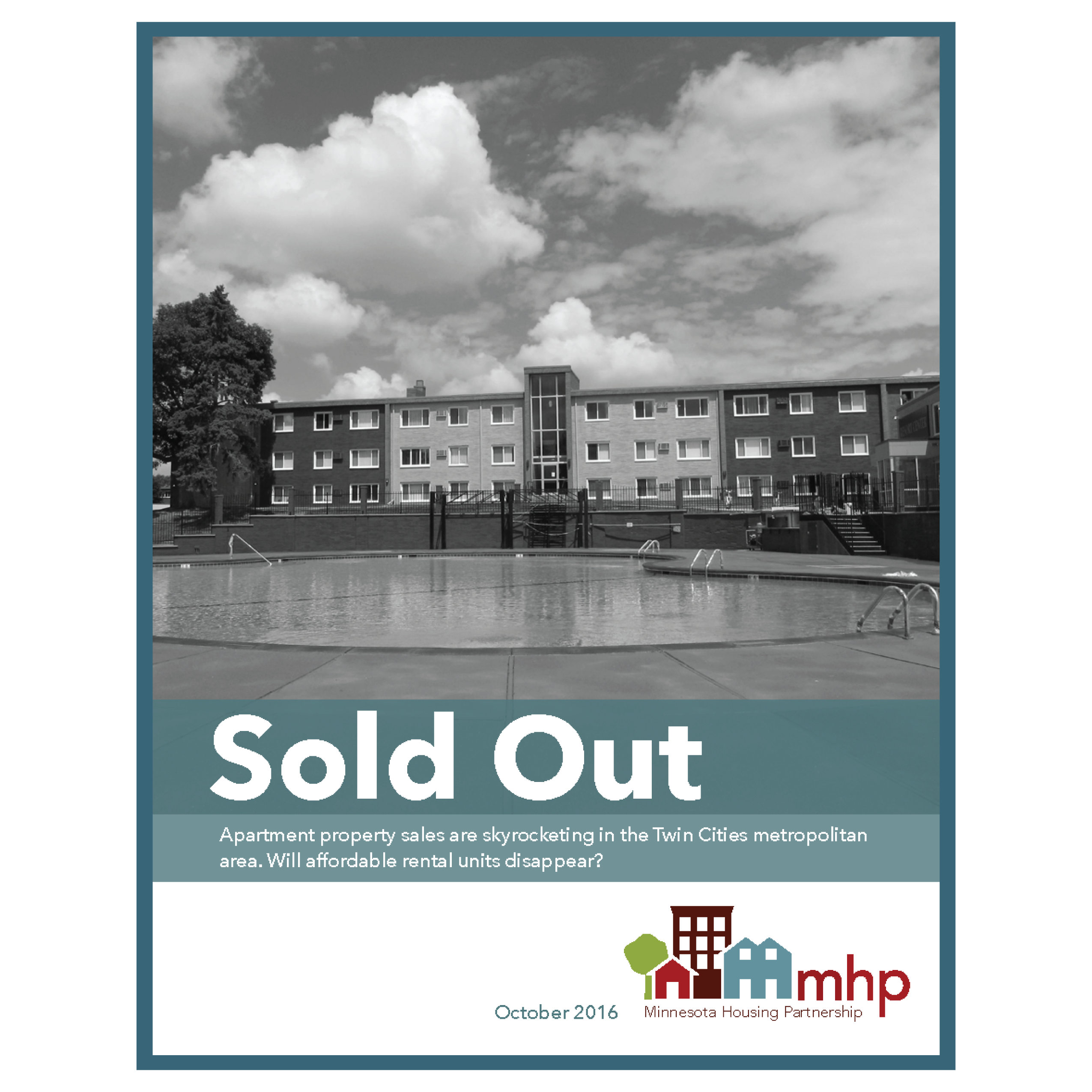
The voices of tenants and owners, advocates and elected officials raise the urgency and opportunity to address the loss of affordable housing in a new documentary. Produced by Twin Cities PBS, in partnership with local advocates and funders, “Sold Out: Affordable Housing at Risk” reveals the price we all pay when families are pushed out of our communities as modestly priced units are replaced with upscale developments.
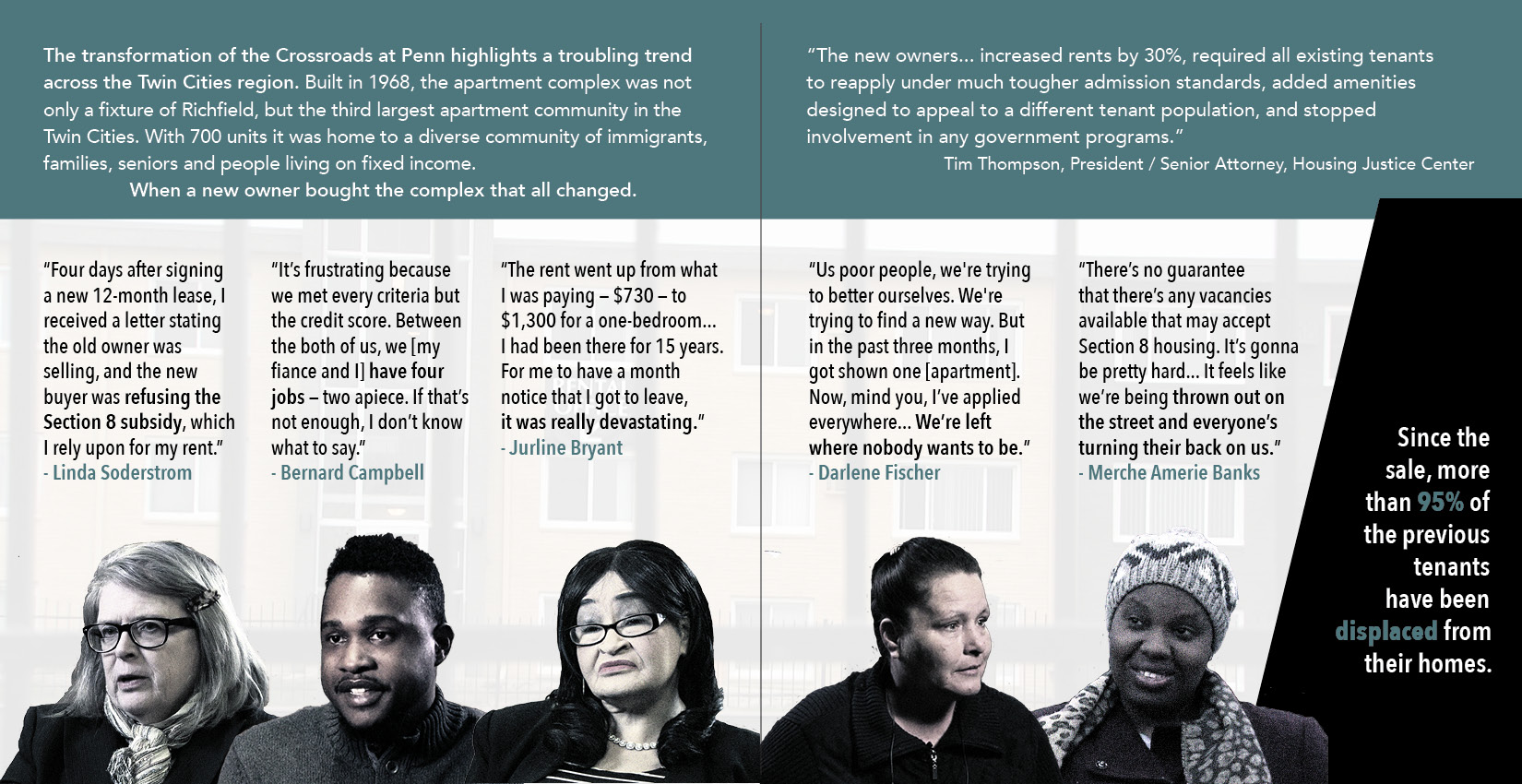
It’s been more than a year since the ultimatum given to hundreds of tenants at the Crossroads at Penn: Pay massive rent hikes, pass stringent tenant requirements — or be forced out into a white hot rental market with very few options for low-income households or those on government assistance. A year later, more than 95% of the tenants are gone — but it’s not just the families who’ve suffered.
“We all pay the price when low-cost rental housing is upscaled for higher income households and families are displaced,” says Chip Halbach, executive director of the Minnesota Housing Partnership. “How we answer this challenge in the near term will impact our region’s economic strength and the resilience of our social fabric. But we must act soon. Unlike cities like San Francisco and Seattle, where housing affordability has spun out of control, we still have time to make the Twin Cities a place where people at all income levels can live and contribute.”
As evidenced in MHP’s 2016 report by the same name, strong growth among renter households with higher incomes — above $50,000 per year — has created a strong incentive to re-position older properties with diverse populations for younger, more affluent households. The new 60-minute documentary provides first-hand accounts from numerous former residents of the Crossroads at Penn, sharing the devastating impacts of being pushed from a place where some had resided for decades.
“It was a wonderful place for all of us families,” says a former Crossroads tenant. “We had neighbors, we had relationships, our community, and also the schools, the transportation, even employment. It was a good place for all of us.” But when residents were forced out by new standards and increased rent, they were dispersed from the support systems and services that made ends meet.
“It’s greatly compounded the difficulties of their lives, figuring out how to get so much farther to their job, to their doctor, to the grocery store,” says Tim Thompson, President and Senior Attorney at the Housing Justice Center. The film also lifts up the work of tenant organizing and highlights a landmark legal suit brought by the Crossroads residents under the Fair Housing Act.
The impacts of apartment upscaling, like the Crossroads, ripple far beyond the individuals and households forced to move. Through interviews with elected leaders, researchers, educators and employers, the films reveals how the uprooting of families negatively impacts area businesses and local schools as well as the social fabric and economic functioning of our communities. It makes clear that the current housing market fails residents struggling to make ends meet — and all of us pay the price.
There is no single or simple solution but there is one certainty: Ensuring adequate affordable homes impacts the lives of every single resident of the region. From tenant organizing to social impact investing, community and elected leaders are putting forward strategies to keep low-cost rental housing safe, stable and available to the workers and families who play a critical role in the economy and life of the region. By hearing directly the voices of those impacted and understanding the trends driving this upscaling, “Sold Out” aims to set the stage for a community-wide conversation focused on enacting policy and lifting up solutions from the grassroots, grasstops and public-private partnerships to stem the loss of affordable housing in the Twin Cities.
Now is the time to act. We hope you will join us in this critical discussion.
Follow the hashtag #SoldOutRenters on Twitter for ways to engage!
“Minnesota must face the growing crisis of families being unable to cover housing costs,” said Chip Halbach, Executive Director of the Minnesota Housing Partnership. “The price we will pay for our inaction will be seen across the age spectrum, from school children with unstable homes falling behind in their studies to senior citizens forgoing medicine and food to retain their shelter.”
“The shortage of stable and sustainable rental housing is hurting communities throughout Minnesota — and we need to address this issue now,” said Jeremy Schroeder, Policy Director for the Minnesota Housing Partnership. “The rising costs of rent and the shrinking supply of available units makes growth in greater Minnesota impossible. It’s clear that the most important way we can help struggling working families is to provide more access to affordable, stable housing.”


 What lowest income Minnesotans can afford (30% AMI)


 It’s not only damaging financially but damaging to your soul, to your spirit, to your self esteem, to your mental and physical health. There were so many lasting impressions and damage that there’s no way money could make you whole again. – Maria Johnson, former Crossroads resident
 The voices of tenants and owners, advocates and elected officials raise the urgency and opportunity to address the loss of affordable housing in a new documentary.
 The Out of Reach report,