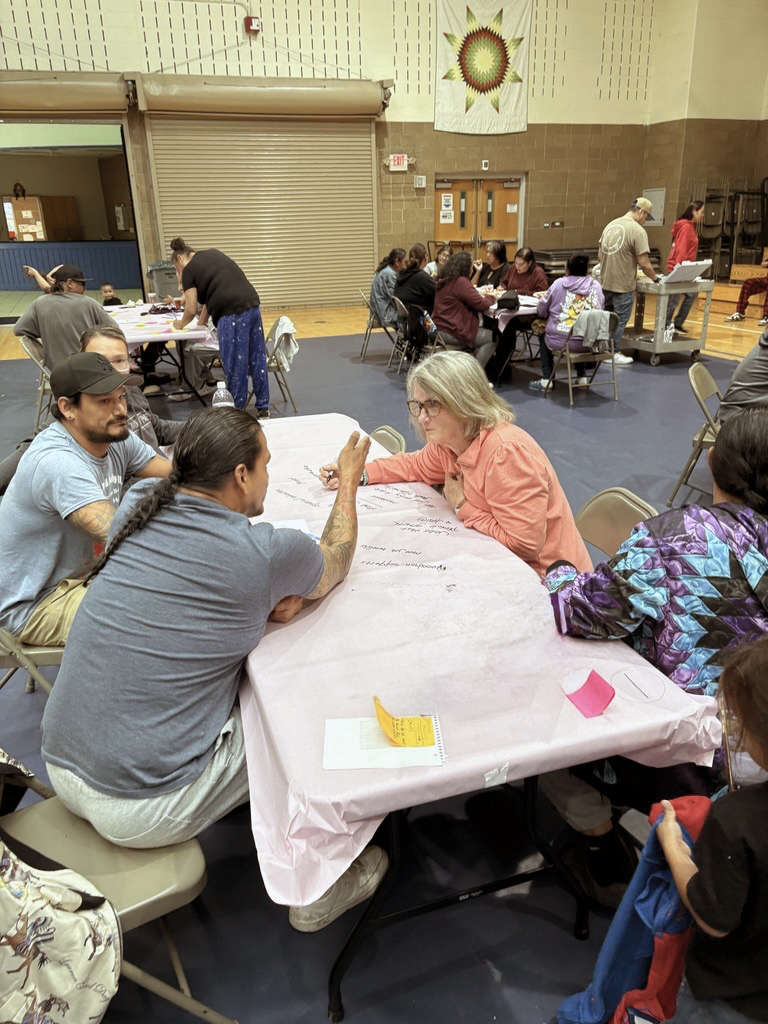
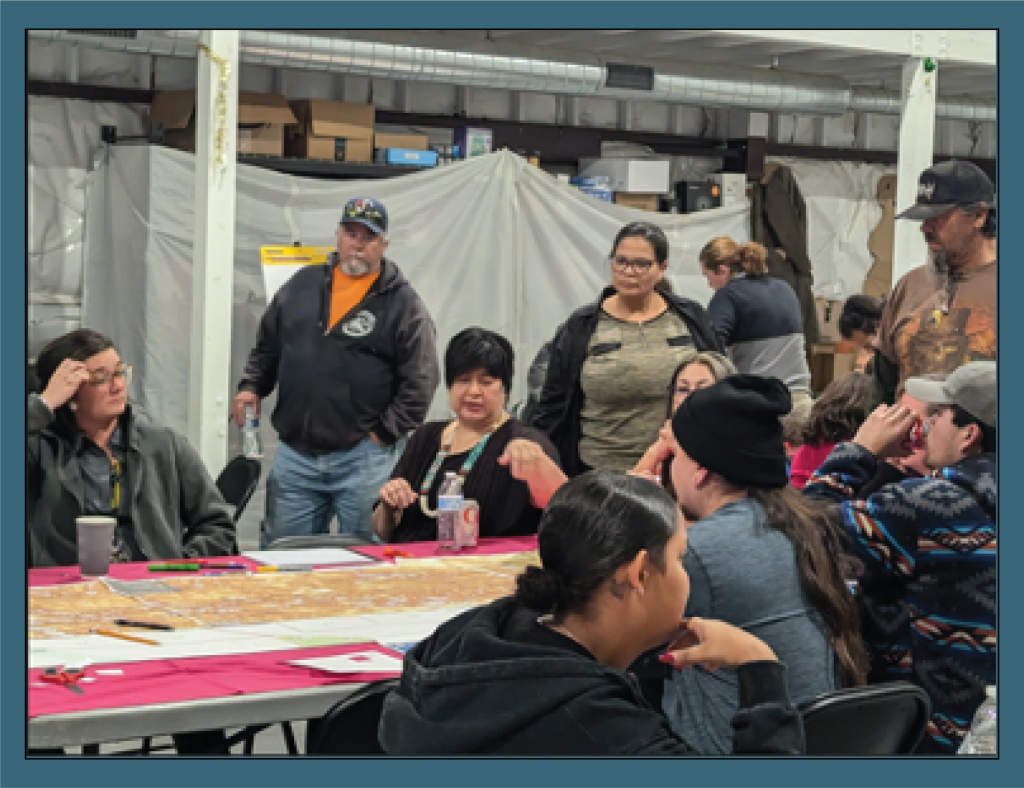
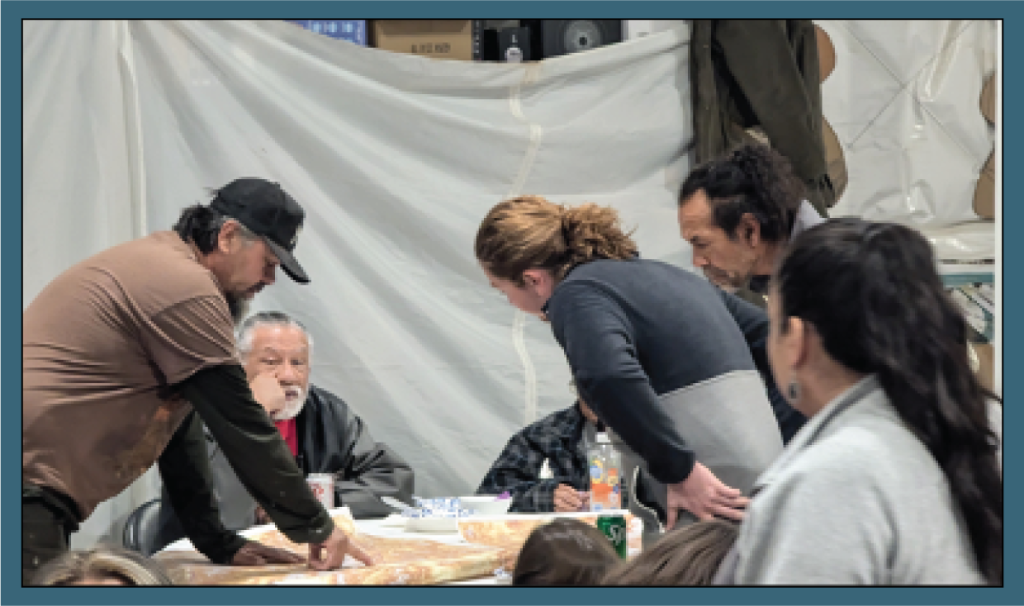
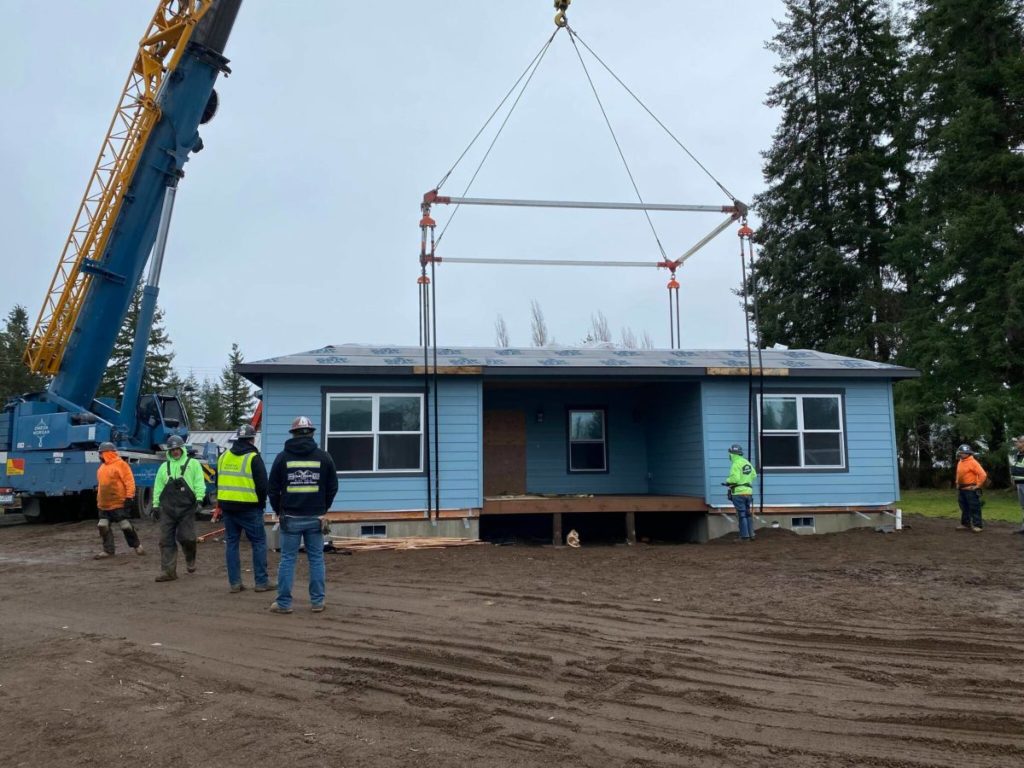
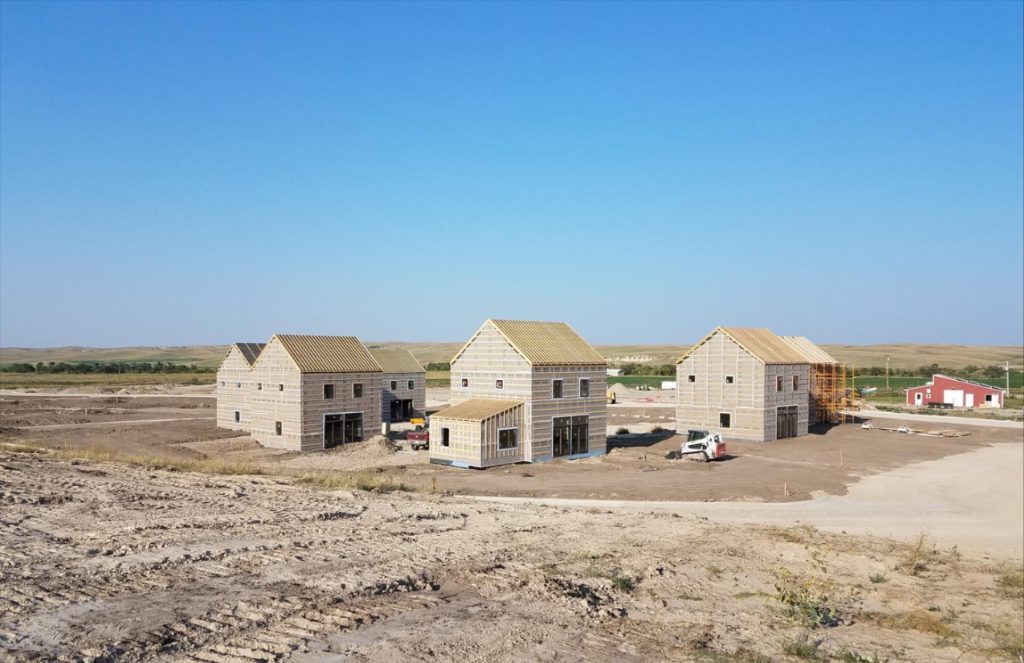
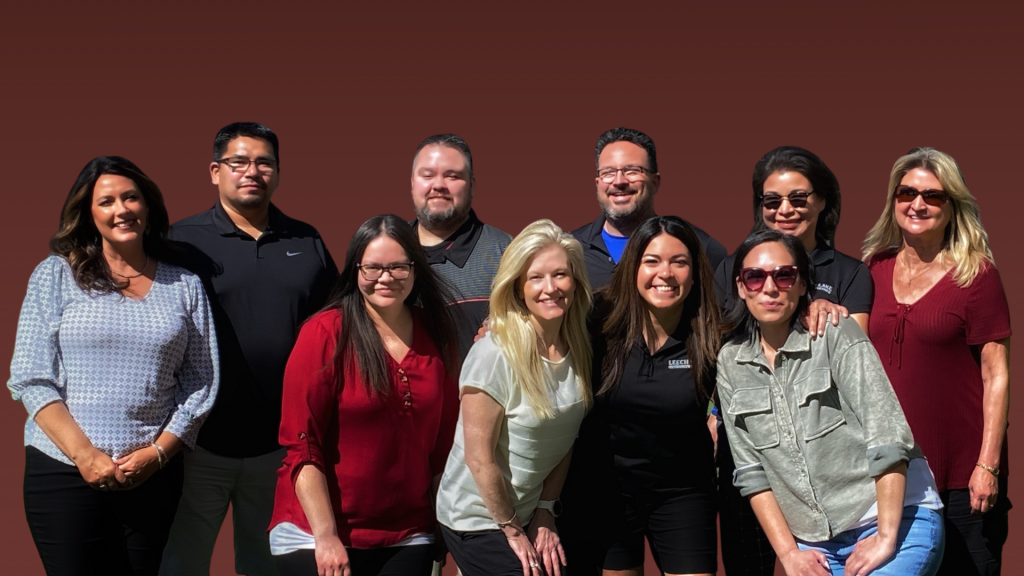
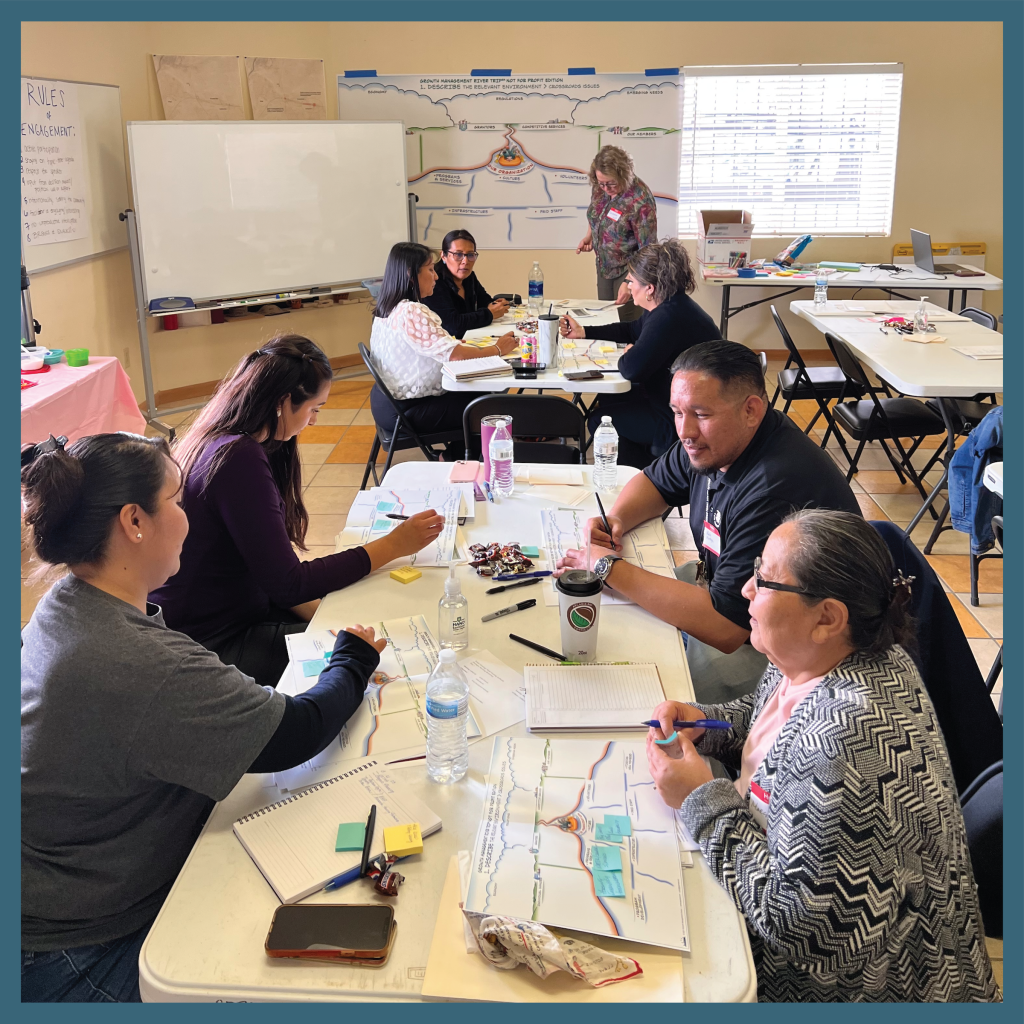
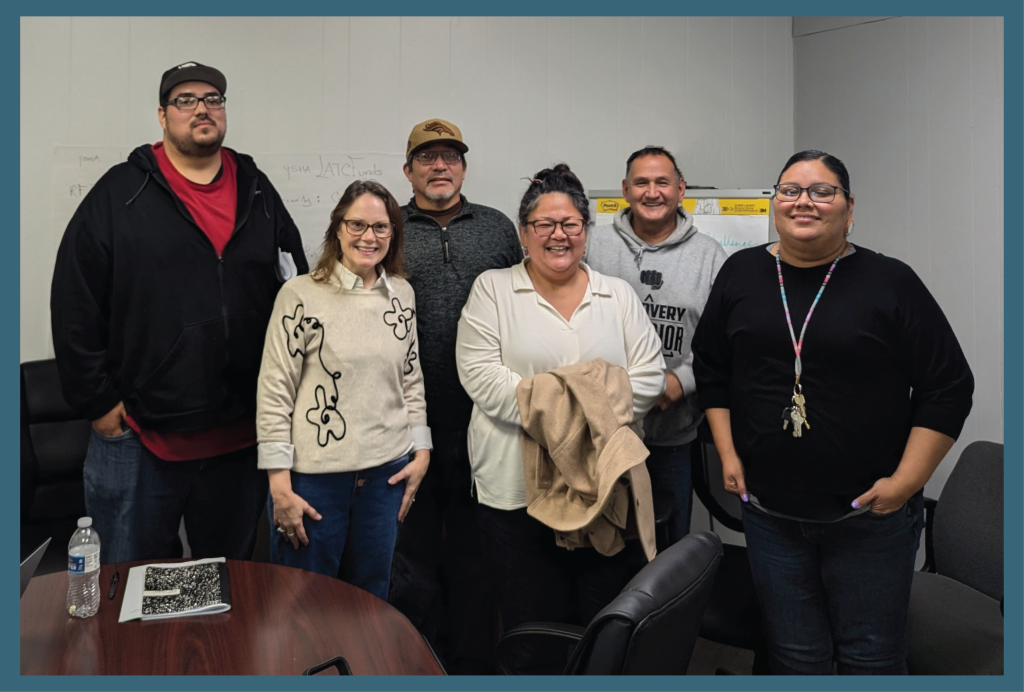
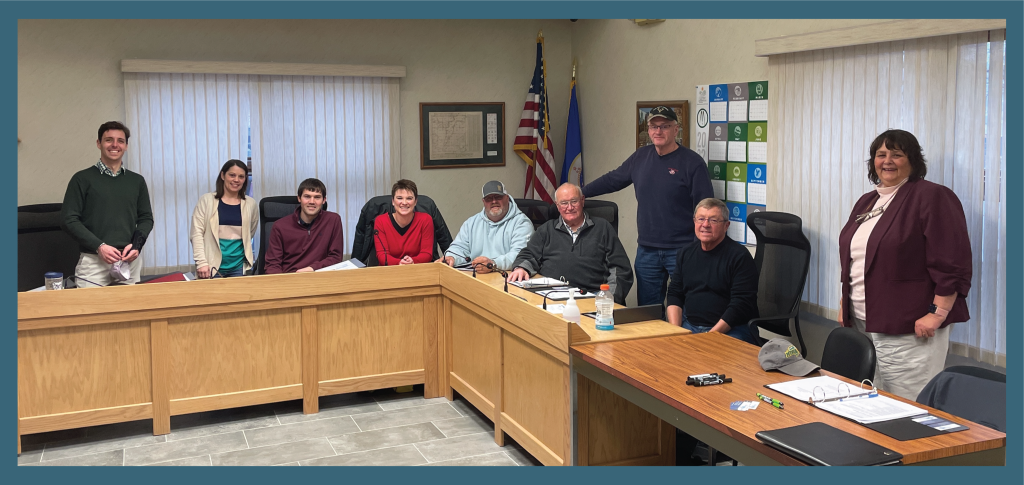
MHP staff are currently providing technical assistance to the Lower Brule Sioux Nation in South Dakota. The MHP team is working collaboratively with the Nation’s Council and staff members to work toward: housing preservation and creation, infrastructure improvement, strengthening local economic systems, and increasing access to mental health services. In partnership with Lowe Brule Sioux, MHP staff are currently designing a master plan that will act as a road map to guide the team and the community as they work towards accomplishing short and long-team goals. In September, the team led a series of engagement activities aspart of the community-led master planning process, facilitating four focus groups, as well as one large community-wide event. The focus groups reached a diverse set of voices—youth, elders, benefit recipients, and tribal staff. The team also facilitated a large community event; 117 adults attended, many were families that also brought their children to participate. So far the team is well on its way to completing this foundational community planning step that will shape a 15-year master plan for the Tribe. The feedback MHP received so far has been overwhelmingly positive, and staff are excited to build on this momentum as the team synthesizes the data collected and continues moving the vision forward!
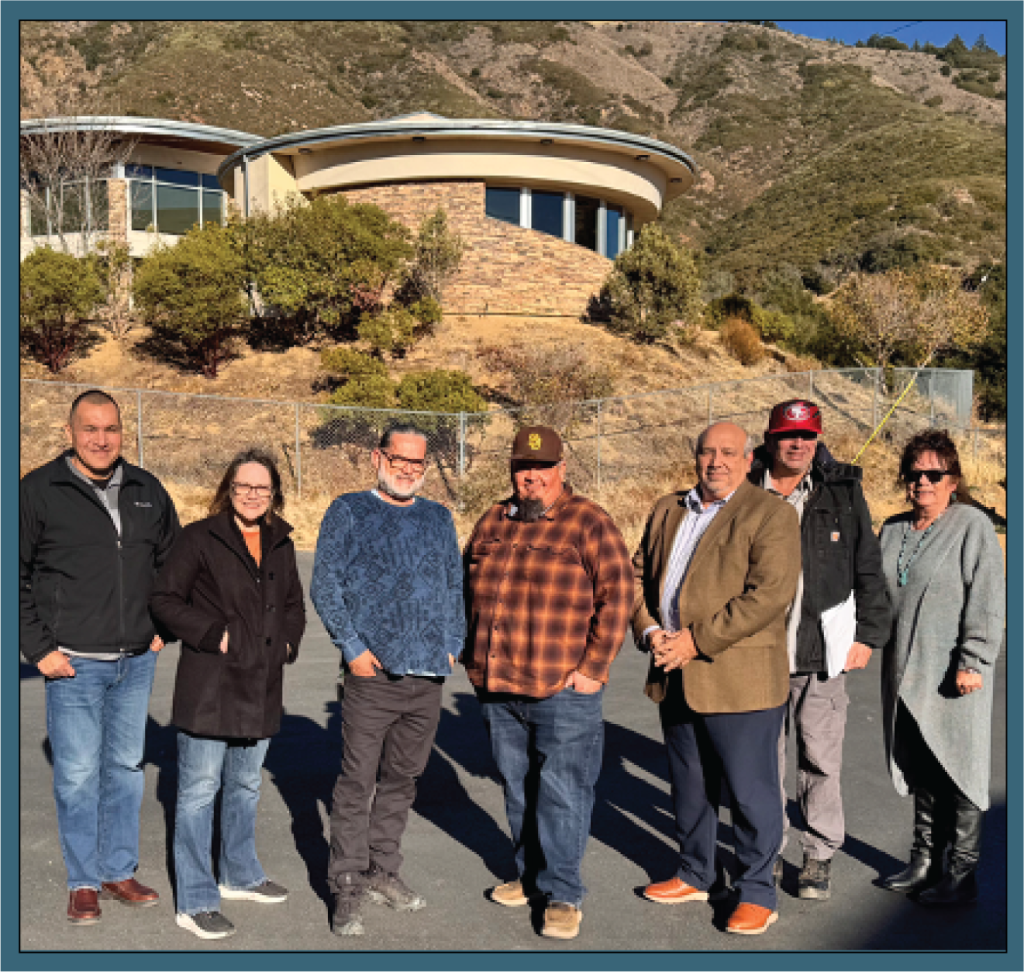
In March 2024, MHP began working with the Iipay Nation of Santa Ysabel (INSY), part of the Kumeyaay people who have lived in present-day San Diego and Imperial Counties for over 12,000 years. The Iipay Nation of Santa Ysabel Reservation was founded in 1893 and is located in northeastern San Diego County near Santa Ysabel and Julian.
The Santa Ysabel Indian Reservation spans elevations from 3,200 to 5,700 feet and covers a total land area of 15,546 acres (23.4 square miles). However, only 810 acres—less than 6%—are developed. The limited development is primarily due to the rugged and steep terrain, which poses challenges for construction. Additionally, water is not readily available on the reservation. Community members often must pump and transport water from community wells.
The Tribal enrollment totals just over 1,000 individuals, with approximately 211 people residing on the reservation across about 152 households. This remote area lacks a significant economy, leading to considerable economic challenges for the community. The per capita income is $26,407, while the median income stands at $45,000, representing a decrease of 66% compared to the national average. Additionally, around 80% of households are economically disadvantaged, often facing obstacles due to unreliable technology and transportation.
The housing stock on the reservation is mainly composed of manufactured homes due to terrain limitations. The Housing Department, managed by one employee under the tribal administrator and council, oversees about 115 units with under $135,000 in federal assistance from the Indian Housing Block Grant. Many homes need repairs or replacement due to limited maintenance funds.
Despite these challenges, INSY staff are motivated partners with capacity-building efforts. They sought technical assistance from MHP in the areas of Organizational Development, Housing Development, and Physical Planning. MHP and the INSY worked with a contractor to conduct a Physical Conditions Needs Assessment for 50 of the managed units of its existing housing and assisted the tribe with the PRICE grant application, which is aimed at preserving and revitalizing manufactured housing. Leveraging these two items creates a significantly positive impact for tribal members living in the tribe’s housing.
Currently, the INSY and MHP staff are collaborating to bring training for the Tribal Council and senior staff to clarify their roles and responsibilities in January. The purpose of this training is to define the duties, powers, and limitations associated with each position, promoting effective governance and decision-making. This training and guidance aim to establish a strong foundation for governance, ensuring the well-being and prosperity of their tribal community.
Is your community facing a lack of affordable housing? Do you work for an organization that could benefit from enhanced local knowledge, training, and strategic partnerships? MHP is excited to open its application for FREE technical assistance for housing and community development! View MHP’s Request for Technical Assistance (RFTA) Applicationhere.
MHP’s renowned Strengthening Rural Communities Program (funded through an eighth-consecutive Rural Capacity Building award from HUD), delivers technical and financial assistance to rural entities and Native Nations across the country, increasing their capacity to meet current and future housing needs—at no cost to RFTA awardees. By increasing local capacity, we position beneficiaries of the assistance to achieve their unique vision and sustain housing and community development successes long after MHP’s work is complete.
MHP has the expertise to assist with a variety of issues, including housing development, housing program development, organizational development, funding and resource development, and community engagement and outreach. Since 2014, MHP staff provided direct assistance to over 132 beneficiaries through customized and individual workplans; including assistance with 54 community development projects. The result: 577 affordable units are in the development process, with 33 new units completed, and 632 housing units have been rehabbed/preserved.. The assistance also contributed to the success of 41 businesses (including 8 new ones) and boosted their local economies. Read about the impact of this technical assistance in just a few communities here:
Priority is given to organizations currently engaged in housing development as a part of their mission or actively working to build their housing development capacity. MHP also works with such entities as rural housing development organizations (RHDOs), local units of government and political subdivisions, tribal governments and tribal corporate entities, and CHDOs and CDCs. Statewide or state-affiliated entities are not eligible.
Applications are being accepted on a rolling basis. Click here to access the application directly. MHP will follow up within forty-five days to schedule a collaborative review of your application. MHP is an equal opportunity assistance provider and markets its technical assistance program to communities historically facing housing disparities. More information paper copies of all materials are available upon request.
We want to work with you! Please reach out with any questions:
As of December 1, 2024, MHP staff has begun the closeout process for their partnership with the Santo Domingo Tribal Authority (SDTHA). The Santo Domingo Pueblo, known as Khe-wa to its residents, is located between Albuquerque and Santa Fe, along the Rio Grande. Recognized for its rich traditions, many community members still speak Keresan, along with English and some Spanish. With over 5,000 enrolled members, the Pueblo has a variety of departments providing services to its residents.
The SDTHA, established in 1995, focuses on affordable housing development for the community. They aim to provide safe, sustainable, and culturally appropriate housing that supports traditional family values and self-sufficiency. SDTHA has implemented a master plan that integrates affordable housing with economic development and infrastructure improvements.
After facing significant organizational challenges, including management issues and financial shortfalls identified in a 2019 HUD-ONAP monitoring review, along with the impacts of the COVID-19 pandemic, MHP assisted the SDTHA with overhauling its staff and operations. MHP improved the SDTHA’s internal capacity and secured funding for new housing development projects. This support included the creation and updating of internal policies, resolving its monitoring findings with HUD-SWONAP (Southwest Office of Native American Programs), strategic organizational planning, and a Housing Needs Assessment.
Additionally, MHP assisted the SDTHA with grant writing for the Competitive Indian Housing Block Grant (IHBG) using resources from MHP’s Strengthening Rural Communities Grant (SRCG). Although the application scored well, it resulted in a tie with several other applicants and did not receive funding. Fortunately, due to the strong score of the application and overall improvements, the SDTHA is now well-positioned to apply for both the IHBG and the Indian Community Development Block Grant (ICDBG). This will allow them to continue planning for projects that had been on hold due to monitoring issues.
MHP Community Development staff recently visited the Yankton Sioux Housing Authority, as part of their on-going work with the Yankton Sioux Tribal Nation. MHP staff and the project team conducted team building sessions and process mapping to support the Housing Authority as they explore opportunities enhance program operations. Together, the project team toured several vacant properties that they plan to rehabilitate utilizing a recent award of $1M from their Tribal Council for this work. Once rehabilitated, these properties will be home to several local families in need of affordable housing!
Starting in the spring of this year, MHP staff began providing community development technical assistance to Buckeye Ridge Habitat for Humanity in Marion, Ohio. This Habitat is a dynamic social service and rural housing nonprofit organization that develops/rehabilitates affordable homes for families in four rural counties of Ohio, just east of the Appalachian Region. In partnership, Buckeye and MHP are determining target communities for affordable housing unit creation, developing a strategic action plan that will include multiple years of development on sites throughout the service area, and identifying funding sources to support the developments. MHP staff are providing tools to enhance project planning, assign resources, and demonstrate project feasibility (like project proformas). MHP is helping Buckeye access funding through multiple sources such as local CDFIs, the Federal Home Loan Bank, and various loan/grant products from the Ohio Housing Finance Agency. This project also includes developing a revolving predevelopment funding pool and exploring opportunities to expand Buckeye’s homeownership education and counseling impact across the community. MHP staff are thrilled to be a part of this amazing project!
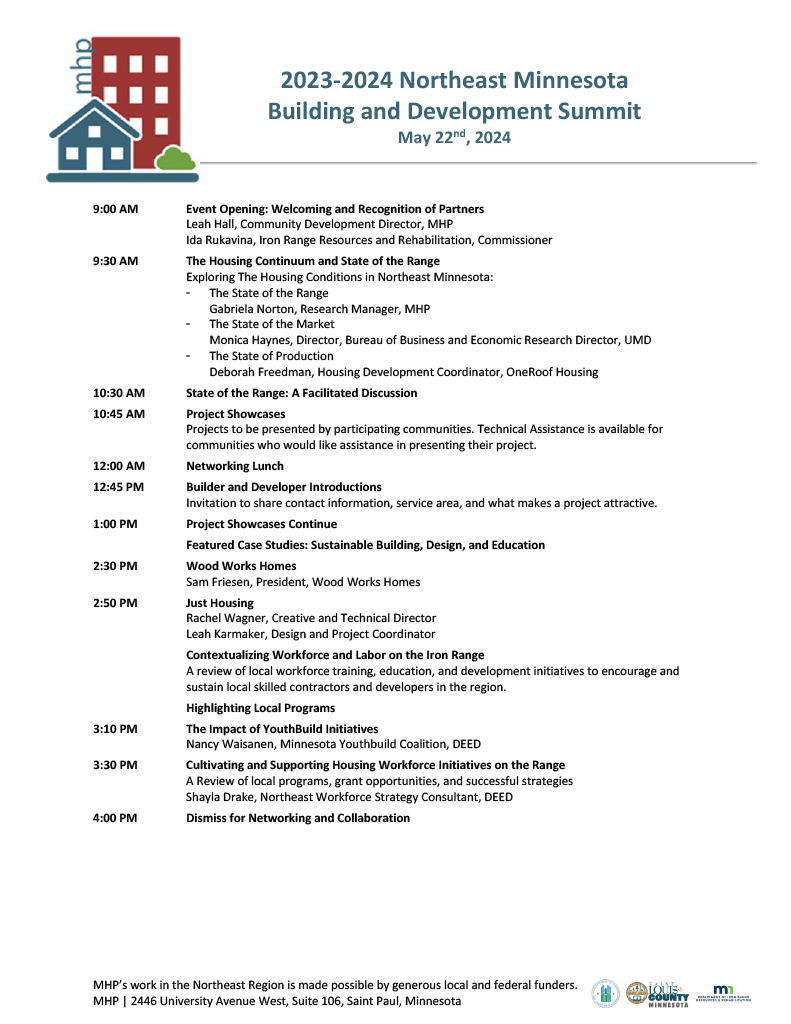
May 22 • 9am – 4:30pm • Iron Trail Motor Events Center in Virginia, Minnesota
MHP is hosting a dynamic peer-to-peer session to facilitate strategic partnerships and encourage development in the Northeast Region of Minnesota. This all-day collaborative event will focus on the current climate for housing production in the heart of the Iron Range, the Tribal Nations sharing that geography, and surrounding communities. Seeking to build on regional momentum for housing activity, MHP will convene community representatives, builders, developers, and other valuable stakeholders to identify and address development challenges and work together towards practical solutions. Community representatives and stakeholders will have the opportunity to present a development project.
Since 2010, MHP’s Housing Institute model has brought together regionalized housing leaders and stakeholders to share their experiences, learn best practices, and develop creative solutions for bringing quality affordable housing to their communities. MHP has recently concluded the 2022-23 institute cohort which featured 4 teams from southern Minnesota: Janesville, Wabasha, Winnebago, and Winona.
Over the course of the institute the teams convened for five in person workshops that covered key topics; exploring foundational work, effective collaboration, strategic communications, the development process and strategies, and funding and resources. Workshop agendas included a variety of activities such as; a panel of Developers specializing in a variety of building strategies, project presentation opportunities to both funders and developers, one-on-one access to stakeholders, training in developing partner relationships, and much more!
In addition to the in person workshops each team teams received direct technical assistance from a MHP liaison. This relationship was able to help supplement the training workshops, further their projects, and provide individualized support as an adjunct. Learn about some of the highlights from each team:
Janesville:
The Janesville team progressed on developing a housing preservation program and have began the process of developing strategic partnerships with a number of regional community action agencies, and multiple private property owners interested in developing housing within the City. Additionally, staff and team members were able to utilize the institute to make connections outside the region with organizations like the North Country Foundation, who work with manufactured home parks to assist with conversion to resident-owned communities. Finally, the institute provided the Janesville team with the opportunity to complete an updated housing study which will continue to be a critical reference for the team’s work moving forward.
MHP Community Development Officer Harlen Buckalew (left) with the Housing Institute 8 Janesville team.
Wabasha:
The Wabasha team began their work by establishing the WATCH Committee (Wabasha Area Team for our Community’s Housing). This committee will be tasked with collaboratively identifying and pursuing build sites with development potential and began informal but effective community outreach right away. Three potential development projects were scoped by the team for both single-family and multi-family development including a vacant athletic field, lots adjacent to a downtown highway realignment project, and supplemental single-family lots. As a result of the team’s work Minnesota Housing has now identified Wabasha as one of their higher priority places for funding.
As the institute concludes the WATCH team will continue to work with Three Rivers Community Action, a local nonprofit, on developing tax credit funded housing projects, engage with the local Habitat for Humanity branch on smaller project development, and will be holding a community event to meet interested private developers for market rate single family development.
Winnebago:
During the institute the Winnebago Team was able to complete a housing study that will provide localized data and information about the housing landscape. Winnebago was also able to identify opportunities for incentivizing new construction, and will pursue small single family homes and continue to explore modular options to support their aging and low-income community. Finally, with the support of MHP staff the team participated in organizing and hosting a community event promoting and clearly communicating these strategies for addressing increasing home value and an aging housing stock. They reinforced the results of the housing study to increase political support for projects.
Winona:
The Winona team has been pursuing an umbrella housing fund that will help address the housing needs of those facing barriers to traditional housing, especially those at risk of homelessness and recidivism. The team has worked with MHP’s assistance to engage several critical partners, including Hiawatha Valley Social Services, the Winona Community Foundation (WCF), and philanthropic supporters. Though the fund is not yet active, all required groundwork is completed, including the establishment of operating procedures, a governing board, and an administrating partner (WCF).
In addition to the establishment of the new umbrella fund, the Winona team has been able to implement their scattered site supportive housing program, for which they have hired a program manager. This manager will work with partnering organizations to support community members at risk of homelessness and/or recidivism with accessing affordable units. Into the future the Winona team will host a community event to provide information to would-be tenants and landlords whom can participate the scattered site program, ideally resulting in the reservation of additional units.
MHP’s travels recently included Florida, to reconnect with a beneficiary of our technical assistance work, Chipola Area Habitat (CAH). CAH seeks to develop a 9-acre site known as the “Cook Property” for affordable housing, and we worked with them to select an architectural firm to help create a master plan for the site. Fitzgerald Collaborativeout of Tallahassee, a certified Minority Business Enterprise (MBE), was chosen.
While in Marianna, we facilitated a community engagement meeting in the City’s historic Black neighborhood, which has historically faced a lack of investment. More than 20 residents attended alongside representatives from Chipola College, City Commissioner and CAH Board member Travis Ephriam, and State Representative Shane Abbott. During the neighborhood planning presentation, MHP introduced the centuries-old, now-social justice saying “Nothing about us, without us, is for us,” to underscore the need for authentic engagement that is community-driven.
MHP’s community technical assistance model is built around self-determination and locally-identified needs, and our experience informs us that the participation and prioritization of communities impacted by racial and economic disparities is critical to successful community development work.
The lively meeting resulted in the start of a neighborhood revitalization plan for the West End, and identifying community members to participate on a steering committee for the master planning at the Cook Property, as there are many connections between these two parts of the city.
With the steering committee organized and the architectural firm selected, MHP will now assist CAH in the next steps of the master planning process, including completing necessary predevelopment studies for the site. The creation of a new advisory committee made up of Habitat homeowners is also in the works. We look forward to our continued work in Marianna, and to see the fruits of the community’s efforts in new affordable housing!
Does your region or community need help adding affordable housing to your area?
“MHP helped Lower Sioux’s Planning & Grants Department identify a new funder for an upcoming rental construction project. They then sat down with us to teach us how to complete the intensive 15-year feasibility projections and they reviewed our proposal draft. “In the end, we were awarded two grants to build 10 new rental homes at Lower Sioux. We simply couldn’t have done it without MHP’s guidance.”
Nora Murphy, Tribal Planner and Grant Writer for the Lower Sioux Indian Community.
The Lower Sioux Indian Community (LSIC) has a very limited land base (1,743 acres held in federal trust) and a growing population. While housing of all types is needed, planning for the future has been challenging due to limited information on the existing housing stock, housing records that are outdated or incomplete, and the lack of a formal land development plan in place to guide future housing development.
The Tribe has 1,124 enrolled members, 85% of whom live on the reservation and/or within the federally designated 10-mile service area that spans three rural counties in Minnesota (Redwood, Renville, and Brown). While the surrounding rural areas are experiencing significant decreases in population, the Lower Sioux’s Enrollment Department reports that the Tribe has seen its population rise 70% since 2000. Just over one-third are young people under 18 years, and 10% are 60 years or older. According to a community survey, 86% of the community state they would like to see their children and grandchildren continue to live on the reservation or in the service area.
Due to multiple complications beginning in the 1990s, the Lower Sioux Housing Authority identified a persistent challenge to completing the homeownership process for Tribal applicants due to incomplete land and title records. This limits not only the capacity for new homeowners today but also the ability of the Tribe to assign land use for future housing development.
While new procedures have been adopted by the Tribe to better track transactions, there remains an estimated 75% of families and homeowners (116) with incomplete land and title files.
“With our current crew, this was the first housing project we put together. Having MHP’s guidance and knowledge of the process saved us time and potential mistakes. It was nice to have MHP on our side during a process that was unfamiliar and at times intensive.”
Larry Swann, Housing Director, Lower Sioux Indian Community
To address the three challenges of lack of housing, incomplete land use and title records, and the need for additional sustainable Tribal revenue streams, MHP began providing on-site and remote technical assistance to LSIC Housing Authority’s and other department staff in 2019. Accomplishments of the project include:
A needs assessment outlining the priority needs of LISC and surrounding community.
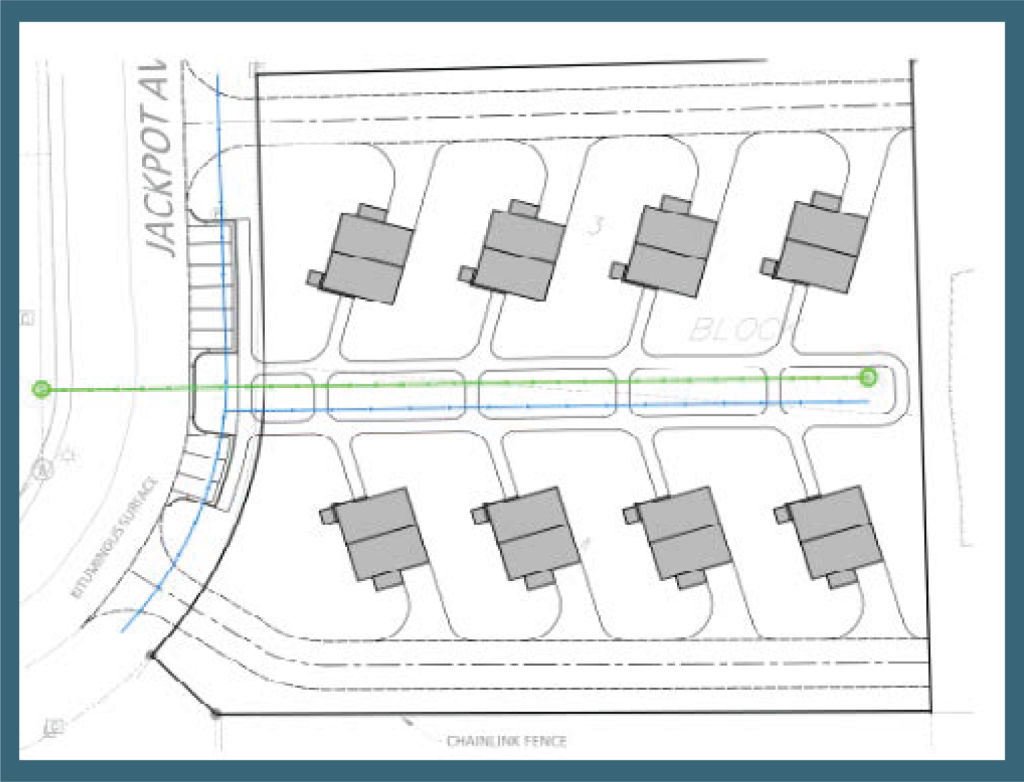
Successfully securing funding for infrastructure, new construction, and rehab (including the creation of an emergency rehab loan program for Tribal members). LSIC’s first-ever application to the Federal Home Loan Bank for construction subsidy for 8 elder units and 2 single-family homes was funded, as was their application to HUD’s competitive IHBG grant application.
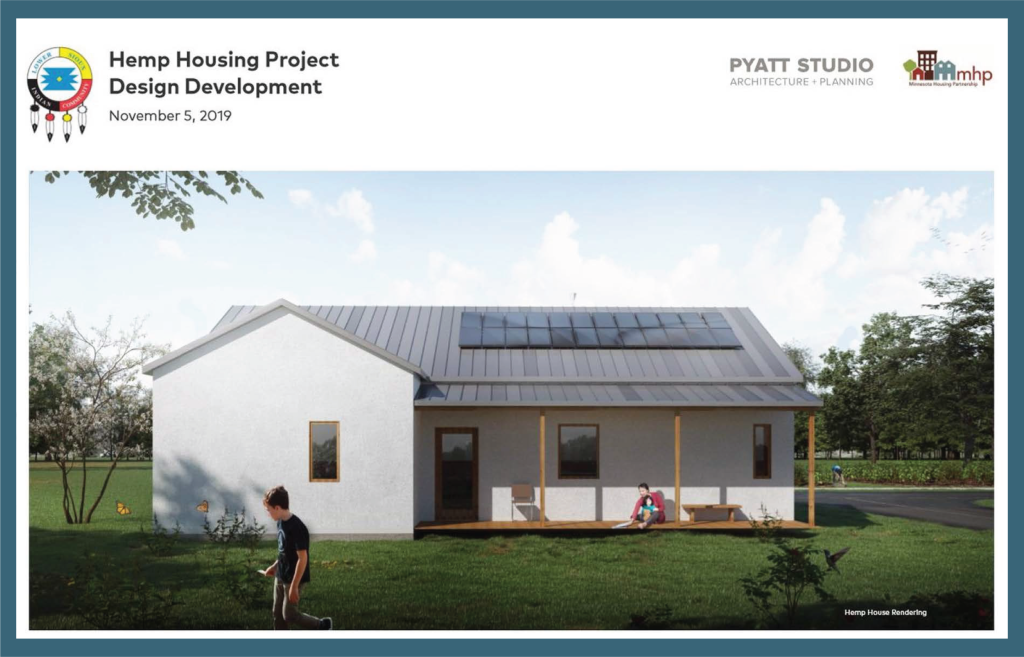
Creating site and housing design standards; the final design documents have been completed by architects and engineers for the housing units.
Creating a strategy of utilizing the local production of hemp in a closed-loop system to employ local/regional people in the farming of hemp, production of hemp hurd/hempcrete, and the installation of the products into housing units.
Completing a feasibility report and business plan (aided by funding from MHP’s Rural Capacity Building program). The preliminary feasibility study/report was used to apply and secure $1.5 million in State EDA funds through the State of Minnesota.
Throughout the work, MHP participated as an advisor, supporter, and development team participant, providing the necessary technical assistance to get 10 houses funded!