
• Tribal teams collaborate on food sovereignty, affordable housing and more

    The Native Community Development Institute supports and strengthens the capacity of Native communities to reach their community development goals through collaborative, self-styled trainings, peer-to-peer workshops, and customized assistance. 

    Hosted by the White Earth Band of Ojibwe at the Shooting Star Casino in Mahnomen, the Native Community Development Institute (NCDI) met in May for its second two-day workshop. Similar to the Housing Institute, sponsored by MHP and the Greater Minnesota Housing Fund, the NCDI is an opportunity to build capacity and foster regional collaboration among Tribal departments from three tribes in Northwest Minnesota. The White Earth, Leech Lake, and Red Lake teams have expressed interest in a wide range of issues, from land use planning to food sovereignty to increasing community engagement.

    This second workshop focused on establishing goals, timelines, and assigning tasks for the project that each team has established. Featured guest presentations included:

    • Dr. Richard Todd, a Vice President at the Federal Reserve Bank of Minneapolis and Advisor to the Center for Indian Country Development, who discussed data collection for use in obtaining funding resources
    • Cris Stainbrook, Executive Director of the Indian Land Tenure Foundation, who spoke about issues surrounding the development of Tribal land, particularly the use of GIS as a tool to uncover land use obstacles
    • Northwest Minnesota Foundation’s Nate Dorr presented an introduction to the Foundation and its work
    • MHP’s Jeremy Schroeder and Libby Murphy gave a policy update

    The Leech Lake Team, based out of north-central Minnesota, described a number of motivations to participate in the NCDI. These ranged from internal community topics, like drug and alcohol abuse, education, and loss of spirituality, to broader organizational issues, like data sovereignty, desire for increased institutional knowledge and vision for the future, and increased capacity in the form of larger shelters and homes.
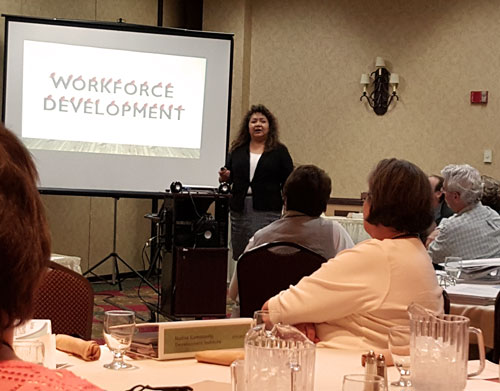
    Initially, the team decided to focus on a data management and data sharing project to improve how the tribal community stores, manages, and shares data within tribal government agencies. With the purchase of data management software and training to go with the software, that project is well underway. The team is now creating a workforce development program to build skills, training, and job opportunities for tribal residents, to prepare for future job markets.

    The Red Lake Team, based in northwestern Minnesota, highlighted three key priorities before the NCDI convened:

    • Youth empowerment: Addressing concerns such as suicide and drug/alcohol abuse with cultural teachings and other social programs
    • Foods initiative: Developing local food production and food sovereignty for the Red Lake Nation, addressing access to healthy foods, and decreasing health issues such as obesity and diabetic issues
    • Land use collaboration: Connecting land use and zoning plan with the comprehensive and strategic planning currently happening

    The Red Lake Team is pursuing the creation of a land use plan that ties into their strategic plan and departmental activity plans and incorporates physical features including motorized and non-motorized transportation, natural and built environments, infrastructure and energy locations, and culturally significant land uses and sites. The benefit of the plan is that it’s reservation-wide, incorporates the input of all tribal offices and Red Lake citizens, and will guide future growth and development activities.

    The White Earth Team, also based out of northwestern Minnesota, hopes to build on the strategic planning initiative that began before the NCDI and focused on assisted living facilities, community business opportunities, and financing of community facilities as their NCDI goals. They emphasized further issues like affordable housing, workforce development, and increased programs for youth as other topics they hope to address in the future.

    During the workshop the team articulated the need for supportive housing that would give Tribal members a safe place to live and at the same time receive the services needed to be successful as they move forward with their lives. The team is working on a development that would provide housing and services for families and an additional program that would serve single men. The team laid out a time line, objectives, and duties for each team member.

    The next NCDI workshop will be September 20-21.
  • Ahead of the Curve: Data drivers for housing in Minnesota

    “Now is a pivot point for the economy and the housing market,” Minnesota Housing Commissioner Mary Tingerthal said. “There are big issues emerging.”
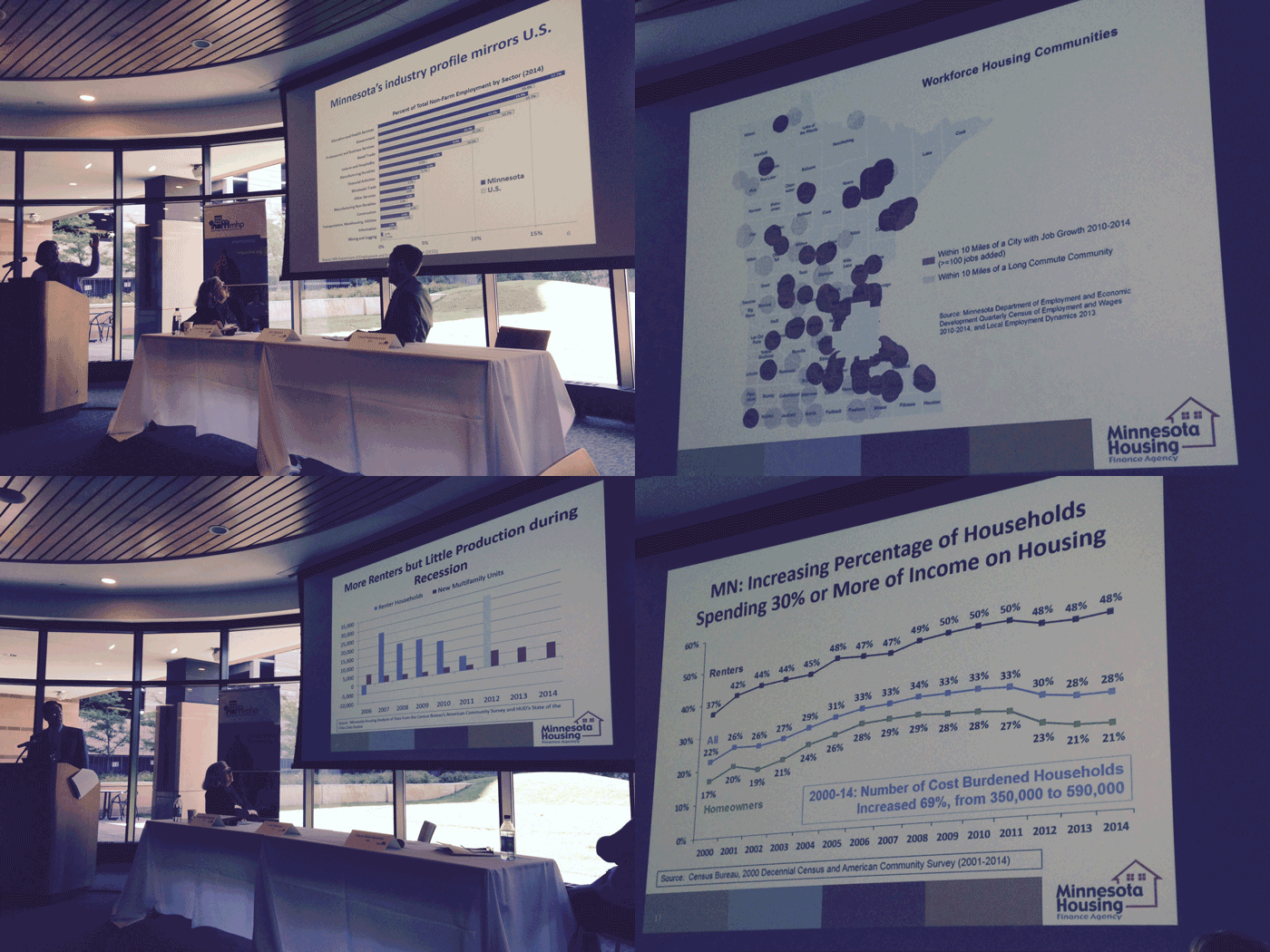

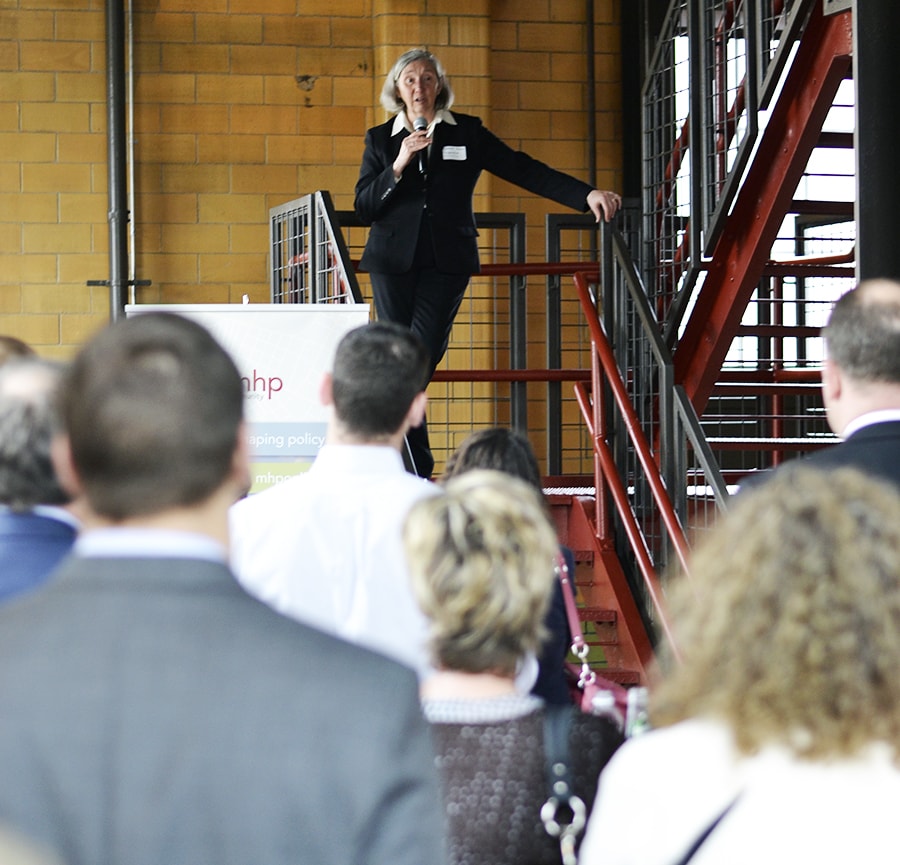
    This week, at MHP’s latest Investors Council breakfast, more than 100 developers and advocates came together to look beyond the chaotic legislative session and consider emerging trends that impact housing across the state.

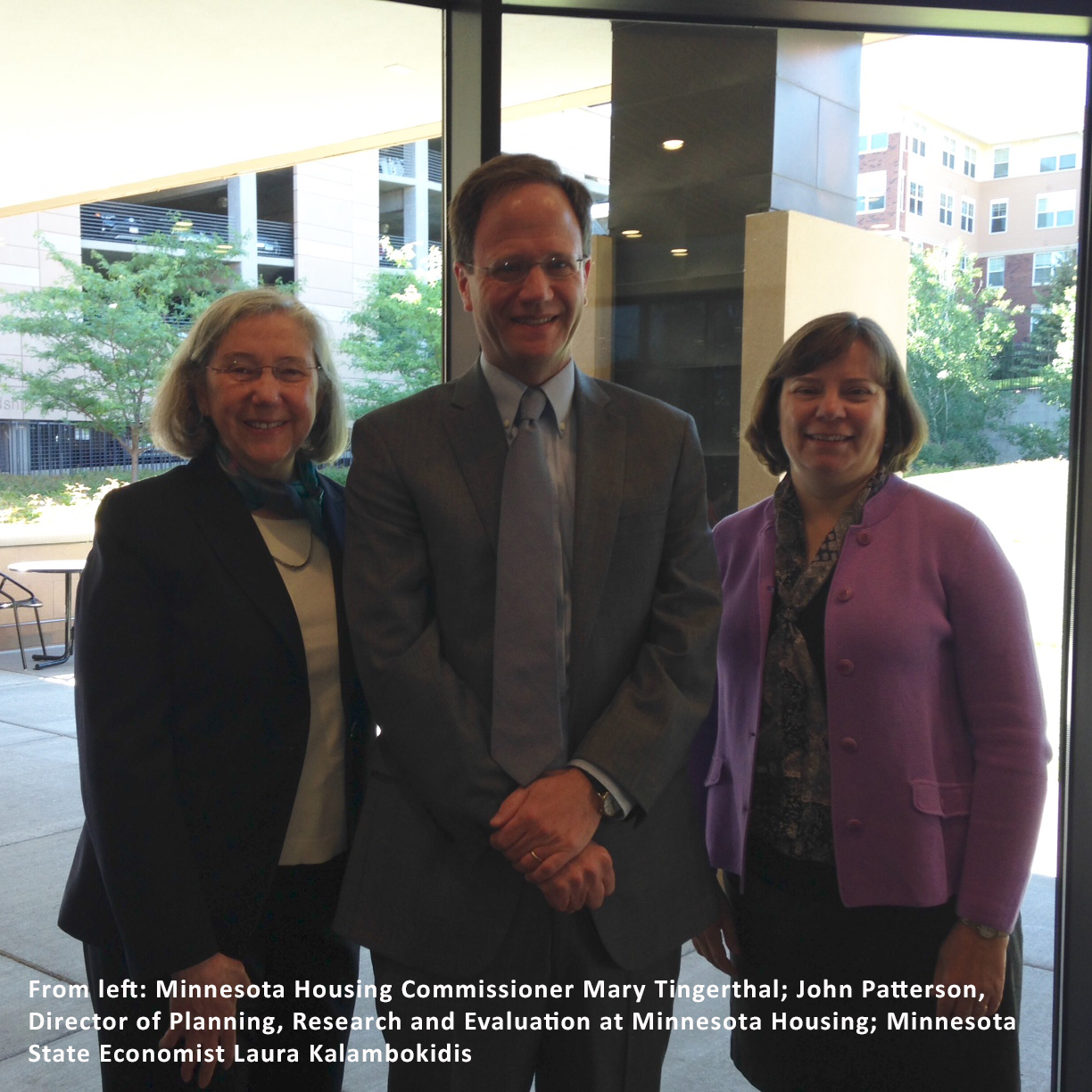
    Along with Tingerthal, MHP welcomed two key leaders — Minnesota State Economist Laura Kalambokidis and John Patterson, Director of Planning, Research and Evaluation at Minnesota Housing — who addressed critical questions.

    How do we stack up against the rest of the nation when it comes to key economic indicators? What’s the state of affordable housing in Minnesota? In our conversation “Ahead of the Curve: Data drivers for housing in Minnesota” we found out.

    Top take-aways from Minnesota State Economist Laura Kalambokidis

    In her presentation, Kalambokidis noted that Minnesota has weathered the global slowdown reasonably well. While real GDP growth has been moderate, it has been even slower in other countries, attracting investment to the U.S. and effectively strengthening the dollar.  

    Economic expansion is expected to continue in the U.S. — especially in Minnesota where we have a diversified economy. Job growth and low interest rates have led to an increase in consumer spending; because of this, we can expect real GDP growth, which will feed into the housing market. This not only creates demand for more housing (as people likely move here for jobs), but it also means more Minnesotans are able to pay for housing.

    Download the slides here 

    Prior to the recession, Minnesota’s total building permits outpaced household formation, meaning there were many houses being built but not enough people to occupy them. Following the recession, household formation and building permits issued began to pick-up.

    Consumer fundamentals are driving the household formation bubble. The Minnesota unemployment rate remains well below the U.S. unemployment rate — the 4th lowest in the country. Employment is growing in nearly all of the economic regional centers of the state, however unemployment by race disparities persist, with black unemployment twice that of white unemployment in the state.

    However, the labor market is continuing to tighten. Employers will thrive if they find those pockets of unemployment and utilize them. Due to demographic trends, Minnesota has had very slow labor force growth, due to the aging of the baby boomer population. As the market tightens, demand increases for labor and supply decreases.

    The new task for companies will be to find ways to attract workers, and, in our current state, productivity matters even more. This means we will need to make further investments in areas like health, education, and infrastructure (including housing) to attract and retain employees. Minnesota cannot afford to leave any workers behind.

    Top take-aways from John Patterson

    As the housing market picks up, the state needs to make sure that we create opportunities for all people to find homes. Household formation is increasing, meaning there are more people looking for long-term stable housing. Unlike the past, though, household formation was greater among renters than homeowners in recent years. However, fewer new multifamily units were added to the market during the recession, and this continues to limit housing options and decrease housing affordability.

    Households are increasingly cost burdened. Median renter income has decreased, while rents are rising. Wage growth is needed at the lowest income levels, targeting the renter population.

    Low vacancy rates have been conducive to rising rents; and while multifamily housing has remained somewhat stable since recovering from the recession, the market for single family housing remains greatly affected. Although demand has shifted since the recession with an increased demand for rented units in contrast to owning units, very little production has occurred of rent available buildings because of the crash.

    Currently in the Twin Cities metro area, owning a home is more affordable than it was in 2006. Particularly when viewing the market through a demographic lens, the bulk of the population is currently in a transitional phase when they are either exploring homeownership or “leaving” their home due to aging. Historically beginning at the age of 25, today that the transition is occurring later and later. This is likely a result of the recession’s impact on that age group.

    In Minnesota, as well as across the U.S., the percentage of people of color is increasing. Minnesota has one of the largest gaps in homeownership between white and other races. Closing that gap and supporting homeownership across all races will build equity in the state.

    Click here for the full presentations from Kalambokidis and Patterson.

    The MHP Investors Council is a professional network of businesses and organizations involved in the affordable housing industry that support MHP’s work. Members benefit from cross-sector networking events, housing advocacy efforts, and up-to-date housing policy research and analysis. 


  • Legislative session recap: Wins (and loss) for affordable housing

    By Jeremy Schroeder, MHP Policy Director

    The looming threat of housing projects failing. The continued loss of affordable units. The prospect of missing out on federal money. And the upcoming elections in November.
    When the Minnesota state legislature convened on a cold afternoon in March, we hoped all those pressing factors would compel elected officials to act. But, as the weeks rushed by, our hopes for a productive session faded.

    As part of the Homes for All campaign, the Minnesota Housing Partnership supported $130 million dollars in bonds for housing, specifically $110 million in housing infrastructure bonds and $20 million in general obligation bonds. These bonds would support home ownership as well as preservation of existing homes. The bill would also expand the eligible uses for these fund to include senior housing.

    Unfortunately, after a flurry of last-minute confusion and chaotic deal-brokering, the legislature adjourned without passing a bonding bill. Still, by advocacy standards, the Minnesota Housing Partnership had a great year.

    We met with more than 70 elected officials on both sides of the aisle and rallied hundreds of emails and phone calls to lawmakers to emphasize the urgency of increased affordable housing for so many Minnesotans. We garnered Republican support for a second bonding bill in the Senate and, with your help, we were able to stop cuts to the Challenge fund and win funding for:

    • $250,000 for the Landlord Incentive Fund Pilot within the Family Homeless Prevention and Assistance Program to rent to at-risk tenants
    • $500,000 for a Rental Assistance for Exploited Families Pilot Program within the Housing Trust Fund that provides rental assistance to individuals and families who are at risk of being homeless and who have been victims of gender-based violence, including domestic violence and sexual assault
    • $750,000 for the Workforce Homesownership Program to increase the supply of affordable, owner-occupied multifamily or single family housing statewide (includes a new use of funds for infrastructure in manufactured home parks)
    • $500,000 for housing in an area with a job training center
    • $500,000 to Build Wealth Minnesota to fund enhanced financial counseling for families
    • A policy change related to Manufactured Home Relocation Trust Fund, which increases relocation compensation from $12 to $15 to owner/occupants who reside in parks where a partial or complete closure has occurred

    While we didn’t secure bonds for housing, I’m proud of the work we did accomplish.

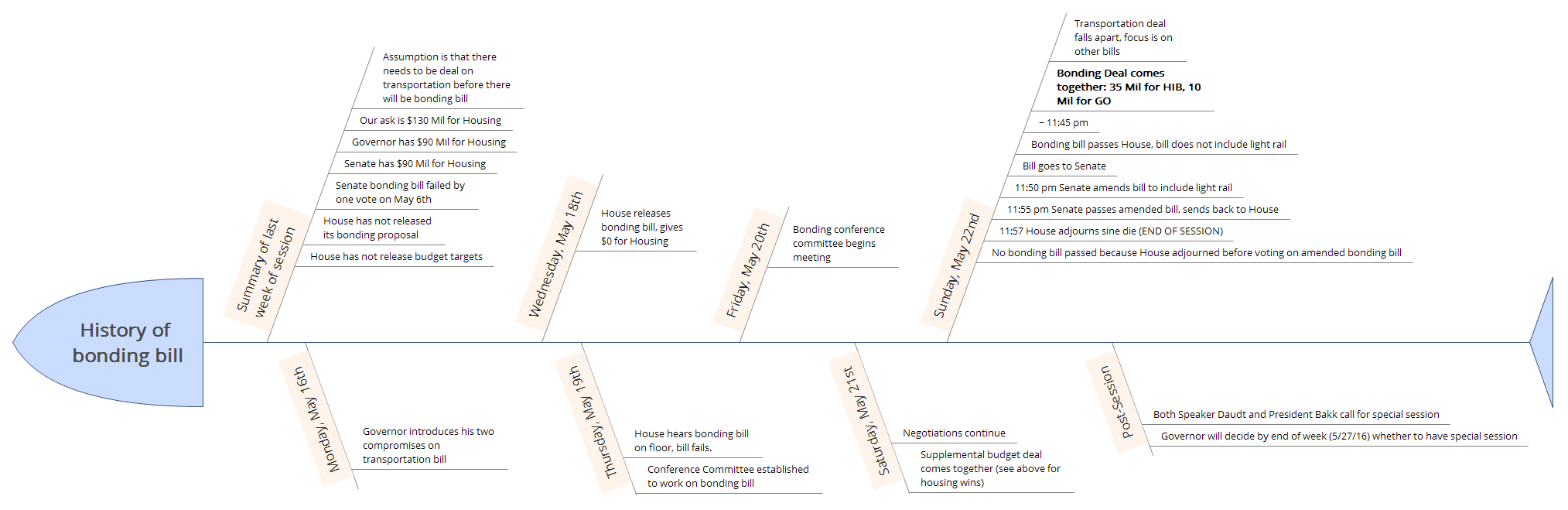
    The session was as unpredictable as the Minnesota weather, but deep down, I sensed that the need was so great that surely we’d get a bonding bill passed. The policy team was at the Capitol on the final day of the legislative session and we started hearing that a bonding bill would hinge on securing a deal on a controversial transportation issue We knew that was bad news because it likely meant there would be less money spent on housing. The rest of the day we tried to track down our supporters, stressing the importance of housing, and identify other legislators who were influencing the negotiations.

    Unfortunately, the negotiations were confined to a few legislators in leadership. But, fortunately, MHP’s legislative strategy to bring our supporters to the Capitol to meet with their legislators worked. Your stories about the need for affordable housing ensured legislators signed on early in the session to support our bonding ask. In the sprint to the finish, legislators stayed committed to the inclusion of housing in any bonding deal. The issue in question? How much money would they include.

    Click to view larger

    By the afternoon, the news broke that there would not be a transportation bill and that negotiations would move forward on the bonding bill.  While this was disappointing for our transportation allies, it did improve our chances of having a bonding bill. By late afternoon, rumors circulated that an agreement on bonding had been reached. No one knew the numbers but the pace started to pick up.  Finally, spreadsheets were released from the House that showed the agreement had $35 million for Housing Infrastructure bonds and $10 million for general obligation bonds.

    As the clock moved toward midnight and the adjournment deadline, the storm rolled in. With about 30 minutes left in the 2016 regular session, the House took up the bonding bill. In the rush, there was little time to review the details of the bill. With minimal debate, the bill passed the House with just 15 minutes left in the session. The Senate took up the bill and immediately brought up that white-hot transportation issue: the lack of funding for the Southwest light rail. Quickly, an amendment was added to include this funding. 

    Within a matter of minutes, the storm had come to a head. The Senate’s amendment meant that the bill had to go back to the House to be voted on again. There were only a few minutes left before midnight but in theory the bonding bill could be passed. That is, if the House was in session. Word of the amendment reached the House and the Minority leader motioned that the House would adjourn, meaning no vote on any additional bills. The motion passed, the House adjourned and just like that the chances of passing a bonding bill were extremely slim. The Senate debated whether to remove the amendment from the bonding bill but the midnight deadline was reached and the Senate was forced to adjourn. 

    When the sun rose the next day, there was no bonding bill. Both the Senate and House have asked the Governor for a special session but neither side has mentioned where they would compromise to make a deal on bonding a reality. As of June 2, there is no special session scheduled. Earlier this week, the Governor released a list of what he would need to be in a bonding deal in order for him to call a special session. Neither the Speaker of the House or Senate President have said they are willing to make all of these concessions and we are currently waiting for negotiations to resume between the parties.

  • Planning for the future of Pawhuska Indian Village

    There is a saying that “great things come in small packages” and that can definitely be applied to Pawhuska Indian Village, a small tribal village located within the Osage Nation in northeast Oklahoma.
    The Village is a cultural hub of the Osage Nation, drawing Osage from around the United States to the In-Lon-Schka dances and other cultural events that take place annually within the community.

    Because of its cultural importance, Village leaders have dreamed about improving their community for current and future generations but recognized they couldn’t achieve their vision without outside resources and assistance.  

    Community development efforts take shape

    In 2014, MHP learned about Pawhuska Indian Village’s hopes for improving their community and submitted an application for HUD Rural Capacity Building (RCB) funds to assist them in their efforts. The funds were awarded and MHP staff began working with Village leaders in 2015 to actively address their community development goals.

    The Village’s first goal is the creation of a community wide master plan that includes a land survey identifying utility and well locations, flood zones, and easements. The survey has to be completed first because most of the infrastructure information available for the Village has not been updated in more than 50 years and current data is critical for development to occur. In addition, with funding support from MHP, Native-owned Blue Star Studios was hired to lead the master planning work with assistance from the University of Oklahoma Regional and City Planning Department.

    Click here for a story in the Osage Nation news.

    But, the work doesn’t end with the completion of the master plan. MHP is already planning for the next stage of development including the creation of single family homeownership opportunities and fostering economic development opportunities in the community. MHP is currently assisting the Pawhuska Indian Village Five-Man Board to find funding and partners for these activities to occur.

    Collaboration is key

    Community collaboration has played a key role in turning dreams into reality for the residents of Pawhuska Indian Village and it has happened because of the dedication and hard work of the Pawhuska Indian Village Five-Man Board, a citizenry committed to improving their community, the support of Osage Nation leaders, the expertise of planning and development professionals, and the funding and technical assistance provided by MHP.

    With so many elements coming together at one time, this project has been particularly exciting. The community has moved from vision, to planning, and will soon begin implementation. There is a lot of work still to be done, but with the support of so many agencies and individuals, changes are already taking place.  

    Stay tuned for more updates in coming months!

    Photo by Blue Star Studios


  • MN Housing Board approves 2018 Qualified Allocation Plan

    At the monthly board meeting of the Minnesota Housing Finance Agency, Commissioner Mary Tingerthal (pictured right) updated the board on new tax credit legislation, the Wells Fargo LIFT program and recent press concerning artist housing. The board also approved the Agency’s 2018 Qualified Allocation Plan (QAP), which includes new scoring criteria for Indian Reservations and process changes for developer applicants. Agency policy staff updated the board on the results of the tumultuous 2016 Legislative Session and the board discussed a $4 million request from Habitat for Humanity for its newly minted home purchase program. Read more below.
     

    Tribute to George Garnett

    Chair John DeCramer opened the meeting with a tribute to board member George Garnett who unexpectedly passed away recently.

    Commissioner’s Monthly Report

    Commissioner Mary Tingerthal started her updates with enthusiasm for a bill introduced in Congress by Senator Maria Cantwell that would increase the housing tax credit program by 50%. Tingerthal said this bill’s introduction represented a move in the right direction after many years of playing defense. Tingerthal also spoke positively about neighborhoods in Minneapolis and St. Paul being selected for the Wells Fargo LIFT program, which allows home purchase borrowers to receive $7,500 in down-payment assistance from Wells Fargo and those resources can be coupled with entry cost assistance available from Minnesota Housing .

    Tingerthal also noted a report co-authored by Myron Orfield (and highlighted in related news articles), which castigates public investment in artist housing. She said that the focus of the Orfield report was on two expensive historic rehab developments but created the impression that all artist housing is expensive and segregated. Tingerthal pointed out that Minnesota Housing had not invested in these two projects because of their high cost, but years ago had provided some financing for a modest development that was targeted for low-income artists.

    Changes in Homeless Management Information System

    Tingerthal updated the board on a change of direction regarding the Agency’s role in the Homeless Management Information System. Because a new vendor has been selected by Continuum of Care organizations, the Agency will not have the lead role it had planned to in overseeing Minnesota’s HMIS. Because of this change, Minnesota Housing will dissolve the HMIS advisory task force it formed in early 2015.

    Approval of 2018 QAP

    The board gave approval to the revised 2018 Qualified Allocation Plan (QAP), governing the allocation of federal housing tax credits. Program director Kayla Schuchman stated that, in response to comments, the Agency made three modifications to the 2018 QAP.

    1. The proximity to jobs requirement was dropped for evaluating dial-a-ride services on Indian reservations.
    2. Modifications were made to simplify the process and the self-scoring worksheet, and to provide developers a better understanding of the competitiveness of their proposals. For instance, the QAP will state that only proposals scoring a minimum of 70 points (formerly 30) will be considered for 9% tax credits. More simplifications will come in 2019.
    3. To better manage scarcity in tax exempt bond authority, proposals seeking those bonds (and related 4% credits) must score a minimum of 40 points (formerly 30) to receive an allocation of credits, and the amount of tax exempt bonds may not exceed 53% of project basis.

    Board member Rebecca Otto said that she appreciated the support for large-family apartments in the new QAP and hoped that, in the coming year, the Agency will investigate recommendations for enhanced energy efficiency and promoting super-long term affordability. Board member Terri Thao endorsed the new definition of homelessness linked to tribal experience and said 50-year affordability is an interesting idea deserving further research. Board chair DeCramer added that he appreciated the Agency addressing the complexity of the LIHTC process.

    2016 Legislative Session Update

    Agency policy staff Ryan Baumtrog and Katie Topinka provided the board a summary on how housing fared in the recently concluded 2016 state legislative session. The final bonding bill agreement, which failed to meet the deadline, would have provided the Agency $35 million in housing infrastructure bonds and $10 million in general obligation bonds (for public housing rehabilitation). The tax bill that passed did not include any of the proposed tax credits for workforce housing, nor did it include TIF provisions that would have impacted use of pooled TIF or increased incomes for housing districts.

    Regarding appropriations, the Agency will receive $250,000 to create risk mitigation reserves available to owners that rent to higher risk tenants; administration of this pilot program, the Landlord Incentive Fund, will be through the Family Homeless Prevention and Assistance program. Another $500,000 will provide rent assistance connected to victims of gender-based violence, for example, forced marriage or domestic abuse. $750,000 will be available to support homeownership (including infrastructure improvements in manufactured housing parks), and $500,000 will go to the family stabilization program of Build Wealth Minnesota, which is focused on preparing households for homeownership.

    Policy changes passed by the legislature include increasing the age within the definition of homeless youth from those under 22 to those under 24 years of age, and making Indian tribes eligible to administer the Family Homeless Prevention and Assistance program. Finally, the fees for contributions to the manufactured housing trust fund will increase from $12 to $15 per unit, and the benefit to owners in  parks that close in the future will also increase.

    New Four-Year Commitment for Metro Habitat for Humanity

    The final topic of discussion concerned a proposal from Twin Cities Habitat for Humanity for a four-year advance commitment of Pool 3 (Agency foundation) funds, $4 million total, to support the organization’s new home purchase financing program. This would enable the metro Habitat chapter to double its annual production, increasing to about 100 homes per year. Staff wanted the board’s reaction to this type of commitment, and added that the Agency would not release funds until other funding partners commit and there is demonstrated demand for the program.

    Board members expressed support for the Twin Cities Habitat proposal but wanted assurance that the program will still serve households whose religious beliefs restrict the payment of interest, because the Habitat program is one of the few that has worked for Muslim families. They also wanted assurance that Greater Minnesota Habitat chapters would not be harmed. Tingerthal responded that the metro Habitat has been meeting for some time with Islamic leaders to ensure the eligibility of families whose culture restricts use of interest-bearing debt.

    Regarding Greater Minnesota chapters, Tingerthal said that under the new arrangement Twin Cities Habitat would not be eligible to access funds in the current Habitat Minnesota loan pools during the four-year period of the new arrangement.  As a result of this restriction, it is projected that Greater Minnesota affiliates will have sufficient access to funds from the existing pools. Board member Terri Thao said that she knows private foundations were wrestling with Impact Investment proposals for this and other programs and considering how that might impact their grant making. Tingerthal said that Sunrise Bank will be the loan origination partner for Twin Cities Habitat and that 90% of those on Habitat’s waiting list are households of color.   

  • New Report: Growing Number of Minnesotans Can’t Afford Rent

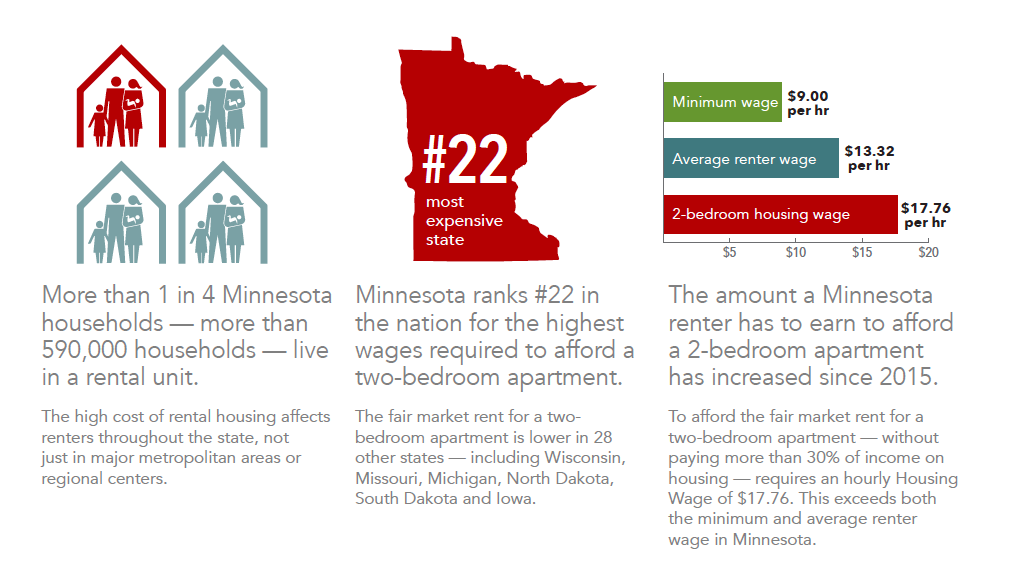
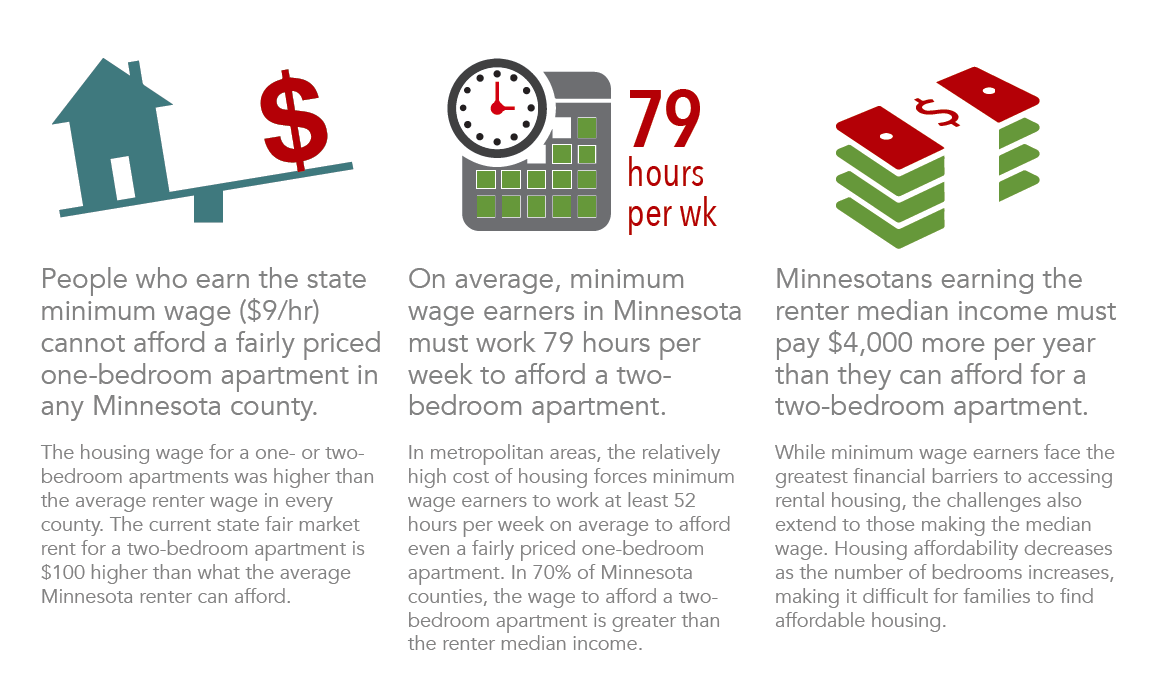
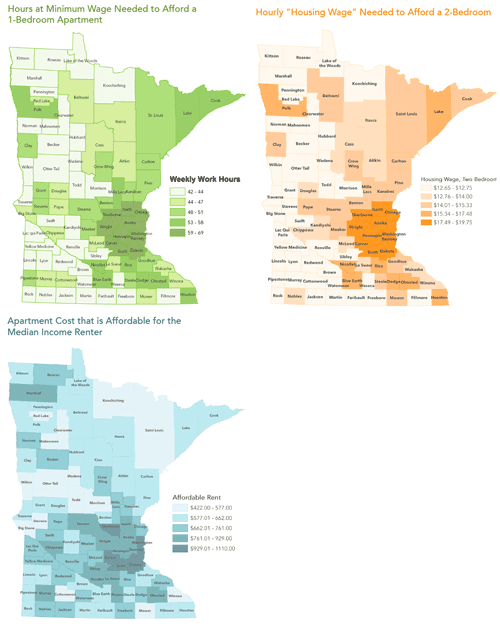
    The Out of Reach report, produced annually by the National Low Income Housing Coalition, spotlights the growing gap between what rental housing costs and how much renters earn. According to analysis by the Minnesota Housing Partnership, Minnesota residents in every corner of the state face significant housing hardships.

    “Minnesota must face the growing crisis of families being unable to cover housing costs,” said Chip Halbach, Executive Director of the Minnesota Housing Partnership. “The price we will pay for our inaction will be seen across the age spectrum, from school children with unstable homes falling behind in their studies to senior citizens forgoing medicine and food to retain their shelter.”

    “The shortage of stable and sustainable rental housing is hurting communities throughout Minnesota — and we need to address this issue now,” said Jeremy Schroeder, Policy Director for the Minnesota Housing Partnership. “The rising costs of rent and the shrinking supply of available units makes growth in greater Minnesota impossible. It’s clear that the most important way we can help struggling working families is to provide more access to affordable, stable housing.”

    Executive Summary

    Click here to read the full report.

  • MN Housing Board discusses legislative session updates and housing trends at April meeting

    In her opening remarks Commissioner Tingerthal presented a rundown on pending housing legislation. She mentioned Rep. Bob Gunther’s successful effort on the House floor to reverse $4.5 million of a committee’s proposal to move $5 million previously appropriated for the Challenge program to DEED’s workforce housing fund. She added that the House and Senate supported a $250,000 appropriation to create a risk mitigation program that can be used to compensate owners for damages done by higher risk tenants. Also in appropriations and related to the Governor’s racial equity proposals, the Senate supported $3 million for downpayment assistance and one-half million for housing counseling. The House did not fund either program.

    Agency updates

    Tingerthal said that she had been asked by the Federal Housing Finance Agency (the body that oversees Fannie Mae and Freddie Mac) to present the Agency comments on the Duty to Serve obligation now being developed. This obligation will stipulate how the secondary mortgage market institutions are to support low income households and underserved markets.

    Anne Smetak, a new staff attorney whose background includes providing legal services to homeless people in Washington DC was introduced to the board. The board was told that Ann’s hiring brought the Agency’s complement of full time attorneys up to four, the most it has ever employed. Four new employees in the Multifamily division were also introduced.

    The board approved a plan to use temporary funds in a manner that minimizes the impact of private activity bonds on the bonding authority limit, or cap, of the Agency. These are federally authorized tax exempt bonds; the amount allowed for each state is set by Congress. During the Great Recession, Minnesota did not come close to utilizing its cap. Now with an improved economy the state housing agency and other Minnesota governmental issuers have reached or will reach the cap.

    State housing trends and continued gaps between income and rent

    Planning, research and evaluation director John Patterson led a lengthy board discussion on Minnesota housing trends. The Agency’s report on trends is the starting point for the 2017 Affordable Housing Plan (AHP), a one-year spending plan, said Patterson. For this year’s planning the Agency will be seeking public comment through May 20, then produce a draft plan in mid-August. The board is to adopt the 2017 AHP at its September board meeting.

    Patterson emphasized a number of trends impacting the Agency’s work. For instance, the state experienced a 59% increase in cost burden over the last 15 years. With the current tight rental and ownership markets, high cost burdens are expected to continue. The sustained divergence of rents and incomes was a significant contributing factor to cost burden. Since the year 2000 inflation adjusted renter incomes fell 12% while rents increased 7% — a 19% spread said Tingerthal.

    Commissioner Tingerthal pointed out that a significant change in ownership affordability, the cost of buying an average cost home decreased 22% since 2006, but other factors such as student debt and tighter borrowing standards meant that many were not able to benefit from the increased affordability.

    The shortage of workforce housing in Greater Minnesota was seen as another important trend. Patterson said that it would take an additional 4500-7000 housing units to bring the vacancy rate in Greater Minnesota job centers to 5%, the point of market balance.

    A positive trend was the drop in homelessness. The reduction in homelessness was particularly significant among families.

    Regarding demographic factors, the Agency believes that with most baby boomers between the ages of 51 and 60, and mostly homeowners, there will be time to plan for the movement of this population to rental, which typically happens at a higher rate when a senior reaches the age of 80.

    Continued loss of affordable housing rental units and the issue of cost burden

    Board and staff discussed the loss of non-subsidized rental housing. Tingerthal said that the state has 300,000 apartments affordable to a household with an income of 50% AMI and of this amount, 200,000 have no income constraints. With investors now seeking to refinance and reposition the Twin Cities supply of three story apartment buildings there is significant threat to the loss of housing affordability – this is a situation that has “burst onto the scene in the last six months,” said Tingerthal. The tight rental market also threatens the viability of the voucher program as owners either are pricing apartments above what rental voucher holders can access or owners are simply refusing to participate in the program. Tingerthal then pointed to efforts, including that of GMHF, to create an investment fund to provide financing to buyers of lower-rent apartment buildings who intend to retain affordability. Minnesota Housing will likely be asked to participate in these funds she added.

    The scarcity of lower cost housing is not just rental, continued Tingerthal. She then pointed to the recent Parade of Homes where only two of the hundreds of homes profiled that were priced under $200,000 (one of which was located in Hudson, WI), and very few were priced under $300,000.

    Board member Terri Thao asked about solutions to the cost burden dilemma that were being pursued in other areas of the country. Tingerthal responded that some local successes were occurring, but that a problem to having a national response was that the shortage of lower cost apartments was localized to hot markets. She then added that this July a work group sponsored by the National Housing Conference is coming to the Twin Cities to convene representatives of 15 metropolitan areas facing the challenge of gentrification.

    Board member Rebecca Otto asked about the role of “tiny houses,” popular among millennials, in expanding affordability. Tingerthal said that she would take a look at this housing type. Board member Thao added that St. Paul was now looking at ways to encourage development of accessory dwelling units, but she said that the cost of even these units was averaging $160,000.

    Board member Stephanie Klinzing asked about manufactured housing. She said that they are here, but that they are often not in good condition. John Patterson said that the Agency was reevaluating its role in financing this housing type, and providing background on the topic might be a focus of the Agency’s summer interns. Board member Joe Johnson, a banker from Duluth, said that there was no secondary market for manufactured home loans so lenders are not making them. He then turned to the general lack of housing inventory, stating that his bank has pre-approved 600 borrowers who were out looking for homes to buy. Tingerthal picked up on the comment about the lack of inventory stating that she had heard recently from partners in the Moorhead area that a law limiting development of lower cost homes was the state statute mandating sprinklers in for-sale twin homes and townhomes. She concluded by saying, turning back to manufactured housing, that manufactured home parks will come back on the radar… that very day the Agency got notice of an upcoming draw on its relocation fund established to compensate manufactured home owners in the case of park closings. While this is the first high impact closure in several years she said that we now might see more.

  • Capitol Countdown for housing advocacy

    With only four weeks left in the legislative session, MHP and Metropolitan Consortium of Community Developers (MCCD) co-hosted a Capitol Countdown event at the Schmidt Artist Lofts on Tuesday, April 26th. The event brought affordable housing developers, advocates, and policy officials together for a call to action to increase resources for affordable housing at the Capitol.

    MCCD Public Policy Director Darielle Dannen and new MHP Policy Director Jeremy Schroeder updated attendees on housing bills making their way through the legislature, and Commissioner Mary Tingerthal reflected on the potential effects of our responsive actions to these bills. Each speaker encouraged those in attendance to call their legislators to stress the importance of pending housing legislation. Given transportation and other priorities, if legislators don’t hear from housing industry stakeholders, the necessity of increasing resources to affordable housing may fall to the background.

    Dannen provided an overview of pending amendments to the Challenge Fund budget that would cut the program by $5 million in 2017, and transfer these funds to the DEED workforce housing grant program, a strictly market rate program only in Greater Minnesota. The amendments would greatly reduce resources for affordable housing. Both policy directors had encouraged attendees to voice their concerns about funding cuts to legislators.  Due to these efforts, legislators returned $4.5M of the $5M originally cut from the Challenge Fund. Many legislators said that the outpouring of calls and emails was critical to the passage of the amendment to restore the $4.5M.

    Schroeder introduced himself as someone new to his position at MHP and provided updates on several active bills. These bills would limit the practice of pooling TIF to finance affordable housing; create a homeownership fund in Minnesota Housing Finance Agency (MHFA); establish a housing tax credit for strictly market-rate rental housing in greater Minnesota; and establish a state 4% tax credit that mirrors the federal 4% Low Income Housing Tax Credit (LIHTC).

    H.F. 3758 / S.F. 3433 would eliminate the use of TIF pooling. “Pooling” is the practice of using tax increments for activities located outside of the boundaries of the district from which they were collected. The bill is intended to provide clarity to the original statute. The bill could lessen the pooling of tax increments received over the life of the district.

    Many communities pool the permitted percentage of increments and expend the pooled revenue to provide additional gap financing for affordable housing development.  This amendment would take flexibility from local communities and limit their ability to pledge money for large upfront costs typical in housing development. For example, according to the League of Minnesota Cities, the bill would mean that if a city spent 10% less than allowed for annual increment in years five to ten out of district obligations, the city could not catch up and increase the original percentage by 10% for a pooled expenditure in years eleven to fifteen.

    H.F. 3377 / S.F. 3167 establishes a workforce and affordable homeownership development program in MHFA funded from an ongoing appropriation based on the annual growth in the mortgage registry tax and deed tax. The fund would provide grants and loans to develop homeownership opportunities. The dedicated appropriation sunsets in 2026. It is expected to raise anywhere from $6 to $10M each year.

    H.F. 3841 / S.F. 3363 creates a workforce housing tax credit program for the development of market-rate rental housing in greater Minnesota. MHP does not support this bill because it is strictly market rate multi-family housing and cannot be paired with any other state, federal, or philanthropic resources that trigger income targeting. This provision limits communities from pairing sparse resources to develop housing most appropriate for each community’s needs. Additionally, the credit’s mechanics are incompatible with typical housing development timelines and investment structures.

    H.F. 3840 / S.F. 3489 would create statewide 4% workforce housing tax credit, which is intended to be paired with the federal 4% low income housing tax credit (LIHTC). MHP supports this bill but believes the bill could be improved to make the credit more attractive to investors.


    Commissioner Tingerthal emphasized two words to remember after making calls to the legislators: “non-partisan” and “results”. Commissioner Tingerthal stressed that the real achievements MHP, MCCD, and Homes for All have made are making the case that affordable housing is not a partisan issue, but rather an issue that affects all Minnesotans. The commissioner noted that the short supply of housing in both the metro areas and in greater Minnesota is a pressing issue that legislators need to address. Additionally, results are critical to future funding through the legislature. The commissioner emphasized that MHFA is extremely quick to get its appropriated money out the door. She mentioned that all of the Agency’s bond dollars from 2014 have been pledged to projects that have, at least, begun construction.  

  • 2×4 Report Contains Good News on the Housing Front, Except for Low-Income Renters

    MHP’s recently released 2×4 report shows some of the lowest foreclosure and eviction rates of the past decade, and a boom in multifamily home construction. But low rental vacancy rates and steadily climbing rents continue to tighten the competition for lower-priced rentals, putting further strain on most renter households. 

    Rents and Home Sales Prices Continue to Increase

    The median home sale prices rose in metro areas throughout the state for the fourth year in a row, with the greatest increase in the Twin Cities metro. In 2015, the number of closed sales hit a 10-year high in the Twin-Cities, St. Cloud, and Brainerd. The Twin Cities metro saw the median sale price increase to $221,190 by the end of 2015, up 7 percent since 2014. Increases in housing prices may reflect a competitive homeowners market in most metropolitan areas. In the Twin Cities, St. Cloud, and Brainerd, the supply of housing on the market decreased by roughly 13 percent between 2013 and 2015. 

    The state rental market also saw an increase in price and a decrease in availability by the end of 2015. From 2010 to 2015, the average monthly rent for a two-bedroom apartment in the Twin Cities metro area increased by 16 percent to $1,055, a monthly rent that is only affordable to people making at least $42,204/yr. Even if renters can afford the median priced apartment, they will likely have difficulty finding one. In 2015, the vacancy rate for apartments that cost $1,000 or less a month dropped below 2 percent in the Twin Cities.

    Evictions and Foreclosures Fall while Residential Construction Booms

    While housing costs are increasing, both renters and homeowners are experiencing greater housing stability in 2015. Evictions dropped by 6% to 18,280 across the state and the owners market saw only 7,212 foreclosures—the lowest number in a single year since 2005. All Minnesota counties saw decreases in foreclosure rates from 2014 to 2015, and for the second year in a row no county experienced a foreclosure rate higher than 1%.

    The home construction industry is making a dramatic comeback, with sale prices rising steadily in large metro areas since 2010. In 2015, the number of closed sales and new residential building permits issued reached a 10-year high in the Twin Cities, St. Cloud, and Brainerd metro areas.  Although most permits were issued to build single-family homes (12,616 permits), more permits for multi-unit buildings are being issued now than ever before. MHP found that 42.3% of all units permitted in 2015 were for duplexes, townhomes, or apartment buildings, the highest percentage since data collection began in 1995.

    Declining Rates of Homelessness Are Not Enough

    Homelessness continues to be a problem in Minnesota, especially among youth and unaccompanied minors.  Hennepin County data shows that the number of families experiencing homelessness in the county declined modestly since 2012. Yet the 2015 Wilder Statewide Homelessness Study reported that there are roughly 3,500 homeless youth and unaccompanied minors in the metro area. This number is far greater than pre-recession counts of homeless youth and unaccompanied minors. These findings show that rates of homelessness are still higher than pre-recession levels, especially among young Minnesotans.

    For more information or to inquire about this report, please contact Atticus Jaramillo at 651-649-1710 or [email protected].

    Written by Erin Olson, [email protected]

    Sources

    Vacancy Rate Figure: Marquette Advisors

    Foreclosure Figure: MN Homeownership Center, County Sheriffs Data

  • Watch the gap: district profiles show rising housing costs and declining incomes across MN

    The growing cost of housing in Minnesota hurts low to moderate income families and the communities they call home. From 2000 to 2014, the statewide median income declined among homeowners and renters, but housing costs increased, creating a housing cost burden for 1 in 3 Minnesota households.

    MHP’s 2016 Legislative District Profiles, released last week, document these trends using data specific to each legislative district, economic development regions, and the state. The profiles are created to accommodate busy schedules of housing advocates and local governments by providing a comprehensive yet concise overview of state housing trends, focusing on housing affordability, wages, the rental market, the homeownership market, and homelessness.

    Stable, affordable housing is the foundation for building strong families and communities, making the gap between incomes and housing costs a real threat to the viability of Minnesota. Legislators should consider the impact housing affordability has in their districts as they consider bonding and other bills in the current session.