• The name’s Bonds, Housing Bonds: Homes for All announces historic ask

    The Homes for All coalition is advocating for a historic $130 million in housing infrastructure bonds in the upcoming legislative session. The bonds will be used to preserve rental housing, develop new rental housing, develop homeownership opportunities, and create new units for Minnesotans experiencing homelessness. The ask includes a $110 million investment in Housing Infrastructure Bonds (HIB) and $20 million in General Obligation (GO) bonds for public housing and builds on the success of the coalition’s $100 million bonding ask in 2014.

    Part of the reasoning behind the $130 million ask is the anticipation of new housing needs across the state, namely housing for low-income seniors. A new proposed eligible use for the Housing Infrastructure Bonds would be senior-only housing. Currently over 149,000 elderly households in Minnesota qualify for affordable senior housing, yet only 23,400 affordable senior-only housing units are available. This group is the fastest growing population experiencing homelessness. The baby-boomer generation approaching the 55+ threshold will need more affordable senior housing than currently available. By investing proactively in this growing need, Minnesota can provide quality, affordable units for a growing senior population and ensure that Minnesota’s seniors can age in place.

    The coalition also anticipates increased housing investment needed to address Minnesota’s approved Olmstead Plan that details a program for improved, integrated living standards for households with disabilities. People with disabilities often require support services paired with their housing in order to thrive in their communities. More housing funds from a bonding bill would help create these supportive units and allow people with disabilities to better integrate into their communities.

    As part of Homes for All, MHP encourages all Minnesotans to endorse the $130 million for housing bonding request. This request represents a significant investment in Minnesotan communities that will provide lasting housing solutions. An estimated 4,100 low-income households will benefit from $130 million bonding dollars which is one step closer to housing stability for all Minnesotans.

    Sign on to endorse the Homes for All agenda. 

    *Note on bonding: Every even numbered year the Minnesota legislature passes a large “bonding” bill or “capital investment” bill that invests in larger projects across the state. Housing Infrastructure Bonds (HIB) and General Obligation (GO) bonds always figure into the larger bonding bill with HIB bonds used to finance private affordable housing developments and GO bonds going to preserve public housing. A bonding bill must pass the legislature with a three fifths majority and then be signed by the Governor. The Governor can then sign, veto, or veto by line (essentially vetoing specific projects) the larger bonding bill.

  • Moving senior housing forward in Mora, MN

    Guest blog from Rose Dunn, Executive Director of Mora Housing and Redevelopment Authority

    When I began working for the Mora HRA nearly nine years ago, there was a waiting list of 82 families for 67 affordable/subsidized units. Since that time, the HRA has added 23 units of senior subsidized apartments. And yet, today there are 277 families on the waiting list for 90 units. Of those, 220 are older adults (over 55). And the demand will only continue to rise as many more people are just a few years from retiring. (Over one third of our region’s total population are 55 and older).

    Over the years, we’ve learned that many of our seniors are not able to afford market rate housing. A 2014 housing study of Kanabec County revealed a need for the addition of 65 units of affordable senior housing with need projected to increase to 89 units by 2019.

    When alternatives are not available, older adults will remain in their homes even when it is no longer safe for them to do so or be forced to move to where housing is available, often distancing them from their families and friends. We can and must do better for our seniors.

    The Mora community is coming together to address the need and creating a roadmap for the future. Mora HRA is currently engaging a developer for the creation of a 34-unit senior housing development with services that would serve a wide range of income levels. The envisioned project will be the fourth phase of development in the HRA’s Eastwood senior campus, which already includes Vasa House (HUD 202 senior independent living apartments), Eastwood Senior Living (assisted living and memory care) and Eastwood Life Enrichment Center (a senior community center).

    Despite these ongoing efforts to build more senior housing in Mora, there are currently not enough local and state resources to meet the need. Mora is not alone. All across Minnesota, communities face a shortage of affordable housing options for their older residents. Read a recently released statewide study of the shortage here. In order to serve our older adults, we require partnership with the state.

    This legislative session, the Homes for All coalition is requesting a $130 million in bonds for housing, including affordable senior housing.

    This proposed investment is key to the Mora community moving forward with solutions that will allow seniors to age in place. Throughout the state, this investment will develop or preserve housing for 4,100 households. As lawmakers begin the process of crafting the state bonding bill, housing should be at the top of the list.

    Endorse the Homes for All coalition’s ask.

    Subscribe for email updates on the coalition’s progress.

    Read the full Homes for All legislative agenda.

    A note from MHP on existing resources for seniors:

    In 2012, Congress eliminated the Section 202 Supportive Housing for the Elderly Capital Advance Program which was the only federal program to fund development of new units for low-income, older adults. Older adults can live in housing developments funded by the federal housing tax credit program. These developments do not always serve the needs of older adults and, under current guidelines, these developments cannot be age restrictive. There is no other federal or state program dedicated to creating housing for the state’s older adult population.

  • MN Housing discusses senior housing pilot, homelessness prevention plan

    In her introductory remarks at Minnesota Housing’s January Board Meeting Commissioner Tingerthal informed the board that the Agency won big in this year’s Better Government Award. Governor Dayton recognized Minnesota Housing for programs to increase homeownership among households of color and for the work of the Interagency Council on Homelessness. Regarding the Council, Tingerthal said that earlier this day the new two-year action plan to prevent and end homelessness was adopted. This plan committed the agency to fund 5,000 units of housing, a stretch goal added Tingerthal, and one that will require the support of many partners.

    (In a footnote to the Commissioner’s report it was announced that the 2016 Super-RFP funding selections would be made on October 19.)

    To enable the Metropolitan Council to provide a grant to the Land Bank Twin Cities, the agency informed the board it would be accepting a $1 million grant from the Council and re-granting it to the Land Bank. The Council does not have statutory authorization to make grants to private agencies so they needed Minnesota Housing to serve as an intermediary. The Agency staff’s report noted that the Land Bank has used $7.2 million for 12 large-site acquisitions and $105.8 million to purchase 1,200 properties following foreclosure.

    Changes in loan programs

    The board modified the terms of the homeownership Deferred Payment Loan and the Monthly Payment Loan programs. The restructuring, including a lower maximum loan amount for deferred loans and higher amounts for the interest-bearing monthly payment loans had to be done to help stretch program resource for the entire year. Because of the increased loan volume there was more demand for these programs. Staff told the board that borrowers for nearly 90% of the agency acquired mortgage loans received funding from one of the programs. The Agency also will draw down one half of its 2016 program contingency reserve ($1 million drawn from “Pool 3”) to increase resources available through the deferred loan program, and add $4 million from its “Pool 2” resources for the low interest monthly payment loans. Board member Garnett asked about the impact on program demand due to the increasing costs to acquire homes in the Twin Cities. Staff responded that they had met with lenders in December and concluded that the new maximum loan amount would be sufficient to meet the needs of borrowers and that a moderate increase in housing prices was considered when determining loan limits. 

    Senior housing pilot program

    John Patterson presented staff’s concept for a senior housing pilot program the Agency would be offering in the 2016-17 program year. Just one project would be funded under the pilot. Patterson said because a large number of seniors have very little income the pilot would encourage inclusion of as many 30 percent AMI affordable units as possible. Staff reported that about 40 percent of all senior renters have incomes under 30 percent AMI (currently 40,000 households – a number expected to double in the next 25 years). The Agency, however, would also look for development approaches like use of 4 percent tax credits that would reduce the level of needed gap funding. The applicants for pilot funding would need to show a services component in their projects. Paterson said that staff are predicting a large need for senior rental housing but that it still would be several years before the big wave hits; in the interim the Agency would continue its efforts to fund improvements that help seniors stay in their homes. Board member Joe Johnson asked how long would it take for the Agency to learn something from the pilot; Patterson responded that it would be two years from the time of construction.

    Homes for All bonding ask

    During the discussion of the senior housing pilot Commissioner Tingerthal mentioned that the Homes for All coalition would seek a higher Housing Infrastructure Bond amount than that proposed by the governor and that the difference would fund housing for low income seniors. The alliance and Minnesota NAHRO had discussed with the Agency the need to advocate for Housing Infrastructure Bonds for senior housing in a way that would not take away funding from other HIB permitted uses. Tingerthal said that the Agency’s pilot and the Homes for All request are aligned but not necessarily associated.

    The pilot parameters will be publicized in February to give potential applicants time to complete proposals under the 2016 Consolidated RFP.

    Agency’s 2016 divisional work plans

    Deputy Commissioner Barb Sporlein updated the board on the Agency’s 2016 divisional workplans. She pointed out progress being made in several initiatives the Agency was undertaking in the year. First was the previously discussed pilot for senior housing. Also the Agency would focus research on expanding homeownership among households of color, answering the questions such as what are the needs and what is working. Other priorities Sporlein highlighted included expanding multifamily first mortgage lending, the interagency initiatives (e.g., the Olmstead cabinet and the Interagency Council on Homelessness), implementing the agency’s role as the lead agency for the homeless management information system (HMIS), and supporting increased capacity among the Agency’s local program partners. 

  • Housing industry leaders prepare for a legislative sprint

    For the wonks who closely follow the comings and goings of the Minnesota state legislature, March 8—the first day of the 2016 legislative session—is a red-letter day.* But for those who work hard building, financing, and operating affordable housing around the state, it’s all too easy to be buried in day-to-day work and miss the action at the legislature altogether.

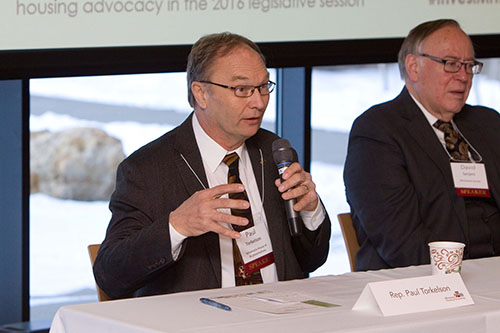
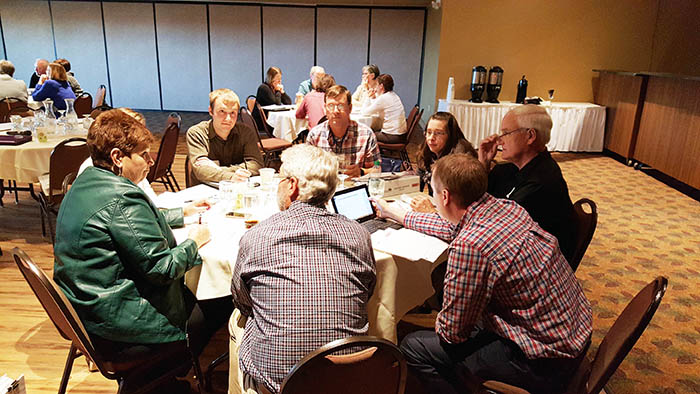
    That’s why more than 100 housing industry leaders gathered on February 9 to prepare for engagement in state policy making. Attendees at MHP’s recent Investors Council breakfast, “Take it to the Steps,” left with a clear understanding that the upcoming legislative process is absolutely critical to ensuring that the state can continue to make progress on providing safe, decent housing to every resident. In 2016, the opportunity is large: The Homes 4 All coalition, which includes MHP, is advocating for $130 million in new bonding for affordable housing statewide; Governor Dayton’s office has proposed $90 million in his initial bonding budget.

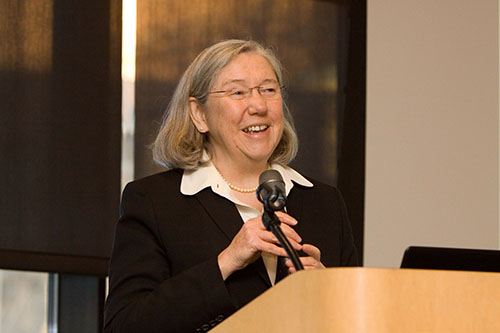
    In her opening remarks, Minnesota Housing Commissioner Mary Tingerthal touched on the impact of the 2014 bonding bill to emphasize the importance of passing a similar bill in 2016. Not only were new units created, but additional opportunities were created across the housing spectrum as former renters accessed downpayment assistance to become homeowners, which in turn freed up more rental units for others.

    Representative Paul Torkelson (District 16B) then kicked off a panel, moderated by MHP board member and North Central States Regional Council of Carpenters political director Kyle Makarios, which also included Representative Alice Hausman (66A) and Senator David Senjem (25).

    Torkelson, who chairs the House bonding committee, which will consider Housing Infrastructure Bond and General Obligation Bond requests for housing this year, started by offering a broad perspective on statewide investment needs. He emphasized the importance of maintaining the state’s existing infrastructure (especially in transportation and water), and to look at housing and other infrastructure investments as a statewide issue. 

    Hausman, the ranking member and past chair of the same committee as Torkelson now presides over, highlighted the importance of a proposed request for senior housing, noting that there is and will continue to be a growing need throughout the state. Hausman also provided context for the size of the 2016 bonding bill, noting that while there can be a “psychological reaction” to the idea of a bill larger than $1 billion, in historical perspective a $2 billion bill would be appropriate.

    Senjem noted the strides that have been made over the years towards the goal of providing affordable housing, and observed the great need for workforce housing for his constituents in Rochester. He observed that people generally are moving toward regional centers where there are economic opportunities, but not necessarily plentiful housing opportunities.

    In the open question and answer session that followed the panelists’ remarks, several audience members asked questions around the theme of how to best engage lawmakers. Representative Torkelson commented that both lobbyists and those working in the housing community are important in this regard. Senator Senjem added that not all activity has to happen at the capitol, emphasizing the significance of keeping in touch with legislators in their home districts. Representative Hausman noted the importance of both professional expertise and constituent testimony.

    If you are interested in learning more about how to engage with MHP and its partners at the capitol this year, sign up for Action Alert updates and get in touch with Libby Murphy at libby.murphy [at] mhponline.org.

    *Some may know that it’s also International Women’s Day.

    The MHP Investors Council is a professional network of businesses and organizations involved in the affordable housing industry that support MHP’s work. Members benefit from cross-sector networking events, housing advocacy efforts, and up-to-date housing policy research and analysis.

  • House unanimously passes major reforms to federal rental assistance program – now onto Senate

    Earlier this year the U.S. House of Representatives unanimously passed (by a vote of 427 Yeas to 0 Nays) H.R. 3700, “Housing Opportunity through Modernization Act” (HOTMA). HOTMA proposes the first major reform to the federal rental assistance program in eighteen years. The bill eases administrative burdens for housing agencies and owners, while delivering more efficient and flexible assistance to low-income households and helping to preserve public housing.

    The Congressional Budget Office estimates that these “modernizing” reforms to rental assistance will reduce spending by $311 million over five years. According to analysis by the Center on Budget and Policy Priorities, these savings will enable HUD to help all families currently receiving assistance at a lower cost and serve more families for the same amount of spending.

    The core of the bill mostly affects individuals receiving federal rental assistance or those residing in public housing. The bill:

    • Expands access to low-poverty areas by allowing housing authorities to use more project-based housing vouchers in high-opportunity areas. In 2014, only 13 percent of families with children participating in the voucher program lived in neighborhoods where fewer than 10 percent of residents were poor;
    • Raises the percent of an agency’s voucher assistance that the agency can project-base in areas where vouchers are difficult to use;
    • Streamlines rules for determining tenant rents;
    • Makes households that exceed new income and assets limits ineligible for assistance;
    • Places households with tenant-based vouchers and who are at risk of experiencing homelessness in homes more quickly by streamlining  the process for inspecting units in emergencies;
    • Encourages work by delaying rent increases for tenants who start employment or whose earnings rise because they get better-paying jobs;
    • Facilitates the use of project-based vouchers in Low Income Housing Tax Credit properties by extending the contract term for these vouchers from 15 to 20 years;
    • Preserves public housing by giving agencies the flexibility to transfer operating funds to capital funds for renovation projects;
    • Alters how tenant incomes are calculated by increasing deduction thresholds for medical and disability expenses for tenants in public housing or receiving rental assistance;
    • Addresses rural housing instability by creating the Multifamily Housing Revitalization Program to provide affordable rural housing and speeds up approval of rural housing loan guarantees;
    • Eases restrictions on the purchase of condominiums with Federal Housing Administration insurance.

    Many of the provisions in H.R. 3700 have received prior congressional consideration. This is not the first time members of Congress have sought to update outdated aspects of federal rental assistance programs. The House’s passage of the bill is particularly exciting because of the unanimous bi-partisan support. Having passed in the House, the bill has moved to the Senate where it awaits consideration.

    To learn more about the bill’s reforms, check out CBPP’s comparison between HOTMA and current law. For a more thorough analysis, read CBPP’s blog and the National Low Income Housing Coalition’ blog.

  • MN plan to prevent and end homelessness highlights affordable housing, coordination of resources

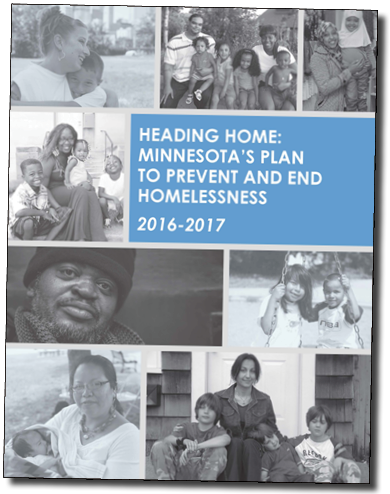
    The Minnesota Interagency Council on Homelessness released an updated two-year action plan on Thursday, January 28 detailing strategies and actions for 2016 and 2017. The Council, which includes eleven state agency Commissioners, the State Director to Prevent and End Homelessness, and the Lieutenant Governor, represents a devoted effort from the highest levels of state government, and this is reflected in the ambition and scope of the plan itself. The updates are organized around eight cross-cutting priorities and four population goals:

    {tab Cross-Cutting Priorities and Strategies}

    1) Housing that’s Affordable
    2) Employment and Earnings
    3) Equity in Outcomes
    4) Streamlined and Accessible Systems and Services
    5) Resource Coordination
    6) Data Quality and Analysis
    7) Transition from Systems
    8) Engagement of Communities and Localities

    {tab Population Goals and Strategies}

    1) Resolve and Prevent Future Veteran Homelessness
    2) End Chronic Homelessness in 2017
    3) Prevent and End Homelessness among Youth Unaccompanied by Parents or Guardians by 2020
    4) Prevent and End Homelessness among Families with Children by 2020

    {/tabs}


    Of particular note in light of the recent release of the Homes for All coalition’s 2016 agenda is the first priority listed, which will call for the creation of 5,000 additional housing opportunities. In previous years, the housing community has seen the investment of $100 million in bonding that went to create and preserve more than 4,000 units of affordable and supportive housing. Advocates hope to see that investment grow in 2016 as the state steps up to meet the challenge of ending homelessness.

    The statewide Point-in-Time (PIT) survey conducted on January 25, 2015 found that more than 7,500 Minnesotans are experiencing homelessness on any given night. This number represents a 10 percent decrease in overall homelessness since 2014, and the PIT survey further revealed that veteran homelessness had declined an incredible 54 percent between 2010 and 2015. Despite these victories, however, the survey also revealed a 27 percent increase in the number of people experiencing chronic homelessness, and a nearly 6 percent increase in unsheltered homelessness.

    A key element of the Heading Home plan is its focus on developing strategies to prevent homelessness from occurring, and to make homelessness rare, brief, and non-recurring. The work of communities like those in Itasca County to develop the Beacon Hill supportive housing project is just one of the efforts around the state that already exists to provide stable housing alternatives. Advocates hope the Heading Home plan will help bolster housing initiatives like those happening in Itasca County, ensuring that communities have the resources and networks available to ensure safe and stable homes for their residents. 

    The Council plans to develop implementation measures for the priorities and goals listed above by June 2016. A PDF of the full Heading Home: Minnesota’s Plan to Prevent and End Homelessness (2017-2017) can be found here or by visiting the Heading Home Minnesota website.

  • Communities collaborate to advance development in Greater Minnesota

    There’s wisdom in the old adage “many hands makes light work.” Still,  when it comes to tackling a community development project, getting the right people together at the right time is often easier said than done. That’s where the Housing Institute for Greater Minnesota comes in.
    Since 2010, the Housing Institute (delivered by MHP in partnership with the Greater Minnesota Housing Fund) has provided a forum for teams of community developers and local stakeholders to effectively and collaboratively tackle some of their communities’ most pressing challenges. Outcomes emerging from the latest round of the Institute illustrate the powerful effect of working across sectors. Whether it is building support for downtown revitalization, recruiting developers to take on affordable housing projects, or developing regional housing information resources, the Institute provides a platform for teamwork that turns aspirations into action.
    “The Institute helped us build ownership of our initiatives within the communities we serve. The program helped us realize how much more we can accomplish when we work together.” –Rose Dunn, Executive Director of Mora Housing and Redevelopment Authority
    Round 4 of the Housing Institute was comprised of four teams from regions throughout north central Minnesota. Over 18 months, the teams took part in four, two-day long seminars with presentations and break-out sessions tailored to meet the needs of the projects identified by each team. Between each seminar, each of the teams worked with a facilitator from MHP to make progress on their own region’s plans.

    Growing support for downtown revitalization

    A team from Central Minnesota used the Institute to support renewed rehabilitation efforts in downtown Brainerd. In partnership with an established nonprofit called Brainerd Restoration, efforts were made to secure funding for a full-time employee to lead special projects. Team members also worked toward acquisition of a vacant store front to be redeveloped into a mixed use facility.

    One of the defining characteristics of the Institute is bringing together unlikely partners from the private, nonprofit, and public sectors to accomplish community projects. Team member Jennifer Bergman and Executive Director of the Brainerd Housing and Redevelopment Authority sees the cross-sector approach as an ongoing strategy, one that will bolster community development projects in the area for years to come.  

    “The Housing Institute gave us the opportunity to bring a group of people together to discuss Downtown Brainerd. I feel our work going forward will be stronger because of the new relationships we’ve created.” –Jennifer Bergman, Executive Director of Brainerd Housing and Redevelopment Authority

    Central MN Team: Jennifer Bergman, Executive Director of Brainerd HRA | Sheila Haverkamp, Executive Director of BLAEDC | Cheryal Hills, Executive Director of Region 5 Development Commission | Amy Gray of Brainerd Restoration | Ed Menk, Owner of Menk Jewelers | Mark Ostgarden, City Planner of City of Brainerd | Becky Laplante and Dave Pueringer of Pueringer Investments

    Planning through a regional lens

    For the team from West Central MN, the Housing Institute provided an opportunity for local stakeholders to engage through a wider, more regional lens. One of the first projects was to conduct a county housing plan. The last county-wide study of Ottertail County was completed nearly 19 years ago.

    Members from the team worked with a consultant and area communities, some of whom had already recently completed housing studies, to compile data for the county-wide study. The study will be completed in late February and the team is organizing a regional housing dialogue for early spring to present the data and receive feedback from regional leaders.  

    “We have an available workforce of about 6,800 in Fergus Falls, but are home to over 11,000 jobs. Such a wide labor draw really demands that we see ourselves regionally and plan regionally. Our economic health depends on it. The Institute allowed our team to engage our communities in new ways and work more closely to ensure the vitality of our region.” –Gordon Hydukovich, Community Development Director for the City of Fergus Falls

    West Central Team: Gordon Hydukovich, Community Development Director for the City of Fergus Falls | Kelcey Klemm, City Manager of City of Perham | Mary Holzer, EDA/HRA Assistant for the City of Perham | Amy Baldwin, Economic Development Director of City of Fergus Falls | Susan Bjorklund, Rehab Coordinator at Fergus Falls/Otter Tail County HRA | Donald Solga, City Administrator for the City of Pelican Rapids

    Building coalitions, creating local resources

    One of the key outcomes for the team from East Central, MN was the creation of an inter-organization partnership called East Central Housing Organization (ECHO). The team established ECHO to ensure ongoing collaboration in community-wide housing and community development projects and to fill in the gaps of services available to residents. ECHO meets once a month to discuss project progress and the group continues to attract new partners.

    The team is working on a region-wide resource website for residents to access up-to-date housing information. The team also worked on an addition to an existing senior housing and community center project called Eastwood Development. The next phase of Eastwood will include 30-40 mixed market and affordable units. The Mora Housing and Redevelopment Authority is currently in the process of selecting a developer for the project.

    “We are so much more capable of doing the project in a more sophisticated way after taking part in the Institute. Before the Housing Institute, we really relied on the developer to shape the project and push it forward. We didn’t realize how much power we had to advocate for the kind of project we wanted and develop the skills to make it happen. Our board has taken more ownership of the project this time around as well.” –Rose Dunn

    East Central Team: Lezlie Sauter, Director/Agency Planner for Lakes & Pines Community Action Council, Inc. | Sara Jayne Treiber, Business Development Planner at Mille Lacs Corporate Ventures | Jennifer Russell, Community and Economic Development Director at East Central Regional Development Commission | Rose Dunn, Executive Director of Mora Housing and Redevelopment Authority | Deanna Hemmesch, Executive Director of Central Minnesota Housing Partnership, Inc. | Tim Burkhart, Executive Director of 7 County Senior Federation | Mary Kay Sloan, Founder of A Place for You

    Strengthening development capacity

    The team from Cloquet used the Institute to increase local capacity in affordable housing development. No new affordable housing has been built in Cloquet since 1970. After a 2014 county housing study showed huge gaps in affordable housing availability, the local housing authority had been struggling to determine what projects were of greatest importance and the role the housing authority needed to take in order to address the need.

    Affordable housing is just one of the many housing needs in Cloquet according to Debra Shaff, Executive Director of Cloquet/Carlton Housing and Redevelopment Authority. The availability of low-income housing, housing for seniors, and supportive housing is extremely limited and some forms of assistance, like emergency housing and shelters, do not exist at all in Carlton County.

    The Housing Institute helped the team prioritize development projects and connected the housing authority with private and public sector development expertise and financing knowledge to move on a project. The team is in the process of selecting a developer for a 36-unit affordable multi-family project.

    “The Cloquet Housing Authority had no previous housing development experience and at one point questioned whether or not they had the capacity to tackle this type of initiative. The Housing Institute finally got us talking about housing in an intentional way and facilitated a place from which to take action.” -Debra Shaff, Executive Director of Cloquet/Carlton HRA

    In order to communicate the high need for new development and build community support, the team has engaged in several conversations with local congregations, led by a team member who serves in the local ministerial society. The team plans to build on their community engagement efforts by holding a housing summit in February to talk about how to grow long-term financial investment in housing, which Shaff hopes will keep the momentum of the team going.

    Cloquet Area Team: Debra Shaff, Executive Director of Cloquet/Carlton HRA | Dave Lee, Director of Carlton County Public Health and Human Services | Bruce Ahlgren, former mayor of City of Cloquet | Linda Schumacher, Cloquet Ministerial, Zion Lutheran Church | Steve Stracek, Police Chief of Cloquet Police Department | Cliff Knettel, Deputy Director of One Roof Housing | Louise Simmons, Divisional Social Services Director of The Salvation Army

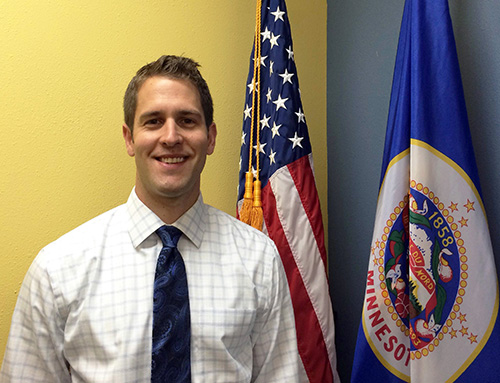
  • Meet MHP’s new Policy Director, Marcus Schmit

    Growing up in Greater Minnesota, I enjoyed the quality of life associated with small town living. There was a distinct sense of community in my hometown. Family plans revolved around Friday night football games and church potlucks. My parents had everything they needed to raise three young boys – quality schools, access to health care, employment, and a place to call home. As the son of two public school teachers, I always had a roof over my head.
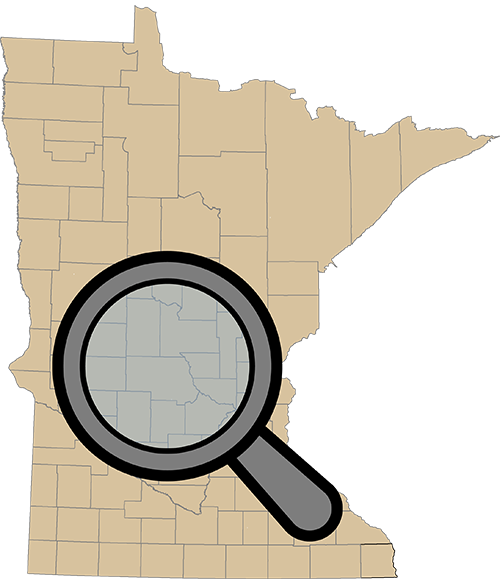
    For many, Greater Minnesota still remains an ideal place to live, work, and raise a family. Some communities, however, lack the available affordable housing options needed to retain and recruit workers. I learned about these challenges meeting with local officials and touring businesses as a longtime aide for Congressman Tim Walz. I was inspired to join Minnesota Housing Partnership, in part, to work with community leaders and other like-minded organizations to address the unique challenge of Greater Minnesota workforce housing.

    Our state is comprised of diverse communities all contributing to Minnesota’s success in their own way. Accordingly, the needs of Perham and Thief River Falls are not identical to the needs of Albert Lea or Worthington. But one of the obstacles these communities face is pretty straightforward: there is not enough available affordable housing to retain and recruit the workers needed for them to grow and prosper. The meatpacker, the IT specialist, and the public school teacher are all out of luck when it comes to securing a place to call home at a reasonable rate in many rural parts of Minnesota. As a result, jobs are left unfilled and some of our communities are not as successful as they could be.

    Without question, workforce housing is only one obstacle facing our communities. As MHP gears up for the 2016 state legislative session, we are listening and learning from folks on the front lines. We are working with policy experts, business and community leaders, state agency staff, and nonprofit partners to identify the most urgent housing issues facing our state. We are learning from the MHP capacity building staff, whose on-the-ground assistance to housing and community development professionals throughout the Midwest provides essential insight into how policies are being implemented and ways we can develop vital, resilient rural and Native American communities.

    It has been an inspiring first month at MHP. There is much work to be done. I am excited to contribute to this organization’s impactful work in our communities and advocate for pragmatic policy solutions that make a difference for all Minnesotans’ quality of life.

  • MN Housing Board hears case for conduit bonds, learns agency risks

    Board encourages agency to further investigate conduit bonds: will consider waiver in the future

    The agency was approached by a developer for $30 million in bond authority that a city had originally issued, but, due to a clerical error, went back to Minnesota Housing on December 1.  At the time the clerical error was identified, the developer was close to closing and was slated to begin construction in March 2016. Because the project is a senior housing development, the developer cannot reapply to the city until May, delaying the project for five months. The developer has asked the agency to issue the bonds on behalf of the city so the project can break ground as scheduled.

    The agency sought permission to move forward with exploring whether to serve as the conduit bond issuer to the project. Commissioner Tingerthal disclosed that serving as a conduit bond issuer does not expose the agency to financial risks if the project fails. Agency staff have reviewed the project’s financing and think the transaction is worthy.

    The agency would require the developer to pay a modest fee to cover agency expenses related to reviewing the project but does not generate income from these transactions. Some board members asked what the public benefit of doing this versus other activities that the agency could expend similar energy and effort on.

    The current board criteria require: (1) that the project be for preservation; (2) another entity cannot issue the bonds; (3) the agency has already been presented with the project and decided not to issue bonds; (4) a private debt agency must review the financials; and (5)  and the agency’s bond council must be utilized. The agency would need a waiver because this project is for new construction, the agency was not presented with the project earlier, and the agency would need to seek outside bond counsel as members of the agency’s bond counsel provided consultation to the original deal. In the past, the agency has issued conduit bonds but only when the agency has had other funds in the deal and was already monitoring the project.

    Mary Tingerthal expressed a keen interest in being a conduit bond issuer to this project. The agency has looked at ways other than the 9 percent tax credit to do modest income senior housing. The developer’s financing model is similar to a model the agency is considering. This would give the agency experience with this new model. Also, the project uses a Freddie Mac tax exempt loan product which would eliminate the double step of originating tax exempt bonds and using loans to pay back the bond. This project would give the agency a chance to familiarize itself with this new Freddie Mac product.

    The board expressed an interest if having staff move forward so it could consider a waiver in January. Board members were amenable to issuing a waiver before amending criteria.

    New assessment helps agency mitigate risks

    The agency periodical assesses risks to the agency to achieving its stated objectives outlined in the 2016-2019 Strategic Plan and 2016 Affordable Housing Plan. Eleven risk sources were assessed, and none received a Very High risk level ranking. Five risk sources received a High risk level ranking, a decrease from six last year. Interest rates were assessed as a High risk source due to continued interest rate volatility.  Interest rate management is a key activity for the agency.  The agency has operated in a low rate environment for many years, which has been stressful to the Agency’s business model. The low interest rate environment made it difficult for the agency to make money. The Commissioner addressed the impact to the loan pool from the Federal Reserve’s decision to raise interest rates. From the perspective of a financial institution, the increased interest rates are welcome. She said the agency is not at risk from increased interests rates but if borrowers’ incomes do not go up with interest rates, single family mortgage activities may see a slowdown. The Commissioner warned that if rates go up steeply, sales will go down among low income borrowers. She mentioned that with increased interest rates, the agency can take better advantage of tax exempt bonds. Another source of high risk discussed was counterparties. As single family mortgage activities are in limbo due to new regulations, the agency is investigating if it should provide mortgage loan servicing differently.

    Bridges rental assistance to serve more areas of the state

    The board approved the agency’s request for $1.016 million to expand two existing grants and add five new grants and serve 102 new households. Agency staff told the board that the funding would help the agency to implement the State’s Olmstead Plan and Plan to Prevent Homelessness. Cass Country HRA for Hubbard County, Cloquet HRA, and Red Wing HRA have been selected as new grantees in service areas previously unserved. Mental Health Resources, an existing Bridges administrator, was selected to operate two new grants for Dakota and Ramsey counties, designated areas of high need.  The agency selected St. Cloud HRA to restore vouchers that were funded in 2014. The agency will partially fund the Metro HRA request, an expansion of an existing grant serving Hennepin, Ramsey and Anoka counties.

    Housing Trust Fund grants expanded to serve highly mobile students

    The board approved a request to use $2 million from the Housing Trust Fund (HTF) to modify existing rental assistance grants and enter into grant agreements with Clay County HRA, Project for Pride in Living, and Amherst H. Wilder to provide funds for short term rental assistance programs for homeless and highly mobile families with at least one child in grades K-12. Staff requested an additional $185,000 to expand grants to the three organizations to continue serving 89 families still receiving assistance and an additional $1.8 million in grant funds to expand services to 83 new households. This funding was appropriated to the pilot by the legislature last spring.  According to Commissioner Mary Tingerthal, this program has helped bridge connections between schools and available housing. Minnesota Housing and the Department of Education are required to submit a report to the legislature in 2017. Both agencies will work together to share data.

    Agency reduces Mortgage Credit Certificate (MCC) rate to serve more families

    The board approved two amendments related to the AHP.  First, the board approved a staff request for a $10 million increase to the amount of bonding authority to be converted to the MCC program. Second, the board approved the staff recommendation that the MCC credit rate reduce from 35 percent to 25 percent.  By increasing authority from $40 million to $50 million and lowering the credit rate, the Agency hopes to run a continuous program through February 2017 and avoid having to end and restart the program. Staff requested the change because the agency is currently at risk of running out of money before its plan to end the program in 2017. Under IRS requirements, 20 percent of funds have to be set aside for Targeted Areas census tracts.  Without increased funds, the agency projects running out of non-targeted set aside funds by summer 2016, at which time the program would have to stop and restart. The agency is seeing more production in non-Targeted Areas than it originally projected. Agency staff believes the requests approved by the board will stretch the allocation. A 35 percent credit rate was determined earlier in order to realize savings in a low interest rate market and a depressed economy. Now that the Federal Reserve has increased interest rates, borrowers can still realize savings and better address racial and ethnic homeownership disparities by serving more families. The additional funds also allows the agency to maximize all bonding authority converted and not let funds go unused.

    Status report on Enhanced Financial Capacity Homeownership Initiative

    The agency provided a status update on the summary of intake data and outcomes from the first year of the Enhanced Financial Capacity Homeownersip Initiative. The program’s first year was funded at $650,000.  The program reached 99% of its original goal. The agency has served 551 clients, 92 percent of whom are households of color and 76 percent of whom are below 80 percent area median income (AMI), and 72 percent of whom identified credit as the primary barrier to obtaining homeownership.  194 clients have exited the program. Of that, 43 percent of clients have purchased new homes, 3 percent are actively pursuing homeownership, 16 percent are still interested but not at this time and 13 percent are no longer interested. In the second program year, also funded at $650,000, the agency plans to enroll 580 clients into the program.

  • Dialogue reveals numerous housing challenges for Central MN

    Stakeholders from central Minnesota gathered in St. Cloud this week to discuss the region’s affordable housing needs. Workforce housing, single family home rehab, the preservation of naturally occurring affordable housing, and worries over rising construction costs appeared as common themes throughout the discourse. Minnesota Housing Finance Agency, Greater Minnesota Housing Fund, and USDA Rural Development hosted the discussion and listened to concerns presented by local housing leaders. 

    In recent years, Minnesota  Housing, USDA and GMHF have hosted similar community dialogues across the state to inform and engage community leaders on their housing needs. The event in St. Cloud was one in a series of these dialogues with others to be scheduled later in the year. 

    John Patterson of Minnesota Housing kicked off dialogue by presenting on the housing trends in central Minnesota’s Stearns, Benton, Sherburne and Wright counties. Minnesota Housing’s research indicates a rise in homeownership, but also greater homeowner cost burden since 2000. Patterson noted that monthly homeowner costs have increased by as much as $287 in the St. Cloud area while homeowner household income remains stagnant since 2000. Minnesota Housing also reports that St. Cloud area renters are feeling the squeeze as 50% of renters are paying more than 30% of their income on rent therefore making them cost- burdened.  Monthly rents have increased as much as $177 since 2000 and renter income has decreased in Benton, Sherburne, Stearns, and Wright counties. These trends coupled with an aging population and a increasingly more diverse demographic underscore an urgent need for more affordable housing options in the St. Cloud area.

    Megan Carr of Sand Companies and Greg Simones of Minnwest Bank, expressed concerns on multifamily development in central Minnesota. Carr and Simones both shared that central Minnesota development projects frequently underscore on Minnesota Housings’ competitive Request for Proposals (RFP) process. Low scores often translate into no funding reward from Minnesota Housing which means many multifamily developments cannot progress in central Minnesota. Carr suggested that development projects in the Metro frequently score higher because of a willingness in Metro communities to contribute to affordable housing. Attendees noted that nimbyism is pervasive in central Minnesota with many local governments reluctant to finance affordable housing from local sources. Both Carr and Simones also pointed towards the RFP timeline as problematic. By the time funding awards are made in October construction season has concluded which means another 6 months until construction can begin. In that time gap, development cost estimates fluctuate which then jeopardizes the project’s financing and raises costs. 

    Lisa Marvin of Essence Property Management raised concerns on workforce housing and the preservation of naturally occurring affordable housing. During discussion Marvin informed Minnesota housing officials that individuals at 61% Area Median Income (AMI) and above can rarely find affordable units. Most units that are funded by Housing Tax Credits can only serve renters with incomes below 60% AMI. This leaves many working families with few affordable options as their incomes are too high for the more deeply subsidized units.  Marvin additionally addressed naturally occurring affordable housing and the lack of incentives to preserve these units. Naturally occurring affordable housing represents unsubsidized units that are low on amenities and make up the older portion of the areas’ housing stock.  In a tight rental market like in St. Cloud rents are rising on naturally affordable units which then stretch the resources of low-income renters.  Marvin asked Minnesota Housing representatives if anything could be done to keep these units affordable.

    Participants in the dialogue also expressed concerns on the need for more single family rehabilitation. Many homeowners in central Minnesota who lost jobs, assets, etc. during the recession deferred maintenance on their homes. Many homeowners still lack the ability to keep up with needed with many homes failing inspections.  Prospective buyers shy away from properties with sizeable maintenance backlogs meaning that the need for single family rehab is huge. Many of the resources that could aid in single family rehabilitation such as USDA’s 502 mortgage purchase remain obscure with other resources like Community Development Block Grant (CDBG) being viewed as suspicious. John Reis of the United Way and Deanna Hemmesch of Central Minnesota Housing Partnership called for stronger partnerships across sectors that would be accountable to a shared housing agenda. Both, Ries and Hemmesch lamented that too often these coalition forming conversations occur with little follow-up afterwards.

    Numerous participants in the discussion shared experiences of community resistance to affordable housing projects. Many times when a developers proposes an affordable housing development to a local government entity current residents express fears that “the wrong type of people” will then move into the area, lower property values, and create problems for local municipalities. Attendees of the dialogue universally agreed that such stigma on affordable housing is false, and that efforts need to be made to combat NIMBYism (Not in My Back Yard).