On behalf of the Minnesota ERASE Campaign, we thank the Governor, lawmakers, and Minnesota Housing Finance Agency for the passage of bill HF 2271, which includes $50M in emergency rental assistance (ERA) for the Family Homelessness Prevention and Assistance Program (FHPAP)! This will provide critical support to Minnesota families who are struggling to make ends meet.
The Minnesota ERASE Campaign (End Rental Arrears and Stop Evictions) advocated for lawmakers to approve emergency rental assistance (ERA) before the end of session, and to ensure ERA will reach the lowest income and most marginalized renters. With Minnesotans facing eviction in historically high numbers, emergency rental assistance will help individuals and families remain housed across our state.
The MN ERASE campaign is affiliated with the National Low Income Housing Coalition’s national ERASE Project. Through the efforts of MN ERASE, advocates elevated the need for emergency rental assistance to government and lawmakers. MN ERASE convened renters, landlords, services providers, housing and redevelopment authorities, and other housing advocates to develop ERA recommendations to Minnesota Housing and lawmakers. We are gratified that the result is an investment in helping our neighbors with lower incomes find and stay in their homes.
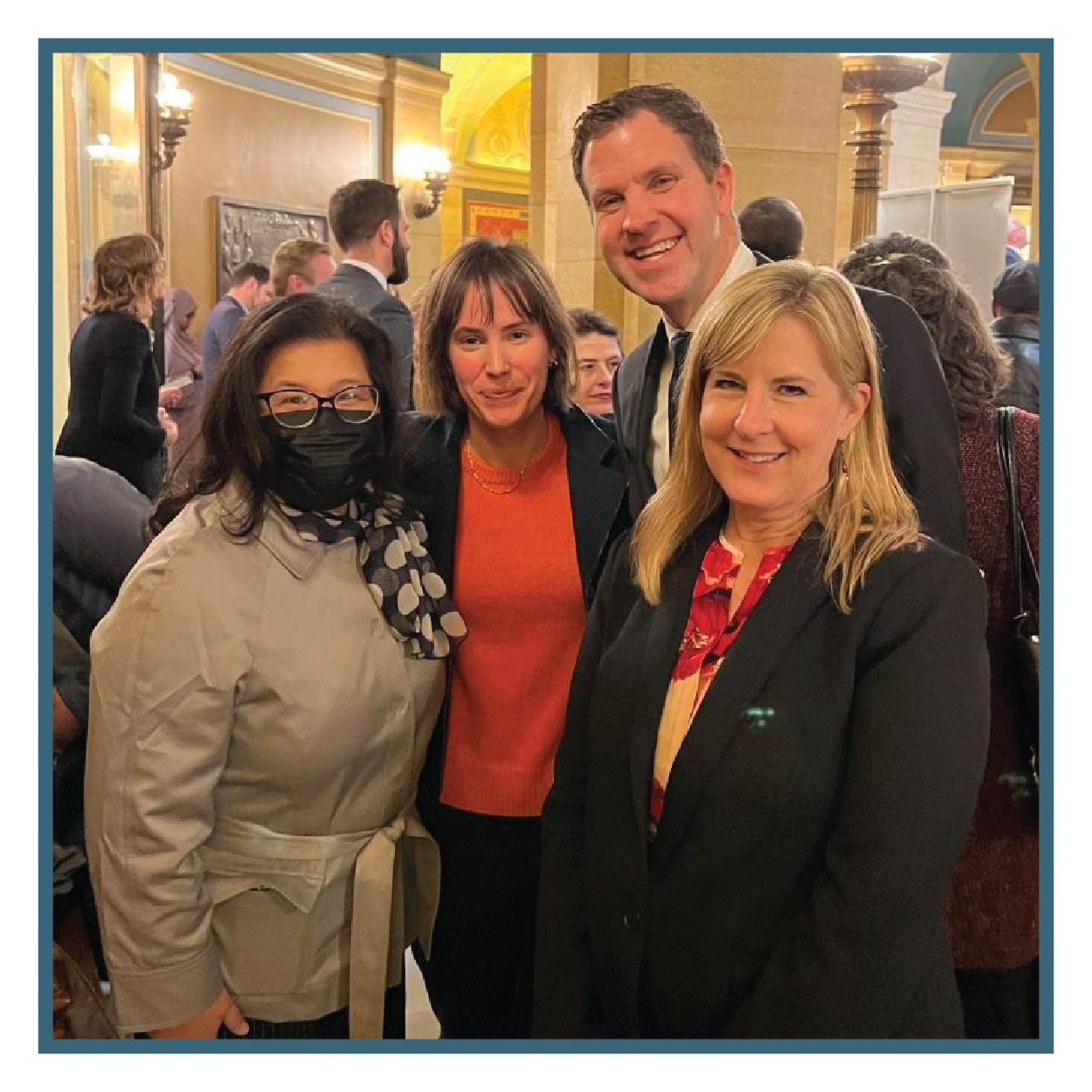
Friday, March 10th at 9 a.m. MHP hosted an update directly from lawmakers and community partners about the latest developments in St. Paul.
We were excited to have been joined by Amy Koch of Hylden Advocacy & Law, Annie Shapiro of Minn Cap and Rep. Esther Agbaje (DFL – Minneapolis). Rep. Agbaje serves as Vice Chair of the House Housing Committe, in caucus leadership, and co-chairs the People of Color and Indigenous (POCI) caucus.
Watch the update below.
Please contact Libby Murphy at [email protected] with any questions.
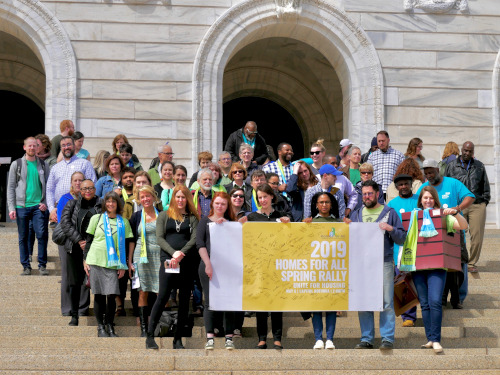
On January 11th, Minnesota housing advocates packed the Capitol Rotunda for a rousing rally to launch the legislative session. Government leaders called for housing investment, including Governor Tim Walz, Lieutenant Governor Peggy Flanagan, Speaker of the House Melissa Hortman, Senate Majority Leader Kari Dziedzic, Minnesota Housing Commissioner Jennifer Ho, House Majority Leader Jamie Long, Senator Lindsey Port, Representative Michael Howard, and Hennepin County Commissioner Irene Fernando.
We are excited in both House and Senate leadership making a commitment to Bring it Home, of which MHP is an endorser. We are also optimistic that Source of Income Protections, which Rep Her is prioritizing, will get across the finish line. Source of Income Protections will only grow in importance as we advance Bring it Home. People who get a rent voucher need protections to ensure they can use their voucher to access safe, quality homes.
In addition to government officials we heard from people with the lived experience of struggling with housing, including Patrice Kunesh of the Native American Rights Fund and MHP board member, who realized the value of housing stability when she found herself living in public housing with her two young daughters – which was neither safe nor stable. Kunesh decried the disparities in housing in Minnesota, where Native people account for 8 percent of Minnesota’s homeless adult population, though they represent about 2% of the population, the largest disparity of any group in the state. She ended with a call for $2B for housing this year and housing on the ballot in 2024!
Becky Zoubeck and her two children live in a Habitat for Humanity home in Faribault built in conjunction with South Central College. As a Habitat homeowner, Becky has personally experienced both the lack of affordable housing in Greater Minnesota and the transformational effects of housing stability.
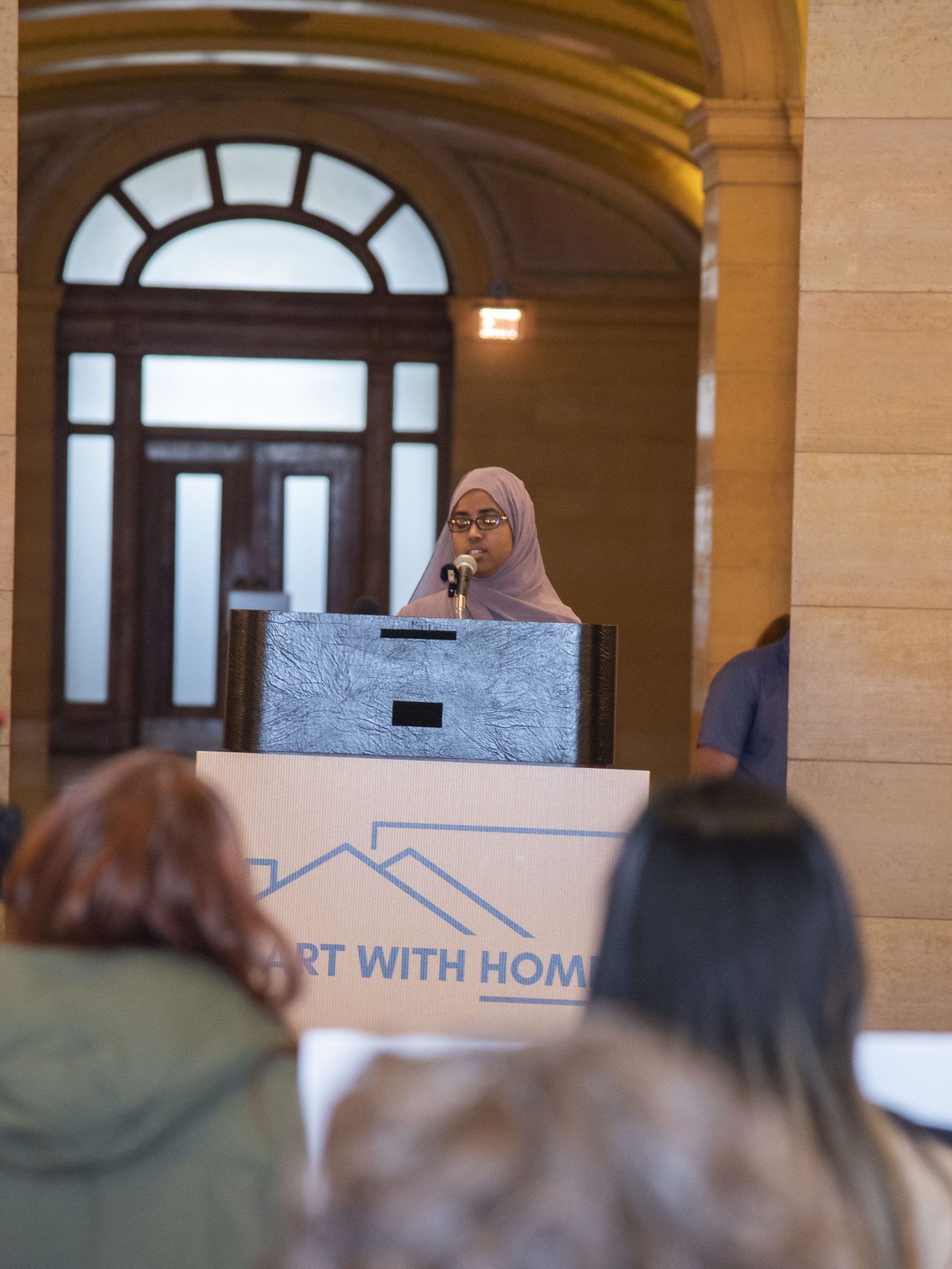
Sedia Omar of the New American Development Center addresses housing advocates
Sedia Omar of the New American Development Center, spoke directly to the question of a constitutional amendment for housing: “You may see a home as a four-wall place, but to East African families and the families we serve, a home means comfort, security.” Sedia continued with “These investments need to be at scale and for decades. We need a new approach, as the status quo has contributed to our housing crisis. We need new solutions. Our proposal for a Constitutional Amendment ensures that frontline leaders and grassroots groups and people with lived experience are decision-makers so that solutions are community driven. … A constitutional amendment ensures long-term investments in home.”
Jim Bargmann, a member of the Bring it Home Coalition emphasized the need for solutions as big as our problems: “Bring it Home, Minnesota will not only be life changing, but society changing. Families who can now afford their housing can move forward!”
Mary McGovern, president of the Minneapolis Highrise Representative Council (MHRC), the city-wide public housing high-rise tenant organization, representing over 5000 residents living in the city’s 42 public housing highrises also spoke about the need for investment in housing.
Housing investments are an excellent strategy for deploying our state’s historic surplus to leverage long-term, generational benefits for Minnesota. Every corner of Minnesota needs more homes that are affordable to families and seniors and ensure local businesses can recruit the growing workforce they need to expand and thrive.
Each year, there are at least three requests to Minnesota Housing for housing project funding for every one that can actually be funded; these projects are shovel-ready right now and once built, will offer safe, decent, stable homes for generations of hard-working Minnesotans.
Communities around the state—from Greater Minnesota’s rural areas to cities like Duluth and St. Cloud—are feeling the squeeze of rising costs that have put homes out of reach of too many families. Our state leaders have an opportunity to come together to ensure that all our neighbors have homes from which to build their future.
Everyone needs a home – this is a bipartisan solution that can provide a fundamental building block of our State’s success. We need housing stability for all aspects of life: to maintain our health, to hold a job, for our kids to get their homework done. A stable home makes anything possible.
It’s time to raise expectations for the level of investments we need in homes for every Minnesotan. Tell your state leaders why housing is so important to you and your family today!
Margaret Kaplan, President of Housing Justice Center and Elizabeth Glidden, Deputy Executive Director of MHP hosted this webinar, featuring examples of Minnesota local jurisdictions utilizing ARPA funds to address housing needs. Thank you to our panelists:
MHP’s Investor’s Council Breakfast returned on July 8 for a virtual meeting. This was the first meeting since February, and the first time since the COVID-19 pandemic has impacted health, housing, and the economy, and the murder of George Floyd has galvanized the largest civil rights movement in US history.
“Since we last met, our world, our country, our communities – everything has been turned upside down and inside out,” MHP Executive Director Anne Mavity said. “Even before any of this happened, together we understood that access to affordable housing, was something so fundamental to support the health and success of families, of school children, of our elders and senior citizens, for workers, and for strong communities.”
Mavity noted the challenges ahead: Housing is an economic stimulus that creates jobs that our state needs, and creates shelter so people can stay healthy (“you can’t stay safe at home if you have no home”) and disparities are a key part of the affordable housing crisis.
“We know more clearly today, than ever before, that we cannot successfully solve our affordable housing crisis, without also understanding, addressing and untangling the policies and programs that have resulted in poorer outcomes in housing for Black, indigenous, and People of Color. We can do better. We must do better.”
Commissioner Jennifer Ho echoed that in remarks to more than 100 attendees participating via Zoom.
“Many things are different, but some things are the same; We had a housing shortage before the pandemic, we have one today.”
“At Minnesota Housing we are doing kind of a shift in our thinking from racial equity to housing justice,” said Ho. “We’re thinking a lot about who’s most impacted by COVID, particularly who is on the brink of losing their home.”
Ho said MHFA is focused on getting housing bonds passed through a legislative session that has been like no other with social distancing and continuous special sessions complicating the picture.
“Our main focus is going to continue to be the housing bonds — both HIB and public housing preservation bonds. Unless there is state action, a lot of developments will not have the financing they need to move forward. Please continue to make the case as loudly as possible, as creatively as you can,” Ho told the attendees.
Lt. Gov. Peggy Flanagan, who received MHP’s Legislative Leader Award, also addressed attendees.
“I’d like to thank the advocates, in particular, MHP and all of your partners, who have continued to keep the pressure on to ensure leaders on all sides know what a priority is housing is. Even in a pandemic, you are making your voices heard. Please keep the pressure on as the legislature convenes on Monday.”
She noted that the housing crisis is worsening and noted the historic number of people at an encampment in Powderhorn Park in Minneapolis.
“This moment is showing the cost of decades of underfunding and neglect. We need more affordable housing. Housing is a foundation. It is incredibly important to every aspect of people’s lives.”
She added that pressure needs to continue on lawmakers to pass $260 million in Housing Infrastructure Bonds. “I have received more calls and emails about housing in the last two weeks than ever before. So many people are just waking up to the challenges that folks are facing. And while it is heartbreaking for a lot of people to wake up to that reality, it also means it is great news because our team of advocates and folks who share our passion is growing.”
Five elected officials were announced to have won MHP’s Legislative Leader Award. Lt. Gov. Peggy Flanagan, Sen. Jeff Hayden, and Reps. Mike Howard, Aisha Gomez, and Dean Urdahl.
A panel discussion with D’Angelos Svenkeson, of NEOO Partners, Inc.; Shoua Lee, Vice President of Community Development at Wells Fargo; and Sarah Berke, Program Officer at Family Housing Fund, delved into topics being tackled by MHP’s Public Policy Advisory Group, which has developed criteria for housing finance policy evaluation. The criteria include: race equity, getting greatest impact from limited public dollars, securing predictable and dependable funding, and enhancing wealth and ownership options.
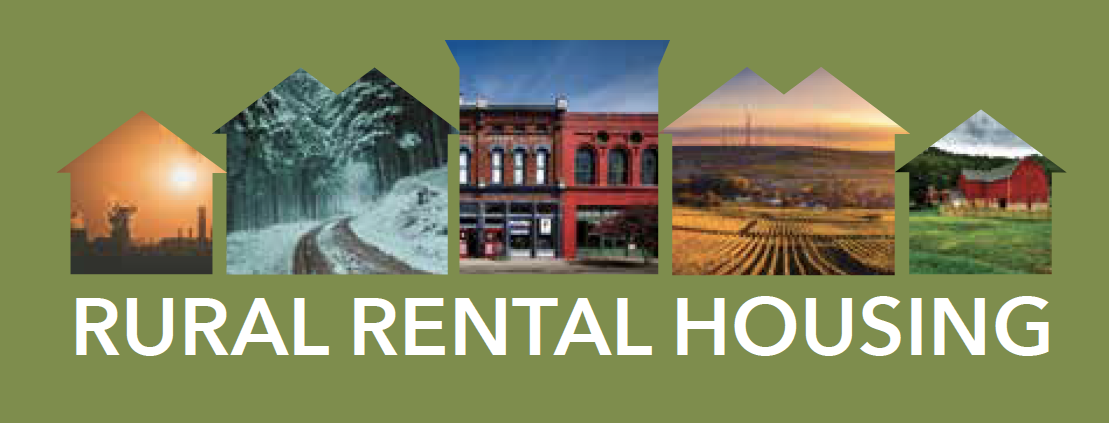
Minnesota Housing Partnership has released Rural Rental Housing: Report and Recommendations (April 2020).
The report is a culmination of stakeholder surveys and a fall 2019 convening of rural rental housing policy stakeholders in Little Falls, Minnesota. Rural housing advocates and community members met to talk about solutions to a variety of rural rental housing challenges. Even within the context of a world coping with the effects of COIVD-19, the recommendations from this group remain relevant, with identified needs magnified.
The discussion included a focus on Minnesota’s unique portfolio of USDA Rural Development 515 properties, or rural rental housing that supports residents, elders and families with very low income averaging $16,500 annually. Participants also focused on Minnesota’s manufactured home communities, 65% of which are located in Greater Minnesota.
The workshop helped identify immediate and critical needs for rural rental housing in Minnesota.
Immediate needs include:
Protect low income renters with housing assistance. In Minnesota, state leaders must provide housing assistance of at least $100 million through the Family Homeless Prevention Assistance Program (FHPAP) or another rental assistance program. At the federal level, $100 billion in emergency rental assistance ( to include renters in USDA financed rental housing) is necessary.
Additional critical needs:
Preserve the USDA rental housing portfolio, with funding to ensure ongoing safe maintenance, operations, and rehabilitation
Capacity building and technical assistance for owners and prospective owners of rural rental housing
Ensure long term affordability and opportunities for resident ownership in manufactured home communities
Engagement of people and communities in Greater Minnesota to ensure that the people most affected by our rural housing challenges are at the table when decisions are made.
Thank you to event sponsors the Housing Justice Center, Initiative Foundation, Greater Minnesota Housing Fund, Minnesota Housing, and Minnesota Housing Partnership. Appreciation to organizing partner Minnesota NAHRO.
View and download the full report here. Read the accompanying cover letter here.
While the legislative session is still more than a month away, MHP has already been meeting with lawmakers, legislative staff, and other affordable housing advocates to garner support for our 2020 policy agenda.
That agenda includes:
$500 million in bonds to create more deeply affordable housing
An Affordable Housing Tax Credit to harness available private capital to create more housing opportunities by filling affordability gaps
State support for local communities to establish and grow Local Housing Trust Funds through a state funding match program
Because 2020 is a bonding year at the Capitol, MHP along with our coalition partners will be pushing for $500 million in bonds to create more affordable housing. $500 million is the largest bonding request for housing in state history, and we are partnering with the Homes for All Coalition to get it done in 2020.
MHP also seeks $25 million annually for the Affordable Housing Tax Credit. More than 60 organizations in Minnesota have endorsed the tax credit (view the list of endorsers and find out how to endorse). This innovative new tool encourages local businesses and neighbors to invest in their community by creating housing opportunities. Because the private market is not supplying housing that is affordable to working people in Minnesota, a public private partnership is the best way to ensure an adequate supply of housing. The Affordable Housing Tax Credit incentivizes private investment and promotes community and economic development.
Local Housing Trust Funds (LHTF) are funds established by a local government by dedicating local public revenue for housing. They are a consistent, flexible resource for housing within a local jurisdiction. Trust funds help communities leverage public and private resources and jumpstart projects that draw investment and jobs. LHTFs enable communities to prioritize developments that maximize benefit to the local community.
Across the country, state investments are proven to motivate communities to create and resource LHTFs. MHP is seeking a $10 million state investment in a match program to jump-start LHTFs across the state, and give communities the flexibility to respond to housing needs.
Please join MHP’s Policy Team as they provide an update on MHP’s legislative agenda and insight into the 2020 session. Click here to register.
 While the legislative session is still more than a month away, MHP has already been meeting with lawmakers, legislative staff, and other affordable housing advocates to garner support for our 2020 policy agenda.