• MHP Partners in Texas to Provide Technical Assistance

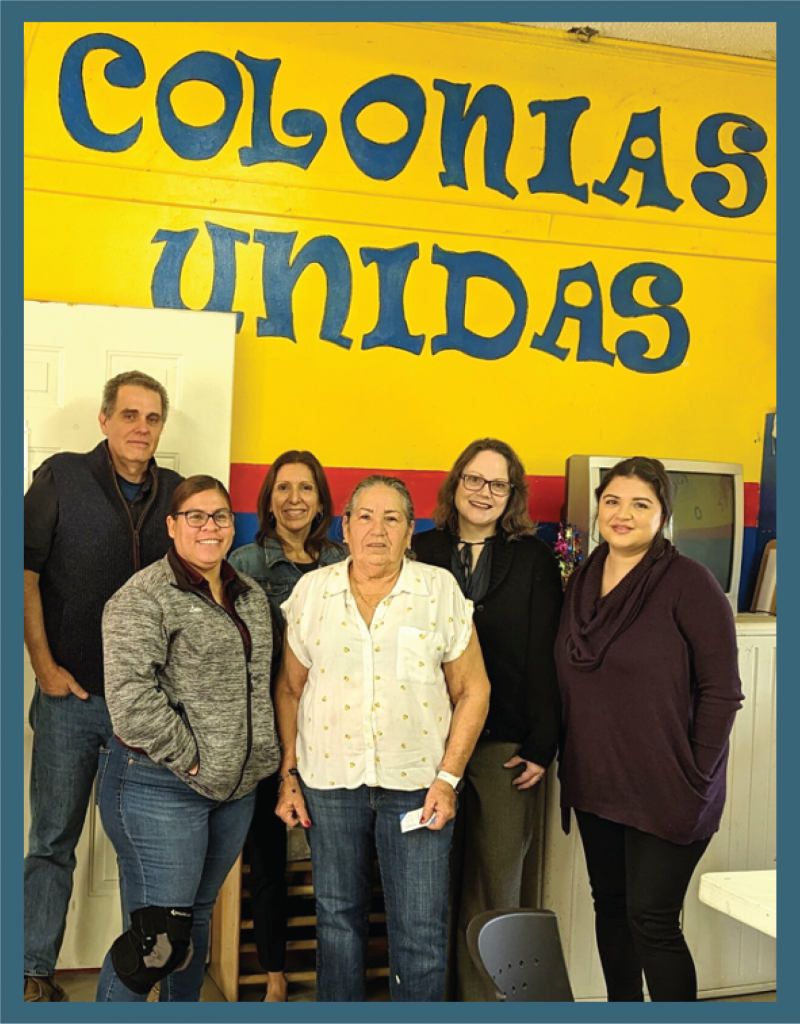
    In December, MHP staff traveled to two rural communities along the Rio Grande River in Texas. Together with staff members from come dream. come build, MHP’s Community Development Team met with local stakeholders including the staff from the Starr County Self Help Center and Colonias Unidas in Los Lomas to learn about the needs in their communities.

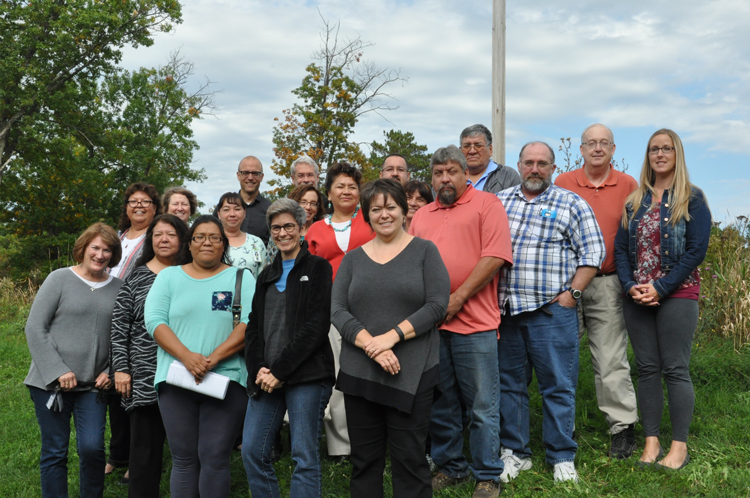
    Staff from Cdcb, Self Help Center, MHP, and Colonias Unidas gather in Los Lomas, TX

    Of the more than 200 Colonias communities in Starr County, MHP worked to zero in on a few as a starting point, including Los Lomas and Rio Grande City. The team learned of 13 vacant lots that might be perfect for cdcb’s MiCasita homes and met with two of the owners.

    While on site, the project team also checked out some multifamily rental properties that were on the market in Rio Grande City and Roma. It was a great start to this engagement, helping CDCB gain a footing in these two rural cities and adjacent colonias communities. MHP’s team is planning another trip there next spring.

  • Where We Work

    MHP is recognized nationwide as a premier technical assistance provider and consultant to create strong, vital communities and affordable housing development. While our work is strongly rooted in Minnesota, we have provided assistance to communities, tribes and organizations across the country. Learn more about the expertise we offer here.

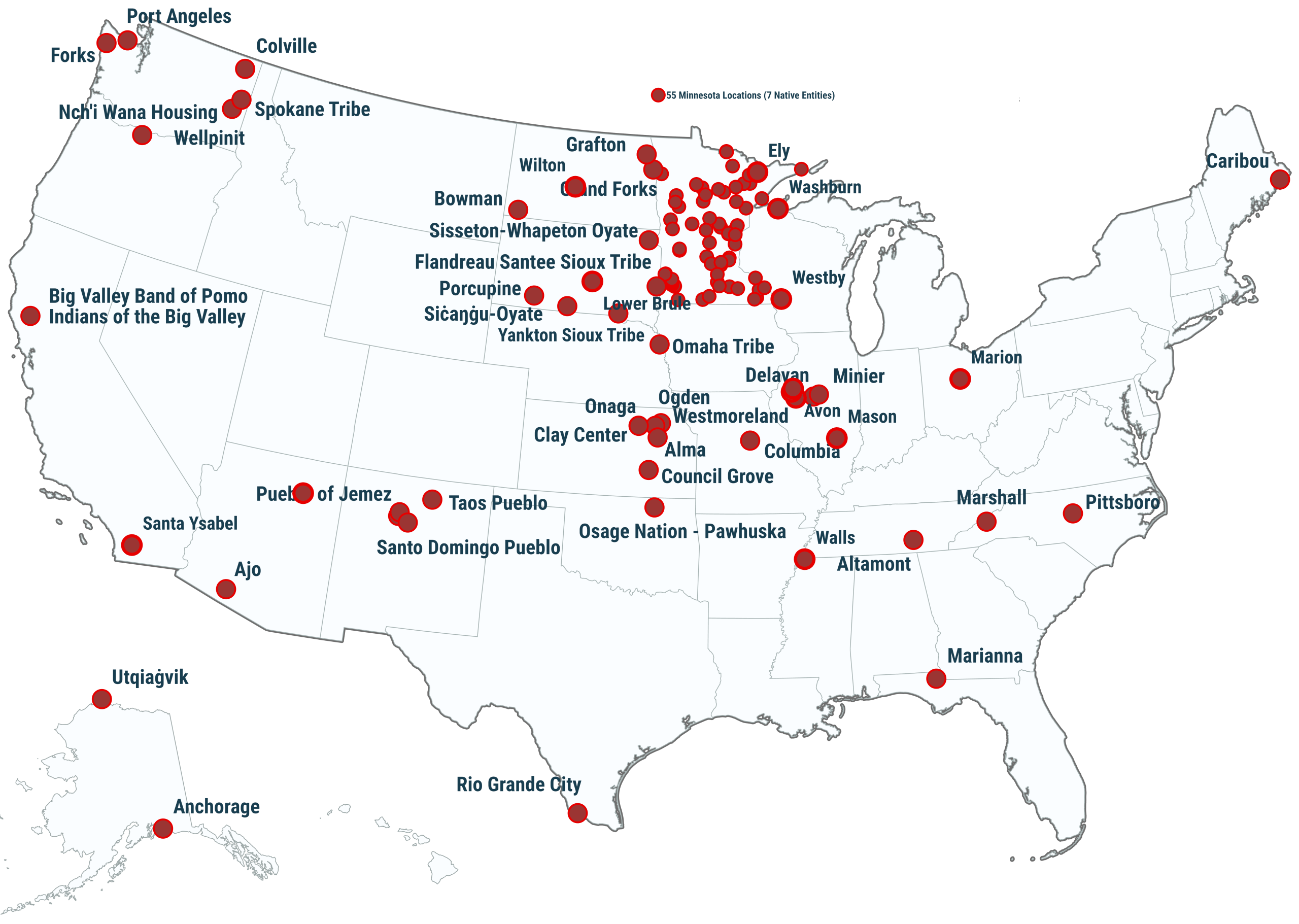
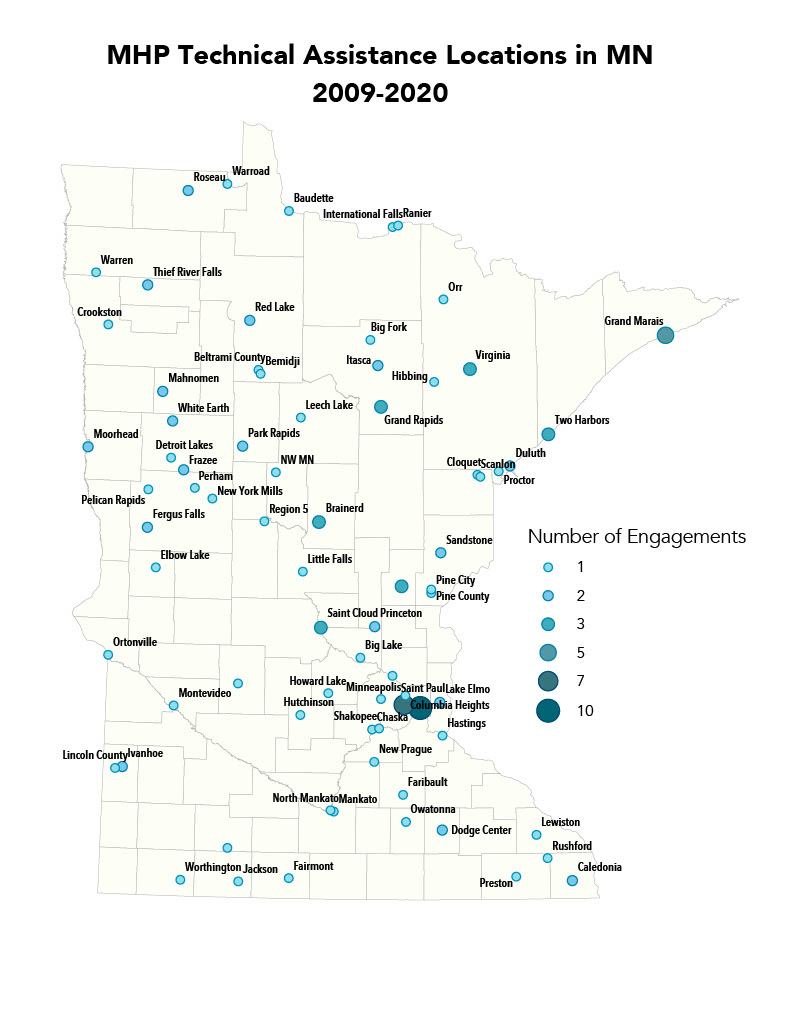
    MHP Partners 2018 – 2025

    Click to download

  • Strengthening Rural Communities

    Equipping Communities to Plan, Fund, and Deliver Rural Housing and Community Development Projects

    What have you been dreaming of for your community? More rural housing? Small town revitalization? A stronger local economy?

    MHP offers free, nationwide support to rural communities and Native Nations. Funded by HUD since 2010, MHP is a nationally recognized leader in community development assistance and technical assistance services.

    Through HUD-funded rural development programs we partner with communities to build capacity, strengthen organizations, and advance housing and community development projects. We also help communities access affordable housing grants, rural development grants, community development grants, housing development funding, and other resources that support rural housing and housing people can afford.

    Who Can Apply

    Anyone can apply! For certain grant-funded projects, the applicants need to be organizations engaged in, or preparing to engage in, housing and community development in rural areas are eligible, including:

    • Community Development Corporations (CDCs) and Community Housing Development Organizations (CHDOs)
    • Local and county governments and political subdivisions
    • Native Nations, Tribal housing authorities, and chartered entities engaged in Tribal community development, Tribal community planning, and Tribal economic development
    • Rural Housing Development Organizations (RHDOs)

    Note: statewide entities are not eligible.

    What We Support

    MHP provides expertise and nonprofit technical assistance to strengthen your community to:

    • Advance Housing & Community Development Projects – Moving ideas from vision to reality, from new or rehabbed housing to innovative models like community land trusts, intergenerational housing, or resident-owned communities.
    • Simplify Funding & Finance – Navigating complex funding sources, layering federal, state, and philanthropic resources, and preparing competitive applications.
    • Turn Research & Data into Action – Conducting needs assessments, housing studies, and mapping that guide decisions and uncover opportunities.
    • Build Momentum – Developing strategies to build broad community and political support, and creating the partnerships needed to realize your goals.

    MHP also encourages regional collaborations, where multiple partners come together to address shared housing and development needs.

    Specialized Focus Areas

    In addition to our general support, MHP also provides targeted assistance with:

    Preserving vital affordable homes in small towns and rural communities.

    Helping communities establish and sustain dedicated housing resources.

    Improving homes, and creating pathways to resident ownership.

    🔎 Explore more ways MHP supports communities: visit our Community Development page.

    What’s Not Covered

    • General operating support
    • Direct housing services such as rental gap assistance
    • Direct construction or development costs
    • Lobbying or political activities
    • Assistance for activities already funded by MHP
  • Native Community Development Institute

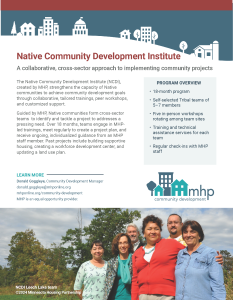
    Click to download the NCDI flyer!

    MHP’s Native Community Development Institute supports and strengthens the capacity of Native communities to reach their community development goals through collaborative trainings, peer-to-peer workshops, and customized assistance.

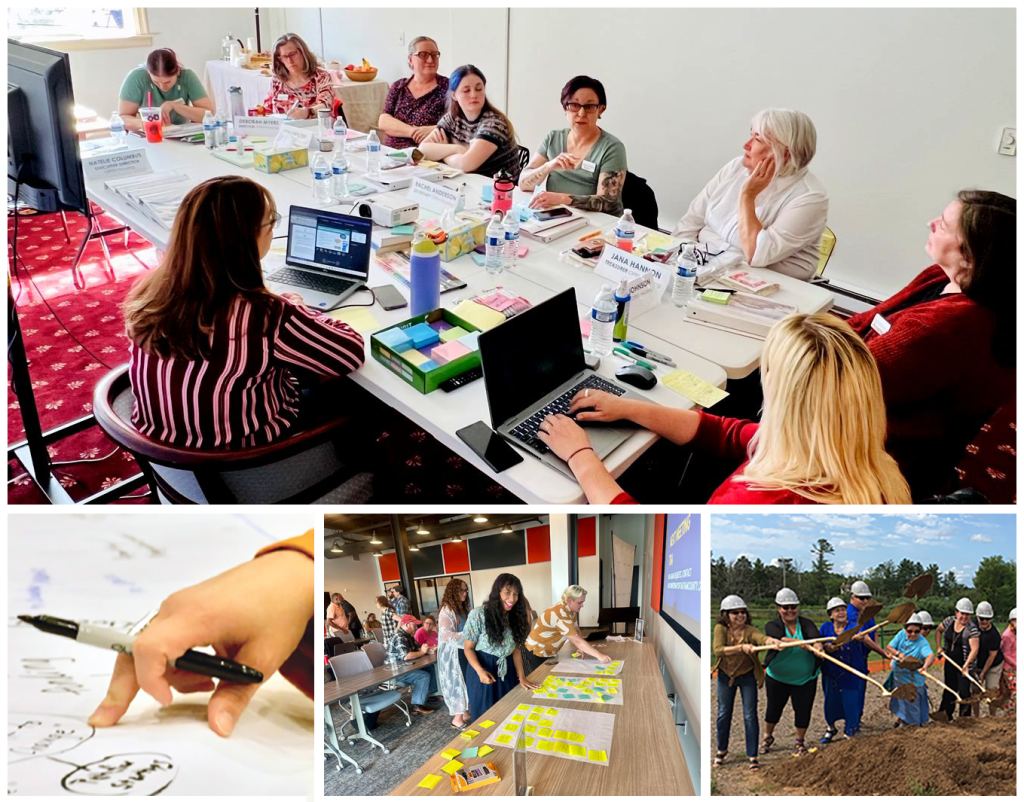
    Participating Native tribes build teams that convene stakeholders from across sectors to identify and tackle a project that addresses a pressing need in their community. Over 18 months, these teams participate in MHP-facilitated trainings and meet regularly to create a project plan. Past projects include building a supportive housing complex, creating a center for workforce development, updating a land use plan, building a deep winter greenhouse, implementing a community needs assessment and developing partnerships to support hard-to-house individuals with wraparound services.

    Key Components of the Native Community Development Institute

    Meet Community Development Needs

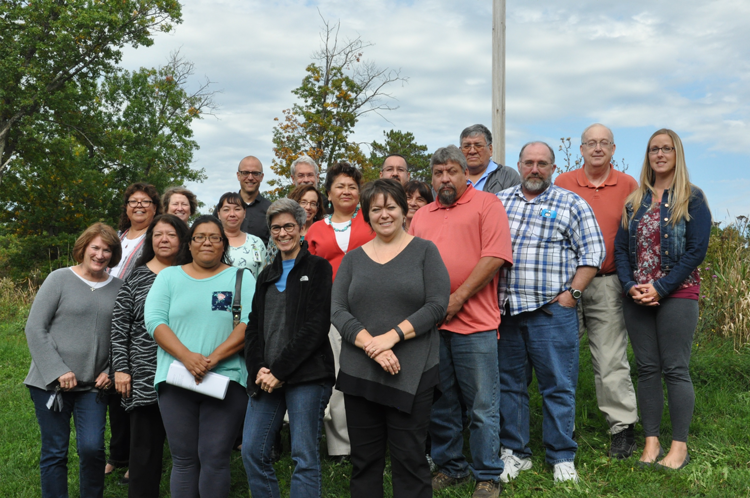
    NCDI’s Leech Lake Team

    Each team identifies a critical community need on which to focus. Workshops and customized assistance give teams the resources and support needed to launch their project.

    Institute participation::

    • Strengthens leadership and collaboration across sectors.
    • Builds team experience working across a wide range of development areas: housing, infrastructure, job creation, and economic and community development.
    • Helps tribal teams facilitate greater community investment in their projects.

    Deepen cross-sector partnerships

    Ambitious outcomes – a stronger economy, a healthier environment, and greater opportunity – demand strong collaborative efforts across tribal departments and sectors at the local and state level. The Institute breaks down divisions of land use, transportation, and housing and economic development. Working across issue areas, teams:

    • Find win-win solutions to commonly held problems
    • Avoid working at cross-purposes in isolation
    • Learn from other’s experience and knowledge
    • Combine resources to take on new projects

    Leveraging resources

    Workshops position Native communities to capture local, state, and national resources to create and preserve community development projects. Teams have the opportunity to network with and receive feedback from funders. These connections provide greater clarity and ultimately strengthen funding proposals. Teams leverage resources by:

    • Sharing existing resources
    • Reducing competition for limited funding and other resources through collaboration
    • Identifying and securing new funding sources through a coordinated approach

    To learn more, contact our Community Development Team:
    CDinfo [at] mhponline.org

    Check out a map of our work with Native nations throughout Minnesota as well as across the country.

  • Loan Funds

    MHP offers two revolving loan funds for expenses incurred during the creation and preservation of affordable housing.
    Affordable Housing Loans

    These flexible funds are available for activities related to affordable housing.

    Eligible activities include:

    • Rehab loan programs
    • Entry cost assistance loan programs
    • Other housing loan programs
    • Construction Financing
    • Gap financing

    Pre-development Loans

    Successful applications will convey a high likelihood that the proposed activities will result in permanent affordable housing construction or preservation within 2 years of the application.

    Eligible activities include:

    • Market feasibility studies
    • Site analysis
    • Site design
    • Securing zoning compliance
    • Preparing funding applications
    • Monitoring construction process
    • Legal fees

    Eligibility & Funding Criteria

    • Applicants must be a nonprofit borrower within the State of Minnesota (limited partnership with for profit developers is acceptable) or a MHP partner if located outside of Minnesota.
    • Affordable Housing Loan: Maximum request of $300,000 will be considered
    • Pre-development Loan: Maximum request of $75,000 will be considered

    Program Guidelines & Application Forms

    For more information, contact:

    Kris Brogan, Community Development Program Officer at 651.925.5550.

  • Housing, Community Development, & Capacity-Building Consulting

    Support for Housing & Community Development Partners

    With decades of experience in housing and community development, MHP provides community development consulting, affordable housing consulting, and organizational development consulting services. As trusted partners to nonprofits, local governments, Native Nations, and community organizations, we help clients strengthen leadership, support nonprofit capacity building, and plan and implement successful projects.

    Our team brings expertise in housing, community, and organizational development, offering tailored training, leadership development services, and project planning.

    Our consulting services include:

    • Nonprofit strategic planning, board strategic planning, and organizational planning for boards, advisory groups, and staff teams
    • Housing needs assessments and housing market analysis to identify community priorities and guide decision-making
    • Community data analysis and research to develop clear, actionable profiles
    • Affordable housing planning, housing development planning, and funding application support
    • Customized trainings, including nonprofit board training, board governance training, executive leadership training, and housing program implementation
    • Facilitation of community meetings, community development workshops, and collaborative events

    To explore a potential consulting project, submit an interest form!

    To learn more about MHP’s expertise and the types of projects we support, visit our Community Development landing page.

  • Section 515 Technical Assistance

    USDA Section 515 properties — and the people who call them home — are at risk. 

    Nationwide, hundreds of thousands of seniors, people with disabilities, and low-income individuals and families live in United States Department of Agriculture (USDA) Section 515 rental properties, a crucial source of affordable housing in rural communities. However, these vital homes are at risk.

    As USDA Rural Development loans for these properties expire, more and more buildings are exiting the Section 515 program. Exiting properties may lose rental assistance funding, and some properties are no longer required to keep rents affordable — meaning tenants could face eviction or homelessness. We simply can’t afford to lose these homes. Learn more from our 515 Fact Sheet.

    How can MHP help YOUR community?


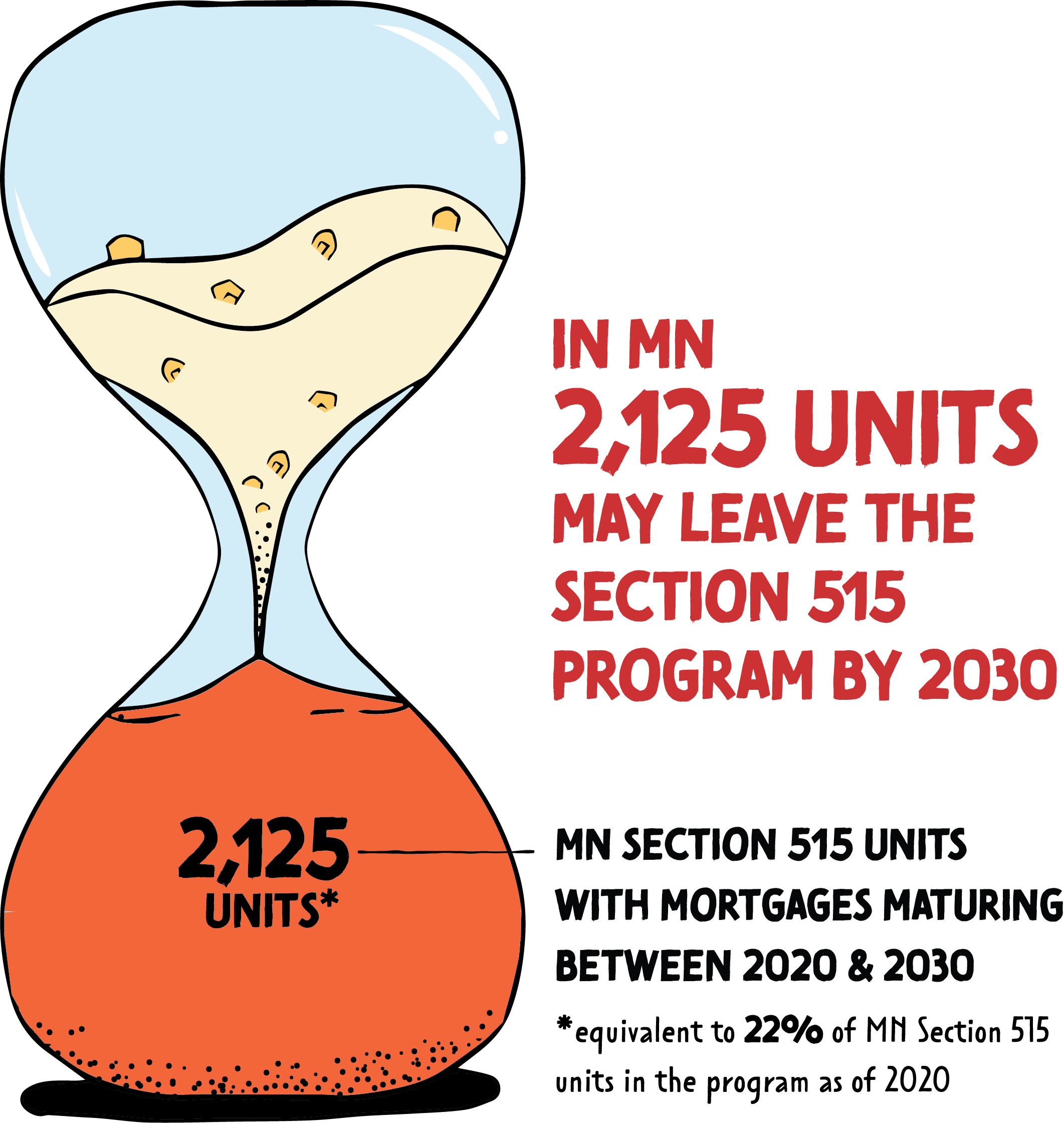
    In MN, 2,125 units may leave the section 515 program by 2030 - or 22% of MN Section 515 units as of 2020

    MHP’s Technical Assistance for USDA Section 515 Transfers 

    MHP’s experienced technical assistance staff can help nonprofits, public housing agencies, and other entities purchase USDA Section 515 properties and ensure they remain affordable to rural households. MHP will assist organizations in successfully navigating the USDA transaction, from reaching out to the current owner to property inspection and more. 

    To learn more about MHP’s technical assistance, contact the Community Development team at CDinfo [at] mhponline.org

    See our one-pager describing our technical assistance services here. 

    Graphic by Kia Lee (Graphic Designer)


    Learn More about Section 515

    https://mhp.sdho.dev/preserving-minnesotas-rural-rental-homes-usda-section-515/

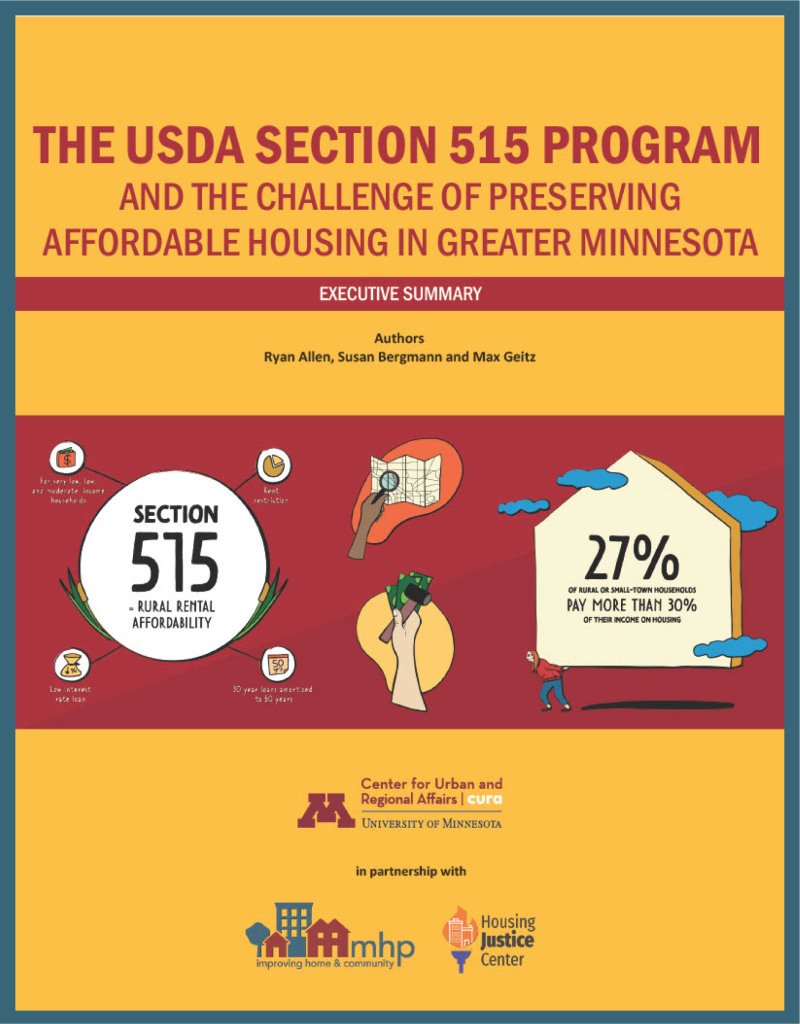
    The USDA Section 515 Program and the Challenge of Preserving Affordable Housing in Greater Minnesota (April 2022)

    This research effort was a multi-year collaboration between the Center for Urban and Regional Affairs (CURA), Housing Justice Center, and Minnesota Housing Partnership (MHP). This report report examines the challenges of preserving housing enrolled in USDA’s Section 515 Program. Read the report here.

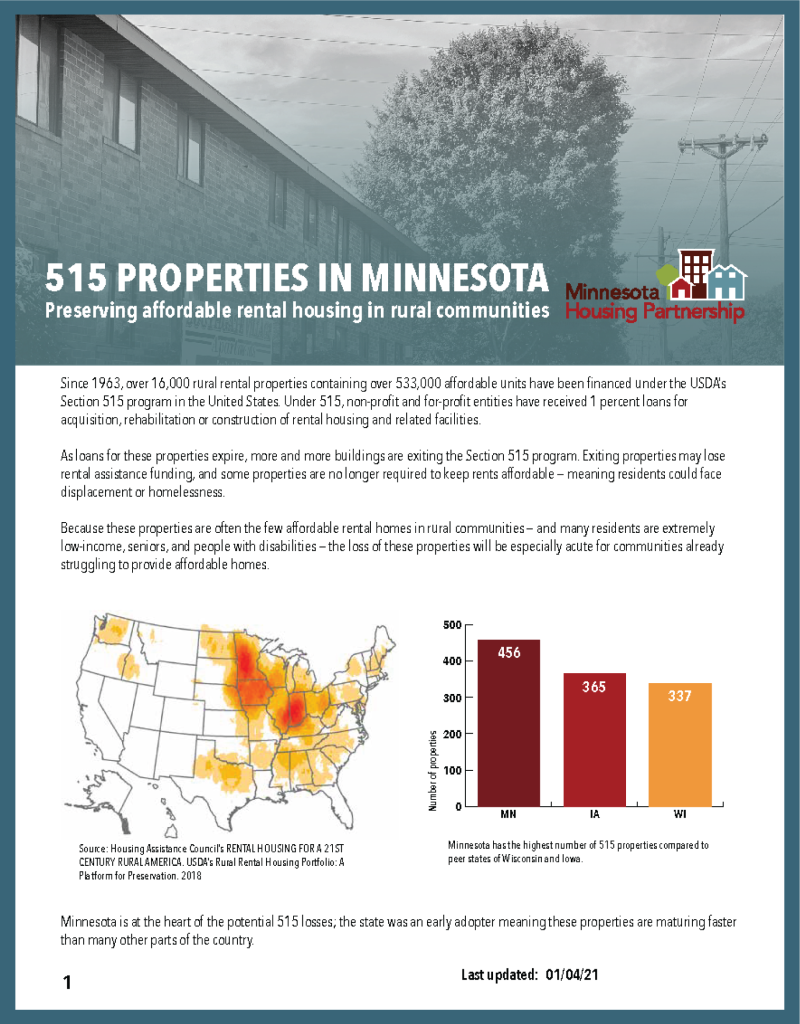
    515 Properties: Preserving Affordable Rental Housing in Rural Communities (January 2021)

    This report describes important affordable rural rental properties across Minnesota and the people who live there. These properties have been financed under the USDA’s Section 515 program. Read the report here.

    Rural Rental Housing: Report and Recommendations (April 2020)

    This report identifies challenges to preservation of rural rental housing and solutions developed by community members that live and work in Greater Minnesota. The report highlights needs and solutions for USDA Rural Development 515 properties. Read the report here.

  • Housing and Community Development in the Arctic Circle – MHP’s trip to Barrow, Alaska

    Touching down on the runway of BRW airport in Utqiaġvik, Alaska (the community formerly known as Barrow), we could already tell from the views of ice floes in the Arctic Ocean and mossy tundra that we were in for a new experience. In late June 2021, Warren Kramer, Community Development Director, and Ella Mitchell, Community Development Officer, met with team members of Taġiuġmiullu Nunamiullu Housing Authority (TNHA), a beneficiary through the HUD Rural Capacity Building 2018 grant. After over nine months of working together virtually, the team was excited to meet in person for a week and see with their own eyes what it’s like to work on housing in Alaska’s North Slope Borough.  Utqiaġvik is a community of 4,500+ people and is the northernmost city/town in the US, located north of the  Arctic Circle.
    Griffin Hagle, Executive Director of TNHA, graciously picked up MHP staff at the airport and brought us on a driving tour of Utqiaġvik, pointing out TNHA properties and unique building techniques, as well as local landmarks like the tribal college and hospital. A whole range of unique, cold climate construction materials and techniques are used in housing development when building on permafrost.  Construction materials must all be transported by ocean barges to Utqiaġvik from Anchorage.  They say the first $150,000 of housing development cost, per unit, is the transportation costs of the construction materials.  A primary focus of the visit was to finish the strategic planning process we’d started months earlier, with TNHA staff and board members.  TNHA is governed by Board members who represent the six native Alaskan villages TNHA serves. Since there are no roads connecting these six villages, the board members need to fly into Utqiaġvik to participate in board meetings and the strategic planning work.  Dr. Pearl Brower, a longtime Utqiaġvik resident and former president of Iḷisaġvik College, facilitated these meetings, leading the group in team building activities and discussions about the future of TNHA. The final product was an approved Strategic Plan that will guide TNHA’s work for the next several years.

    In between sessions, the group enjoyed pastries homemade by very talented TNHA staff, participated in a weekly group walk around town hosted by the Mayor’s office and even caught a glimpse of the annual whaling festival, Nalukataq. Utqiaġvik is a  centuries old whaling village which is still a significant part of the community’s culture and economy.  Some 32 teams of local whalers went out in pursuit of bowhead whales in 2021.  22 of those whaling teams successfully harvested a whale this year.
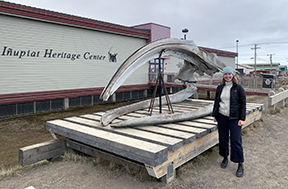
    We were also able to tour a 29-unit apartment built in 1977 that TNHA is in the process of renovating with funding from HUD and other entities. Some other highlights of the trip included a delicious barbecue dinner hosted by Griffin and his wife Kelly, a tour of the NOAA Barrow Atmospheric Baseline Observatory where researchers around the world are tracking weather and climate change data, and a visit to the Iñupiat Heritage Center to learn more about local native history and culture.

    While North Slope communities share many housing challenges with other rural and tribal communities in the United States, they also face unique challenges due to their extreme remoteness and unique physical environment. Sustainable housing solutions are a critical innovation need as these communities are directly impacted by the effects of climate change, including tundra subsidence and sea level rise. For example, all housing in the area is built on piers or stilts so that the heat from the building does not thaw the permafrost beneath the home. More recently, sled rails have been added to cap the stilts so that the structure can be moved if the coastline changes and the community must relocate. Energy efficiency measures such as improved insulations, new windows, and electric stoves are also critical improvements because utility costs can be astronomical in the North Slope’s deep winters and indoor air quality during these months can be a major issue. MHP’s successful trip to Utqiaġvik brought these issues to life as staff were able to see in person the real issues and challenges of working in this remote region, as well as the strengths and commitment of our beneficiary up there, TNHA. ~Ella Mitchell

  • Community Partners in Lanesboro Work On Housing Solutions, with Help from MHP’s Housing Institute

    Community Partners in Lanesboro Work On Housing Solutions, with Help from MHP’s Housing Institute
    Through its participation in MHP’s Housing Institute, Lanesboro partners are working to address the area’s severe lack of available housing and create solutions. Established in 2010, MHPs Housing Institute brings together housing leaders and stakeholders to share their experiences, learn best practices, and develop creative solutions to bring quality affordable housing to their communities.
    MHP’s Seventh Round of the Housing Institute, which was launched during the COVID-19 pandemic, is the first entirely virtual institute. To ensure community teams from Preston, Lanesboro, Fairmont, Owatonna, and Lewiston Minnesota could participate and advance their community initiatives, MHP moved all institute networking, training exercises and development goals to an online platform. While an all-virtual environment has had challenges, each team has shared both continued commitment and a lot of needs around housing goals that the Housing Institute continued to support.
    Individual teams, such as Lanesboro, are looking at potential projects, land availability and local funding sources to use in development. Resources provided through the Housing Institute have included a workshop on how best to build a consistent message to different audiences, convening a regional advisory committee comprised of state and rural housing funders as well as developers and local economic development practitioners, and a presentation on local government financial tools that can be used to increase affordable housing in rural communities.
    The Lanesboro team, which includes; Desiree Borth-Ferrie, Jeff Brogle, Philip Dybing, Ben Gorman, Eliza Mitchell, Michele Peterson, Elliot Riggott, Matt Schultz, Wyatt Seablom and Cathy Enerson, have documented their efforts to date through photos and this blog post.

    What is home? By Ben Gorman – Thursday, 20 May 2021

    It’s a big question. Is home a building or a community? Is it found in the emotional landscape or the built environment? For some, the answer only arises from a complex interplay among emotional and practical considerations; for others, the answer is quite simple: “Home is where you hang your hat.” For too many, there is no answer, or the answer is unknown. Those of us fortunate enough to have a place we call home would do well to reflect on what constitutes our sense of home, what makes it real for us.

    Members of the Lanesboro Burro Borough, brought together by the Minnesota Housing Partnership, may, individually, have different definitions of home, but we all agree that home is a vital part of our well-being and recognize that everyone should have a place to call home. We also agree that in Lanesboro we have a place which, for us, is worthy to call home, a place where we can thrive—and where we hope others can thrive as well: neighbors old and new that we hope to call friends.

    Our collective love and respect for Lanesboro, and our interest in this community’s future, led us to engage the Minnesota Housing Partnership program and embark on the 18-month journey to identify and engage opportunities to improve our housing stock and help existing and prospective residents find places here to call home.

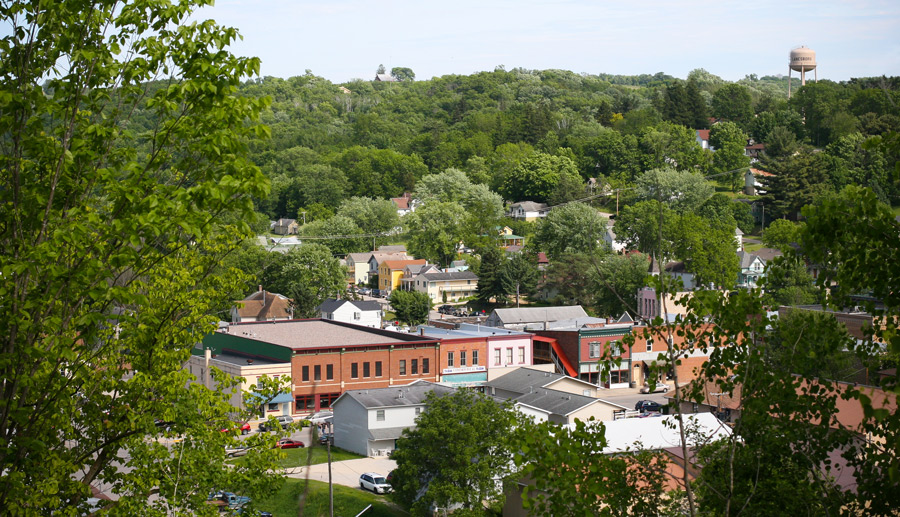
    Lanesboro, Minnesota, in Fillmore County, as seen on the approach descending the hill on Route 8.

    So far, it has been a journey of learning and growth and discovery—with a few surprises along the way, like all the best journeys have! Inventorying the positive aspects our little hometown was the easy part; we readily recognize the features and quirks that drew us here and keep us here—we even agree on most of them! But identifying the barriers and helping to create a shared vision of how to facilitate an expansion of high quality, affordable and equitable housing in Lanesboro took a little more creative thinking. Fortunately, with the help of experienced and creative minds like Cathy Enerson of Community and Economic Development Associates and Warren Kramer of Minnesota Housing Partnership—indeed, with the whole talented team at MHP in our corner—we are working on defining our challenges and setting goals to overcome them.

    What we’ve learned in the process will help us to build a better Lanesboro community, not just—our primary goal—by adding suitable housing stock to our local market, but by understanding the needs and challenges we face as residents, as neighbors, as contributors to the local community. We all believe in our little ’boro—with its population of proud Burros!—and we want to see it thrive well into the future.

  • Sandstone’s The Rock slated to become affordable housing

    Sandstone’s The Rock slated to become affordable housing

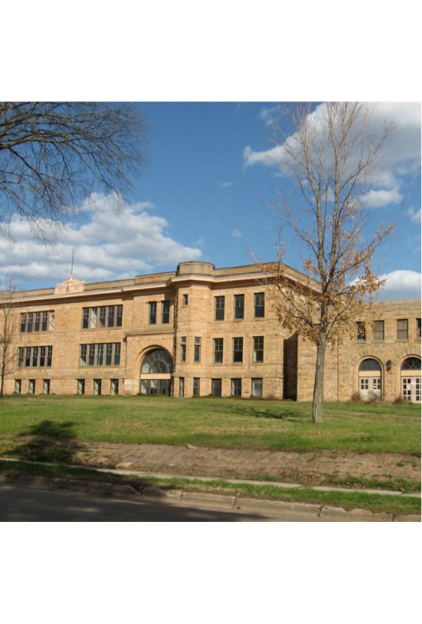
    An iconic former school made of sandstone — in the City of Sandstone — will soon become a place to call home. Once complete, The Rock, as it’s known locally, will be a shining example of the adaptive reuse of a historic local landmark.

    Sandstone and the surrounding Pine County area lack housing that schoolteachers, trash haulers, and workers at the nearby low-security federal prison can afford. People who want to move to the community for job opportunities often struggle to find a place to live.

    One of the primary reasons for this lack of affordable housing is that it costs too much to build new multi-family rental properties. Incomes in Pine County have stagnated as construction costs continue to rise, so developers tend to pass the region by in favor of more profitable areas. Over the past several years, this has led to a critical lack of affordable homes.

    Developers have tried and failed to transform The Rock in the past.. The iconic building was constructed in 1910 out of sandstone that was quarried from the Kettle River Sandstone Company Quarry, and it served as the City of Sandstone’s main school until a new facility was built in the early 2000s. Since then it has sat vacant, a shadow of its former self.

    Soon that will change, and The Rock will be revamped into affordable community housing. MHP connected the City of Sandstone with Community Housing Development Corporation (CHDC), a nonprofit developer with experience in complex rehabilitation and affordable housing projects. CHDC helped the City of Sandstone realize the community’s vision for the Rock’s renovation into rental housing using Historic and Low-Income Housing Tax Credits.

    Once complete, the building will provide 24 units of affordable workforce rental housing to Pine County residents. Ten units will be reserved for people with disabilities and those who have experienced homelessness. Lakes & Pines Community Action Council and Pine County Health and Human Services will provide supportive services including employment training, mental health assistance, and food support. The building will have on-site laundry, common space, and a management office.

    “This project is vital in order to provide quality, safe housing options for all residents in Sandstone,” said Kathy George, City Administrator for Sandstone. “This is an opportunity to preserve an iconic and historic building for future generations. It will also create an incentive for future generations to stay in Sandstone by providing housing that young people working in their first jobs can afford.”

    Several community and regional stakeholders have come together to help make this project a reality. Community Housing Development Corporation has worked closely with the City of Sandstone to design, finance, and soon begin construction on the rehabilitation of this important local landmark. Lakes & Pines Community Action and Pine County are coordinating supportive services, and Minnesota Housing Partnership is providing additional funding and technical assistance.

    An application for funding has been submitted to the Minnesota Housing Finance Agency.  Funding awards will be announced this fall.  Construction is anticipated in 2022.