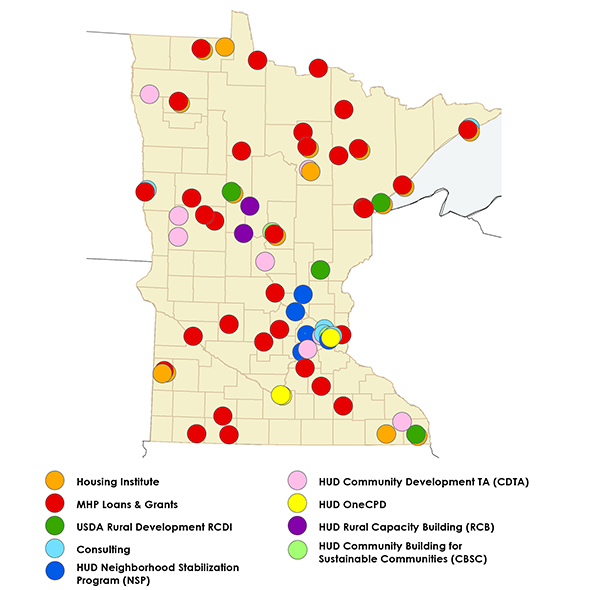
In her opening remarks at the Agency’s October Board Meeting, Commissioner Mary Tingerthal stated that the board would soon be making the annual project funding awards. Once this was done she and Lieutenant Governor Tina Smith would be in Rochester for an announcement of the awards. Tingerthal commented that finally the media was giving this commitment of funding the attention it deserves.
Tingerthal also reported that the Agency received three recognition awards at this year’s National Council of State Housing Agencies event. The national association recognized Minnesota Housing for its Housing and Jobs Initiative, the Community Fix-up Fund, and the registry used to connect homeless veterans to housing and other services.
Commissioner Tingerthal informed the board that Jim Solem, one of her predecessors, was being inducted into the University of St. Thomas’s Real Estate Hall of Fame. Tingerthal said that she couldn’t think of anyone who has contributed more to affordable housing finance in this state than Jim Solem.
In one action not connected with the Super RFP awards the board endorsed the staff recommendation to redistribute enhanced homeownership capacity initiative funds to three other participating agencies. Staff told the board that White Earth Investment Initiative, one of the recipients of the program which is intended to increase minority home ownership, declined to accept its awarded funds due to a lack of staff capacity to administer the program. Board member George Garnett asked why none of the program funds was going to Duluth, a community with a significant minority population. Staff said that no applications had been received from Duluth agencies but that they will be hosting another program outreach in January and might be able to attract Duluth agencies.
Discussion of RFP Awards
In introducing the super RFP recommendations (all of which were subsequently adopted by the board) staff stated that 1420 units would be funded, with a total $88.3 million in Agency funds awarded. Should all funded projects proceed as proposed, development costs would total $236 million.
In providing context for the awards staff said that at least one project would be funded in each region of the state, and this year 65% of the awarded funds would go to Greater Minnesota. Over a five year period the agency has funded development or redevelopment of 12,000 housing units, with 60% of awarded funds going to Twin Cities projects and 40% to those in Greater Minnesota. While staff was pleased that more fundable Greater Minnesota projects had been submitted they noted that some areas within Greater Minnesota were still underrepresented in the awards. Particularly so was the Central region, they said, where 13% of the state’s residents live but only receiving 4% of the agency’s funds. Commissioner Tingerthal said that over the next couple of years the agency will focus its technical assistance on this region.
With its homeownership awards, 16 Twin Cities and 12 Greater Minnesota projects will receive funding. Agency resources being distributed include $500,000 from Housing Infrastructure Bonds; these are being used to support community land trust projects. For the first time in assessing home ownership project proposals the Agency considered walkability and industry cost data supplied by R.S. Means. All funded projects were within an acceptable cost range based on this data, staff said. Median targeted affordability for agency homeownership funds is 52% of area median. Staff saw trends in more proposals linked to workforce needs and larger multi-bedroom new homes. Coming out of the Great Recession new ownership construction had nearly ceased, but now staff were seeing confidence to recommence construction.
Board member Garnett again expressed concern about the Duluth area. In what he described as a relatively closed system where most development was controlled by the housing authority and a couple of nonprofits, Garnett wanted to know whether homeownership opportunities were going to minority families. In response, staff said that the Agency really encouraged the nonprofit One Roof to expand beyond its land trust development model and serve the community with a variety of development types. Staff added that in its review they found that One Roof did serve minority households above the percentages in which minority households reside in Duluth.
From the 78 multifamily proposals submitted staff recommended 23 for funding, representing 1,100 housing units. Of the projects awarded, 10 are located in the Twin Cities, 13 in Greater Minnesota. Staff said that the emphasis on process improvement supported their clearer funding priorities – preservation, family housing, workforce housing and supportive housing — and this clarity benefited developers.
The board asked staff to respond to an email submitted by a resident of Moorhead who was opposing a 43 unit supportive housing project proposed by a local faith based nonprofit. Tingerthal said that this had been a contentious project a year ago, but the developer reworked the proposal to address most of the concerns that had been voiced. The current proposal rated very high; and while residual concerns still exist the level of community opposition drastically reduced.
Staff highlighted a number of rental projects including one for homeless youth in Edina, a community where only 8 affordable units had been developed in 14 years they noted. Commissioner Tingerthal added that the city supported the youth project, in spite of initial community opposition, due in part to the organized efforts of area congregations. Edina also was requiring market-rate rental developers to include affordable units or contribute to a fund. Tingerthal then described pro-affordable housing efforts of other local governments, with many of these spurred by the formation of the Urban Land Institute sponsored Regional Council of Mayors.
 At the start of the September MN Housing Board Meeting, Commissioner Tingerthal announced she has been appointed to the Federal Reserve Board of Governors’ Consumer Advisory Council. She represents one of 15 people nationally recruited to provide advice to the Fed on the impact of its policies on various types of consumers. Tingerthal also announced that Paula Beck, the general counsel, was leaving the Agency to work for Sherman Associates; Tingerthal asked the board for attorney recommendations to fill that post.
 Once again Katherine Kersten shares a vision for regional growth in which all roads lead to less regulation and lower taxes. Kersten’s alarmist piece includes numerous misleading or misplaced condemnations of the Metropolitan Council, affordable housing, and the planning profession. I’ll focus on two of her examples given as reasons to feel very bad about public life in the Twin Cities.
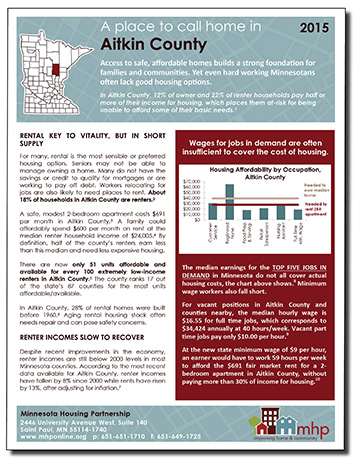
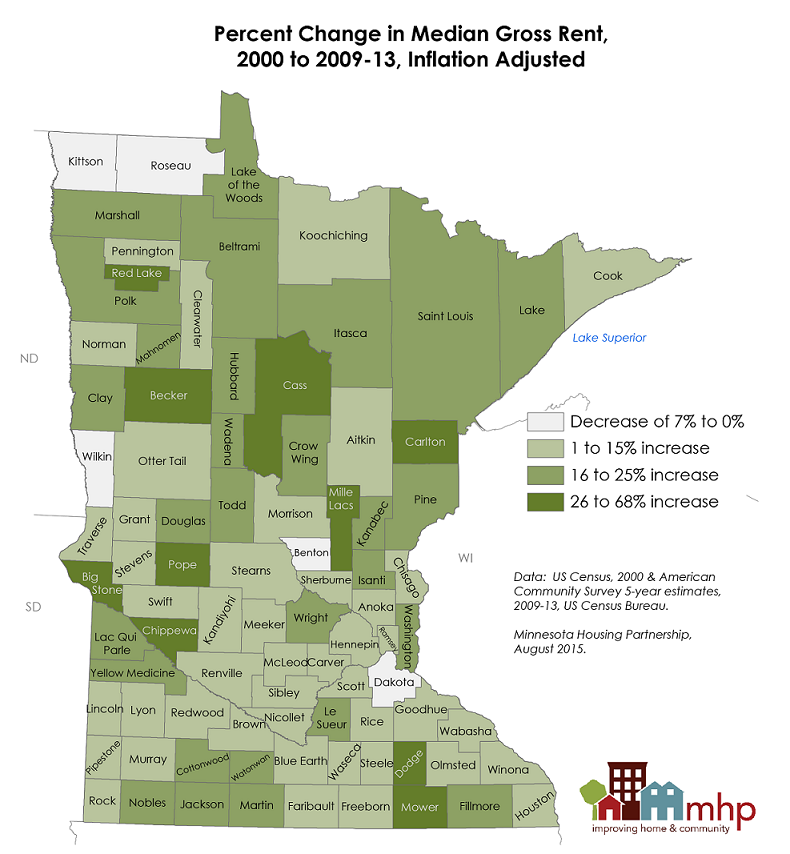 Our 2015 County Profiles point to trouble for renters all across Minnesota. Rents have risen and affordable rental units are in very short supply for those who need them. This year’s profiles for each of Minnesota’s 87 counties include data not just on housing cost burden, but also on new units permitted for construction, projected needs for seniors, and affordability for top jobs-in-demand. The profiles show there is unmet need in all counties, and that Greater Minnesota counties have seen the sharpest increases in rents since 2000.
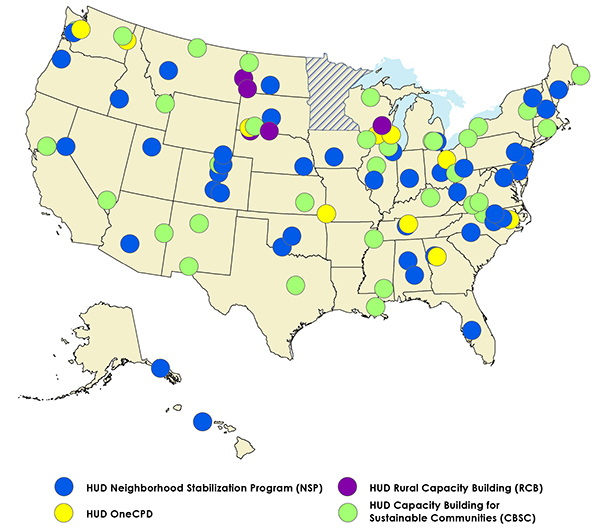
 As the result of a recent federal grant, MHP staff are preparing for work in three rural US communities: Osage County, Oklahoma, the Lakes & Pines Region of E. Central Minnesota, and Bowman and Golden Valley counties in North Dakota. All three communities, which have undertaken extensive planning and strategizing, are poised to implement a wide variety of development projects under the grant.

 Renewable energy, especially solar, is of great interest to affordable housing developers from both a financial sustainability and mission perspective. However, effective practices and financing systems are still emerging in Minnesota.
 Michael Bodaken discussed the topic from both a national policy and on-the-ground practice perspective: As part of the
 Gina Ciganik gave context for the challenges of using alternative energy in Minnesota. On average, Minneapolis has a 130º swing in temperatures between summer and winter—greater than most other metropolitan areas in the U.S. Our systems are strained through sub-zero temperatures, snow, heat, and humidity. This extreme climate variation means that Minnesota housing developers may not be able to adopt models from projects located in milder climates.

 Vihar Sheth provided an investor’s perspective on the data needed to make the case to tax credit investors to underwrite renewable energy investments. In part, the challenge is in underwriting savings that accrue directly to tenants, rather than to owners. One innovative approach Sheth noted is to incorporate energy costs into rent (with no net effect on residents’ pocketbooks) so that the savings can be more directly underwritten at the project level and incorporated into lower cost projections for the building.
 Since at least the 1940s, there have been lawsuits nationwide regarding racial segregation and affordable housing. A recent controversial report from the Institute for Metropolitan Opportunity at the University of Minnesota and a related fair-housing complaint have amplified the discussion in Minnesota.