• Housing bills move through House and Senate

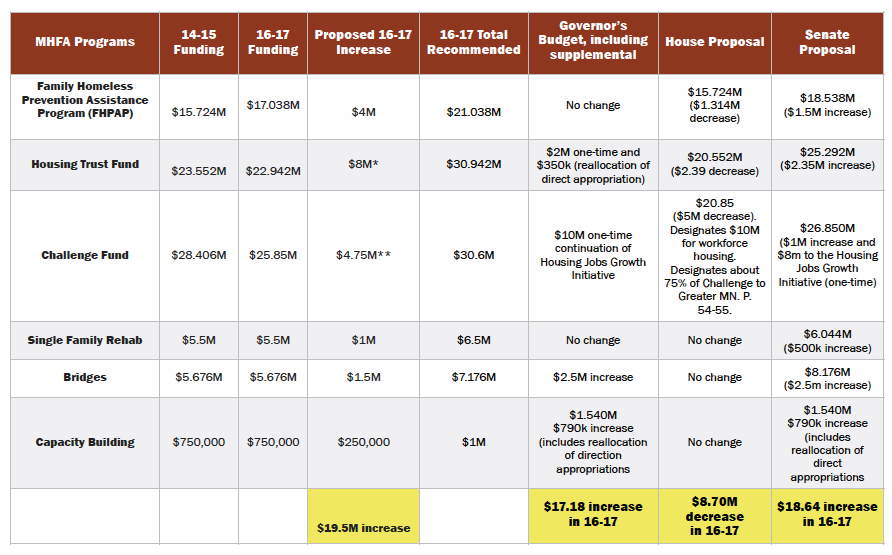
    Side-by-side budget comparisonHousing and services bills have been moving rapidly through the House and Senate, as both bodies position themselves for end-of-session negotiations. It may come as no surprise that the House, Senate, and Governor’s versions of the budget differ from each other when it comes to Minnesota Housing funding and homelessness services. A side-by-side budget comparison table and analysis follow with special focus on the $39 million increase sought in the Homes for All agenda for 2016-17 and on programs for housing for workers. It’s an important time to reach out to legislators, as negotiations will be underway in the coming weeks.

    Minnesota Housing funding: Homes for All-related

    Looking collectively at the House, Senate and Governor’s proposals for programs on the Homes for All agenda for Minnesota Housing, the House proposal looks most like an outlier, with millions in cuts proposed. The other two budgets offer increases. The House and Senate bills both passed off of the floors of their respective chambers on April 22 and will head to conference committee. Conferees are likely to be announced this week.

    Here’s how the Minnesota Housing proposals stack up in comparison to Homes for All, which seeks a $19.5 million increase to key programs:

    The current House proposal (H.F. 843) cuts $8.7 million to Homes for All Minnesota Housing programs. The Challenge program takes the biggest hit, with $5 million diverted to DEED for a workforce housing program (see Other Housing below). The Housing Trust Fund and Family Homelessness Assistance Program also are reduced. The proposal, including controversial policy changes to the Challenge Fund, is discussed in detail in our April 13 blog post.*

    The Senate proposal (S.F. 2101) by contrast, offers a $16.2 million increase in funds for the Homes for All program priorities. Each of the six programs gets a boost, though not at the levels recommended by Homes for All. The biggest winner is the Challenge Fund, which sees a $1 million increase in regular funding, plus a one-time increase of $8 million for the Housing and Job Growth Initiative. (The one-time funding would support housing in communities with a shortage of housing for workers. This issue has been heard at the legislature as a need in Greater Minnesota this session.) Bridges, which serves people with serious mental illness who face homelessness, also comes out ahead of the original Homes for All recommendation, with a $2.5 million increase. Other programs with funding increases in the Senate bill, but at lower levels than Homes for All recommends, include the Family Homeless Prevention Assistance Program (FHPAP), the Housing Trust Fund, Single Family Rehab, and Capacity Building grants.

    The Governor’s proposal, proposes total increases of $15.6 million to Homes for All programs, just slightly less in sum than the Senate proposal. However, the distribution of dollars across programs differs. Challenge again receives the largest increase ($10 million) via a one-time increase solely for the Housing and Job Growth initiative. Several programs are funded at the same level as last year, and several see small increases.

    Also, the non-Homes for All “HOME” bill to fight disparities in home ownership rates receives $500,000 in the Senate proposal, where it is rolled into the Capacity Building grants. (The House does not appropriate any resources for the HOME bill, but does urge Minnesota Housing to deploy resources and make “continuous improvements” to reduce disparities.

    See the side-by-side table for detailed budget breakouts.

    Other housing for workers

    As discussed above, the Housing and Job Growth initiative in the Challenge Fund is a key program for housing for workers. Challenge serves renter households earning up to $62,000 and owner households up to $89,000. MHP is also following several additional proposals not included in the Homes for All ask:

    • In the House and Senate bills, $5 million and $4 million respectively are budgeted for a program to be housed in the Department of Employment and Economic Development (DEED) (as opposed to Minnesota Housing) for market-rate rental housing development for workers in Greater Minnesota. This program would build housing without any income limits attached. In fact, pairing these dollars with any funding source that carries income restrictions for residents is prohibited in these proposals. In the House, the $5 million proposal comes at the expense of the Challenge fund.
    • Both the House and Senate (but not the Governor) allocate $1.4 million, for 2016 only, to continue a workforce housing pilot program in DEED from the current budget cycle for creating housing in Roseau and Pennington counties. (This program has seen mixed results, with some dollars yet to be utilized.)

    While MHP recognizes the need for housing in Greater Minnesota, even for workers at moderate-income levels, we have serious concerns about several elements of the DEED program proposed. Key concerns include the inability to utilize income-restricted funding sources to piece together funding, as well as locating such a large housing program in DEED, which has much less expertise in financing rental development than the Minnesota Housing Finance Agency.

    The legislature is also looking at tax policy changes related to housing for workers, to be covered in a future post.

    Services funding

    For services through the Department of Human Services for people facing homelessness, Homes for All has proposed an increase of $19.5 million across five programs. The three budgets (House, Senate, and Governor) offer far lower increases, totaling $7 million, $9 million, and $6.5 million respectively. The Homeless Youth Act and the Bridges program for adults with serious and persistent mental illness both see increases in all three proposals. Transitional housing sees no increase in any budget, and the Senate kicks in more than the other two proposals for long-term homeless support services and emergency services. You can find details in the side-by-side budget comparison.

    The Senate HHS bill passed off the floor last week, and the House bill is to be voted on today (4/28).

    How to support

    Please contact your legislator in support of $39 million for Homes for All  and $10 million for the Housing and Job Growth Initiative. Please ask them to share your interest with conference committee members, who will be named soon.

    *Note: our April 13 Capitol Connect blog post originally reported that the House bill removes income limits from the Challenge Program, and disallows pairing Challenge funds with other income-restricted sources. However, these two changes apply only to the half of Challenge funds carved out for workforce housing in Greater Minnesota for 2016-17.
  • 2016-2017 Minnesota Housing Budget Update

    In the final days of the 2015 legislative session, Minnesota Housing Finance Agency’s budget faced uncertainty. Lawmakers released the Jobs/Energy bill, in which Minnesota Housing’s budget is included, with less than an hour before the Legislature’s adjournment deadline of midnight on May 18. The House took up this “lights on” bill in the final minute of session.
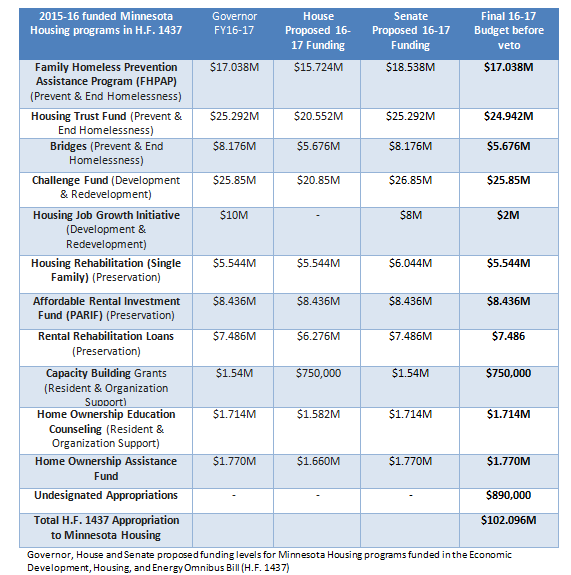
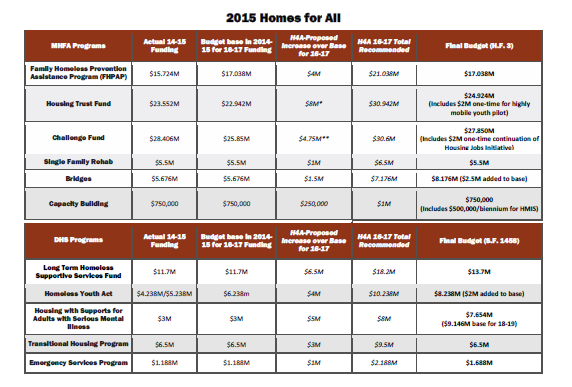
    The bill maintained Minnesota Housing’s base level funding and secured an additional one-time $2 million to the Challenge Fund for the Governor’s Housing and Job Growth Initiative and an additional one-time $2 million to the Housing Trust Fund for the Homeless/Highly Mobile Youth Student Project. A veto from the Governor – related to other portions of the Jobs/Energy bill – loomed even before session adjourned. After several days of deliberation, Governor Dayton vetoed the Jobs/Energy bill and the 2016-2017 budget for housing is still unsettled.

    The Governor’s veto means there is uncertainty about Minnesota Housing’s budget, but MHP is optimistic that the bill that is now being negotiated between the Governor and Legislative Caucus Leaders will maintain the additional $4 million for the Housing and Job Growth Initiative and the Homeless/Highly Mobile Youth Student Project. Additionally, Governor Dayton released a statement saying he and Legislative Caucus Leaders had agreed to appropriate more funding for the Bridges program, which helps prevent Minnesotans with mental illness from becoming homeless.

    At the Capitol, rumors are currently circulating that Governor Dayton will call a special session this Friday. Look for upcoming blog posts on the Jobs/Energy bill and Minnesota Housing’s budget. Follow MHP on Twitter for up-to-the-minute updates.

    Minnesota Housing Appropriations Summary 

  • 2015 Session Wrap Part I: Homes for All

    At the Capitol this year, MHP worked with Homes for All to increase funds for housing across the spectrum of need. MHP and Homes for All asked legislators to budget an additional $39 million for housing development and supportive housing services to meet housing needs of the homeless to moderate-income workers. Ultimately, Homes for All met with success again this year in securing an additional $25.5 million in funding. Funding included $15.5 million in budget appropriations for housing and human services programs plus $10 million in bonds for housing, which was a welcome outcome of end of session leadership negotiations. Ultimately, Minnesota Housing and DHS will benefit from $36.5 million more in 2016-17 than in 2014-15 for these selected programs.* 

    Last Days of Regular Session

    In the final days of session, housing advocates waited eagerly for the Economic Development, Housing and Energy Conference Committee to meet and produce a “Jobs/Energy bill” with funding for Minnesota Housing. On the last day of session, Governor Dayton, Senate and House leadership, and committee chairs were still negotiating compromises behind closed doors, leaving the conferees and the public in the dark about the contents of the final bill. Rumors that the legislature would never take up a Jobs/Energy Bill or that a “lights on bill” was being drafted circulated until the final hour. Finally, in the last half hour of session, Senate staff distributed copies of the Economic Development, Housing, and Energy Omnibus Bill. Most senators had little or no time to read the bill. After the Senate passed an amended version of the bill and with three minutes until midnight, a staffer literally ran the bill to the House Chambers. Speaker of the House Kurt Daudt called the House to a vote and, despite objections by House members who didn’t even have a copy, the House passed the bill.

    The “lights on bill” that passed on May 18 secured an additional $4 million for programs in Minnesota Housing. Governor Dayton’s veto, soon after the close of regular session, of the Jobs/Energy bill left advocates uncertain about the future of Minnesota Housing’s funding for the next biennium. After weeks of negotiations with the four Legislative Caucus Leaders, Governor Dayton called a special session on Friday, June 12.

    2016-2017 Homes for All Minnesota Housing Finance Agency (MHFA) Increases

    In the end, lawmakers agreed to appropriate an additional one-time $2 million to the Governor’s Housing and Job Growth Initiative to finance affordable and workforce housing. Lawmakers also appropriated an additional one-time $2 million for the Homeless/Highly Mobile Youth Student Project to provide temporary rental assistance for families with school-age children who have changed their school or home at least once in the last school year.

    As part of pre-special session negotiations, Governor Dayton also requested including more funding for Bridges to help the state further its Olmstead Plan efforts to address the needs people with disabilities. The special session Jobs/Energy bill (H.F. 3) increased funding for Bridges by $2.5 million per biennium. Bridges helps provide housing for people with mental illness experiencing chronic homelessness. The final outcome resulted in Homes for All securing an additional $6.5 million for programs in Minnesota Housing. Senator Tomassoni, chair of the Environment, Economic Development and Agriculture Committee, said that he wished the bill had done more for housing but that he believed what was in the bill “is adequate.”

    Bonding gets a boost

    When the regular session adjourned a bonding bill had not passed both houses and, therefore, was not part of the package of bills sent to the Governor. Prior to the special session, Governor Dayton successfully negotiated a public works spending bill. H.F. 2, which passed in the special session, gives Minnesota Housing authorization to issue up to $10 million in Housing Infrastructure Bonds (HIB). HIBs can be used to finance the acquisition, rehabilitation, stabilization, or construction of affordable housing for particular uses. In an interview with Senate Media Services, Senator Stumpf, chair of the Senate Capital Investment Committee, said “next year we’re going to have to make a much bigger attempt” at housing.

    For a complete overview of funding for all Minnesota Housing programs, check out Minnesota Housing’s 2015 Legislative Summary. 

    *The victory of $25.5M in additional funding is compared to the program “base” funding originally slated for 2016-2017 during the previous budget cycle, and corresponds to goals set by Homes for All this year. The actual budget increase for the coming biennium will be $36.5M for these selected programs compared to last biennium.

  • 2015 Session Wrap Part II: Workforce Housing

    For several years, MHP has heard from community partners that the lack of available and affordable housing for workers in Greater Minnesota is an ongoing frustration which leaves renters competing for housing and constrains job growth. MHP believes that the Legislature has a role to play in addressing the near inability of the market to support development of workforce housing for lower and moderate income renters in Greater Minnesota.
    With the November election shifting the political landscape at the Capitol towards Greater Minnesota issues, MHP, lawmakers, interest groups, municipal agencies and local officials wanted to make 2015 the session to boost Greater Minnesota workforce housing. Legislators considered several tools to increase the supply of rental housing in Greater Minnesota. While we were happy that workforce housing was touted as a top priority this year, we quickly became concerned by the direction lawmakers wanted to take; especially when proposals surfaced to cut Minnesota Housing’s Challenge Fund program to subsidize strictly market-rate development in the Department of Employment and Economic Development (DEED).

    Taskforce and Minnesota Housing Funding

    At the beginning of session, MHP created and convened the Greater Minnesota Housing Developers Taskforce. Drawing upon the expertise of for-profit and not-for-profit developers and housing authorities, the taskforce petitioned the legislature to provide more resources for the Housing and Jobs Initiative in the Challenge Fund program in order to support development in areas lacking workforce housing. The taskforce also advocated to ensure that any new housing resources would provide communities and developers the flexibility to pair affordable and market-rate housing resources to create mixed-income housing, and would add to the array of tools at Minnesota Housing. The taskforce successfully persuaded Governor Dayton to include $10 million for the Housing and Jobs Initiative in the Governor’s Supplemental Budget. This inclusion was critical to the legislature budgeting an additional $2 million for the Housing and Jobs Initiative in the bill that ultimately passed.

    DEED Funding

    In addition to the funding for the Housing and Jobs Initiative in Minnesota Housing, the legislature also funded several DEED workforce housing programs for Greater Minnesota.

    DEED Workforce Housing Pilot Update. The two-year Workforce Housing Pilot program, created in 2014 to develop workforce housing in select cities in Northwestern Minnesota, was allowed to carry over into the 2016-2017 biennium and received the remainder of its unspent funding ($1.373 million) from the currentbiennium. MHP and taskforce members also successfully persuaded legislators to increase the size of eligible grants from $400,000 to $1 million and to reduce the match dollars required from communities to make it easier to access these unspent funds.

    DEED Workforce Housing Grant. Legislators also appropriated $4 million to create a new market-rate Workforce Housing Program in DEED. The program’s funds are available only to communities in Greater Minnesota where the lack of rental housing has negatively impacted an employer. The program’s chief architects created a strictly market rate rental housing program that explicitly excludes using the program’s funds with any income-restricted sources of funding. MHP and the taskforce actively worked against this restriction on communities in determining how best to meet their rental housing needs. Some communities will not be able to use this new housing resource because they would need to also utilize financing tools with income-restricted funds to finance projects. Some key eligibility criteria for the grant program as passed include:

    • Cities with populations greater than 500, or communities with combined populations of 1,5000 within 15 miles of a city. Preference will be given to areas with populations under 18,000.
    • Average rental vacancy rates of any city within 15 miles of the proposed project have been five percent or less for at least the prior two-year period.
    • One or more businesses located within 25 miles with at least 20 full-time employees must claim that a lack of rental housing impedes its ability to retain and/or recruit employees.
    • The workforce housing grant must not exceed 25 percent of the rental housing development cost; and for every $2 provided in grant funds, a local government, business, or nonprofit must provide $1.

    Tax Provisions

    Because the legislature did not approve a tax bill this year, no changes were made to tax policies that could support rental housing development for Greater Minnesota. However, several policy proposals were discussed at length and could resurface next year.

    Workforce Housing Tax Credit. The Senate Tax Committee was very keen on creating a Workforce Housing Tax Credit to help spur market-rate rental housing development. Like the aforementioned DEED grant, the proposed tax credit could not have been paired with other sources of income restricted funding. While certain provisions of the tax credit would have ensured that units funded with this resource were affordable to the majority of workers, MHP and the taskforce will continue to educate lawmakers about the value of allowing communities to pair market-rate and affordable housing finance tools.

    Tax Increment Financing (TIF). The House and Senate tax committees proposed expanding the definition of economic development districts to include workforce housing. The proposed modification would have allowed spending increments from an economic development district to develop market rate workforce housing projects. Economic development districts are allowed to earmark tax increment for nine years.

    Both the House and Senate tax committees also proposed modifying the existing Housing TIF to permit building housing for families with higher incomes than those now served under the current TIF housing districts.

  • Sequestration Compliance Forces Drastic Cuts in Proposed 2016 HUD Budgets

    This summer, the U.S. House and the Senate Appropriations Committee has each passed a Fiscal Year 2016 Transportation, Housing and Urban Development (THUD) bill that severely under-funds needed housing programs. Both bodies were forced to make drastic cuts in order to to adhere to the 2011 Budget Control Act spending caps.

    Until a sequester relief deal is struck, appropriation committees in both the House and Senate are adhering to the spending caps. In the meantime, Senate Democrats plan to block full Senate floor consideration of both the House and Senate bills. President Obama has threatened to veto any spending bill that uses sequestration spending caps.

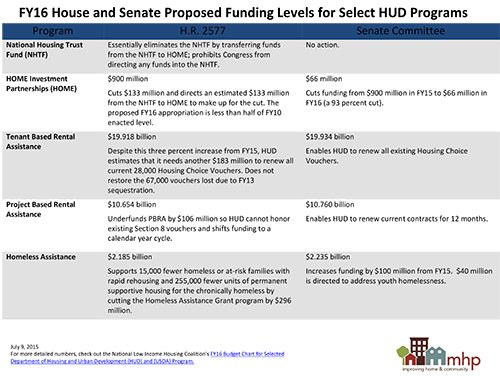
    Click on the chart to see detailed House and Senate proposed funding for select HUD programs. Read below for more analysis and policy updates in the two bills.

    House bill guts National Housing Trust Fund, threatens fair housing

    On June 9, the House approved, by a 216 to 210 vote, its THUD FY16 funding bill (H.R. 2577). The bill provides $42 billion for HUD, which is $1 billion above the FY15 enacted level but $3 billion less than the President requested in his budget. The House Appropriations Chairman Hal Rogers (R-KY) believes the bill “provides responsible levels of funding for core housing programs” and cuts waste.

    The bill is a disaster for advocates of the National Housing Trust Fund (NHTF) and extremely low-income households since it transfers all funding set aside for the NHTF – to the HOME program and prohibits Congress from directing funds to NHTF in the future. This transfer of funds to HOME makes up for a cut to HOME.

    Despite funding increases to tenant and project based rental assistance, the House bill still under-funds these programs given the actual costs of running these programs. Under the proposed budget, HUD would not be able to renew all existing Housing Choice (Section 8) Vouchers. Congressman Keith Ellison remarked:

    The resources provided in the bill make it impossible to address the needs of low-income working families, people with disabilities and the elderly. It provides too little to serve families that currently receive housing assistance and no new resources for the millions of low-income families paying more than half of their income for rent and utilities.

    A White House statement opposed the bill citing that “only one in four families who are eligible for housing assistance actually receives it” and that the bill would set back efforts to end homelessness. Senior advisers to the President have already advised him to veto H.R. 2577 if it crosses his desk.

    The House bill also includes several provisions that threaten fair housing. The bill prevents HUD from implementing, administering, or enforcing the just released Affirmatively Furthering Fair Housing (AFFH) rule. The AFFH rule is meant to help communities advance housing opportunities, overcome patterns of segregation, and improve coordinated public investments in areas of highly concentrated poverty. The bill prohibits HUD from using funds to implement, administer or enforce the disparate impact standards of the Fair Housing Act. Under the House bill, HUD would not be able to help victims of polices that produce disproportionate adverse impact against any group based on race, national origin, color, religion, sex, familial status, or disability. 

    Senate bill cuts HOME program by 93%

    On June 27, the Senate Appropriations Committee passed its THUD FY16 spending bill in a 20 to 10 vote. While the Senate did not raid the NHTF, it did cut the HOME program by 93 percent. Chair Collins (R-ME) defended the committee’s allocation priorities by stating that the cuts to HOME, which in her opinion is troubled with “misuse” and “fraud,” were necessary, in light of mandated sequestration spending caps, to maintain funding for rental assistance programs.

    The HOME program is the largest federal block grant to states and localities to fund a range of activities including development of affordable housing for rent or homeownership and direct rental assistance to low-income people. HUD awarded grantees in Minnesota $14.3 million in HOME funds in 2014. Assuming Minnesota grantees were to receive the same share in FY16, Minnesota grantees would only receive a little over $1 million, less than Hennepin County alone received in FY13. Duluth, which received $544,482 in FY15, would only receive $39,928, less than the cost to construct one unit of housing.

    The committee’s top priorities were ensuring funding for existing rental assistance programs. Programs funded above FY 15 levels include: Tenant-Based Housing Assistance, Project-Based Rental Assistance, Public Housing Operating Fund, Homeless Assistance Grants, and Housing for Persons with Disabilities. Several other programs also fare better in the Senate bill than the House bill. (See table.)

    The Senate also expands the Moving to Work (MTW) demonstration program from 39 to 339 public housing authorities (PHAs). Many advocates are concerned by this proposal because participating PHAs can impose rent structures that are not income targeted, choose not to assist any new extremely low income households, implement work requirements, and shift funds between the public housing and voucher programs without a requirement to serve the same number of households. The Senate would also expand the Rental Demonstration (RAD) cap from 185,000 units to 200,000 units.

    The Senate, like the House, reduces the frequency of income re-certifications for certain HUD rent-assisted households when fixed-income sources make up at least 90% of their income. Re-certifications would occur every three years, instead of annually.

    What you can do

    MHP will continue monitoring HUD’s FY16 budget. Look for updates and analysis throughout the year. In the interim, July and August are excellent months to schedule in-district meetings with your elected officials. Urge your congressional delegates to repeal sequestration, protect the NHTF and HOME programs, and ensure the integrity of the Fair Housing Act. 

  • Southeastern MN: housing challenges for changing communities

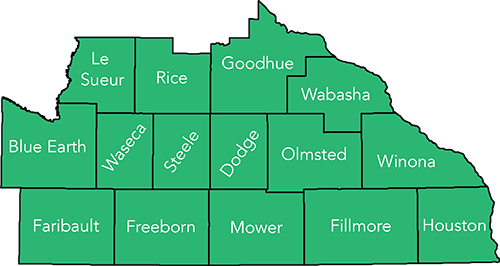
    Local stakeholders from southeastern Minnesota identified workforce housing and increased commitment to culturally-specific support at a regional housing dialogue in Faribault last month. The dialogue was held by Minnesota Housing, Greater Minnesota Housing Fund (GMHF), and USDA Rural Development. Housing and community leaders were briefed on housing trends in the region, shared local insight, and brainstormed solutions to housing and development challenges facing their communities.

    In recent years, Minnesota Housing, USDA and GMHF have hosted community dialogues across the state in an effort to inform and learn from community leaders. The Faribault event was one of several being held across the state — the next regional housing dialogue will take place Tuesday, December 15 in St. Cloud. 

    Minnesota Housing provided a detailed overview of key housing trends in Le Sueur, Rice, Goodhue and Wabasha Counties in southeastern Minnesota. While the area has seen an increase in homeownership, more homeowners are cost-burdened (i.e. spending more than 30 percent of monthly income on housing) today than ten years ago. Over the last decade, median monthly homeowner costs have increased while median monthly household income decreased anywhere from $2,000 to $5,000 in all four counties. In 2014, the median home sale price ranged from $139,000 to $165,000 — below the national and state averages — and the region housed 20 percent more cost-burdened renters. 

    In southeastern Minnesota, demographers are projecting a decline in household formation over the next 30 years while communities of color or Hispanic ethnicity are slated to increase by over five percent (in the next 10 years), making it necessary for housing and community developers to plan for more diverse communities. Rice County has the greatest homeownership disparities between white households and households of color or Hispanic ethnicity. According to the American Community Survey, 78 percent of white households in Rice County own a home while only 44 percent of households of color or Hispanic ethnicity own their own homes.

    While jobs increased since 2009, Rice County is alone in experiencing a significant increase in household formation since 2013. Many workers would move to the area if housing were available but are forced to commute to the region’s job centers from other counties. Almost no new housing stock was added to the area’s market in the last 10 years, which presents a major challenge for community developers as 50 to 70 percent of the housing stock was built before 1980. Much of the affordable, subsidized rental housing stock was built in the 1970s and needs to be rehabilitated.

    Jenny Larson and Athou Lam of Three Rivers Community Action, Abdullah Hared of Somali Community Resettlement Services, and Randal Hemmerlin of the Red Wing Housing and Redevelopment Authority all shared their perspectives on the region’s challenges. Lam and Hared spoke about the need for more linguistic and culturally appropriate services for Somali families wishing to own homes and for housing that could adequately accommodate larger household sizes. Hemmerlin expressed his disappointment that Red Wing was denied funding by Minnesota Housing for almost 10 years despite the demonstrated need for more rental housing for workers with moderate incomes. He elaborated on the difficulties rural communities experience scoring competitively in Minnesota Housing’s Super RFP process, which awards tax credits to housing development projects. The issue of “middle ground” housing for the area’s workforce was also cited as a top priority from participants in the single family and multifamily discussion groups.

    Due to the area’s aging housing stock, significant attention was paid to preservation with some citing a need for stronger inspection processes in order to maintain properties. Minnesota Housing pointed out that much of the area’s subsidized housing stock is nearing the end of its 30-year affordability period. Facing this reality, planners and housing advocates must find ways to preserve the affordability of these properties while finding capital to make improvements in order to offer quality, affordable housing.

  • ‘Local control for a local issue’ – Affordable Housing Trust Funds in rural communities

    Guest blog by: Randal Hemmerlin, Executive Director at Red Wing Housing and Redevelopment Authority

    Randal HemmerlinIt is no longer much of a secret that a housing shortage exists throughout Minnesota. The State’s population continues to grow as business is growing its workforce. So much so, that places like Red Wing show a rental vacancy rate of 0.9 % overall and 0.0% in affordable housing in 2014.  Complicating this further, the annual new construction of Single Family owner occupied housing in Red Wing is not near the levels of construction as in the 1990s or early 2000s.  The result is that 6,600 people commute into Red Wing to work each day and seniors have few options as to where they may like to move to from their single family house.

    Other communities in Minnesota report similar findings. 

    One idea that came in 2015 that the City of Red Wing HRA is using to promote new housing or rehabbing existing housing was the establishment of an Affordable housing Trust Fund (AHTF). An AHTF is not a new concept and has been used in Minnesota before by cities such as Minneapolis. It is not common, however, to see AHTFs in rural communities.  Organizations such as Minnesota Housing Partnership and Greater Minnesota Housing Fund would like to see that to change so that the AHTF is one more source of funding that can be used in housing. Since all housing needs are local, it makes sense that local jurisdictions have a stake in the matter financially and an AHTF would allow that to happen.

    In 2015, the Red Wing City Council authorized the HRA Tax Levy to be increased to its maximum statutory limit with the difference going into the AHTF. This was about $97,000 for the fund.  The HRA is working to find other sources to increase that AHTF, such as employer contributions and foundation donations.

    Throughout the state, it is estimated that we have $34 million in unused HRA Tax levies that could be used to create AHTFs.

    To increase the chances of AHTFs being created statewide, a matching state fund could be developed to match the local dollars 1 to 1, or even 3 to 1. Another idea is that Minnesota Housing or DEED housing fund applications that come from jurisdictions with an AHTF would receive a priority over applications from jurisdictions that do not have an AHTF.

    A local AHTF could also decentralize the funding of housing. Right now, funds come mainly from St. Paul to fund housing. Local control for a local issue should carry well with the local jurisdictions.

    With the housing shortage being so critical in our communities and the pressure for funding sources so great, an AHTF may be just the ticket that a local community can use to increase its housing supply.

    Randal Hemmerlin, Executive Director Red Wing HRA

  • MN Housing Board funds manufactured home co-ops, reports on Affordable Housing Plan

    In her opening remarks at the Agency’s November Board meeting, Commissioner Tingerthal announced that Tom O’Hern had been hired as the agency’s general counsel. O’Hern had been supporting the Agency’s board from his position on the Attorney General’s staff. Tingerthal added that, going forward, the Agency will end this direct staffing arrangement with the Attorney General and will add additional legal positions to its staff. The Agency is now recruiting an attorney to focus on multifamily transactions. The Attorney General’s staff will still handle lawsuits and complaints directed at the Agency, such as the current one concerning fair housing, and will be available if the board seeks its own representation. 

    Family Housing Fund hires new president

    Tingerthal announced that the Family Housing Fund, one of the Agency’s funding partners, has hired Ellen Sahli as President, filling the position held by the now retired Tom Fulton. Sahli, who will be moving to the Twin Cities from Chicago, most recently served as Chief Housing Officer for the Chicago Housing Authority; and prior, was Director of Community Engagement for the University of Chicago. She has also held several positions for the City of Chicago, including directing the city’s plan to end homelessness.

    Affordable Housing Forum with Secretary Castro

    Tingerthal also spoke about the recent affordable housing forum attended by HUD Secretary Castro where Tingerthal participated on a community panel. She said that Rep. Keith Ellison did a “masterful job” of moderating the event and ensured that audience participants were able to share their viewpoints. Tingerthal said she met with several HUD staff, in town for the forum, who were reviewing the fair housing complaint made by MICAH and other community groups. Tingerthal said HUD was now asking the complainants to reply to the formal responses provided by Minnesota housing from the initial complaints.

    Loan provided for the co-op conversion of manufactured home parks

    The co-op conversion of manufactured home parks received a boost by the Agency. The board approved staff’s recommendation to participate in a $1.7 million loan being made to allow residents of the 125-lot Five Lakes Manufactured Homes Community in Fairmont to become a resident-owned cooperative. This is the Agency’s third loan participation with ROC (Resident Owned Communities) USA under a demonstration program launched in 2010. Board members asked how prior loans were doing. Agency staff said that they were proceeding as expected, although one Agency loan had been repaid early when ROC USA initiated a refinancing to address unexpected infrastructure costs. Board member Joe Johnson asked about a proposed 1% loan servicing fee a much higher level than usually seen on mortgage financing. Staff responded that most of the fee goes to Northcountry Cooperative Foundation (NCF), ROC USA’s technical assistance provider on Minnesota loans. Tingerthal added that these manufactured housing co-ops have ten times the complexity commonly found with condo homeowner associations and justified the necessity of capacity building support provided by NCF. She added that manufactured housing cooperatives uniquely provided very affordable near-homeownership.

    Affordable Housing Plan report

    Staff provided the board with the fourth quarter and final report on the Agency’s 2015 Affordable Housing Plan goals. Staff reported that the Agency’s production was far above goals for single family mortgage commitments (153% of goal) and new rental construction (160%) for the year. Staff attributed the rental housing success to the utilization of the federal 4% tax credit program and the availability of housing infrastructure bonds. Regarding financial performance, staff reported a 3.5% return on net assets which they said was a strong outcome in a low interest environment. The rate of loan delinquencies, while above Minnesota’s market bench mark, was below that of peer state housing agencies as reported by US Bank, the servicing contractor for Agency loans.

  • Creating a platform for success – Twin Cities stakeholders talk affordable housing at recent forum

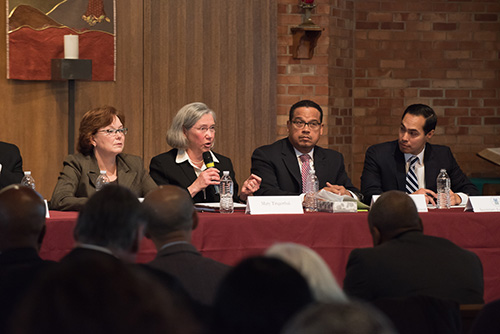
    HUD Sec. Castro addresses forum audience, 10/30/15United States Housing and Urban Development (HUD) Secretary Julian Castro engaged housing advocates in a lively discussion about the future of affordable housing in the Twin Cities at a forum on October 30. Congressman Keith Ellison (MN-5) hosted the event, which was held at Mayflower Church in Minneapolis. The forum generated discussion on issues of mobility, property management and efforts to secure additional resources for affordable housing. 
    “Affordable housing is a platform for success.” – Secretary Castro

    Secretary Castro opened the forum by outlining recent accomplishments at HUD, including the Affirmatively Furthering Fair Housing decision and the new disparate impact analysis. Referring to HUD as the “Department of Opportunity,” Secretary Castro envisioned a HUD aiding in the creation of healthy, vibrant communities. Toward that end, he stressed the importance of mobility and improving access to new housing opportunities in order to positively impact people’s lives. Secretary Castro applauded the audience for participating in the robust dialogue taking place in the Twin Cities.

    Playing host, Congressman Ellison facilitated a panel discussion that included Minnesota Housing Finance Agency Commisioner Mary Tingerthal, Richfield Mayor Debbie Goettel, Project for Pride in the Living CEO Paul Williams, community organizer Nelima Sitati, Metropolitan Council Member Gary Cunningham and Yusuf Mgeni of the St. Paul NAACP. 

    Commissioner Tingerthal addresses forum participants.

    “Minnesotans should live in safe and stable homes they can afford in a community of their choosing.” – Commissioner Tingerthal

    While Commissioner Tingerthal echoed Secretary Castro’s remarks, the discussion among the panelists centered on the need for more affordable housing across the Twin Cities metro as well as the impact of racial disparities on housing-related decision-making — most panelists agreed not enough is being done to tackle the issue. Cunningham criticized the lack of political will to increase African Americans’ access to asset-building opportunities such as homeownership. Sitati condemned insubstantial private investment in communities of color and demanded greater accountability at the municipal level.

    Forum participants address panel at October forum.

    During the open comment period, individuals seized on the opportunity to voice their input on issues surrounding affordable housing and their personal experiences, sharing stories of unfair evictions, lack of home financing, rising rents and a sense that they lack the power to affect change. Audience members aired specific frustrations on poor property management and negligent landlords. Others voiced worries about restrictions placed on affordable units. Minor criminal charges often prevent potential tenants from getting the affordable housing they need. In response, Secretary Castro stated that HUD intends to weigh in on the broader discussion of criminal justice reform taking place in Washington.

    Most panelists agreed that deeper investment must be made to improve housing conditions in the Twin Cities. Williams praised the work of nonprofit developers like Project for Pride in Living, but said he felt more could be done to attract private investors in order to finance projects with larger numbers of units. Williams emphasized his organization’s success revitalizing older, urban neighborhoods like Frogtown and Phillips. Yusuf Mgeni of the St. Paul NAACP encouraged more investment in existing urban neighborhoods. Mgeni noted that the high concentration of poverty in areas like North St. Paul limits people’s ability to access opportunity and thrive. He added that a limited stock of housing options exacerbates this problem.

    “I very firmly believe that HUD has a role to play, that housing has a role to play in ensuring that we effectively give folks a second chance in life.” – Secretary Castro

    In his closing remarks, Secretary Castro assured HUD’s commitment to the Twin Cities and emphasized a willingness to partner on the challenges presented during the forum. After thanking Secretary Castor and the panelists, Congressman Ellison challenged the audience to remain engaged and continue to demand change. He encouraged support for the Homes for All coalition’s state bonding request during the 2016 state legislative session and cited his legislation, the Common Sense Housing Investment Act, as ways to advance much-needed resources for affordable housing.

    “Where there is a constituency to drive an issue, there will be change.” – Congressman Keith Ellison.

    Photos courtesy of HUD. View more photos from Secretary Castro’s visit. 


  • MN Housing underscores increased commitment to Greater MN and metro suburbs in 2015 awards

    Last month, Minnesota Housing awarded $92 million for affordable housing development projects across the state. These investments will finance new construction and rehabilitation of single family and multifamily housing projects, increasing affordable housing options for Minnesota families.
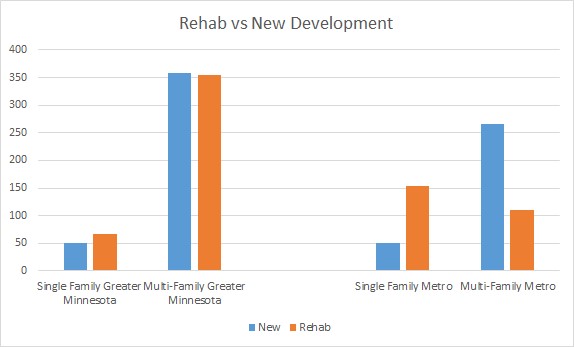
    $92 million of investment in affordable housing will have a significant impact for the over 120,000 cost-burdened Minnesota families (those spending 30% or more of their annual incomes on housing). However, there was a significant reduction this year in total funding awarded to multifamily projects due to a reduction in Housing Infrastructure Bond (HIB) proceeds and Housing and Job Growth Initiative funding. The reduction in HIB funding also means projects will leverage $61 million less in private equity from four percent tax credits this year as compared to last year. Accordingly, Minnesota Housing will fund 1,090 units this year compared to 3,423 units in 2014.

    The funding shortfall means that Minnesota Housing denied applications amounting to $97 million for 20 multifamily developments in Greater Minnesota and $273.5 million for 31 metro-area developments. Overall, the agency denied $3,670,086 million to 11 single family project applicants.

    Key Facts

    Below is a breakdown of Minnesota Housing’s funding allocations. Similar to previous years, the majority of awards go to multifamily rental projects. However, there is a marked increase in awards for single family development this year.


    Single Family

    Multifamily

    Total

    Dollars

    $7.9M

    $84.5

    $92

    Awards

    28

    23

    51

    Units

    320

    1100

    1420


    56 .5 percent of selected projects are located in Greater Minnesota compared to 45 percent last year. Overall, 714 new multifamily units and 117 single family homes will be constructed in Greater Minnesota. The Economic and Housing Jobs Initiative funding will finance 215 new rental units that will be constructed in Greater Minnesota communities experiencing job growth, where there is a shortage of housing that is limiting job expansion or where future expansion is expected.


    TC Metro

    Greater MN

    % in Greater MN

    Single Family

    203

    117

    37%

    Multi-Family

    386*

    714

    65%

    Total Units

    589

    831

    58.5%


    *Nine multifamily units are supported with HUD Section 811 Rental Assistance. These units do not show up in Minnesota Housing’s 2015 Multifamily Funding Selections spreadsheets.

    This year the agency funded more multifamily new construction (57 percent) than preservation when compared to last year (44 percent).

    Also worth noting is that Minnesota Housing awarded more new construction projects in higher income suburbs located in the Twin Cities metro, including 139 new affordable units in Edina, Chaska, Dayton and Mound, where median rents range from $759 to $1156 and median household incomes range from $70,199 to $84,211.[1] Of 10 metro area multifamily developments, four are located in Minneapolis and St. Paul and six in suburban locations.

    Multifamily Takeaways

    Minnesota Housing received applications for 78 proposals, requesting $217 million in deferred loans, permanent first mortgage financing and Agency-administered tax credits. Within those proposals, Minnesota Housing and its funding partners awarded 23 projects with deferred, bridge and permanent first mortgage loan financing, tax credits and rental assistance. Of those 23 projects receiving multifamily housing financing, 10 are located in the seven-county metro-area and 13 are located in Greater Minnesota. 714 units will be built in Greater Minnesota – 215 of which the Agency considers workforce housing – and 386 will be built in the metro. 

    The agency awarded $8,300,794 million in nine percent tax credits to 12 projects; $39,322,979 in deferred loan capital to 17 projects; $18,316,000 in permanent first mortgage financing to 11 projects; $14,775,000 in bridge loan financing to four projects; $1,135,080 in Section 811 Rental Assistance Grants to four projects; and $2,627,000 in funding partner contributions to seven projects.

    Of the 12 projects receiving $8,300,794 in housing tax credits, six are located in the metro and six are located in greater Minnesota. Minnesota Housing estimates that syndication will bring over $40 million in equity to the metro and over $42 million to Greater Minnesota.

    Multifamily projects that were awarded funding will:

    • Preserve 249 units of federally-subsidized rental housing.
    • Construct 624 new and preserve 217 affordable units without federal assistance.
    • Generate 287 supportive housing units to prevent and end homeless. (*This year’s RFP selections award all HIB proceeds to supportive housing).
    • Support the agency’s efforts to prevent foreclosure and support community recovery with 76 units.

    Single Family Takeaways

    Minnesota Housing received 39 single family applications requesting $17,881,741. 71 percent ($12,783, 911) of the requested funds were for projects serving parts of the Twin Cities metro area and 29 percent ($5,097,830) of the total amount requested were Greater Minnesota projects. Minnesota Housing was able to meet $7,919,375 of the overall need.

    39 percent of the Impact Fund ($2,782,700) will fund 12 projects in Greater Minnesota and 61 percent of the Impact Fund ($4,821,675) will serve 16 projects in the Twin Cities metro area. Overall, the agency and partner funding awarded $3,037,700 to Greater Minnesota and $4,881,675 to the metro area.

    Minnesota Housing funds allocated to single family projects will help:

    • Six Twin Cities metropolitan area and five Greater Minnesota organizations focus outreach efforts to reaching underserved populations.
    • Enhance Community Economic Integration efforts (i.e. areas have higher median family incomes and greater access to jobs).
    • Invest $3,462,539 to develop new homeownership opportunities for areas in need of workforce housing. This represents nearly half of the total awarded resources. According to Minnesota Housing, Impact Funds can accommodate more than 90 percent of new jobs growth throughout Minnesota.
    • Invest $526,500 of HIB funds in two metro area and one Greater Minnesota community land trusts.

    [1] MN Compass and City Data