
• Toward Culturally Sensitive Housing

    A guest blog post by Tasoulla Hadjiyanni, Ph.D., Associate Professor, Interior Design, University of Minnesota

    Anyone who cooks from scratch knows the implications of that daily activity on kitchen spaces, the cook, and the family: the mess that has to be cleaned, the amount of food, utensils, and other items that have to be stored, the steam and smells generated that can overtake the rest of the house. At the same time, ending the day with a delicious meal accompanied by lively family conversations around the table can be priceless. It fosters connections with family members, transfers healthy eating habits to the younger generations, and helps craft meaning and memories. The question that confronts designers and planners of housing is how can peoples’ efforts to create meaning in their lives be supported at a time when we all speak, cook, eat, sleep, socialize, pray, dress, etc. in so many different ways?

    Designers are often asked to design houses that can be the home for a specific family in the city or the countryside, houses that a developer can duplicate in a suburb, or houses for families in public assistance, such as affordable housing. In many of these cases, designers are not dealing with a specific client who will relate that family’s needs and priorities to them. Instead, they often have to respond to market trends or their own assumptions of what a house should look like. This approach can be problematic, particularly since in the past few decades, the demographic landscape of Minnesota has changed and many new immigrant groups have joined long-standing minority groups in calling Minnesota home.

    Culturally sensitive housing is one way by which designers, planners, developers, and policy makers can begin to work toward housing that meets the needs of everyone. Culturally sensitive housing is housing that accommodates diverse ways of living. As such, culturally sensitive housing is not culturally-specific housing; culturally-specific housing stereotypes what a “way of life” entails, positioning everyone who calls themselves Hmong, Somali, Mexican, or American as having one way of life—a “Hmong” way of life, a “Somali” way of life, an “American” way of life, etc. Instead, culturally sensitive housing acknowledges the many ways to belong, the multiple ways by which one can be a Hmong, Somali, Mexican, or American and everything in between. Therefore, culturally sensitive designs are adaptable and flexible.

    Housing characteristics, such as ventilation systems, window types, spatial layouts, and material selections can impact residents’ ability to practice traditions that foster health and well-being. Let’s take for example the activities of cooking nutritious foods in a safe manner and eating together as a family:

    • dining area too smallLack of appropriate ventilation to exhaust the odors and particulates from oils and spices used in cooking as well as a kitchen that is not sized to prepare food for large numbers of people prompted this family to use the basement as a cooking area. Cooking with propane gas however, is neither safe nor comfortable.
    • Similarly, most apartments have open-plan kitchens that are open to other spaces in a home, including the living areas. Cooking in open kitchens can be uncomfortable and dangerous, for example, when a veiled Muslim woman has to be covered to cook in the presence of male visitors.
    • Without adequate space to eat informally as a family (pictured right), some people choose to eat alone, which diminishes the many benefits of eating together, such as nurturing healthy nutritional habits and strong family relationships.

    guestblogpost2Designers who are cognizant of diverse uses of home spaces can implement culturally sensitive design solutions. In Ripley Gardens in Minneapolis, affordable housing developer Aeon designed kitchens that can be easily adjusted to enable a Muslim woman to cook without wearing her veil and without being seen (pictured left). A curtain could be hung to screen the kitchen and even the dining area from the living area of the home, the space where men would likely socialize. Such an alteration is low cost as it does not involve having to move the sink or the stove or even building walls. In this design, a veiled woman would also be able to access the bedrooms and bathroom without having to pass by the living area, easing her life and caretaking responsibilities.

    Because of their emphasis on diversity, adaptability, and flexibility, culturally sensitive housing designs have economic and environmental benefits: they have a greater appeal to a larger market share, can be occupied for longer periods of time, and can minimize environmentally and financially costly renovations, conserving resources in the process. With housing choices that respond to diverse ways of living, Minnesota can be more attractive to a broader segment of the population, strengthening the region’s cultural and economic vitality and positioning Minnesota’s global competitiveness. Furthermore, although Minnesota is one of the healthiest states in the nation, it has some of the greatest disparities in health status and incidence of chronic disease between Populations of Color / American Indians and Whites. Occurrences of physical health concerns, such as obesity, diabetes, and heart disease as well as mental health inequalities, abound among Minnesota’s minority and immigrant groups. By supporting diverse ways of living, culturally sensitive housing can play a role in alleviating some of these disparities.

    Part of the challenge in working toward culturally sensitive housing is “unlearning” the standard and typical approach to
    planning a residential project. Designers and planners who recognize the many ways by which people chose to live their lives can devote time and energy to revisiting guidelines and regulations for cultural sensitivity. Building synergies among all stakeholders is another integral part of the process, and more areas of collaboration and networking as well as sharing of best practices should be nurtured. One thing is certain: housing that supports various ways of living can facilitate healthy lifestyles and improve the health and well-being of everyone in our communities.

    Tasoulla Hadjiyanni is an Associate Professor in Interior Design at the University of Minnesota. Her work includes exploring how the design of interior spaces intersects with culture and identity through the experiences of new immigrant and minority groups in Minnesota. Her approach to culturally sensitive housing designs has appeared in leading journals and conferences.

  • MHP Launches 2013 Housing Institute: Facilitates Regional Collaborations & Builds Capacity of Greater MN Communities

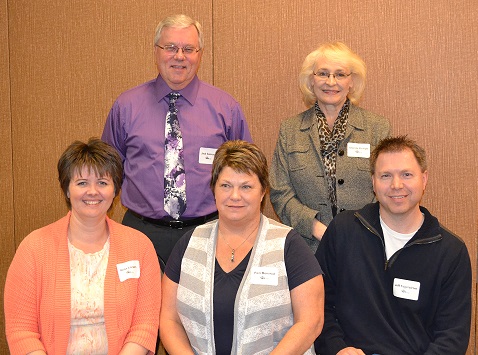
    The Minnesota Housing Partnership recently launched our 2013-2014 Housing Institute for Greater Minnesota. The Housing Institute fosters regional collaborations and builds the capacity of communities to meet housing needs in rural Minnesota.  This year’s Housing Institute includes teams from Itasca County, Thief River Falls, and Roseau County.  Each team will work on a housing project/program over the next twelve months.

    The Housing Institute is an opportunity for housing leaders to come together to share their experiences, learn best practices in housing and community development, and develop creative solutions to bring quality affordable housing to their community.  Quarterly training sessions and one-on-one technical assistance helps teams strengthen their skills to make their project a reality. The Housing Institute for Greater Minnesota is a project of the Minnesota Housing Partnership and Greater Minnesota Housing Fund.

    Meet the 2013-2014 Housing Institute Teams

     Roseau County Team

    Roseau Co HI Team


    Economic growth in Roseau County has caused a shortage of housing, making it difficult for businesses to recruit employees to the area.  In 2012, a local housing study identified the need for additional homeownership and rental housing opportunities within the region.  The team hopes to develop a mix of housing options; ensuring workers at every pay level have access to affordable homes.

    Team Members Include:

    • Todd Peterson, City of Roseau
    • Pam Monsrud, City of Badger
    • Jack Swanson, Roseau County Commissioner
    • Anita Locken, City of Greenbush
    • Glenda Phillipe, Roseau County Commissioner
    • Jeff Fagerstrom, Northwest Minnesota Housing Cooperative
    • Lee Meier, Northwest Multi-County HRA

    Thief River Falls Team

    Thief River Falls HI Team


    Like in Roseau, economic growth in Thief River Falls has caused a shortage of housing, making it difficult for businesses to recruit employees to the area. In 2011, a local housing study identified the need for additional homeownership and rental housing opportunities in Thief River Falls.  The team hopes to develop the skills to support housing development in Thief River Falls and implement a communication strategy that will engage the community in the process.

    Team Members Include:

    • Michael Moore, City of Thief River Falls
    • Dale Hahn, Thief River Falls City Council
    • Maryel Anderson, Anderson Realty
    • Kermit Genereux, Genereux Realty
    • Leroy Flickinger, LV Contracting
    • Steve Crittenden, Northland Community & Technical College
    • Catherine Johnson, Inter-County Community Council
    • Jeff Fagerstrom, Northwest Minnesota Housing Cooperative (Alternate)

    Itasca County Team

    Itasca Co HI Team


    There is a growing need for affordable housing Itasca County. The changing demographics in the region and the rise of homelessness have caused a shortage of affordable housing options.   In addition, much of the current housing stock is in need of repairs.   The Itasca County team hopes to collaborate on a project that will help homeless individuals and families access stable housing. Audrey Moen, Housing Manager at Northland Counseling Center and Itasca County Team member noted “We hope that by collaborating we will be able to develop permanent, supportive housing, creating an environment that fosters safe, affordable housing that is well integrated in the community.”

    Team Members Include:

    • Diane Larson, Itasca County HRA
    • Amanda MacDonnell, Itasca County HRA
    • Lorna Mix, Northland Counseling Center
    • Audrey Moen, Northland Counseling Center
    • Dana Herschbach, Kootasca Community Action
    • Victor Moen, Minnesota Department of Corrections
    • Jason Anderson, Minnesota Department of Corrections (Alternate)
    • Sherry  Shadley, Grace House
    • Ami Bolster, Grace House (Alternate)
  • In the News: Renter Affordability Out of Reach in MN

    This week the annual Out of Reach Report jointly released by the National Low Income Housing Coalition, and in Minnesota MHP, hit the airwaves all over Minnesota, placing the issue of affordability for renters in the spotlight. The report’s release was well-timed, given federal and state budget negotiations for housing programs.

    According to the report released on Monday, in 2011 a Minnesota family must have 2.2 minimum wage earners working full-time – or one person working 87 hours per week at minimum wage – to afford a modest two-bedroom apartment in Minnesota.  Of the 12 states in the Midwest, Minnesota ranks the worst for rental affordability among minimum wage workers.

    In order to afford the rent and utilities for a safe and modest 2-bedroom apartment in the private housing market, a Minnesota worker must earn $15.79 per hour, 40 hours a week, 52 weeks a year.  By contrast, the typical renter in Minnesota earns $11.61 per hour, and a minimum wage earner makes only $7.25 per hour.

    Shortly after MHP’s press release was issued on Monday, the Star Tribune, MPR, WCCO, and the Public News Service (picked up by Clear Channel) produced stories featuring the report and the struggles of renters to afford housing (see MHP in the Media for links to each.)

    Much to the delight of housing advocates, the story hit the television news, too. In the Metro, a KARE 11 story on kare11Wednesday looked at the rental market and the struggles of Minnesotans unable to afford their rent. Catholic Charities housing advocate Katie Tuione of Catholic Charities, and 22-year-old Luvrahsheda Robinson, who earns $600 in income monthly, but also pays $600 in rent, both helped explain the issues.fox_9

    On Thursday, MHP’s executive director Chip Halbach made an appearance on Fox 9 on Thursday for the 11:00 news to discuss some of the reasons for the high rents in Minnesota. He also appealed to the Governor and the Legislature to prioritize decent affordable housing for Minnesotans when considering the state’s budget.

    northlandsnewscenterMeanwhile, in Greater Minnesota, as Minnesota Housing hosted its Regional Housing Dialogue in the northeast, Northland’s NewsCenter did a television story on the need to fund affordable housing programs on the Iron Range, without relying on trust fund money set aside for the Iron Range Resources and Rehabilitation Board (IRRRB), as proposed earlier this session. In this segment, Tony Sertich, Commissioner of the IRRRB and a former legislator, reiterated the need to fund housing.
    “We’ve got to make sure we’ve got available and affordable housing for workers and businesses that are growing on the Range,” Sertich said.

    Out of Reach, which can be found at the National Low Income Housing Coalition’s website at http://www.nlihc.org/oor/oor2011/ includes data on rental housing affordability for every state, county, and metro area in the country.

    Some additional facts about Minnesota rental affordability from Out of Reach 2011

    • The least affordable counties for renters in Minnesota, as determined by the estimated percentage of renters unable to afford a modest two-bedroom apartment, given their earnings, are as follows:

    Winona County (68% unable to afford)
    Aitkin County (67%)
    Mille Lacs County (67%)
    Big Stone County (65%)
    Grant County (63%)
    Faribault County (62%)
    Wadena County (62%)
    Chisago County (62%)

      • The counties with the highest increase in rents since 2000 are outside of the Twin Cities Metro, particularly in southwest Minnesota.  Rents in Martin, Faribault, Cottonwood, Pipestone, Murray, Rock, Watonwan and Jackson Counties have increased by 56% or more since 2000, compared to 32% statewide since 2000.
    • The most expensive area to be a renter continues to be the Twin Cities metro area, where a modest two-bedroom apartment requires a full-time worker to earn $17.77 per hour year-round.

  • 2011 County Profiles Released

    Whether by choice or necessity, more and more people are renting across Minnesota. By 2010, 27% of the state’s households rented their homes, up significantly from mid-decade, according to MHP’s 2011 County Profiles, just released today. What’s more, Hennepin and Ramsey counties are by no means the only counties where renting is important.

    county_profiles_thumb11The County Profiles show that only two of the top ten counties with the highest rental rates in Minnesota are located in the Twin Cities metro.

    Ramsey (39% renter households) and Hennepin (36%) top the list, but are followed closely by Blue Earth (35%), Lyon (34%) and Benton (31%) in Greater Minnesota. (See the full Top Ten list.)

    Over the course of the decade from 2000 to 2010, all ten of the counties with the largest increase in the percentage of renter households were outside of the metro area. Mahnomen, Big Stone, Mower, and Beltrami counties head up this list.

    MHP’s County Profiles pull together housing data for each of Minnesota’s 87 counties—including cost and affordability for owners and renters, changes in home prices, foreclosures, homelessness, and unemployment.*

    Findings include:

    • Rising rents and falling incomes leave Minnesota renters in limbo, especially in a fragile economy. From 2000 to 2011, 80 of 87 Minnesota counties saw increases in rental costs, after adjusting for inflation. Based on the best available data, renter incomes decreased 17% between 1999 and 2009 statewide.
    • In 25 counties, renting a modest two-bedroom apartment requires a higher income than buying a median priced home, assuming a 10% down payment and a 30-year fixed mortgage.
    • Affordability is a critical concern for the state’s expanding rental population. Nearly half of the state’s renters paid more than they should for housing in 2009, by HUD’s affordability standards.
    • The median home sales price ranged from a low of $40,500 in Traverse County in western Minnesota to a high of $247,500 in Carver County in the metro area in 2009-10.
    • From 2006 to 2010, 74 counties (85% of counties) experienced decreases in the median home sales price, after adjusting for inflation. However, over the entire decade through 2010, 60 counties (69%) actually experienced increases in the median price.

    Check out your county profile and the Top Ten lists. Do you see any surprises? Also, we welcome you to share ideas about how you plan to use the County Profiles this coming year.

  • Q4 2010 2×4 Report Released

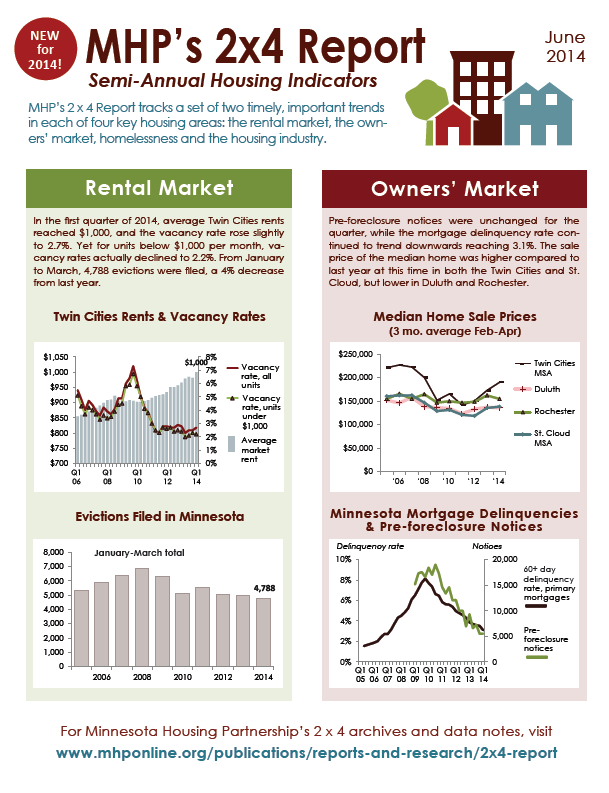
    MHP’s latest “2 x 4” Report finds family homelessness little improved from height-of-recession 2009 highs, generous inventories of homes still for sale, and employment in housing construction at a 17-year low for the time of year. Meanwhile, Minnesota lawmakers consider deep cuts to state housing and economic development program.

    2x4_thumbnail

    On a brighter note, fewer home owners were delinquent on their mortgage payments.

    Late last week, Minnesota House and Senate lawmakers announced plans to cut funding for housing and economic development programs by about 50%.

    Chip Halbach, MHP’s Executive Director, questioned the wisdom of such cuts with so many workers unemployed.  “State investment in housing is a win-win. It leverages private sector dollars and puts people to work, not to mention ensuring that more Minnesotans can afford a safe place to live,” said Halbach.

    MHP’s “2 x 4” housing indicators report graphically depicts 2 indicators for each of 4 key housing areas: the home ownership market, the rental market, homelessness, and the housing industry. Through quarterly updates, the report provides a concise and timely overview of housing challenges facing Minnesota.

    For fourth quarter of 2010:

    • Vacancies in the Twin Cities rental market again fell sharply to 3.8%, down from 7.3% a year earlier.
    • Family homelessness in Hennepin County was nearly unchanged from height-of-recession 2009 rates for the time of year.
    • Mortage delinquencies fell to 6.5%, compared to about 8% a year earlier.
    • Inventories of homes for sale in the Twin Cities metro were high, despite historically low mortgage rates. About 34% of the homes on the market were foreclosures or short sales.
    • Monthly employment in residential housing construction averaged a mere 8,900 workers, a number for the quarter not seen since1993 for the time of year.

    Be sure to check out the full “2 x 4” Report including graphs, data sources, and analysis.