• Public Housing Residents Need the Next Mayor of Minneapolis to Work on Solutions

    mayoralaudience
    mayoraloverview

    On Thursday, October 24, 2013, eight leading Minneapolis mayoral candidates fielded questions from public housing residents and housing advocates concerning the growing affordable housing crisis in Minneapolis. In the course of this candidate forum, seven of the eight candidates expressed strong support for the United for Homes campaign and the federal bill embodying the campaign’s objectives — H.R. 1213, the Common Sense Housing Investment Act, introduced earlier this year by Representative Keith Ellison.

    The forum covering housing and homeless topics was co-hosted by the Minneapolis Highrise Representative Council (MHRC), the Minneapolis Scattered Site Resident Council (MSSRC), and the

    Minneapolis Highrise Representative Council logo

    Minnesota Housing Partnership (MHP). Candidates responded to questions from the forum sponsors as well as attendees. Questions concerned security for public housing, the connection between race and homelessness, and efforts to keep Somali youth out of the criminal justice system.

    What conference sponsors found most surprising was the broad and strong support among candidates for a proposal to convert the federal mortgage interest deduction into a tax credit. This effort would both benefit lower income homebuyers (particularly those that do not itemize deductions on their taxes), and without requiring new federal revenues, free up about $20 billion per year which would go to states to provide housing for very low income renters.

    This proposal is the objective of the national United for Homes campaign and was introduced to Congress through Rep. Keith Ellison’s bill, the Common Sense Housing Investment Act.

    Seven of the leading candidates for mayor voiced strong support for the proposal. The eighth, Cam Winton, an attorney and business executive, stated that his opposition was based on concern that it would only add to the national debt. After the event, Winton was informed that the bill does not require any new revenue sources; it reallocates current tax expenditures. Based on this clarification, Winton said he would take a closer look at the proposed legislation.

    In voicing their support of the Ellison proposal, two of the candidates – former City Council president Jackie Cherryhomes and current Council member Betsy Hodges – described the federal government as a key partner in developing and preserving affordable housing. Cherryhomes, who also had worked as an affordable housing developer, described the current situation, stating “The feds have walked away and abdicated responsibility.” Hodges added, “If we had a strong federal partner, we would be able to do so much more here in Minneapolis.”

    Dan Cohen, former Council member, and Stephanie Woodruff, business executive, also expressed support for the reform and said that the funding made available could leverage other resources.

    Candidate Bob Fine, a Minneapolis Park Board commissioner, expressed willingness to go to Washington D.C. to help lobby for passage of H.R. 1213. Candidate and Council member Don Samuels stated that there would be no stronger advocate for this legislation than he; and added that in this advocacy, he would draw upon his ties to HUD Secretary Shaun Donovan and President Obama, whom he has gotten to know through his work to improve his impoverished north Minneapolis ward.

    Mark Andrew, a business executive and former Hennepin County Commissioner concluded, “The mayor ought to be willing to take a stand on this legislation,” which he described as “a clear, thoughtful proposal.” Andrew went on to say he would put it in the city’s federal legislative package, would add it to the Minnesota League of Cities platform, and do what he could to call public attention to the need for affordable housing. 

    About MHRC: As the citywide independent public housing high-rise tenant organization, the Minneapolis Highrise Representatives Council works to increase resident involvement and voice in issues important to them and that impact their quality of life.

    About MSSRC:  The Minneapolis Scattered Site Resident Council brings together residents from Minneapolis Public Housing Authority’s 753 single-family homes in Minneapolis to discuss and address issues of common concern.

  • Minneapolis School Board Voted Unanimously to Endorse United for Homes and H.R. 1213

    At its December 10 meeting, the Minneapolis Public School Board voted unanimously to endorse H.R. 1213, the Common Sense Housing Investment Act, introduced earlier this year by Representative Keith Ellison, and United for Homes, which is the National Low Income Housing Coalition campaign that supports the bill.
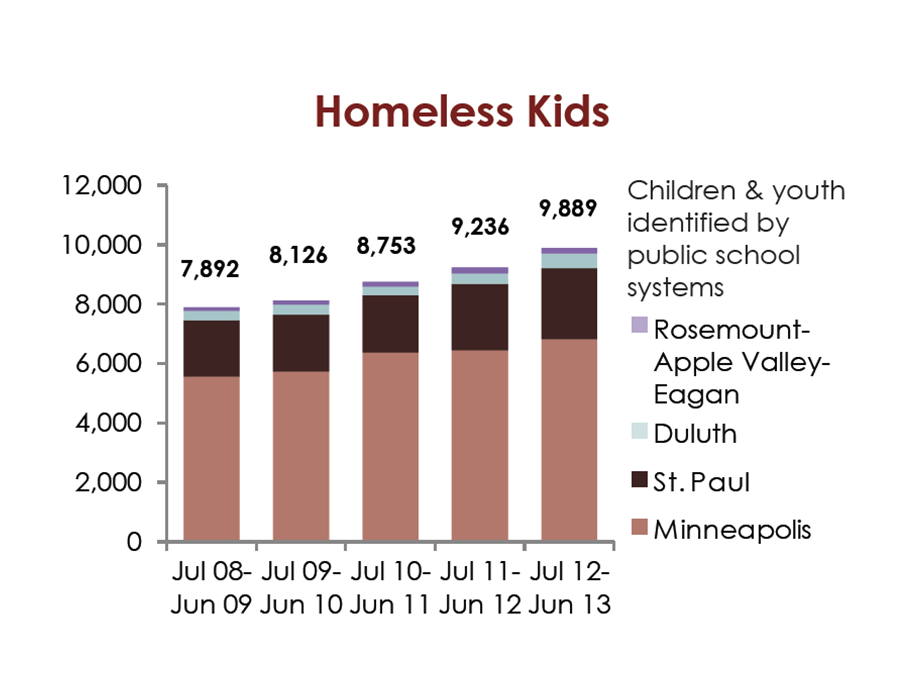
    The resolution cited the growth in the Minneapolis Public Schools’ population of homeless and highly mobile students over the past year – an increase of 22% from September 30, 2012 to September 30, 2013. The district, which totals 39,000, has about 4,000 students who are homeless or highly mobile, the highest of any school district in Minnesota.

    Rep. Ellison’s bill currently has 10 congressional co-sponsors (Clarke-NY, Grijalva-AZ, Jeffries-NY, Lee-CA, Lowenthal-CA, McDermott-WA, Scott-VA, Slaughter-NY, Tonko-NY, Wilson-FL). In order to influence more elected officials to sponsor the bill, Minnesota Housing Partnership is organizing endorsements from all sectors, including school districts. Minnesota currently has 49 organizations signed on as endorsers, including religious organizations, disability advocates, for profit and nonprofit developers, minority organizations, and women’s advocates, in addition to housing and homelessness organizations.

    In the resolution, the Board also cited the research of Dr. Ann Masten at the University of Minnesota Institute for Child Development demonstrating the negative impact homelessness has on the academic performance of Minneapolis children.  “Two major messages have evolved from this research,” says Elizabeth Hinz, District Liaison for Homeless and Highly Mobile students.  “One of the most important is the astonishing variability in reading and math test scores . . . among Homeless and Highly Mobile students. The majority are below the national norm, but many shoot high above the norm, indicating that individual attention offers real promise.”

    Hinz emphasizes the importance of stable housing for students to get individual academic attention. Stable housing helps students attain more school and life success as individuals, and also helps the state close its achievement gap. “Kids who face these particular challenges cannot be stereotyped. The research reinforces our argument against those who would say they need a particular curriculum or treatment. They are not special-needs students. They need stable housing.”

    To sign on your organization as an endorser, fill out this quick form today, or contact Libby Murphy, Policy Associate, 651-649-1710.

  • Governor Dayton Prioritizes Housing

    This past Wednesday, Governor Dayton introduced his 2014 bonding proposal, in advance of the 2014 legislative session (which begins on February 25).  The proposal includes $50 million for housing investment, which would be the largest bonding investment for housing in Minnesota history. Advocates, including MHP, are grateful to Governor Dayton for prioritizing housing in his budget, and are thrilled with this “running start” to a session that puts housing first!

    Homes for All, an advocacy alliance of local and state housing and homelessness organizations, recognizes the extensive needs of Minnesota’s homeless and low-income residents and is requesting that the bonding amount be increased to $100 million. This would jump-start the $1.1 billion in shovel-ready projects waiting for funding and complete overdue public housing repairs. The Minneapolis Star Tribune expressed its support for this $100 million level in its January 10 editorial.

    Familiar with personal stories of the tremendous pressure on low income families in a tight housing, rental and job market, advocates seek to remind legislators that having a stable home is the foundation for maximizing our state investment in all other areas, including health care, education, and job growth.  For more details, see the one page Homes For All Legislative Agenda.  

    The Governor’s budget includes $40 million for Housing Infrastructure Bonds.  These bonds will be used to preserve federally subsidized rental housing; to acquire and rehabilitate or replace foreclosed properties; and to expand the availability of supportive housing units, which combine housing with other social services.  It also includes $10 million in General Obligation Bonds to rehabilitate public housing in communities throughout the state.

    Housing is on page 5 of the budget proposal summary issued by the Governor’s Office. Homes for All thanks the Governor for his leadership and is looking forward to working together this session.

    Last year’s session culminated with lawmakers approving increased funding for affordable housing and homeless services by a total of $33 million for 2014-15. This tremendous success was due to the shared priorities of the Homes for All coalition partners. We hope to leverage this success into another successful year at the Capitol.

    To get involved or to sign on as a supporter, please contact MHP’s Policy Director, ThaoMee Xiong, and visit MHP’s Homes For All page for more information.


    The Homes for All alliance advances shared policy initiatives that lead to housing stability for all Minnesotans.

  • Homes for All bonding request making steady progress in legislature

    We are excited to share three key Homes for All milestones from the past month, toward the goal of securing $100 million in bonding for affordable housing in the 2014 legislature:

    1. In late February, the Homes for All bonding bill requesting $100 million for Housing was introduced in the House by Rep. Alice Hausman (DFL) and in the Senate by Sen. LeRoy Stumpf (DFL).
    2. On March 14, the Minnesota House DFL released its budget targets for the 2014 session. The budget lists target levels by category, including $20 million in Government Obligation bonds and $80 million in Housing Infrastructure bonds.
    3. Last Thursday, Rep. Hausman introduced HF-3250, the Capital Investment bill. This proposed legislation is consistent with the House DFL targets for housing, as it also includes $20 million in Government Obligation bonds and $80 million in Housing Infrastructure bonds. The Senate has not yet released its Capital Investment bill.

    The Homes for All alliance requested $100 million to help thousands of the 600,000 households in Minnesota who pay more than 30% of their income on housing.  Specifically, the money will create supportive housing, preserve federally-assisted housing, help foreclosure impacted areas, and rehab public housing. 

    We thank the housing bonding bill authors in both the House and the Senate, as well as Minnesota House leadership for including affordable housing in their budget priorities. All the progress to date is the result of the combined efforts of legislative leadership and advocacy work from many organizations and individuals over the past few months.

    You can help keep up the momentum by participating in two events at the Capitol – no experience necessary for either event:

    • Housing Development Day on the Hill is next Thursday, March 27 from 9 am – 3pm. Join MHP, along with the Metropolitan Consortium of Community Developers and Minnesota NAHRO, for a day of legislative advocacy. If you can’t come for the full day, join us for the morning!  Speaker of the House Paul Thissen (DFL), along with Rep. Alice Hausman (DFL) and Sen. John Pederson (R), will kick off the morning on a breakfast panel at the League of Cities at 9 am. Register Here!
    • Habitat on the Hill – Minnesota 2014 is Tuesday April 8 from 8 am – 1 pm. Register Here! Meet at the Minnesota State Capitol, Room 118. Participants get free parking, t-shirt and box lunch.

    You can also follow progress on all housing-related bills on MHP’s bill tracker.

    MHP is a proud partner of Homes for All. The Homes for All alliance advances shared policy initiatives that lead to housing stability for all Minnesotans. To learn more about Homes for All, including the legislative agenda, list of current members, and other tools for advocates, click here.

  • $100 million for housing remains well-positioned in Minnesota House

    The $100 million requested in bonding dollars by the Homes for All alliance remains well-positioned after Wednesday’s passage of two bills through the House Capital Investment Committee. These two bills represent the House version of the bonding bill that will now travel to the Ways and Means committee.

    House Capital Investment Committee Chair Alice Hausman divided the $100 million bonding request between the two larger bills, one totaling $850 million to be funded by bonds, and one totaling $125 million to be funded by cash appropriations.

    • H.F. 2490 (Omnibus Capital Investment Bill) contains $20 million in Government Obligation (GO) bonds for public housing rehab
    • H.F. 1068 (Appropriations Bill) contains $80 million in Housing Infrastructure Bonds (to be funded by cash)

    Although there were no particular challenges to the housing portions of the bills, Representative Matt Dean, the Minority Lead on the Capital Investment Committee, did propose a “delete all” amendment, citing the need to abide by the $850 million capital investment cap agreed to by some legislative leaders last session, and the need for more Republican input into the prioritization of projects. Specifically, he recommended carrying forward projects that were not funded last year. In response, Vice-Chair Ward quoted Chair Hausman, stating that even at $975 million, the current bills are not adequate to meet the capital investment needs of Minnesota. The delete-all amendment did not pass.

    The Senate version of the bonding bill remains under wraps. We don’t expect to see that version until after the Easter/Passover break.

    Meanwhile, in a symbolic showing of support for bonding for housing, the original Homes for All bonding bill proposal (now rolled into the above bills) picked up several more co-authors in the House including Representatives Paymar, Huntley, Marquart, and Hamilton, bringing the total number of House co-authors to 33. MHP and Homes for All are grateful for this tremendous support!

  • Minnesota’s largest school districts endorse United for Homes

    Citing a rise in the percentage of students experiencing homelessness, the Superintendent of Saint Paul Public Schools and the Board of Minneapolis Public Schools both recently endorsed the United for Homes campaign to fund the National Housing Trust Fund, which would generate $200 billion to invest in low income housing across the U.S. over ten years.

    Valeria Silva, the Superintendent of Saint Paul Public Schools, expressed support for United SPPSfor Homes in a letter dated March 28, “because SPPS students deserve a place to call home”. Silva cited more than 2,000 Pre-K to 12th grade students experiencing homeless within the district, about 5% of the total student population.  Ninety percent of these are students of color. Silva points to the lack of affordable housing and emergency shelter as the reason that 60% of Saint Paul’s students experiencing homelessness were doubled up with family and friends, which increases the likelihood that they are moving around to various schools throughout the academic year.

    As previously reported on this blog, the Board of Minneapolis Public Schools passed a resolution at its December meeting, citing an 22% increase in its population of homeless and highly mobile students between September 30, 2012 and September 30, 2013, bringing the current estimates to almost 4,000, or 10% of its student population.

    Both the Minneapolis School Board and Saint Paul Superintendent Silva emphasize how housing instability affects student outcomes.  According to Silva, “every time a student changes schools, they lose over three months of academic progress”. The Minneapolis School Board cited the research of Dr. Ann Masten at the University of Minnesota Institute for Child Development demonstrating the negative impact homelessness has on the academic performance of Minneapolis children.

    Minnesota currently has 56 organizations signed on as endorsers of United for Homes, including religious organizations, disability advocates, for profit and nonprofit developers, minority organizations, and women’s advocates, in addition to housing and homelessness organizations.

    To sign on your organization as an endorser, fill out this quick form today, or contact Libby Murphy, Policy Associate at MHP at libby.murphy(at)mhponline.org or 651-649.1710.

  • Coverage of Housing Features Superintendents and Local Impact

    In case you’ve missed it, we wanted to highlight just how broadly housing has been covered across the state this legislative session. From Bemidji to Rochester and far beyond, housing has been in the news.

    school-doors mainIn particular eight superintendents from across the state have underscored in a MinnPost commentary how essential it is to fund housing. Each day in their schools they see children experiencing homelessness and its devastating impact. The superintendents from Rochester, Duluth, Moorhead, Brooklyn Center, Minneapolis, St. Paul, and Anoka Hennepin, and Bloomington public schools have publicly come out in support of Homes for All and $100 million for bonding for housing. The superintendents explained:

    “Every day teachers and other school staff hear from students the realities of their young lives made harsh by lack of safe and stable housing.

    • A student’s mom loses both of her part-time jobs, and the family starts moving from one place to another, sometimes staying just a week before their welcome wears out.
    • A teacher notices a student falling asleep in the classroom. Privately he confides that he’s uncertain where he will be spending the night — again.
    • A worried student tells her teacher that she wants to check on her younger siblings — or even her parents – because they are anxious about not having a place to live with her parents unable to find work.

    Younger students are more likely to share such stories with teachers day-to-day. The older ones more often turn to teachers only reluctantly, out of desperation.”

    The superintendents also appeared on television on most Twin Cities stations, in conjunction with the release of the MN2020-MHP Uneven Recovery report.

    But it’s not just the schools and children capturing the media’s attention. TV and newspapers in Bemidji, Duluth, Rochester, St. Cloud and smaller presses such as the Southwest Journal have picked up housing, due to its statewide impact across our communities. The Rochester Post Bulletin specifically endorsed bonding for housing in a recent editorial.

    You can check out the recent coverage of Homes for All in the Media and MHP in the Media. It’s also a good time, as we go into the final stretch at the state legislature, to write a letter to the editor about why housing matters to you and your community.

  • Senate Proposal Includes $80 Million for Housing

    This morning, the long-awaited Senate bonding proposal was released by the Capital Investment Committee. The proposal includes $80 million for housing. We are grateful to Senate Capital Investment Committee Chair Stumpf and the entire committee for such a strong showing for housing. How does this compare to the House proposal, and what does it mean for securing $100 million in bonding for housing, the goal of the Homes for All alliance this year?

    The Senate bill differs from the House bill in a few ways:

    • The Senate bill contains a total of $80 million for housing with $70 million in housing infrastructure bonds to create supportive housing, to preserve federally-assisted housing, and to help foreclosure impacted areas, and $10 million in government obligation (G.O.) bonds to rehabilitate public housing. By contrast the House bill has $100 million for housing in alignment with the Homes for All request, with $80 million for housing infrastructure and $20 million in G.O. bonds.
    • The $80 million in the Senate bill is completely contained within the omnibus bonding bill. In the House, the $20 million in G.O. bonds appears in the bonding portion of the capital investment proposal, and the $80 million appears in a separate portion to be paid with cash. This difference is important because bonding bills require a two-thirds majority, while cash bills require only a simple majority to pass. In both houses, some Republican votes will be required to reach a two-thirds majority to approve bonding.
    • Overall, the Senate proposal totals just shy of $1.1 billion, with $846 million in bonds and $200 million in cash. The House proposal stands at $975 million, with $850 million in bonds and $125 million in cash. The total dollar amount of the bonding bill is expected to remain a sticking point for legislators as they approach final negotiations. The Republican caucus has stated that a bonding bill no larger than $846 million should be sufficient to meet the state’s needs.

    As part of the Homes for All alliance, we would like to proudly thank our chief authors, Senator Leroy Stumpf and Representative Alive Hausman, who chair their respective Capital Investment committees. Both have been tireless advocates for housing and have put housing in a very strong position for final negotiations this session. Both proposals come in substantially above the $50 million originally proposed by the Governor.

    We will continue to support $100 million for housing, knowing how deep the needs run in our communities. In particular, we will be working to shore up support for G.O. bonds for public housing rehab, which was cut from $20 million to $10 million in the Senate version of the bonding bill.

    Investment in housing in these proposals is a particularly good way to ensure that our state’s investments will help create and rehabilitate thousands of units of housing for low income Minnesotans all across the state.

  • Compromise bonding bill passes off House floor with $100M for housing

    **Update 12pm May 16: The bonding bill was passed by the Senate this morning and is headed to Governor Dayton for his signature.**

    Days before the end of legislative session, $100 million in bonding for housing is poised for final passage.

    Early in the morning on May 16, the House passed a compromise bonding bill off the floor, which includes a record $100 million in bonds for housing. Because a three-fifths majority is required for bonding bills, the bill needed the support of at least eight Republicans to pass. In the end the bill passed 92 to 40.

    This bill, which totals $846 million, will next head to the Senate floor, where passage is also expected. An additional $200 million cash bill was also passed by the House.

    Earlier this week, House and Senate leaders worked to iron out differences between the two chambers’ versions of the bonding bills. While the House version included $100 million for housing all along, the Senate bill included only $80 million. Through the negotiations, housing emerged with a full $100 million commitment.

    If the Senate passes the bill and Governor Dayton signs it, as expected, the state will be able to invest in supportive housing, preservation of affordable rental properties, including public housing, and recovery for communities hard hit by foreclosures.

    The Homes for All alliance, including MHP, has been advocating for $100 million in bonding for housing all session.

    This bill marks an investment of historic proportion for housing, exceeding the bonding investment of $37.5 million for housing in 2012. In light of extensive housing need, with an estimated 14,000 homeless per night, and nearly half of all renters cost-burdened by housing, this investment has been embraced by Homes for All. The $100 million watermark would set a new standard for future legislatures to adequately invest in housing.

    Lawmakers on both sides of the aisle have been instrumental in championing housing in the bonding bill.

    Representative Alice Hausman and Senator LeRoy Stumpf, chairs of the House and Senate Capital Investment Committees respectively, have both been tremendous allies championing housing in the bonding bill.

    Thousands of advocates affiliated with over 100 organizations in the Homes for All alliance have contacted and met with legislators, written letters to newspapers, and used Twitter and other social media extensively to make their voices heard. Teachers, congregations, mental health organizations, and local governments as well as housing and homelessness organizations, architects and developers have all been a part of conveying the urgent need for housing resources.

    Thank you to everyone who has worked so hard this session to ensure that Minnesota’s housing needs are better met. We remain hopeful that we will see this bill passed by the Senate and signed into law…stay tuned.

  • Post-Session Housing Highlights for 2014 in Minnesota

    The 2014 legislative session might be well behind us. But this year’s short session brought huge achievements for housing, and we wanted to provide a recap. The most notable accomplishment of the session was hard to miss: passage of a full $100 million in bonds for affordable housing in the Capitol Investment Bill. The Legislature also approved several other bills in 2014 to address pressing housing issues in the state, such as a workforce housing in Greater Minnesota, disparities in homeownership between households of color and white households, and others.

    Capital Investment

    When the governor signed the omnibus capital investment (bonding) bill on May 16, he signed into law the single largest bonding investment in housing in Minnesota history.

    • The Minnesota Housing Finance Agency received the full $100 million in bonds for affordable housing, with $20 million in general obligation (GO) bonds for public housing rehabilitation and $80 million in housing infrastructure bonds (HIB). This effort was made possible with the strong support of Chair Alice Hausman, Chair Leroy Stumpf, and Minnesota Housing, not to mention the thousands of people who participated in the Homes for All Alliance. Applications for the first-round of bonds were due in June and will be awarded in October.
    • The Dorothy Day Center in St. Paul received a $6 million appropriation for design and/or renovation of this facility, which serves homeless people. $6 million represents a small portion of the full amount sought by Catholic Charities to renovate and expand the Dorothy Day Center.
    • Harriet Tubman Center East in Maplewood received $720,000 to build an additional 36 shelter rooms for victims of trafficking, exploitation, and other forms of trauma.

    See HF 2490/SF 2605 (Hausman/Stumpf) for more info.

    Taxes: Workforce Housing and Renters’ Credit

    The omnibus supplemental tax bill, HF 3167/ SF 2726 (Lenczewski/Skoe), led to two important outcomes for housing.

    In Northwest Minnesota, rural communities are struggling to attract developers to build rental housing units, despite extremely low rental vacancy rates and high demand for housing options. Two million dollars was appropriated to Minnesota Department of Employment and Economic Development (DEED) for a pilot workforce housing grant for Roseau and Pennington Counties.

    • These grants will go toward the construction of market rate housing units;
    • Projects may only receive $400,000 or 10% of the total project cost (whichever is lower)

    The tax bill also included a one-time, 6% increase to the Property Tax Refund for Renters (Renters’ Credit), an addition of $12.5 million to the program. This will result in an average increase in the renters’ credit by roughly $40 (from $580 in 2012 to roughly $620 per household).

    Supplemental Budget 

    During even-numbered bonding years, the Legislature often makes budgetary additions in a supplemental budget. This year’s supplemental appropriations bill included several changes to the biennial budget for housing passed in 2013.

    For Minnesota Housing Finance Agency:

    • $2.2 million was allocated in fiscal year 2015 from the general fund for up to two grants for housing projects in communities that have 1) low-vacancy rates and 2) education and training centers for jobs in natural resources or aviation maintenance fields or other occupations with anticipated significant job growth potential.
    • $500,000 in existing funds was set-aside from the Challenge Program to create home-ownership opportunities for families with children with disabilities who have faced eviction because of the child’s disability. If the funds are not expended by October 31, 2014, they will be available for any Challenge Program purpose.
    • $250,000 was appropriated to conduct veteran housing-needs assessments throughout the state. Minnesota Housing can make grants of up to $50,000 each.

    For Department of Human Services:

    • $1 million was allocated for the Homeless Youth Act to create a homeless youth outreach program;
    • $500,000 was budgeted for the Safe Harbor Initiative to raise awareness of and prevent sexual exploitation of youth.

    See HF 3172/ SF 2785 (Carlson/Cohen) for more about the 2014 Supplemental Budget.

    Victims of Violence and Homeownership Disparities

    Fiinally, the bill called “Landlords and Tenants; Victims of Violence Remedies Established, and Housing Opportunities Made Equitable Pilot Project Established” bill, or HF 859/SF 771 (Clark/Hayden) was signed into law. This legislation:

    • Clarifies protections for victims of domestic violence when they must leave a lease. It ensures that landlords receive compensation for rent and prevents landlords from evicting tenants because they are victims of domestic violence.
    • Approves the Housing Opportunities Made Equitable (HOME) Pilot Project as a way to address the disparities in homeownership rates between households of color and white households. (Minnesota has the highest disparities in the country.) The new law authorizes Minnesota Housing to choose providers to assist homeowners in areas of financial education, training, case management, mending credit, homebuyer education, and foreclosure prevention/mitigation services. This bill does not include a budget for these activities.

    For details on language for any of the bills passed this session, click here. And if you have questions about outcomes from the 2014 session, contact MHP’s policy director, ThaoMee Xiong, at thaomee.xiong(at)mhponline.org.