• New MHP report looks at rural rental properties and the residents that call them home

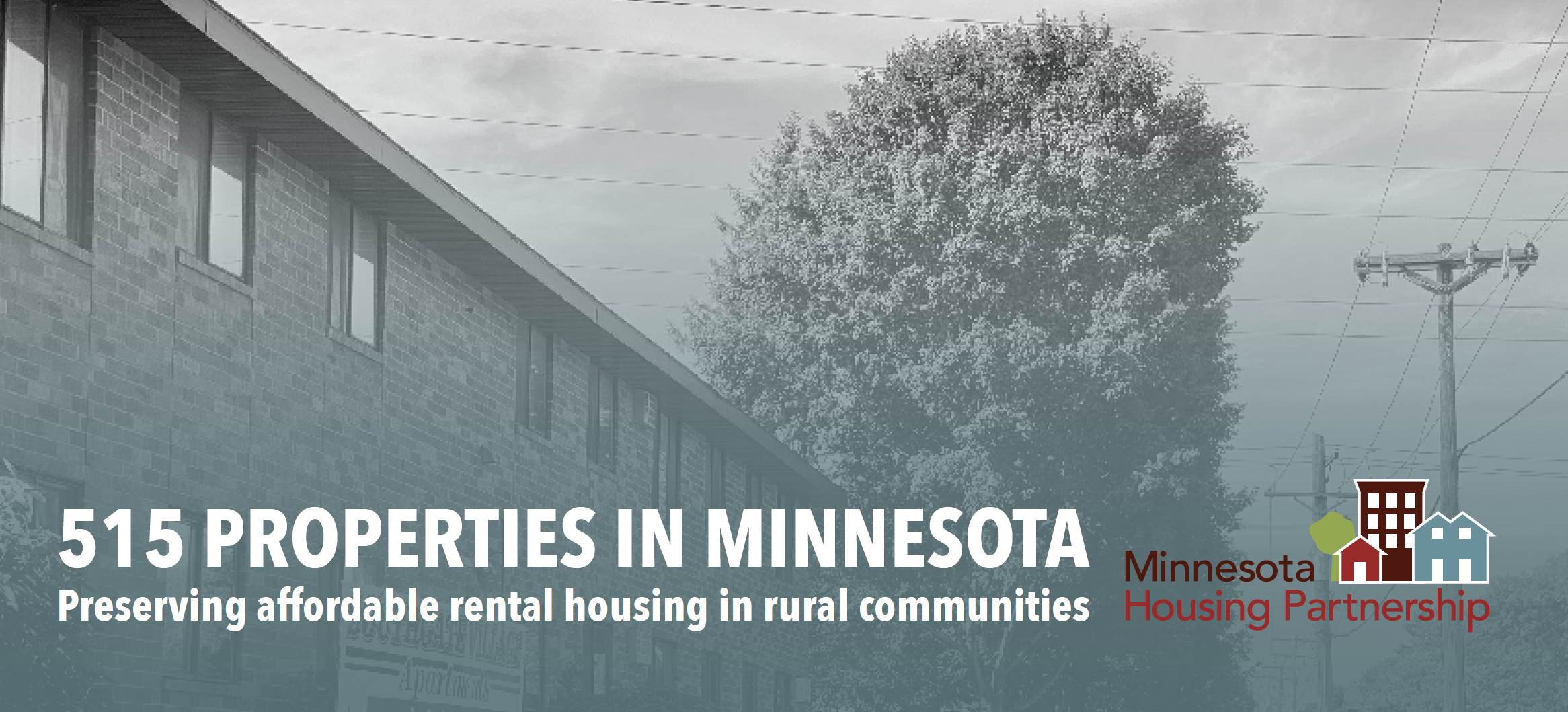
    A new report by MHP describes important affordable rural rental properties across Minnesota and the people who live there.  

    In communities across Greater Minnesota, rural rental housing is at risk due to declining investment and failure to construct new housing affordable to community members. — and MHP is working with partners and communities to save it (Learn more about our technical assistance here).  These are rental units that have been financed under the USDA’s Section 515 program. Under 515, nonprofit and for-profit entities have received 1 percent loans for acquisition, rehabilitation or construction of rental housing and related facilities. 

    Many rural rental homes are aging and in poor condition. As federal investments in the 515 program have been insufficient and declining for many years, many 515 properties are in declining condition and there has been no new construction for years. 

    As loans for these properties expire, more and more buildings are exiting the Section 515 program. Exiting properties may lose rental assistance funding, and some properties are no longer required to keep rents affordable — meaning residents could face displacement or homelessness. 

    These properties are often the few rental homes in rural communities that are affordable to extremely low-income residents, seniors, and people with disabilities. The loss of these properties will be especially acute for communities already struggling to provide affordable homes. 

    Part of the effort to save these properties is to quantify and describe these properties and who lives in them. MHP, in collaboration with the University of Minnesota’s Center for Urban and Regional Affairs, analyzed the most recently available data. The result is this report.  

    Among the findings:  

    • Minnesota has 456 properties under the 515 program providing 9,667 affordable rental units and housing 13,435 people.  
    • Average annual income for residents of these properties is $17,061.
    • These properties are found in 82 of Minnesota’s 87 counties but are concentrated in central and southern Minnesota.  
    • Significant age of the properties, indicating a need for regular maintenance and potentially poor conditions.
    • Households are more likely to be headed by women and are more likely to be BIPOC. 


  • What does Minnesota’s projected budget surplus mean for housing?

    MHP’s Libby Murphy, Deputy Director of Policy, gives an overview of what we know about the state budget and how housing will be affected.

    Minnesota Management and Budget released the official November revenue and spending forecast earlier this week, and it was a pleasant surprise. What had been a projected $2.42 billion deficit earlier this year is now a $641 million surplus for the upcoming biennium.

    The November forecast in even-numbered years is critical starting point for the Minnesota Legislature. Governor Walz and lawmakers use the forecast to draft their two-year state budget proposals.

    The surplus offers lawmakers an unexpected opportunity to help more individuals and businesses hurt by the second round of pandemic-related closures. While there is bipartisan support for some type of relief package in a December special session, it is unclear how much of the surplus lawmakers will agree to spend this December. A relief bill in December has broad support because Federal CARES Act dollars are largely already spent and any remaining money must be spent by the end of the calendar year.

    Governor Walz and others have indicated that the surplus should be viewed as an opportunity to provide a 60-day bridge to struggling businesses and households until Congress passes a second relief package. While talks at the Federal level are accelerating, stalled talks in the fall led many to believe relief won’t come until February, after President Elect Biden takes office.

    Even before the surplus announcement, Republican and DFL leaders released plans to provide financial help to businesses ordered to close and workers impacted by these closures. Walz acknowledged that the updated forecast will help accelerate discussions. Leaders on both sides of the aisle in both bodies acknowledged that the announcement provides assurances that the State has enough money in the short term to provide relief to those individuals and businesses that need it the most.

    The surplus is a result of higher general fund revenues than predicted and lower spending than expected. It’s important to keep in mind that the May forecast was really a best guess estimate at the impacts COVID-19 would have on the State’s economy. While the budget outlook is also improved for the next biennium, MMB still projects a $1.273 billion deficit in the following (2022-2023). That deficit will influence lawmakers spending and revenue making decisions this year but, to what extent, remains to be seen.

    Lawmakers are guaranteed to return to the Capitol, albeit mostly virtually, on December 14 for their sixth special session of the year. They are required to convene every 30 days to extend Governor Walz’ peacetime emergency. If lawmakers can agree to a relief package sooner, lawmakers will likely return sooner in order to get money quickly into the pockets of individuals and small businesses targeted through their relief efforts.

    The recession’s unequal impacts

    The higher than expected tax collections are attributed to the fact that the pandemic recession is hitting Minnesotans differently. Those in low-wage, service jobs most impacted by shutdowns are doing worse, especially after enhanced unemployment payments ended this summer. But many others experienced no decline or even increases to their incomes. For this reason, DFLers want to be laser focused on getting aide to lowest wage workers.

    What this means for housing

    Housing assistance is largely absent from the public conversations and proposals. The surplus announcement has the potential to broaden the range of direct economic supports to households in need and, potentially, housing providers.

    MHP believes it is essential for the economic relief package to not only provide direct stimulus payments to households to help them pay their bills through the next few months; it must also include additional housing assistance dollars to help households catch up on past due housing payments. Debt as a direct or indirect consequence of COVID-19 and the pandemic recession is a financially crippling event that Minnesota lawmakers need to address. The Great Recession demonstrated what long-term consequences housing related debt has on low income households, especially Black, Indigenous and People of Color (BIPOC) households. And, when these households cannot fully participate in the economy, everyone suffers.

    MHP joins Homes for All is calling on lawmakers to invest an additional $50 million in emergency housing assistance. Despite receiving nearly $700,000 in daily requests, Minnesota Housing will stop taking new applications after 11:59 p.m. on December 7 in order to process all payments. Households are still learning about the program and how to navigate the process. Additionally, the proposed stimulus amounts for direct payments may not be enough to help all households make their rent, mortgage, HOA, utility or other housing related expenses. MHP calculates that a low wage worker in the food prep or service industry could find themselves paying anywhere between 90-103 percent of their unemployment check on rent.

  • Nov. 2020 Investors Council Recap: Looking forward to 2021

    The second virtual Investors Council meeting of 2020 was held on Nov. 18 and featured a panel of journalists to answer the question: “What does the 2020 election mean for affordable housing?” 

    But first, MHP honored seven housing advocates that made a big difference in 2020. 

    “We succeed in our advocacy work because of the outstanding efforts of people like you,” said MHP’s executive director Anne Mavity. 

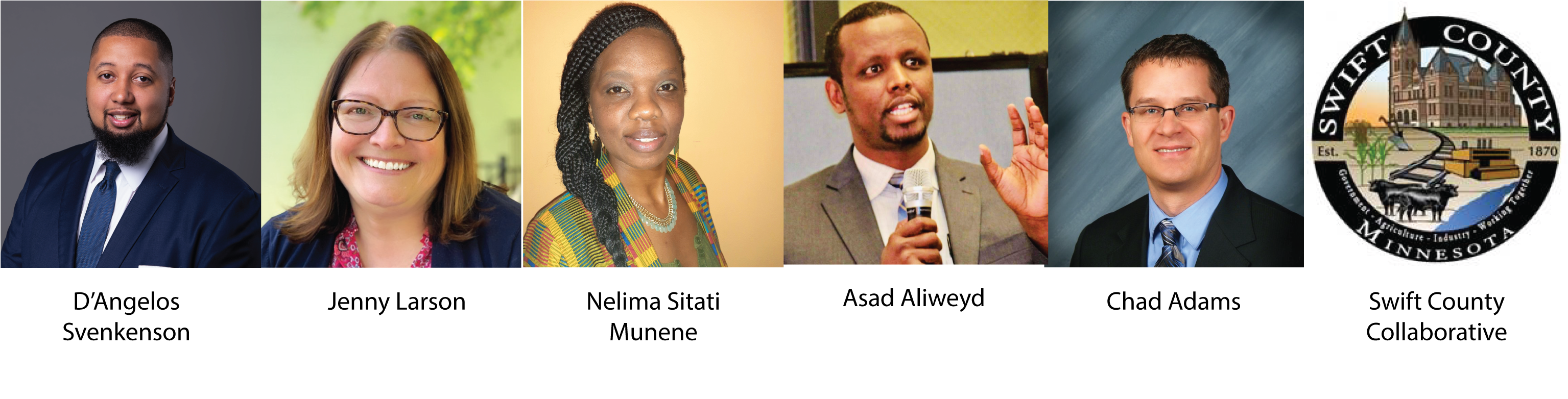
    Those honored on Wednesday include: D’Angelos Svenkenson, Founder & CEO, NEOO

    Partners Inc.; Jenny Larson of Three Rivers Community Action; Nelima Sitati Munene of ACER; Asad Aliweyd of New American Development Center; Chad Adams of Southwest Minnesota Housing Partnership; and the Swift County Collaborative. You can read more about these Outstanding Advocates at the MHP Connect blog. 

    In her remarks, Minnesota Housing Commissioner Jennifer Ho praised those advocates — and all advocates fighting for housing and shelter. 

    “Advocacy matters. And with legislative sessions during COVID, it matters even more because we can’t pack the capital or the offices.”

    She added, “If there’s one takeaway from my remarks today… I just want to say that advocacy really, really matters. So thank you again to the advocates and to MHP, and Minnesota Coalition for the Homeless, and Homes for All.”

    She noted that support and momentum are crucial in this moment when so many people need assistance — including the $100 million in housing assistance that Minnesota Housing is administering and counties are implementing.  

    “We need your help supporting the local grant administrators who have seen an overwhelming asks for assistance. The need has not gone away just because the federal support has gone away.”

    A panel discussion about the 2021 legislative session’s potential impacts on housing included C Terrance Anderson, Director of Community Programs at CURA; Peter Callaghan from Minnpost, and Briana Bierschbach from the Star Tribune. 

    “The needs around housing are great,” Anderson said. “We are seeing an intensified reality around housing. Gentrification, disinvestment in communities, and redlining really shaped what is happening today and these are vital to understanding what is happening in Twin Cities.”

    Anderson noted that Minnesota is in store for a huge surge in evictions. “We have this moratorium for folks not to be evicted but as soon as that ends, we are in for a tidal wave of evictions.” 

    He said policy solutions can help alleviate that including extending the evictions filing timeline and enacting financial assistance. “Renters need more time to reconcile with landlords and a lot more help from the feds and state.”

    On how lawmakers and decision-makers view racial disparities in housing, Anderson said, “I think everybody’s politics should have changed post-George Floyd,” he said. “The priorities are quite clear about BIPOC communities: Employment, education, and housing. The opportunities are there and the ideas are there but will they be prioritized?”

    Peter Callaghan of Minnpost noted that some bonding could happen. “Is there appetite for another bonding bill? They’ve always done a smaller bonding bill in the odd year — the first year of the legislative. And they would have last time if they were so tied up in partisan disputes.” 

    He added, “Housing has not been a controversial vote on bonding. If there’s a bonding bill I would anticipate there would be housing money in it.”

    But, he said, it could get complicated. “Republicans have pushed for the addition of housing regulatory reform to any additional bonding money. I think that will happen again.” 

    Briana Bierschbach from the Star Tribune noted that the upcoming session will be tough. 

    “These people find ways to disagree even on things they agree on.”

    She agreed that political realities changed after the George Floyd uprisings and that there’s a broader consensus among Republicans — especially Paul Gazelka who met with families who lost loved ones to police brutality. 

    In addition, she said, “The pandemic has hit people that are vulnerable the hardest and taken all these issues in our society and made them visible for everyone.”

    But, most issues will be a tough sell in 2021. “When things are really hard, legislators tend to get done only what they have to get done. There will be so many battles just to respond to the pandemic, just to get a budget passed. A lot of issues probably won’t get attention.” 

    The conversation was much deeper, insightful, and complex than can be captured in this blog so be sure to watch it here: 

    {source}
    <iframe width=”560″ height=”315″ src=”https://www.youtube.com/embed/fzW9QRbO-b4″ frameborder=”0″ allow=”accelerometer; autoplay; clipboard-write; encrypted-media; gyroscope; picture-in-picture” allowfullscreen></iframe>
    {/source}

    To be part of these dynamic conversations, become a contributor or renew your contribution in the MHP Investors Council today!
  • MHP Announces Outstanding Advocate Awards

    MHP is excited to announce the 2020 Outstanding Advocates! MHP recognizes outstanding volunteers and organizational partners who have made significant contributions to promote affordable housing solutions at the local, state, and federal levels. Favorable consideration is given to those that advance MHP’s policy goals. MHP prioritizes building relationships with and recognizing the contributions of Black, Indigenous and People of Color community members.

    The 2020 Outtstanding Advocates are:

    D’Angelos Svenkenson, Founder & CEO, NEOO Partners Inc.

    As a member of the MHP’s first Public Policy Advisory Group, D’Angelos helped MHP develop policy recommendations and criteria that are shaping MHP’s current policy framework and agenda. He actively participated in group discussions and provided extensive feedback, drawing upon his unique experiences and perspective, on messaging, letters to policymakers, and the final report. He shared the group’s body of work with MHP’s broader network at an Investors Council Breakfast. D’Angelos lobbied lawmakers with MHP

    and proactively reached out to MHP on numerous occasions to offer his assistance in additional efforts to secure the bonding bill.

    Jenny Larson of Three Rivers Community Action

    Jenny was critical to MHP’s advocacy for $100 million in housing assistance. She participated in emergency task force and one-on- one calls to help identify policy solutions responsive to COVID-19. She used her relationships and influence to aggressively lobby the Walz administration and lawmakers to secure this vital resource for Minnesota families. She is recognized statewide as an expert in many areas of housing. She has always made herself available to MHP staff to answer any policy question, even while implementing a new housing assistance program. Jenny responded to every request to engage and lobby lawmakers and provided insight and feedback on numerous communications with policymakers and the administration.

    Nelima Sitati Munene of ACER 

    Nelima partnered with MHP on several research and policy areas this past year. She has been a crucial resource to MHP staff on local, state, and national policies and campaigns. Nelima continually raised the voices and experiences of some of Minnesota’s lowest income renters. As a participant and guest speaker at MHP’s COVID-19 Housing Task Force, Nelima always advocated for resources to help elevate cost burdens impact on extremely low-income families and policies to improve housing stability, access to quality housing,

    and fair and dignified treatment of renters, including evictions policies.  On numerous occasions, Nelima helped inform MHP’s policy positions, especially emergency housing assistance. She ensured MHP’s communications with policymakers, the administration, and the media reflected the experiences and needs of the tenant communities she organizes. She co-chairs Congresswoman Omar’s Eviction Task Force.

    Asad Aliweyd of New American Development Center

    Asad’s leadership in helping to advance local and federal advocacy efforts and his role in influencing state policy development and advocacy was critical to MHP this year. He worked across sectors and levels of government to build the public narrative around housing, with consistent focus on uplifting voices of renters, under-resourced households, and the East African community. His leadership in lobbying Hennepin County Commissioners helped secure significant increases in housing resources for the county. His relationships with Minnesota members of Congress helped MHP more deeply engage with electeds, and helped produce a forum with hundreds of attendees. He is also a founding member of Opportunity Starts at Home Minnesota Chapter. Asad was a regular participant, speaker, and policy thought leader at MHP hosted events including MHP’s Legislative Update series, speaker at the IC breakfast, and participant in MHP’s COVID-19 task force.

    Chad Adams of Southwest Minnesota Housing Partnership

    Chad engaged directly with legislators through trips to the State Capitol and direct lobbying. He was critical in helping MHP engage with key lawmakers in Southwest Minnesota throughout regular session and special sessions. He used his relationships to help navigate complex political dynamics and foster understanding. Chad responded to odd hour and weekend texts and calls asking for his assistance to lobby lawmakers on urgent matters. He always found time to advise MHP staff on policy issues and proposals, including through participation in MHP’s COVID-19 Housing Task Force. In this forum, he highlighted unique challenges for rural Minnesota communities. Chad eagerly stepped up to serve as the Homes for All Co-Chair after initial MHP outreach. His advocacy efforts were noticed by the statewide membership, which overwhelming supported his nomination.

    Swift County Collaborative

    Swift County partners participated in MHP’s Housing Institute (Round 6). Following the conclusion of the institute, Swift County RDA, HRA, and the County Administration continued to advocate for policy goals in furtherance of their community development priorities. With the support of County Commissioners, they proposed and received approval for a Swift County Local Housing Trust Fund in 2020. Along the way, they worked with MHP staff to advocate at the state level for a state match for local housing trust funds, including contacting their local lawmakers including chief author Senator Andrew Lang (17, R). Swift County HRA and RDA staff worked with MHP technical assistance providers on acquiring and preserving multi-family rural rental homes (USDA Rural Development 515 properties). In so doing, they built and maintained relationships with former Congressman Colin Peterson and his staff, ensuring their federal representatives were educated on the housing needs of Swift County

  • State election recap: 2021 will look a lot like 2020

    MHP’s Libby Murphy, Deputy Director of Policy, gives an overview of what happened on election day and what’s in store for 2021 at the Minnesota Legislature. 

    Minnesota voters opted for two more years of divided government. Republicans retain control of the Senate while Democrats hold onto their majority in the House.  

    While some key Senate races are still being tallied, we expect the Senate GOP to maintain its 35-32 majority or a reduced 34-33 majority. House Republicans picked up six seats, reducing the DFL’s 2020 75-59 majority to 69-65.  House Republicans picked up a number of seats in suburban and rural districts and some DFL seats were replaced by more progressive successors. The new composition has the potential to further exacerbate existing rural-urban divides.  

    Last week, party caucuses in each chamber met to elect their leadership. Here, again, Minnesotans will experience status quo. House DFLers reelected Melissa Hortman as Speaker of the House and Ryan Winkler as House Majority Leader.  House Republicans reelected Kurt Daudt as their House Minority Leader. In the Senate, Republicans reelected Paul Gazelka as their Majority Leader and Democrats reelected Susan Kent as their Minority Leader.  

    Facing a pandemic, a big budget deficit, redistricting and a host of other issues, pundits expect a lot of tensions going into the 2021 session. With such close margins in both chambers, lawmakers will have to overcome existing fraught political dynamics and work across the aisle to pass a budget. But Minnesotans may need patience when it comes to getting much else done. House Speaker Hortman, Senate Majority Leader Gazelka and Governor Walz have all acknowledged that the coming year will be more difficult than previous years but have expressed optimism that despite disagreements on policy and budgeting, lawmakers and the Governor will have a productive working relationship. 

    The roughly $4 billion budget deficit amidst the ongoing pandemic will dominate the 2021 session. Lawmakers will need to make extremely tough choices. While Democrats will look to sources of new revenues, Republicans will likely focus on identifying perceived inefficiencies to cut.  

    Cooperation could prove difficult as Republicans and Governor Walz continue to disagree over the governor’s use of executive powers. Republicans ousted two commissioners in summer special sessions. The Senate GOP could continue to exert their power to remove commissioners in an effort to check the governor’s agenda.  

  • Advocates make Housing a top priority in 2020 election

    Housing advocates across the state are busy educating voters and candidates about housing issues. 

    Housing as an issue is hitting home for more and more Minnesotans. Encampments during the COVID19 pandemic have put a spotlight on the need for affordable homes, shelters, and housing services. Many Minnesotans are filled with anxiety as eviction and foreclosure moratoriums come closer to expiring, and households with large housing debts wonder how they’ll keep their homes. Lawmakers, perhaps sensing this anxiety,  approved the largest package of bonds for housing in the history of Minnesota ($100 million in Housing Infrastructure Bonds and $16 million in general obligation bonds) during October’s special session.

    Minnesota Housing Partnership (MHP) and Homes for All MN are busy at work this election season gathering responses to the 2020 Candidate Questionnaire on Housing Issues. The questionnaire was sent to all candidates for Minnesota House and Minnesota Senate. Candidate responses are available on the MHP website (www.mhponline.org/policy/advocacy/2020-candidate-questionnaire). Dozens of candidates from the three major parties (Democratic-Farmer-Laborer, Legalize Marijuana Now, and Republican) have responded, reflecting statewide interest in housing. 

    Homes for All MN members helped amplify the candidate questionnaire. Minnesota Coalition for the Homeless used their state-wide network to encourage responses. Habitat Minnesota has promoted the candidate questionnaire to its affiliates, volunteers and Habitat 500 bike ride participants. MICAH (Metropolitan Interfaith Council on Affordable Housing) sent the candidate questionnaire to thousands and encouraged its chapter/regional leaders to ask candidates to complete the questionnaire. CommonBond Communities, which owns, manages, and develops affordable homes across the state, engaged its housing advocate volunteers in asking candidates to complete the questionnaire. 

    Housing partners utilized social media to encourage candidates to respond to the questionnaire, and highlighting candidate by name who have responded. To help make this quick and easy, MHP developed a promo-kit of pre-drafted content that could be cut and pasted into social media posts. MHP also hosted a twitter storm, with over twenty (20) participating organizations. As well, MHP organized a candidate engagement webinar to promote the questionnaire, with tips for non-partisan activities.  

    Housing advocates have been highly active in Minnesota in 2020, using a variety of initiatives to amplify the need for solutions to candidates and voters: 

    • Many housing advocacy organizations have increased their voter engagement activities, helping make the connection between voting and home. The New American Development Center, African Career Education & Resources (ACER), and Jewish Community Action are three grassroots housing advocacy organizations actively organizing voter registration and connecting residents to voting resources. 
    • African Career Education & Resources (ACER) canvassers have worked for months reaching residents with voter registration information along with housing assistance resources. Get out the vote efforts have included pairing free produce giveaways with voting information. 
    • Catholic Charities of St Paul and Minneapolis has been leading voter outreach for staff, residents and clients at all its program sites across the Twin Cities. For individuals experiencing homelessness, including those at Catholic Charities emergency shelters and opportunity centers, activities have included encouraging early registration, educating on options to vote early in person or on election day, and ensure individuals are available to vouch for anyone who’s registration and ballot is more likely to be challenged. 
    • Twin Cities Habitat for Humanity created a Candidate Conversation Guide, encouraging its thousands of volunteers and homeowners to speak with candidates about the importance of affordable homeownership and to “Vote for Home.”  
    • Beacon Interfaith Housing Collaborative hosted multiple candidate forums on housing issues and prepared a list of suggested questions for engaging candidates on housing, engaging their dozens of member congregations in housing advocacy. 
    • CommonBond Communities joined the NLIHC Housing Providers Council, increasing its efforts to assist residents to vote.  
    • Multi-sector housing advocacy partners, who work in other areas of advocacy in addition to housing, have also increased their electoral season engagement. The Arc Minnesota, a Homes for All MN member, has been the lead partner in Rev UP MN, a group of 22 organizations focused on disability advocacy. Activities have included a mailing of 50,000 postcards, social media campaign, and questionnaire for state legislative candidates on disability issues. 
  • Bonding bill finally passes; what does it mean for housing?

    Libby Murphy, MHP’s Deputy Policy Director, provides an update about the bonding bill and what it means for housing going forward.

    On October 14, the Minnesota Legislature passed a $1.87 billion bonding and tax bill with overwhelming bipartisan support. Thanks to the persistence of advocates, lawmakers were forced to overcome partisan differences and finally pass a bonding bill in their fifth special session after failing to reach agreement in regular session or in the four previous special sessions.

    A bonding bill requires a supermajority of lawmakers in each chamber to pass. The DFL controlled House only needed six votes. The House’s first attempt to pass a bonding bill at the end of regular session n May gained no Republican support and failed on a 75-58 vote. Last week, 25 GOP members voted in favor of the bill, securing a 100-34 vote. It passed in the Senate by a 64-3 vote.

    This bonding bill includes hundreds of infrastructure improvement projects around the state, including $100 million in Housing Infrastructure Bonds (HIBS) and $16 million in General Obligation (GO) bonds for housing. HIBS will help to create and preserve roughly 500-1000 homes. The GO bonds will help maintain existing public housing units.

    Calculating the impact of the bonding investment in housing is challenging because HIBs can be used for a number of eligible uses, including new supportive housing, preservation of existing federally subsidized housing, manufactured housing, and land for land trust homes. Lawmakers, hoping to do more to address persistent homeownership gaps, expanded eligible uses of HIB to build single-family homes. The Homes for All coalition’s request to add “deeper affordability” to build units for households at or below 50% of AMI without supportive services did not make it into the final package.

    The bill also included some tax relief for small businesses and farmers. A regular session Senate tax bill had included 4d tax relief for affordable housing while the original House tax bill included a provision to capture $4 million annually of the mortgage registry and deed taxes to fund the Workforce Homeownership and Affordable Housing Program. This capture was included in some special session House and Senate proposals but lawmakers, ultimately, excluded the provision from the final bill.

    For the first time, the bonding bill included several “Equity Appropriations” that allocate money for communities that have been left out of the funding process in the past. There are also provisions aimed at ensuring local governments follow the state’s workforce participation goals and equal-pay protections for communities of color and women.

    The bonding bill also includes $4.5 million in bonds for a Perspective Family Center in St. Louis Park. These funds can be used for a variety of purposes to support the welfare of homeless children, including supportive housing.

    While it could be months before the infrastructure projects financed by the new bonds will get underway, passage of this bonding bill is a relief to housing advocates. More projects that applied to Minnesota Housing for funding in July and who applied in hopes of new and robust state investments will be able to move forward as a result of this bill.

    Check out Session Daily for a summary of what is in the bill. 

  • MHP to HUD: Proposed shelter rule is egregious, cruel, and dangerous for transgender Minnesotans

    Minnesota Housing Partnership submitted a comment on Monday, Sept. 21 to the U.S. Department of Housing and Urban Development urging withdrawal of a rule that would sanction discrimination in shelters for people experiencing homelessness. View MHP’s comment here.

    “MHP recognizes that the proposed rule change is a part of the current administration’s ongoing efforts to limit the rights and protections for the LGBTQ+ community, particularly transgender people,” wrote Elizabeth Glidden, MHP’s Director of Strategic Initiatives and Policy. “This Proposed Rule would strip protections for transgender and gender non-conforming people seeking HUD-funded shelter and is rooted in harmful and dangerous stereotypes about transgender persons, particularly transgender women.”

    “We urge that this proposed rule change be withdrawn in its entirety.”

    The rule change was published on July 24 and is titled, “Making Admission or Placement Determinations Based on Sex in Facilities Under Community Planning and Development Housing Programs.” It provides a list of ways for shelters to turn away transgender and gender expansive people. 

    “This proposed rule would grant single-gender shelters permission to close their doors to transgender people experiencing homelessness, an unacceptable result,” MHP’s comment states. ”MHP believes that moving forward with this proposed rule change is egregious and cruel, and particularly so during a global pandemic when access to housing may mean the difference between life and death.”

    For more than two decades Minnesota law has protected the rights of transgender and gender expensive residents. 

    “Minnesota values strengthening protections for transgender community members, not weakening them,” MHP stated. 

  • Tell legislative leaders to pass a bonding bill!

    {source}

    <!– Plugin BEGIN –>
    <script language=”javascript” src=”//www.congressweb.com/cweb/js/jquery.congressweb.iframe.js”></script>
    <script language=”javascript”>$cweb(function(){ $cweb(‘#congressweb-action-18’).congressweb({ url : ‘//www.congressweb.com/MHP/18’, responsive : true }); });</script>
    <div id=”congressweb-action-18″></div>
    <!– Plugin END –>

    {/source}

  • MHP welcomes Daniel Atunah-Jay as Director of Finance and Human Resources

    MHP is excited to announce Daniel Atunah-Jay as our new Director of Finance and Human Resources. Daniel’s extensive experience in accounting and administration will help position MHP for a strong future in an increasingly complicated fiscal environment.

    With a Bachelor’s degree in Accounting and a Master’s degree in Business Administration, Daniel’s past experience includes work as an auditor, with a foundation, and as a nonprofit CFO.  He currently serves on the Model Cities Board of Directors where he built a knowledge base on affordable housing, and runs his own social enterprise to support micro entrepreneurs in Africa to maintain their financial records.

    “We’re thrilled to welcome Daniel,” said Anne Mavity, Executive Director. “Daniel joined MHP as an interim director of finance earlier this summer and we are excited that he is joining our team full time.”

    Daniel joins MHP after a prior tenure as Chief Financial Officer at the Minneapolis Urban League.

    On joining MHP, Daniel says, “I am privileged to add my experience to the MHP team who are leaders in advocating for affordable housing for the underserved communities.”