• New Resource: Federal Housing Advocacy Toolkit

    New Resource: Federal Housing Advocacy Toolkit

    Congress is drafting the FY26 federal budget, which includes funding for vital housing programs that prevent homelessness and keep families safe at home. Many essential programs are facing cuts, including public housing and rental assistance. The U.S. House has already advanced a bill that makes deep and dangerous cuts to housing programs. Full overview of the federal budget proposals can be found here.

    This toolkit was created to make it easier for advocates across the state to speak up for strong federal investments in housing. Inside, you’ll find everything you need to take action—including key talking points, contact information for your members of Congress, sample social media posts, and more. By using a shared message and speaking out together, we can show lawmakers that funding housing is a priority in every community.

    • Messaging & Talking Points 
    • Calls to Action 
    • Congressional Contact Info 
    • Content Library (Social Media, LTEs, etc.) 
    • Storytelling & Messaging Amplification 
    • Events & Engagement 
    • Policy & Data Resources
  • Immigration Issues for Housers and Housing Advocates

    Immigration Issues for Housers and Housing Advocates

    Friday, July 18th | 10:00 – 11:00 am

    Please join us for a special presentation with Juventino Meza, the New Americans Immigration Hub Attorney with the Immigrant Law Center of Minnesota. Juventino will provide an overview presentation with some time for questions.

    You are invited to submit questions for our presenter along with your registration – this will help guide the content of the presentation.

    Register to Attend!

  • Tell your Legislators: Protect Federal Rental Assistance, Homes, and MN Families

    Tell your Legislators: Protect Federal Rental Assistance, Homes, and MN Families

    Take Action on Rental Assistance with Easy Form to Contact Your Lawmakers

    Minnesotans want to live near their work, send their kids to neighborhood schools, and feel safe at home. More than 100,000 Minnesota households—seniors, families, people with disabilities—rely on federal rental assistance to afford a place to live. Many more Minnesotans qualify for rental assistance but don’t receive it, due to insufficient funding. Now, proposed federal cuts threaten to take away Minnesotans’ ability to stay in their homes, putting lives and local economies at risk. 

    Congress is drafting their fiscal year (FY) 2026 spending bills, including those that fund vital housing programs that prevent homelessness and keep families safe at home. While the draft spending bill released on July 13 by the House rejects the extreme dismantling of HUD programs proposed by President Trump in his FY26 budget request, many vital programs are facing cuts.  For details, see NLIHC’s complete analysis and updated budget chart. 

    The draft House bill would cut public housing and rental assistance by millions of dollars, leaving thousands of people without safe access to home. Even a 1% reduction to rental assistance would displace about a thousand Minnesota families—pushing more people into homelessness, straining shelters, schools, rural hospitals, and county safety nets, and drive up costs for our communities. 

  • Pints, Policy and Progress (Happy Hour)

    Pints, Policy and Progress (Happy Hour)

    Thursday, June 12 | 3:30 PM

    Location: Lake Monster Brewing Company (550 Vandalia St #160, St Paul, MN 55114)

    Join fellow housing advocates, MHP, and co-hosts from 3:30-5:30 pm on June 12th at Lake Monster Brewing as we recognize, celebrate, and toast the hard work done by housing champions and lawmakers during the 2025 Legislative Session.

    Co-hosts include the MN ERASE Campaign, Family Housing Fund, Habitat for Humantity Minnesota, Greater Minnesota Housing Fund (GMHF), Minnesota Consortium of Community Developers (MCCD), Minnesota Housing Stability Coalition, Our Future Starts at Home, Twin Cities Habitat for Humantity, and Yes To Homes MN.

  • President Trump Releases “Skinny Budget”

    President Trump Releases “Skinny Budget”

    The President’s “skinny budget”: has been released and, as anticipated, makes deep cuts to non-defense discretionary spending by $163 billion, representing a cut of 22.6% from FY25 budget levels. The President’s budget makes devastating cuts to HUD and housing programs in other agencies. A list of spending cuts and other spending proposals, including to HUD, are here. The President’s full budget proposal will be released in the coming weeks.

    President Trump’s budget proposal includes a 44 percent reduction to HUD’s housing programs. The proposal calls for eliminating vital programs, such as the HOME Investment Partnership program (HOME), Community Development Block Grant program (CDBG), Low Income Home Energy Assistance Program (LIHEAP), Fair Housing programs, the Neighborhood Reinvestment Corporation (NeighborWorks America) and the United States Interagency Council on Homelessness (USICH). It also includes significant cuts for homelessness prevention, Native American programs, resilience and utility efficiency, and rural development programs, and the Community Development Financial Institutions Fund (CDFI Fund).


    Rental Assistance

    The President’s budget proposal would slash rental assistance by more than 40%, or $26.72 billion, and combine all remaining funds and block grant them into one program, State Rental Assistance Block Grants. It would be up to states to continue to provide housing assistance to the millions of people who rely on it. The programs eliminated and replace with the block grant would include Housing Choice Vouchers (HCVs), Public Housing, Project-Based Rental Assistance (PBRA), Section 202 Housing for the Elderly, and Section 811 Housing for Persons with Disabilities. In addition, the President’s budget would impose a two-year time limit on receiving rental assistance for “able-bodied adults.”


    Supportive Housing

    The President’s proposal would eliminate the Continuum of Care Program and Housing Opportunities for Persons with AIDS (HOPWA) and move them into the Emergency Solutions Grant Program, with a cut of $532 million. The ESG program cannot be used for long term housing, but rather only funds short-term shelters and housing limited to two years. See NYTimes coverage – impacts to supportive housing


    USDA Rural Housing Programs

    President’s preliminary budget would eliminate U.S. Department of Agriculture single-family housing direct loans (section 502), self-help housing grants, and rural housing vouchers, arguing these programs “are duplicative, too small to have macro-economic impact, costly to deliver, in limited demand, available through the private sector, or conceived as temporary.“


    House Reconciliation Bill and Tax Provisions

    The House of Representatives is expected to review all or portions of the reconciliation bill during the week of May 12. Republican goals for a reconciliation bill, which can avoid the Senate’s 60-vote filibuster threshold, including extending tax cuts, expanding border security and defense, and cutting federal spending. The Ways and Means, Energy and Commerce, and Agriculture Committees are responsible for determining key provisions of the bill, including tax cuts and extensions, cuts to Medicaid and healthcare assistance, and cuts to food assistance. 

    While housing assistance has not been identified as a potential target for cuts, cuts to anti-poverty programs such as Medicaid and the Supplemental Nutrition Assistance Program (SNAP), both named as targets for potentially large cuts, would negatively impact economic stability and housing stability for families and people with low incomes.

    House Tax Bill Expands Tax Credit

    The House Ways and Means Committee, on May 12, released legislative text for the House tax reconciliation bill, which includes an expansion of the Low-Income Housing Tax Credit (Housing Credit), and expanding the Opportunity Zone tax credit. The bill would:

    • Increase the Housing Credit volume cap for 9 percent properties by 12.5 percent from 2026-29;
    • Lower the bond financing threshold to 25 percent for 4 percent Housing Credit properties placed in service after December 31, 2025; and
    • Provide a basis boost of up to 30 percent for properties located in rural and Native American areas.

    Take Action:

    The House Ways and Means Committee, on May 12, released legislative text for the House tax reconciliation bill, which includes an expansion of the Low-Income Housing Tax Credit (Housing Credit), and expanding the Opportunity Zone tax credit. The bill would:

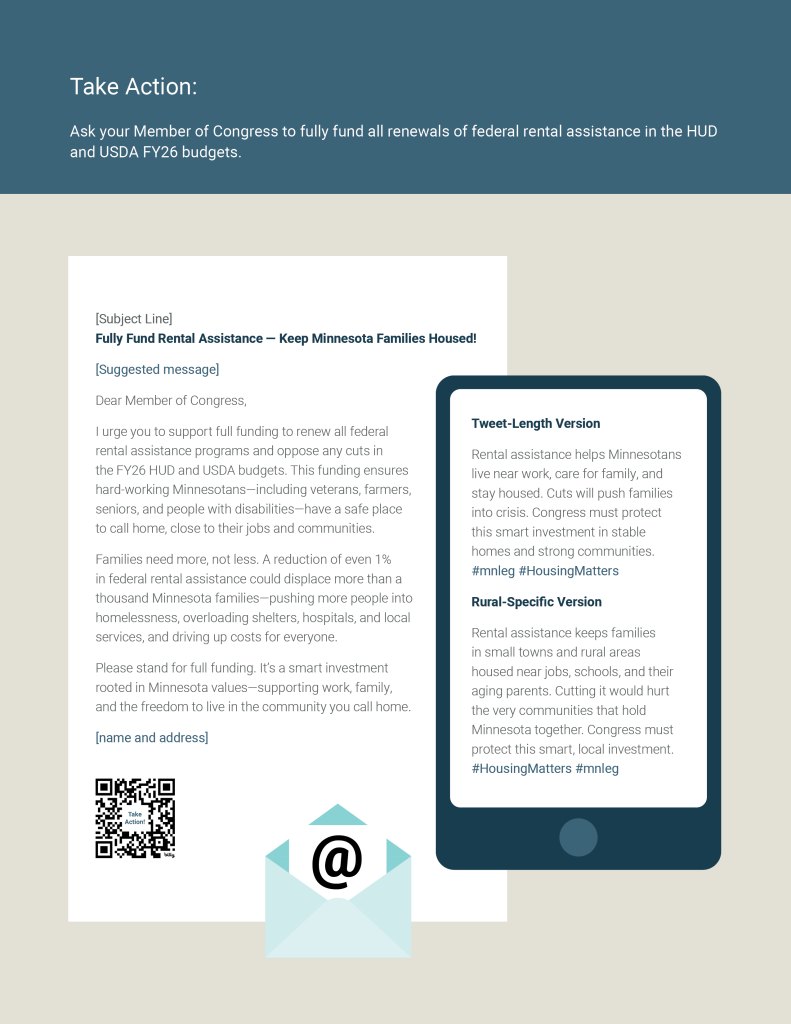
    • Use NLIHC’s toolkits and resources to take action on FY26 funding to urge Congress to pass a FY26 spending bill with increased funding for HUD’s affordable housing programs. You can use NLIHC’s Take Action page to look up your member offices or call/send an email directly.
    • Minnesota NAHRO has shared a one-pager of the impacts of HUD funding in Minnesota, here, You can use the NAHRO Action Alert to contact your Member of Congress about the devastating impact of the President’s proposed FY26 budget on rental assistance and public housing.
  • Action Alert – Ask Governor Walz to Prioritize Housing During Budget Negotiations

    Action Alert – Ask Governor Walz to Prioritize Housing During Budget Negotiations

    Right now, leaders in the House and Senate and Governor Walz are negotiating joint budget targets. It’s not too late to influence Minnesota’s FY26-27 budget. The stakes are high, and state housing investments are more important than ever. President Trump just released his “Skinny Budget” last week. The proposed cuts to HUD would have devastating impact on Minnesota families. We need state leaders to prioritize housing. The Minnesota House’s initial budget proposal invests $75M in one-time appropriations and $100M in Housing Infrastructure Bonds. We need leaders to support the House’s position. 

    Governor Walz’s Telephone Number: 651-201-3400

    Template Phone Script:

    My name is [name] and I live [address]. Support $75M in appropriations to housing and $100M in Housing Infrastructure Bonds.  Safe, stable, affordable homes are the foundation of a thriving state. Minnesota does poorly when Minnesotans don’t have homes that they can afford. 

    Thank you,

    [name, org, contact]

  • Action Alert – Ask Governor Walz to Support a Strong Housing Budget

    Action Alert – Ask Governor Walz to Support a Strong Housing Budget

    Minnesota Legislative leaders from the House, and Senate will soon begin negotiating with the Governor to set a universal budget target. This will determine how many resources are dedicated to housing in the final state budget.

     Ask Governor Walz to support the House Budget of $75 million for housing, with $30 million for FHPAP, and $100 million in Housing Infrastructure Bonds. 

    Governor Walz’s Telephone Number: 651-201-3400

    Template Phone Script:

    Hello, My name is [__name__] and I live/work at [___address & city___]. Please support the House’s budget for housing of $75 million, including $30 million for the Family Homeless Prevention Assistance Program, and $100 million in Housing Infrastructure Bonds. Our families are facing hard times financially, and paying the rent or mortgage, including utilities, is the biggest cost for household budgets. Our Minnesota families and neighbors need help with housing more than ever

     [tell your story – why housing is this important]

    Thank you,

    [name, org, contact]

  • Federal Focus on Housing

    Federal Focus on Housing

    MHP hosts Federal Focus on Housing virtual events on the fourth Friday of the month, from 10:00 -11:00 a.m., or as needed. You can register for the meeting series here. 

  • 2025 Mid-Session Legislative Update

    2025 Mid-Session Legislative Update

    Friday, April 25 · 4 – 5pm

    Please join us for a virtual event to hear from partners and elected officials about the status of various proposals at the MN Legislature.