• Projects and Campaigns

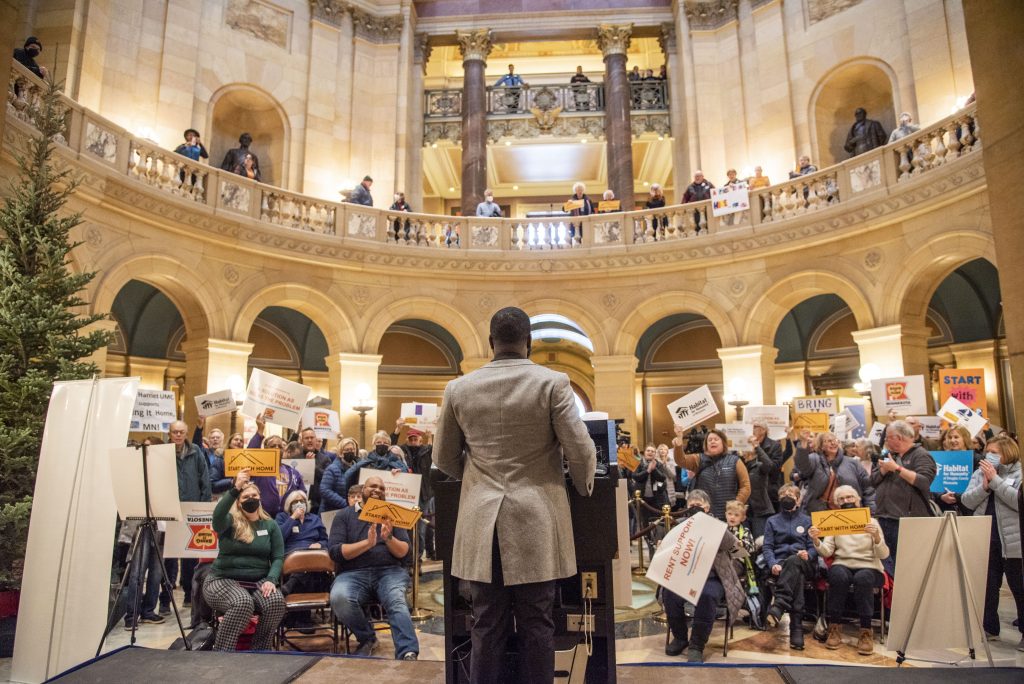
    Pastor Elijah McDavid addresses housing advocates gathered for the annual Starts with Home Rally

    MHP works in partnership with coalitions and campaigns to raise the profile of affordable housing issues, urge legislators to act, and ultimately, to achieve policy goals.

    MHP Leads These Collaborative Efforts:

    Additional Partners, Projects, and Campaigns Include:

  • MHP Announces Outstanding Advocate Awards

    MHP is excited to announce the 2020 Outstanding Advocates! MHP recognizes outstanding volunteers and organizational partners who have made significant contributions to promote affordable housing solutions at the local, state, and federal levels. Favorable consideration is given to those that advance MHP’s policy goals. MHP prioritizes building relationships with and recognizing the contributions of Black, Indigenous and People of Color community members.

    The 2020 Outtstanding Advocates are:

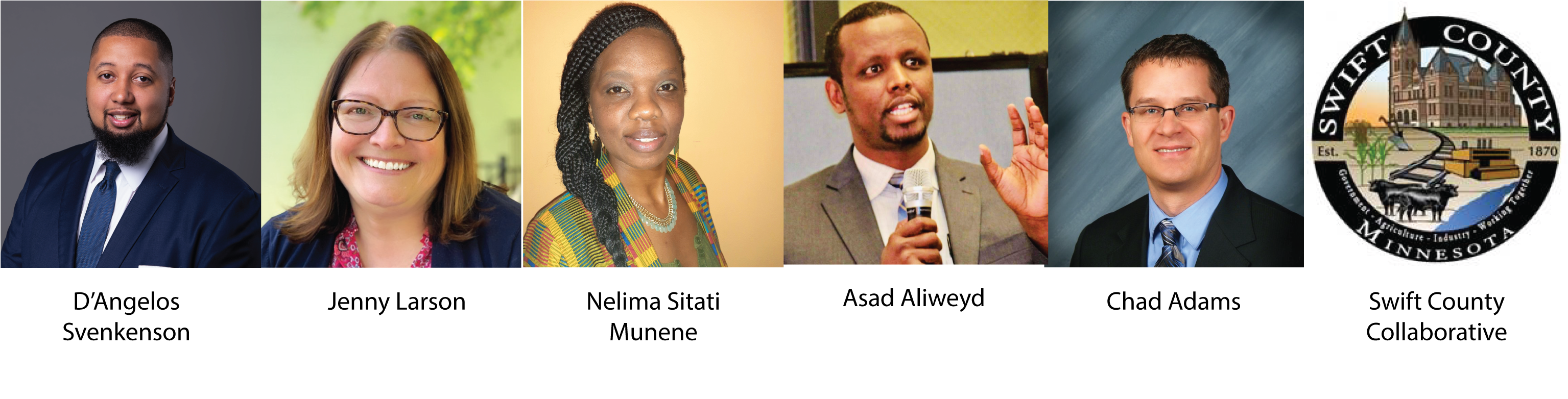
    D’Angelos Svenkenson, Founder & CEO, NEOO Partners Inc.

    As a member of the MHP’s first Public Policy Advisory Group, D’Angelos helped MHP develop policy recommendations and criteria that are shaping MHP’s current policy framework and agenda. He actively participated in group discussions and provided extensive feedback, drawing upon his unique experiences and perspective, on messaging, letters to policymakers, and the final report. He shared the group’s body of work with MHP’s broader network at an Investors Council Breakfast. D’Angelos lobbied lawmakers with MHP

    and proactively reached out to MHP on numerous occasions to offer his assistance in additional efforts to secure the bonding bill.

    Jenny Larson of Three Rivers Community Action

    Jenny was critical to MHP’s advocacy for $100 million in housing assistance. She participated in emergency task force and one-on- one calls to help identify policy solutions responsive to COVID-19. She used her relationships and influence to aggressively lobby the Walz administration and lawmakers to secure this vital resource for Minnesota families. She is recognized statewide as an expert in many areas of housing. She has always made herself available to MHP staff to answer any policy question, even while implementing a new housing assistance program. Jenny responded to every request to engage and lobby lawmakers and provided insight and feedback on numerous communications with policymakers and the administration.

    Nelima Sitati Munene of ACER 

    Nelima partnered with MHP on several research and policy areas this past year. She has been a crucial resource to MHP staff on local, state, and national policies and campaigns. Nelima continually raised the voices and experiences of some of Minnesota’s lowest income renters. As a participant and guest speaker at MHP’s COVID-19 Housing Task Force, Nelima always advocated for resources to help elevate cost burdens impact on extremely low-income families and policies to improve housing stability, access to quality housing,

    and fair and dignified treatment of renters, including evictions policies.  On numerous occasions, Nelima helped inform MHP’s policy positions, especially emergency housing assistance. She ensured MHP’s communications with policymakers, the administration, and the media reflected the experiences and needs of the tenant communities she organizes. She co-chairs Congresswoman Omar’s Eviction Task Force.

    Asad Aliweyd of New American Development Center

    Asad’s leadership in helping to advance local and federal advocacy efforts and his role in influencing state policy development and advocacy was critical to MHP this year. He worked across sectors and levels of government to build the public narrative around housing, with consistent focus on uplifting voices of renters, under-resourced households, and the East African community. His leadership in lobbying Hennepin County Commissioners helped secure significant increases in housing resources for the county. His relationships with Minnesota members of Congress helped MHP more deeply engage with electeds, and helped produce a forum with hundreds of attendees. He is also a founding member of Opportunity Starts at Home Minnesota Chapter. Asad was a regular participant, speaker, and policy thought leader at MHP hosted events including MHP’s Legislative Update series, speaker at the IC breakfast, and participant in MHP’s COVID-19 task force.

    Chad Adams of Southwest Minnesota Housing Partnership

    Chad engaged directly with legislators through trips to the State Capitol and direct lobbying. He was critical in helping MHP engage with key lawmakers in Southwest Minnesota throughout regular session and special sessions. He used his relationships to help navigate complex political dynamics and foster understanding. Chad responded to odd hour and weekend texts and calls asking for his assistance to lobby lawmakers on urgent matters. He always found time to advise MHP staff on policy issues and proposals, including through participation in MHP’s COVID-19 Housing Task Force. In this forum, he highlighted unique challenges for rural Minnesota communities. Chad eagerly stepped up to serve as the Homes for All Co-Chair after initial MHP outreach. His advocacy efforts were noticed by the statewide membership, which overwhelming supported his nomination.

    Swift County Collaborative

    Swift County partners participated in MHP’s Housing Institute (Round 6). Following the conclusion of the institute, Swift County RDA, HRA, and the County Administration continued to advocate for policy goals in furtherance of their community development priorities. With the support of County Commissioners, they proposed and received approval for a Swift County Local Housing Trust Fund in 2020. Along the way, they worked with MHP staff to advocate at the state level for a state match for local housing trust funds, including contacting their local lawmakers including chief author Senator Andrew Lang (17, R). Swift County HRA and RDA staff worked with MHP technical assistance providers on acquiring and preserving multi-family rural rental homes (USDA Rural Development 515 properties). In so doing, they built and maintained relationships with former Congressman Colin Peterson and his staff, ensuring their federal representatives were educated on the housing needs of Swift County

  • Housing and homeless organizations share high hopes for bonding victory

    After bonds for housing were left out of last summer’s bonding bill, housing and homeless organizations and the Minnesota Housing Finance Agency have been determined to work together to make bonding for housing a top priority at the Minnesota Legislature this year. As the end of session draws near, advocates are hopeful that their hard work together will pay off.

    billdingThe Minnesota Senate proposed $36 million in bonds for housing and homelessness in their omnibus bonding bill this week. This is $4 million more than the $32 million in bonding for housing recommended by the governor earlier this year. The $36 million proposal comes as welcome news after last week, when the House of Representatives proposed only $15 million in bonds for housing and homelessness.
    If passed, the bonding package will invest in public housing rehabilitation, housing preservation, rental housing development and community land trusts, and permanent supportive housing construction and rehabilitation. (See chart at end for a more detailed breakdown).

    In response to the low amount in the House proposal, members of the HousingJobs Campaign, Twin Cities Habitat for Humanity, Minnesota Coalition for the Homeless, Minnesota NAHRO, Minnesota Community Land Trust Coalition, Lutheran Social Service of MN, MN CAP and many others have been at the Capitol telling legislators that more was needed. Mr. Bill Ding from HOME Line also made a special appearance, visiting several legislators and telling them he’ll be able to undergo much-needed rehab if bonds for housing are passed.

    With housing included in the key bonding bills from the House, Senate, and Governor (see chart), we will likely see some money for housing passed this session. But the final amount is yet to be determined. Going forward, the House and Senate will have to come to agreement on bonding amounts in conference committee, the final bill will have to pass with votes from at least three-fifths of the members in each body, and the Governor will have to sign the legislation.

    Although our work together is far from over, we can take a second to celebrate how far we’ve come. This session, members of the HousingJobs Campaign have had at least 65 meetings with key legislators alone. Add to that a chorus of other voices joining us from partner organizations. The buzz at the Capitol was fed by the media stories generated by MHP’s latest 2×4 Report and Out of Reach releases this month.

    Stay tuned for an action alert and more news soon- and contact Julie Johnson if you’d like to get in on the fun by meeting with legislators at the Capitol.

    “What unites us is far greater than what divides us.” ~John F. Kennedy
     
    Bonding Side-By-Side Comparison
     
    House (HF 2622)  
    Senate (SF 2577)
    Governor (HF 2205/SF 1823) 
    Public Housing rehabilitation (general obligation bonds) $5 million $6 million $7 million
    Housing Infrastructure Bonds to address foreclosures, permanent supportive housing for the homeless, and federally subsidized rental housing. (appropriations bonds) $10 million $30 million $25 million
    TOTAL $15 million $36 million $32 million
  • New Energy for Renewables in Affordable Housing

    Renewable energy, especially solar, is of great interest to affordable housing developers from both a financial sustainability and mission perspective. However, effective practices and financing systems are still emerging in Minnesota.
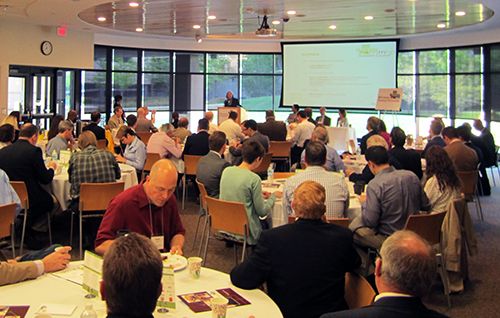
    In May, the MHP Investors Council hosted a breakfast discussion focusing on alternative energy sources for affordable housing. Minnesota Housing Commissioner Mary Tingerthal moderated a thoughtful discussion about current projects, challenges in implementation, and the future of alternative energy in multifamily housing on both a statewide and national level. Panelists included Michael Bodaken from National Housing Trust, Gina Ciganik from Aeon, and Vihar Sheth from US Bancorp Community Development Corporation. More than 80 additional leaders representing the Investors Council and its guests, from all sectors of the affordable housing industry, participated in the event. 

    Panelist perspectives

    Michael Bodaken discussed the topic from both a national policy and on-the-ground practice perspective: As part of the Energy Efficiency for All coalition, he works with utilities to implement energy efficiency programs and improve energy investments in affordable housing. The opportunity is massive: By 2025, the coalition projects that utilities will spend $15.6 billion each year in energy efficiency investments in buildings (up from $7.2 billion in 2011). The National Housing Trust has made investments totaling $2.5 million in solar thermal and photovoltaic systems for six properties in its multifamily affordable housing portfolio; in the next five years alone, this is projected to save $1.2 million and prevent the release of 330 metric tons of greenhouse gases. Bodaken also noted that alternative energy is one of the biggest opportunities developers have to reduce costs and carbon output. The largest controllable variable operating cost in affordable housing is the cost of energy and utilities.  Reducing these costs through retrofits or the use of less costly renewables helps keep housing affordable over a longer period of time. 

    Gina Ciganik gave context for the challenges of using alternative energy in Minnesota. On average, Minneapolis has a 130º swing in temperatures between summer and winter—greater than most other metropolitan areas in the U.S. Our systems are strained through sub-zero temperatures, snow, heat, and humidity. This extreme climate variation means that Minnesota housing developers may not be able to adopt models from projects located in milder climates. 

    This graph (featured in Ciganik's presentation) shows the wide annual temperature fluctuation (130 degrees F) in Minneapolis compared to other metropolitan areas.

    Ciganik emphasized that before considering photovoltaic (PV) or other renewable energy strategies, the first order of business is to create buildings that significantly conserve energy, and water.  Solar and other clean energy strategies are less effective in poorly designed buildings with high energy use intensities (EUI).

    Vihar Sheth provided an investor’s perspective on the data needed to make the case to tax credit investors to underwrite renewable energy investments. In part, the challenge is in underwriting savings that accrue directly to tenants, rather than to owners. One innovative approach Sheth noted is to incorporate energy costs into rent (with no net effect on residents’ pocketbooks) so that the savings can be more directly underwritten at the project level and incorporated into lower cost projections for the building. 

    Future prospects for alternative energy in Minnesota 

    Ciganik’s comments were grounded in Aeon’s experience attempting, with partner Hope Community, to achieve net zero energy at their upcoming “The Rose” project at Franklin Avenue and Portland Avenue in Minneapolis.  The Rose is designed to be incredibly energy efficient—operating at just 20-30% of the regional average baseline for energy usage—and to use renewable sources as much as possible for the energy it does consume. After exploring a number of other options for incorporating renewable energy in the project, the developers are now pursuing a Community Solar Garden through a partnership with consulting group Eutectics. 

    Ciganik also noted that resident engagement is critical in energy efficiency. Developments can be LEED certified and use alternative energy, but if tenants do not engage in sustainable practices, developments can still consume a lot of energy and may not reach efficiency goals. Energy efficiency can also be a selling point to residents and contribute to a sense of pride and community. 

    Sheth said that states with the most alternative energy in housing right now have tax credits or some form of stable funding program in place. The panelists agreed that Minnesota’s current lottery system for solar incentives was not workable with affordable housing programs; community solar gardens provide a more predictable resource and seem to have more potential for serving this need.

    In the open discussion that followed the panelists’ comments, many audience members had good news to share. Dominium highlighted its use of hydropower at its new Pillsbury A-Mill development, the St. Paul Public Housing Authority shared the news that its community solar garden initiative for high-rise properties is projected to save over $4 million for the agency, and Northcountry Cooperative Foundation is hoping to implement community solar to reduce costs for resident-owned manufactured home park cooperatives. 


    To learn more about the MHP Investors Council, and the conversation described here, visit https://mhp.sdho.dev/about/investors-council/events

  • Food for Thought: Racial Segregation and Affordable Housing

    Since at least the 1940s, there have been lawsuits nationwide regarding racial segregation and affordable housing. A recent controversial report from the Institute for Metropolitan Opportunity at the University of Minnesota and a related fair-housing complaint have amplified the discussion in Minnesota.

    To help readers consider the issues surrounding racial segregation and affordable housing, MHP has compiled a sampling of reports, studies, and articles from various perspectives on this issue, as well as some historical context. Look for more posts in the coming months, as MHP moves towards formulating a policy position to help guide this important public discussion.

    The report in question asserts that the Twin Cities are more racially segregated than similar metropolitan areas due to affordable housing policy. The legal complaint, filed by three inner-ring suburbs, claims that the Metropolitan Council and the Minnesota Housing Finance Agency have not appropriately supported affordable housing development in predominantly white, wealthier suburbs.

    A Sampling of Perspectives

    Below is a collection of articles, reports, and studies representing different perspectives on addressing racial segregation and affordable housing today. This list is not comprehensive of all perspectives; rather, it is meant to provide “food for thought” as the Twin Cities and the nation continue to examine these issues.

    • Is Ending Segregation the Key to Ending Poverty? (Alana Semuels, The Atlantic) discusses the benefits of moving distressed households out of concentrated areas of poverty and racial segregation as well as the struggles of implementing successful program models on a national level.
    • Where the White People Live (Alana Semuels, The Atlantic) identifies racially concentrated areas of affluence, which can be considered alongside racially concentrated areas of poverty, using research from the Center for Urban and Regional Affairs at the University of Minnesota.

    A Slice of Housing History

    We also wanted to include a brief discussion regarding how our current situation cannot be divorced from the historical and social context.

    From the 1940s through the 1960s, the practice of redlining made it difficult for persons of color to obtain home loans, maintaining racial segregation throughout neighborhoods. When neighborhoods began to integrate, “block-busting” occurred; realtors would scare white homeowners into selling their homes, which they would in turn market to households of color at higher costs, creating cost burden for thousands of families and promoting racial segregation. Protests directed at homeowners of color in newly integrating neighborhoods also occurred to intimidate families of color from moving in or to encourage them to move out, with one example being Arthur and Edith Lee in South Minneapolis.

    This 1935 “Natural Areas” planning map of downtown St. Paul is just one example of how segregation has historically informed the city planning process. The map is overlaid with today’s freeways and the Metro Green Line.

    Meanwhile, between the 1950s and the 1980s, the practice of city administrators, planners, and council members in approving and vetoing the location of low income public housing projects led to many being located in poor neighborhoods and communities of color. By the late 1980s/early 1990s, the Low Income Housing Tax Credit (LIHTC) and Housing Opportunities of People Everywhere (HOPE VI), were created in part to repair the state of low income housing and address concentrated poverty. As the perspectives above demonstrate, there have been some degree of successes with these programs, but not without controversy over the beneficiaries, the implementation, the measurement of success, and the program structure.

    (More on the history of housing and racial segregation can be read here.)

    Thoughtful Debate

    At MHP, we very much want to see more equal and equitable housing options for communities of color. Knowing how important this topic is, understanding the nuances of the varying positions is essential. As this sampling of perspectives suggests, there remains room for healthy debate and creativity in considering action and solutions.

    ,