• RentHelpMN Application Portal Closure Leaves Minnesotans in Need

    RentHelpMN Application Portal Closure Leaves Minnesotans in Need

    PRESS STATEMENT ON BEHALF OF THE MINNESOTA ERASE CAMPAIGN

    Minnesota Housing has announced, as of Tuesday January 25, that the deadline for applications to RentHelpMN is January 28, 2022, at 9:00 pm. RentHelpMN is closing due to lack of ongoing funds. We are concerned that RentHelpMN is closed to application as many Minnesotans remain in dire need, in the dead of winter, with a continuing COVID-19 pandemic. We urge the Governor and Legislature to appropriate funds for emergency housing assistance to ensure housing stability for Minnesota families; without continued funding, the number of Minnesotans facing displacement, eviction, and even homelessness will escalate.

    Of note is that RentHelpMN’s closure precedes the planned bi-partisan approved eviction off-ramp, that included protections for renter households from eviction for non-payment of rent until June 1, 2022, as long as they had an application pending at RentHelpMN or similarly-funded local programs. 

    The pandemic has affected Minnesotans disproportionately; while many have felt a strain on health and income, Black, Indigenous, and people of color have suffered the effects of Covid-19 the most. The ERASE campaign urges lawmakers to pass emergency rental assistance as soon as the legislative session begins.

    The abrupt depletion of federal emergency assistance through RentHelpMN, a state program that has assisted tens of thousands of Minnesota households remain stably housed through a pandemic and economic turmoil, underscores the importance of emergency housing assistance for Minnesotans as well as implementing a universal rental assistance program.

    The Minnesota ERASE Campaign (End Rental Arrears and Stop Evictions) is an effort to ensure that the historic aid enacted by Congress reaches the lowest-income and most marginalized renters it is intended to help. Co-conveners of the campaign include ACER (African Career Education Resource); Housing Justice Center, and MHP (Minnesota Housing Partnership).

    African Career Education & Resources, Inc (ACER) is an issue-based African organization working to end disparities within the African immigrant and African heritage community in Minnesota. For over 13 years, ACER has led in advancing equity in our community through organizing, education and advocating for policies that will result in equitable outcomes in our communities. ACER serves as a Field Partner of the RENTHelpMN program to expand access through outreach and navigation support to the most impacted community members in need of rental assistance.

    Housing Justice Center (HJC) is a nonprofit public interest advocacy and legal organization, founded in 1999 as the Housing Preservation Project, whose primary mission is to preserve and expand affordable housing for low-income individuals and families. HJC attorneys work with tenant and advocacy organizations, public and private housing funders, owners, developers, and policy makers in their efforts to protect and expand affordable housing. Based in Minnesota, HJC works nationwide.

    Minnesota Housing Partnership (MHP) expands housing and community development opportunity for those most impacted by economic and racial disparities by leading collaborative work to promote systems change and grow equitable development capacity. For more than 30 years, MHP has accomplished this mission by producing data-informed research, advocating for equitable housing policy, and providing community development services across the US.
  • MHP Partners in Texas to Provide Technical Assistance

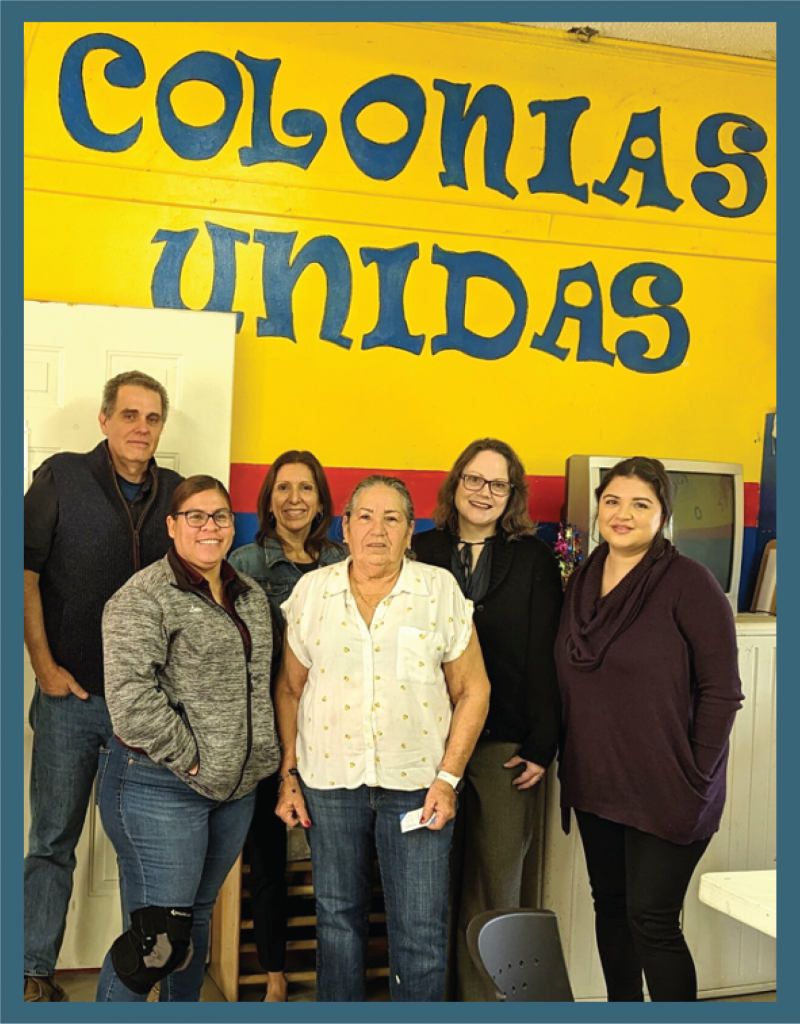
    In December, MHP staff traveled to two rural communities along the Rio Grande River in Texas. Together with staff members from come dream. come build, MHP’s Community Development Team met with local stakeholders including the staff from the Starr County Self Help Center and Colonias Unidas in Los Lomas to learn about the needs in their communities.

    Staff from Cdcb, Self Help Center, MHP, and Colonias Unidas gather in Los Lomas, TX

    Of the more than 200 Colonias communities in Starr County, MHP worked to zero in on a few as a starting point, including Los Lomas and Rio Grande City. The team learned of 13 vacant lots that might be perfect for cdcb’s MiCasita homes and met with two of the owners.

    While on site, the project team also checked out some multifamily rental properties that were on the market in Rio Grande City and Roma. It was a great start to this engagement, helping CDCB gain a footing in these two rural cities and adjacent colonias communities. MHP’s team is planning another trip there next spring.

  • MHP Applauds Governor Walz’s Announcement of Bonds for Housing

    MHP Applauds Governor Walz’s Announcement of Bonds for Housing

    Today Governor Walz announced a $2.7 billion infrastructure to support projects across the state. MHP was pleased that the Governor’s announcement included a request for $250 million in housing infrastructure bonds and $60 million in general obligation bonds for public housing.

    “The Governor’s bonding investment proposal for over $300M in housing reflects the recognition that Minnesota thrives when Minnesota families have stable housing,” says Anne Mavity, MHP Executive Director. “We appreciate his leadership in continuing to prioritize housing. We also recognize that if we want every corner of Minnesota to thrive, we need solutions that scale to the demand for housing. When we invest in housing, we invest in Minnesota families and communities and our State’s businesses.”

    MHP appreciates the Governor’s leadership in continuing to prioritize housing. The proposal is a bold start, and much more is needed. 

  • MHP hosts webinar: Using ARPA’s Fiscal Recovery Funds for Housing Investments

    Margaret Kaplan, President of Housing Justice Center and Elizabeth Glidden, Deputy Executive Director of MHP hosted this webinar, featuring examples of Minnesota local jurisdictions utilizing ARPA funds to address housing needs. Thank you to our panelists:

     You can access presentation slides (PDF): here, a recording: here, meeting chat (PDF): here.

  • Take Action: Make or Break Moment for Federal Housing Investments!

    The housing provisions in the Build Back Better Act are at a make or break moment. The collective actions of advocates like you have put housing back in the bill after the funding was nearly eliminated. Now we’re making a final push for one last increase and to ensure the funds are used primarily to get and keep the lowest income people housed. We’re making progress, but we’re not there yet.

    If enacted and done right, this could be the most consequential federal housing bill in our lifetimes. Everything we’ve done for the last few weeks, months and years has led to this moment and created this opportunity. It’s now or never. Final decisions may be made this weekend.


    Contact your US Representative and U.S. Senators TODAY:   

    We are asking advocates to contact their members of Congress to weigh in with the White House and Congressional leadership to urge that any cuts to Build Back Better aren’t made at the expense of getting and keeping people housed. Use the script below to call your members of Congress or use the National Low Income Housing Coalition’s action center to send an email.

    FIND YOUR MEMBER OF CONGRESS: CLICK HERE

    Suggested message:

    “My name is ___ and I live/work at ___ . 

    I am asking Representative/Senator (your representative) to support robust housing investments at the highest levels in the Build Back Better bill.  Please contact [House or Senate] leadership and the White House and weigh in with your support for robust housing investments in a final bill. Thank you.”  

  • Lead Our Capacity Team as Community Development Director

    Community Development Director Kelly Zelenka is leaving MHP in early May to join the Minneapolis Public Housing Authority. At MPHA, she’ll develop and drive implementation of Agency’s new comprehensive human services strategy geared toward significant outcomes in health, educational attainment and workforce development for MPHA-assisted families, children, seniors and persons with disabilities.

    “Kelly has been a tremendous leader at MHP and her leadership of our community development programs has made a lasting impact on communities around Minnesota and beyond,” said Anne Mavity, MHP’s executive director. “We will miss Kelly at MHP, but there is a silver lining: Kelly will be putting her experience and skills into work that will elevate the lives of people served by the MPHA. She’s going to do a tremendous job.”

    Kelly has graciously agreed to stay with MHP and assist with the transition through early May.

    If you or someone in your network is interested in joining MHP’s leadership team as Community Development Director, view the position profile here.

  • Take Action Now! Call your Member of Congress and Join a Sign-on Letter, to protect Affordable Housing Investments in the “Build Back Better Act.”

    President Biden and congressional leaders need to hear from you and from as many members of Congress as possible in support of essential housing investments included in the Build Back Better Act. The proposed $3.5 trillion bill will be, according to news reports, reduced to around $2 trillion, with housing investments at risk.  

    The Build Back Better Act included more than $300 billion in funding for new and existing federal housing programs, including public housing, weatherization, housing services, rental assistance, homeownership supports, and investment in the Housing Credit.  

    Contact your senators and representatives and urge them to advocate for robust housing investments at the highest levels in the “Build Back Better Act”


    Call your US Representative and U.S. Senator today:    

    FIND YOUR MEMBER OF CONGRESS: CLICK HERE 

    Suggested message:

    “My name is ___ and I live/work at ___ . 

    I am asking Representative/Senator (your representative) to support robust housing investments at the highest levels in the Build Back Better bill.  Please contact [House or Senate] leadership and the White House and weigh in with your support for robust housing investments in a final bill. Thank you.”


    Join our Sign-on Letter by October 14, 9 am, for Housing Investments in the Build Back Better Bill:  

    MHP is coordinating a sign-on letter that will be sent to all Minnesota Members of Congress. The letter asks for their support for robust housing investments in a final bill. Please let us know if you will co-sign this important letter by 9 am on Thursday October 14.  

    Read the full text of the letter and sign-on here.  


  • MHP’s Housing Institute Summit

    This October 19 MHP presents the Housing Institute Summit in Rochester, MN. The hybrid in-person/live virtual access event will provide the opportunity to network with other community teams, funders, developers, and to learn more on key topics such as grant management, naturally occurring affordable housing (NOAH), community design process, green communities’ standards and more. There will be multiple tracks for teams and participants to follow depending on their project goals, and the opportunity to present project concepts to funders and developers for feedback. The all-day summit kicks off with keynote speaker Jennifer Ho, Commissioner of the Minnesota Housing Finance Agency. All Housing Institute #7 (HI-7) participants are invited to attend the conference.

  • Housing and Community Development in the Arctic Circle – MHP’s trip to Barrow, Alaska

    Touching down on the runway of BRW airport in Utqiaġvik, Alaska (the community formerly known as Barrow), we could already tell from the views of ice floes in the Arctic Ocean and mossy tundra that we were in for a new experience. In late June 2021, Warren Kramer, Community Development Director, and Ella Mitchell, Community Development Officer, met with team members of Taġiuġmiullu Nunamiullu Housing Authority (TNHA), a beneficiary through the HUD Rural Capacity Building 2018 grant. After over nine months of working together virtually, the team was excited to meet in person for a week and see with their own eyes what it’s like to work on housing in Alaska’s North Slope Borough.  Utqiaġvik is a community of 4,500+ people and is the northernmost city/town in the US, located north of the  Arctic Circle.
    Griffin Hagle, Executive Director of TNHA, graciously picked up MHP staff at the airport and brought us on a driving tour of Utqiaġvik, pointing out TNHA properties and unique building techniques, as well as local landmarks like the tribal college and hospital. A whole range of unique, cold climate construction materials and techniques are used in housing development when building on permafrost.  Construction materials must all be transported by ocean barges to Utqiaġvik from Anchorage.  They say the first $150,000 of housing development cost, per unit, is the transportation costs of the construction materials.  A primary focus of the visit was to finish the strategic planning process we’d started months earlier, with TNHA staff and board members.  TNHA is governed by Board members who represent the six native Alaskan villages TNHA serves. Since there are no roads connecting these six villages, the board members need to fly into Utqiaġvik to participate in board meetings and the strategic planning work.  Dr. Pearl Brower, a longtime Utqiaġvik resident and former president of Iḷisaġvik College, facilitated these meetings, leading the group in team building activities and discussions about the future of TNHA. The final product was an approved Strategic Plan that will guide TNHA’s work for the next several years.

    In between sessions, the group enjoyed pastries homemade by very talented TNHA staff, participated in a weekly group walk around town hosted by the Mayor’s office and even caught a glimpse of the annual whaling festival, Nalukataq. Utqiaġvik is a  centuries old whaling village which is still a significant part of the community’s culture and economy.  Some 32 teams of local whalers went out in pursuit of bowhead whales in 2021.  22 of those whaling teams successfully harvested a whale this year.

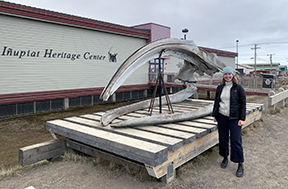
    We were also able to tour a 29-unit apartment built in 1977 that TNHA is in the process of renovating with funding from HUD and other entities. Some other highlights of the trip included a delicious barbecue dinner hosted by Griffin and his wife Kelly, a tour of the NOAA Barrow Atmospheric Baseline Observatory where researchers around the world are tracking weather and climate change data, and a visit to the Iñupiat Heritage Center to learn more about local native history and culture.

    While North Slope communities share many housing challenges with other rural and tribal communities in the United States, they also face unique challenges due to their extreme remoteness and unique physical environment. Sustainable housing solutions are a critical innovation need as these communities are directly impacted by the effects of climate change, including tundra subsidence and sea level rise. For example, all housing in the area is built on piers or stilts so that the heat from the building does not thaw the permafrost beneath the home. More recently, sled rails have been added to cap the stilts so that the structure can be moved if the coastline changes and the community must relocate. Energy efficiency measures such as improved insulations, new windows, and electric stoves are also critical improvements because utility costs can be astronomical in the North Slope’s deep winters and indoor air quality during these months can be a major issue. MHP’s successful trip to Utqiaġvik brought these issues to life as staff were able to see in person the real issues and challenges of working in this remote region, as well as the strengths and commitment of our beneficiary up there, TNHA. ~Ella Mitchell

  • Last Chance to influence Governor Walz’s American Rescue Plan recommendations.

    Governor Walz is soliciting input to inform his request to lawmakers on how to spend $1.2 billion in federal American Rescue Plan (ARP) funds. The Governor’s office has requested people submit requests for the ARP funds through this MMB portal by Thursday, September 30th. This $1.2 billion is in addition to $500 million that the Governor has and can spend at his discretion. 

    MHP is following the recommendations of the Homes for All Coalition, which includes $50M for supportive services and shelter, $300M for preservation, $55M for housing partners and support, $200M for new development, and $20M for emergency rental assistance related activities. 

    We encourage advocates to take a moment to fill out the survey. Feel free to copy and paste the below text into questions 4, 5 and 6. 

    Thank you!


    Question 4)

    Public health; disadvantaged communities; renter and homeowner assistance

    Question 5) 

    Supportive Services & shelter support- $50 million

    • Funding for shelter and supportive housing programs to ensure people experiencing or at-risk of experiencing homelessness have access to shelters, transitional housing, supportive services and COVID mitigation and prevention.
    • Uses include: Emergency Services Program COVID-19 aid; technical assistance to implement Housing Stabilization Services; and more

    Preservation & Anti-Displacement- $300 million

    •  Funding to preserve, acquire and rehab affordable multi- and single-family housing. Preservation and rehab programs can mitigate the home health risks that disproportionately impact renters and homeowners with low incomes, such as mold and mildew, asbestos, and radon and lead positioning.
    • Uses include: Public housing rehab; Naturally Occurring Affordable Housing (NOAH) preservation and acquisition; homeowner rehab; lead remediation; manufactured housing rehab, replacement and infrastructure

    Housing partners and local support- $55 million

    • Capacity and financial support for local partners who have been working to distribute COVID 19 housing assistance and prevent evictions and foreclosures
    • Uses include: housing partner and provider capacity funds; tenant eviction defense (legal advice, legal services, and representation in court); homeowner counseling and foreclosure prevention; local housing trust fund match

    New development- $200 million

    • Uses include: shelter capital; homeownership opportunities; lowest income rental housing; supportive housing

    Emergency COVID-19 Housing Assistance- $20 million

    • Support the roll-out of both RentHelpMN and HomeHelpMN to prevent evictions and foreclosures
    • Uses include: additional funding for field partners; technical assistance dollars; eviction prevention dollars; additional dollars for COVID rental and homeowner assistance

    Question 6)

    Minnesota faced a housing crisis before the pandemic, but COVID-19 has exacerbated this crisis. Unsafe housing often means exposure to lead, asbestos-contaminated vermiculite, and mold, all which can cause health issues and are serious COVID- 19 comorbidities. For people experiencing homelessness or who are unhoused, the risk and spread of COVID-19 may be more likely if shelter and services are provided in congregate settings with limited isolation or quarantine space and due to lack of access to health care. Lack of access to safe, stable, and affordable housing disproportionally impacts communities of color, heightening COVID-19 and public health inequities, while access to safe, affordable and stable housing is an essential public health intervention to mitigate the spread and risk of COVID-19. Use of the ARPA funds for housing across the continuum is called out as an eligible use throughout the Department of Treasury Interim Final Rule from May 10, 2021.