• “The Gap” in Affordable Housing in Minnesota

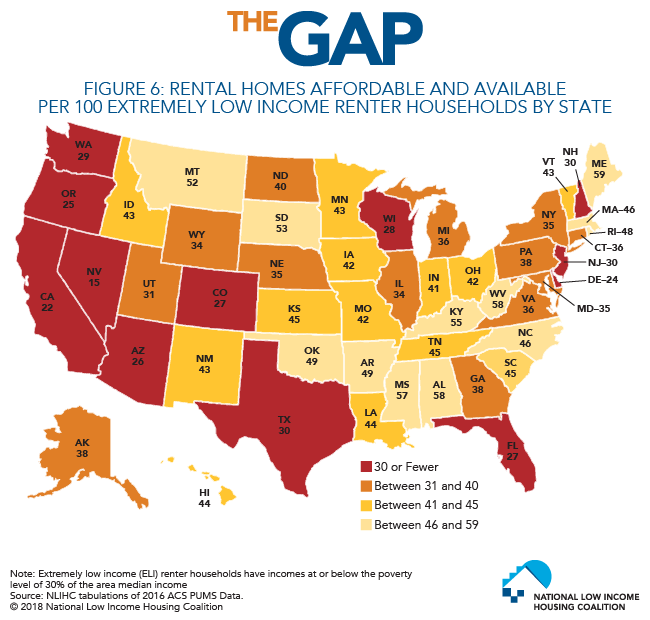
    Today, the National Low Income Housing Coalition (NLIHC) released The Gap: A Shortage of Affordable Rental Homes, outlining both state and metro shortages in affordable homes, especially for low-income families. 

    According to the report, which relies on 2016 ACS PUMS data, 43 percent of all renters in the Minneapolis – St. Paul – Bloomington metro area are cost burdened (paying more than 30 percent of their income on housing) and 22 percent are severely cost burdened (paying more than half of their income on housing). 

    Those numbers are even more stark for extremely low-income (ELI) families. More than 107,500 households earn less than 30 percent of area median income (AMI), or less than $25,750 for a family of four. A striking 78 percent of households in this income bracket are cost-burdened, with 63 percent paying more than half of their income on housing. 

    Not surprisingly, households earning less than 30 percent AMI face extreme challenges in finding affordable housing options. In the Minneapolis metro area, there is a deficit of nearly 65,000 affordable and available housing units for ELI households. While Minneapolis ranks in the top 10 in the nation for metro areas that have the least severe shortage of affordable housing, there are still only 40 affordable and available units for every 100 ELI households that need them. Meanwhile, there is an excess of 6,220 units available to those earning at or above the area median, or $85,800 annually.

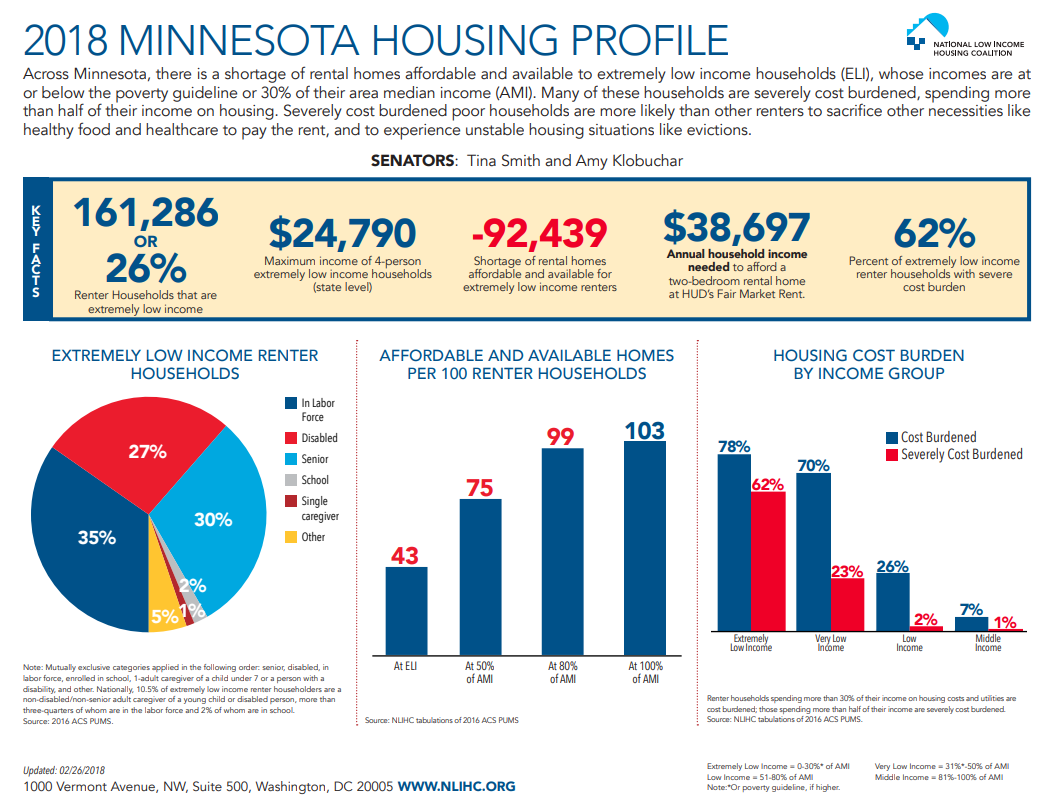
    At the state level, there are 161,286 extremely low-income renter households, with 78 percent experiencing cost burden, and 62% paying more than half of their income on housing. For extremely low-income renter households, there is a deficit of 92,439 affordable and available units across the state; in contrast, for those at or above median income, there is a surplus of 12,438 units. Many of these ELI renters are among our most vulnerable populations: 27 percent are disabled and 30 percent are seniors.

    While progress has been made in addressing the gaps of housing for households at the 50 and 60 AMI levels, more resources and tools are urgently needed to address the shortage of housing for ELI households. Especially as unsubsidized rental housing is moving out of affordability for many low-income renters, robust rental assistance programs and the creation of more deeply affordable housing are essential to providing adequate housing to sustain our local economies and provide for our most vulnerable populations like seniors and people with disabilities. Commitment to capital investments and federal funding are vital to protecting affordable housing and the overall health of our communities, as well as new, sustainable solutions at the state and local level.  

    Click here for more information on the NLIHC’s The Gap report.

  • Investors Council Recap: Dynamic trends shaping the nation’s housing markets

    What are the dynamic trends shaping the nation’s housing markets, and how do the Twin Cities stack up?

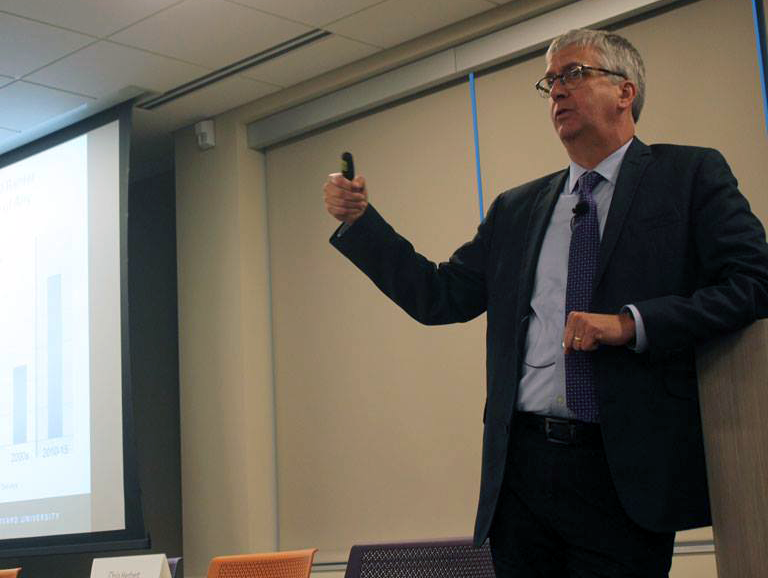
    On November 1, nearly 100 Investors Council members convened to hear a special presentation on these questions by Chris Herbert, Managing Director of the Harvard Joint Center for Housing Studies. Herbert highlighted key trends from the annual “State of the Nation’s Housing” report, released in June. Here are six takeaways from Herbert’s presentation:

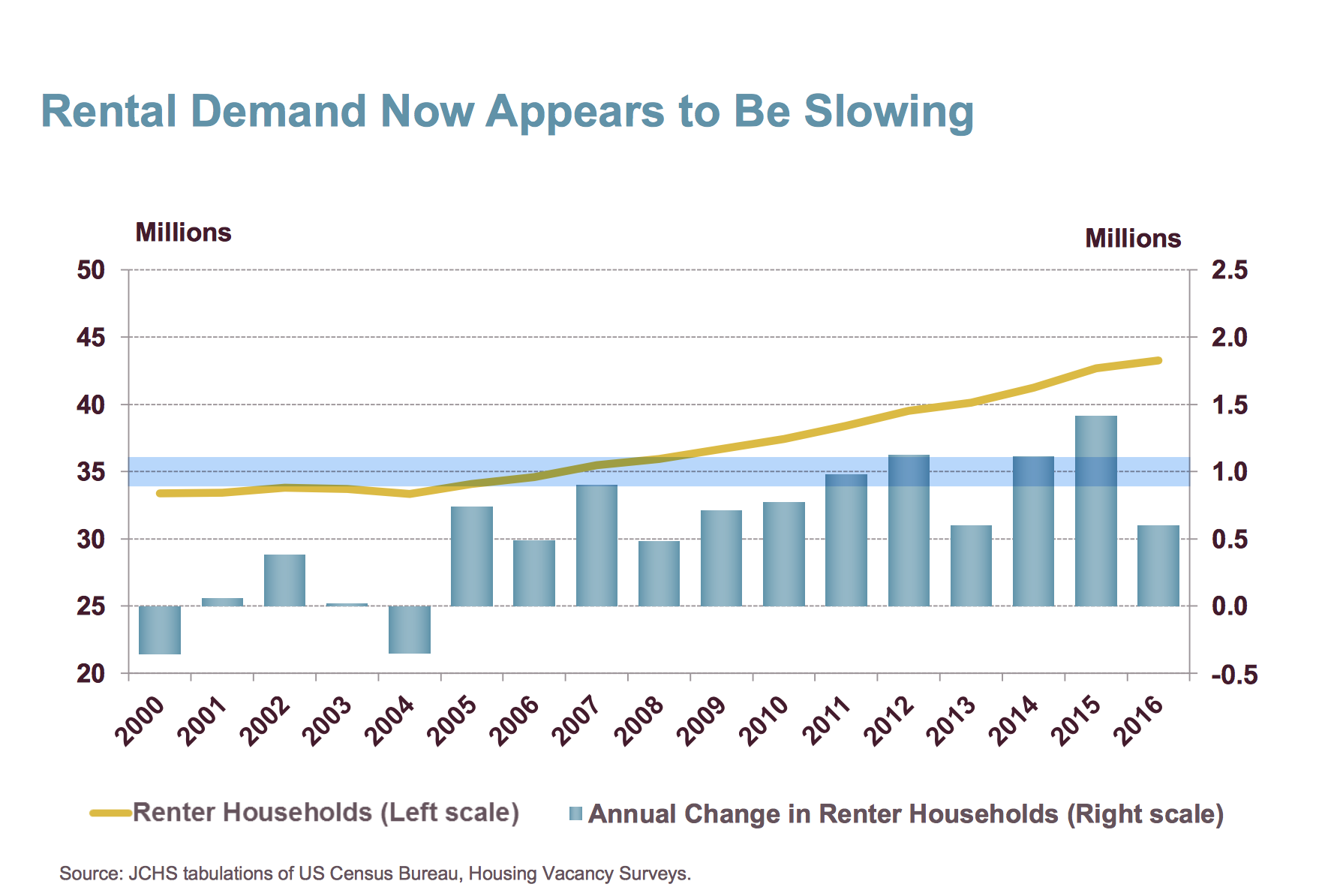
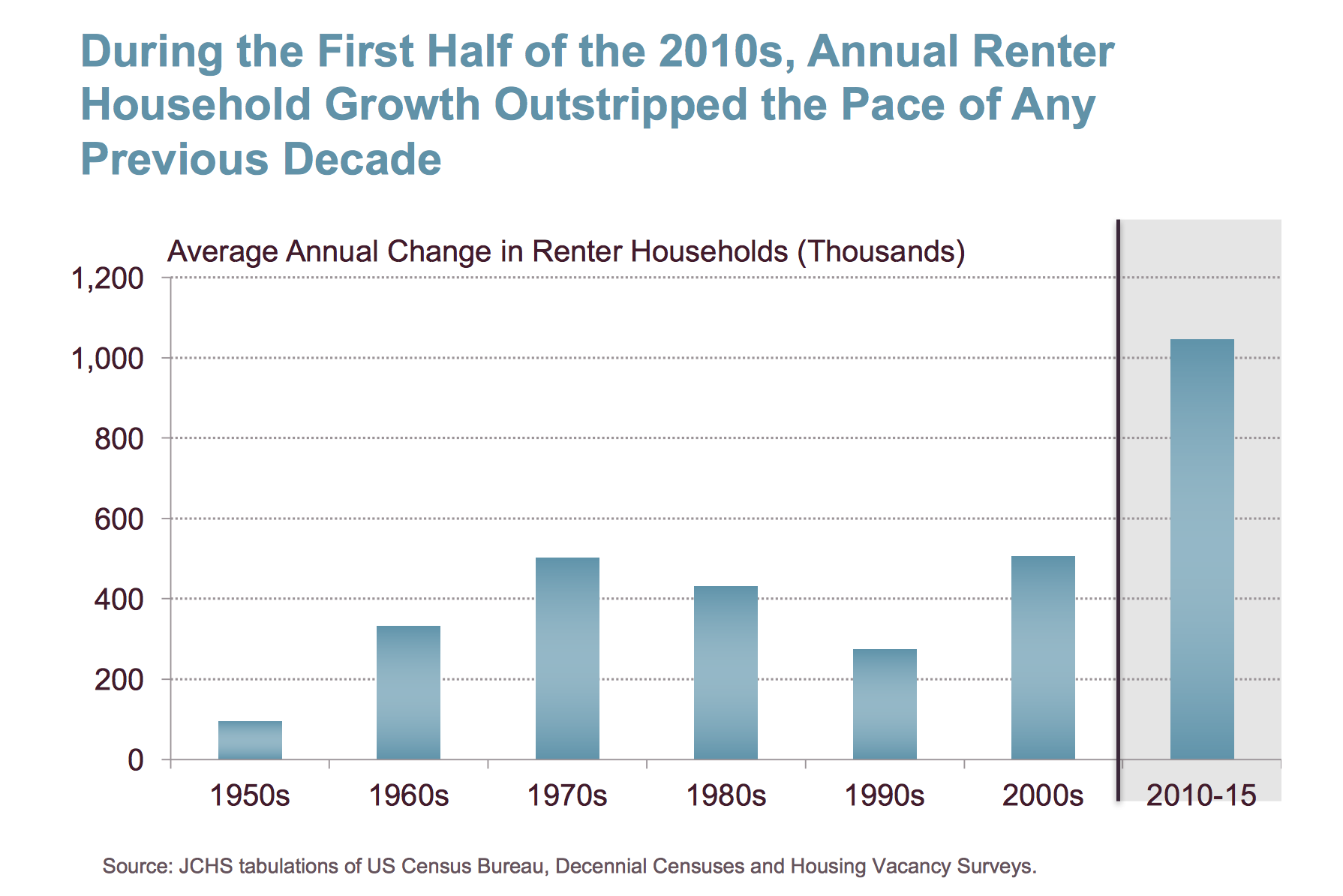
    1) While there’s been significant growth in renter households over the past 10 years, that growth is now slowing.

    From 2010 to 2015, the annual growth in renter households outpaced all previous decades. Though households comprised of a single person are the most common renters — and millennials have played a significant role in driving this trend — the growth in renter households has been diverse across age, family type, and income level. However, this growth appears to be decelerating. From 2015 to 2016, annual growth fell by 1 million renter households.
     

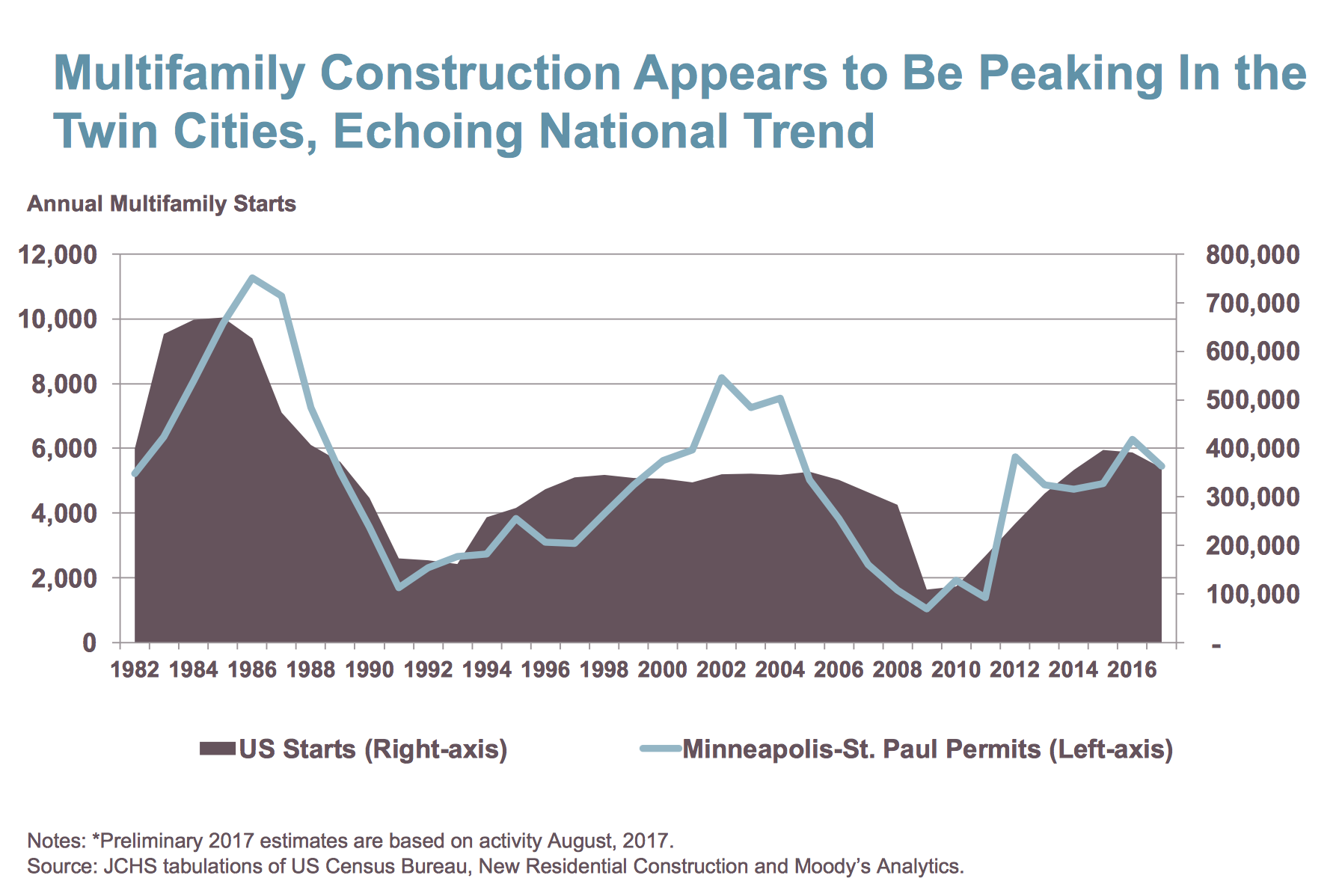
    2) Consistent with the national trend, multifamily construction appears to have peaked— specifically at the high end of the market — since recovering from historic lows during the recession.

    Post-recession, the multifamily construction market saw a more robust recovery than the single family market. In the past five years, though, the majority of new multifamily units were renting for $1,500 or more. That’s much higher than 2005, when the majority of units rented in the $850 to $1,099 range. While demand is slowing at the high end of the market, demand for older, more affordable rentals continues to rise.
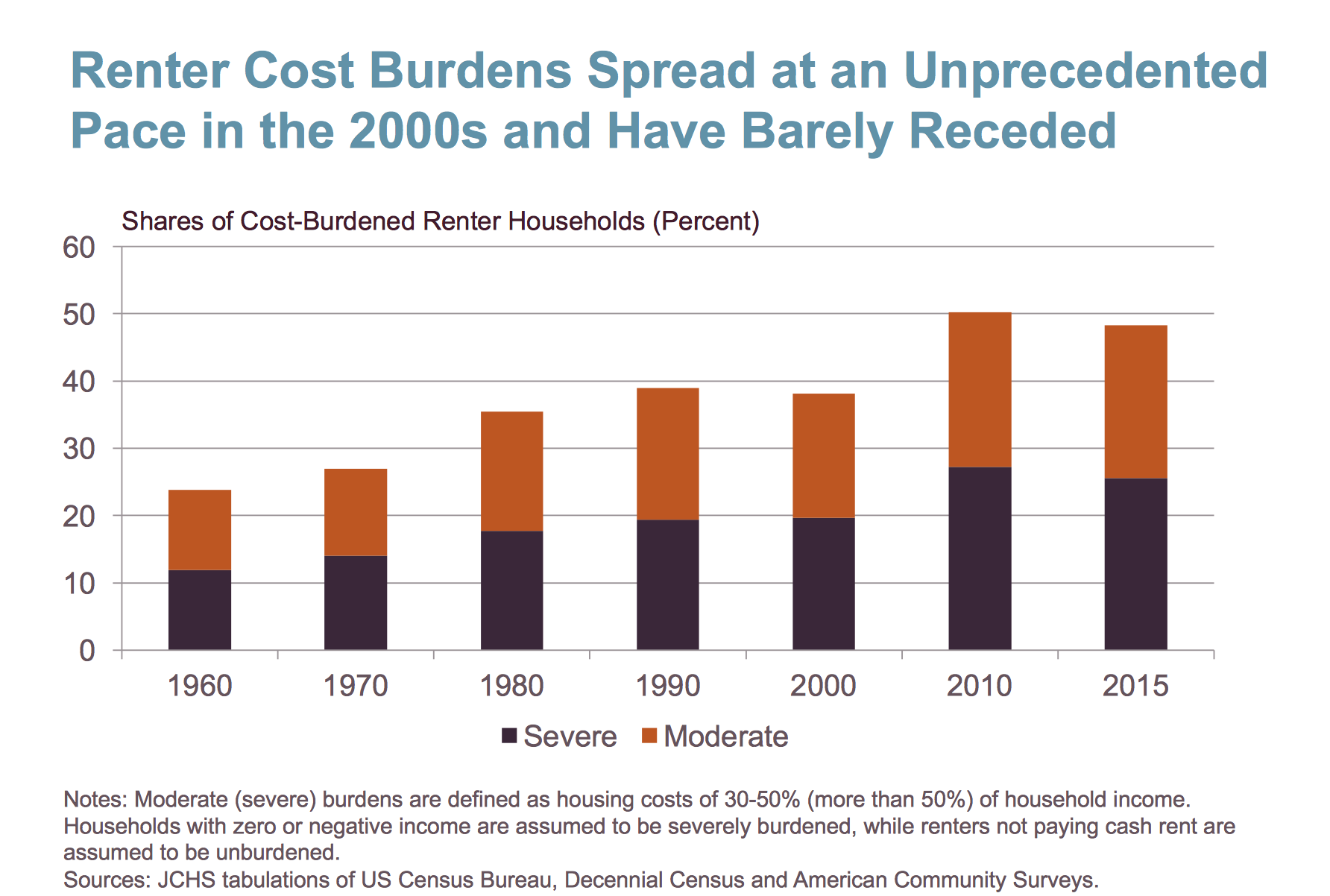
    3) Though rental affordability is improving slightly nationwide, the number of renters paying more than a 30% of their income for rent remains near record highs.

    In the 2000s, the percentage of cost-burdened renters rose at a record pace — to record high levels. Why? According to Herbert, housing costs have increased sharply while incomes have declined. Middle-income renters have been hit hardest, seeing the biggest increase in households paying more than 30% of their income for rent. Minneapolis reflects national cost-burden trends, and while the city has more subsidized rentals than similar cities across the country, there’s a significant shortage of affordable unsubsidized units.

    Herbert emphasized that the housing sector must create “a long vision of how we’re going to maintain affordability over time” and take steps now to address the gap between wages and rent.
     

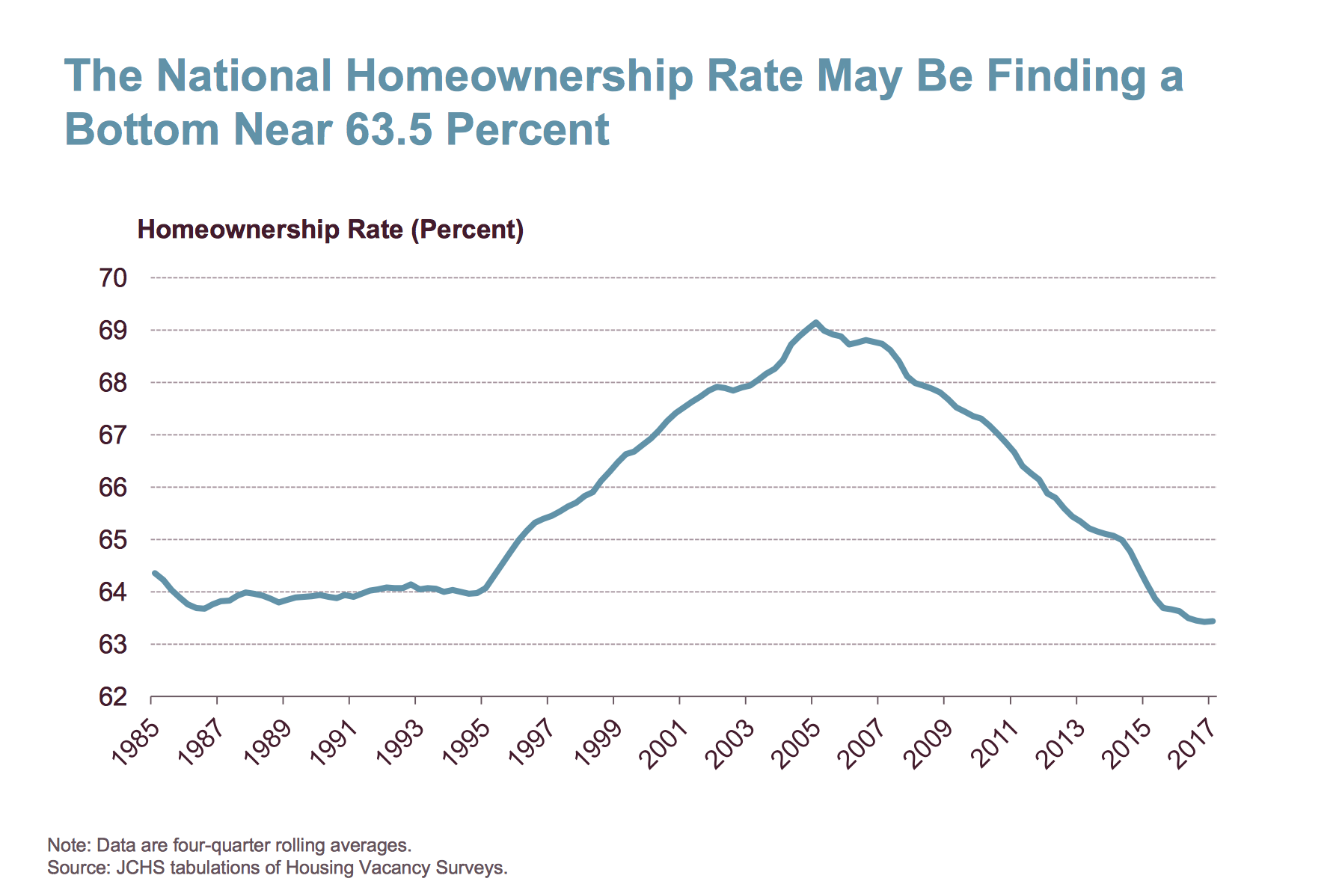
    4) Because renter growth is slowing, the falling national homeownership rate may have reached its lowest point.

    The recession and foreclosure crisis have driven a steep decline in homeownership. Since 2015, the homeownership rate nationwide has hovered around 63.5 percent compared to more than 69 percent in 2005. From 1990s levels, homeownership among households under 55 has plummeted as much as eight percentage points. However, according to Herbert, it appears that the rate of decline is slowing. At the end of October, one source reported a homeownership rate of 63.9 percent.
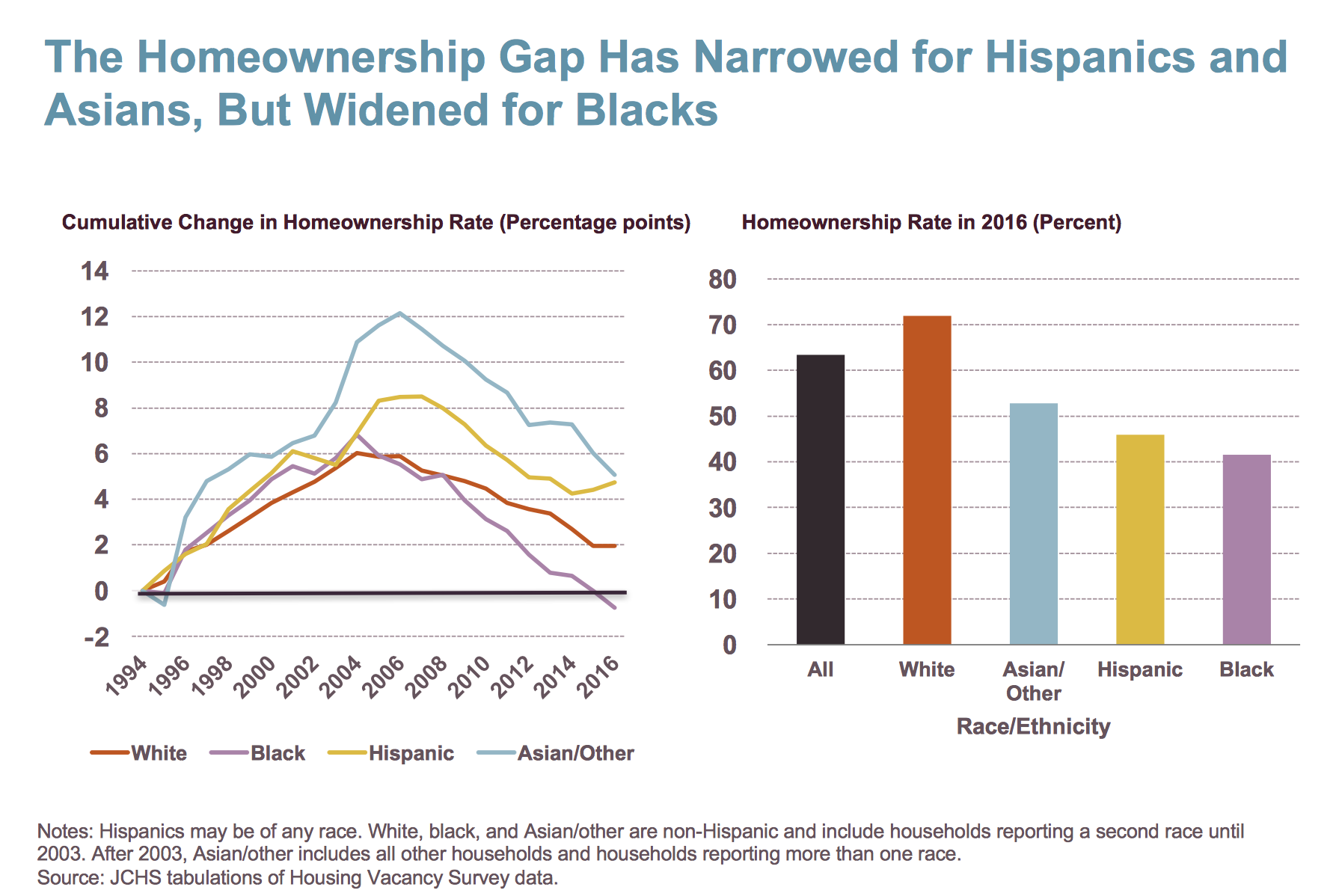
    5) Despite a rebound in the homeownership rate, racial disparities between White and people-of-color led households persist, and some groups face major barriers to owning a home.

    Major homeownership disparities remain — or have worsened — between White and people-of-color led households over the past two decades. The homeownership rate for Black households is lower than it was in 1968, the year the Fair Housing Act went into effect.

    Herbert pointed out that because housing is still the primary vehicle for wealth accumulation among low-income and people-of-color households, this is a major problem. “This is an amazing loss of progress on an important social indicator over two generations,” Herbert said. “As we approach becoming a majority minority country, we can’t lose sight of the importance of homeownership as a vehicle for residential stability, as well as financial stability.”
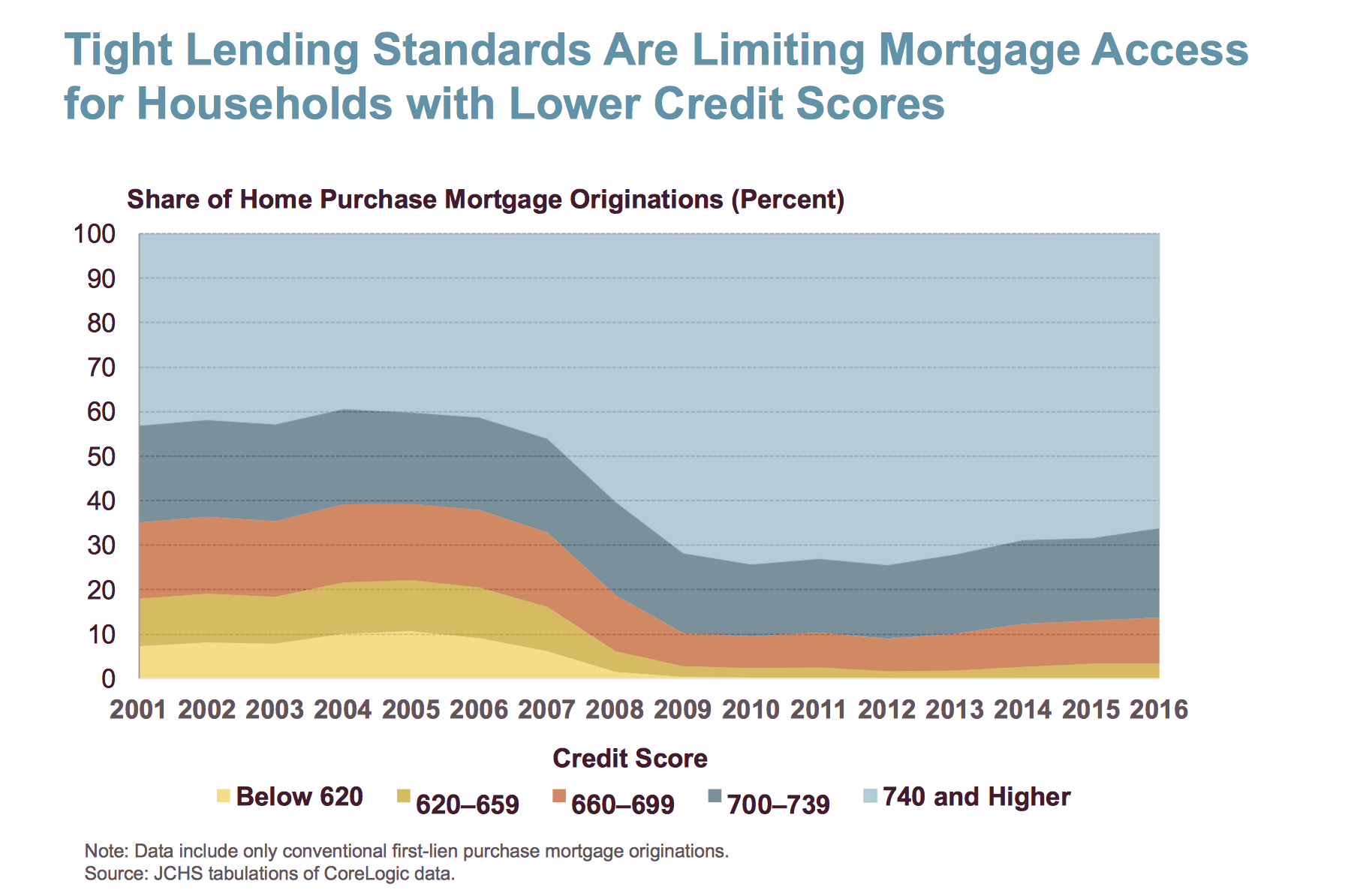
    Other groups face significant barriers to homeownership, as well. Many recent college graduates must dedicate a significant portion of their income to paying off student debt, making it tough to pay a mortgage. And for people with lower credit scores, it’s become harder and harder to get access to credit since the recession. For first time homebuyers, less expensive homes under 1,800 square feet are increasingly difficult to find.
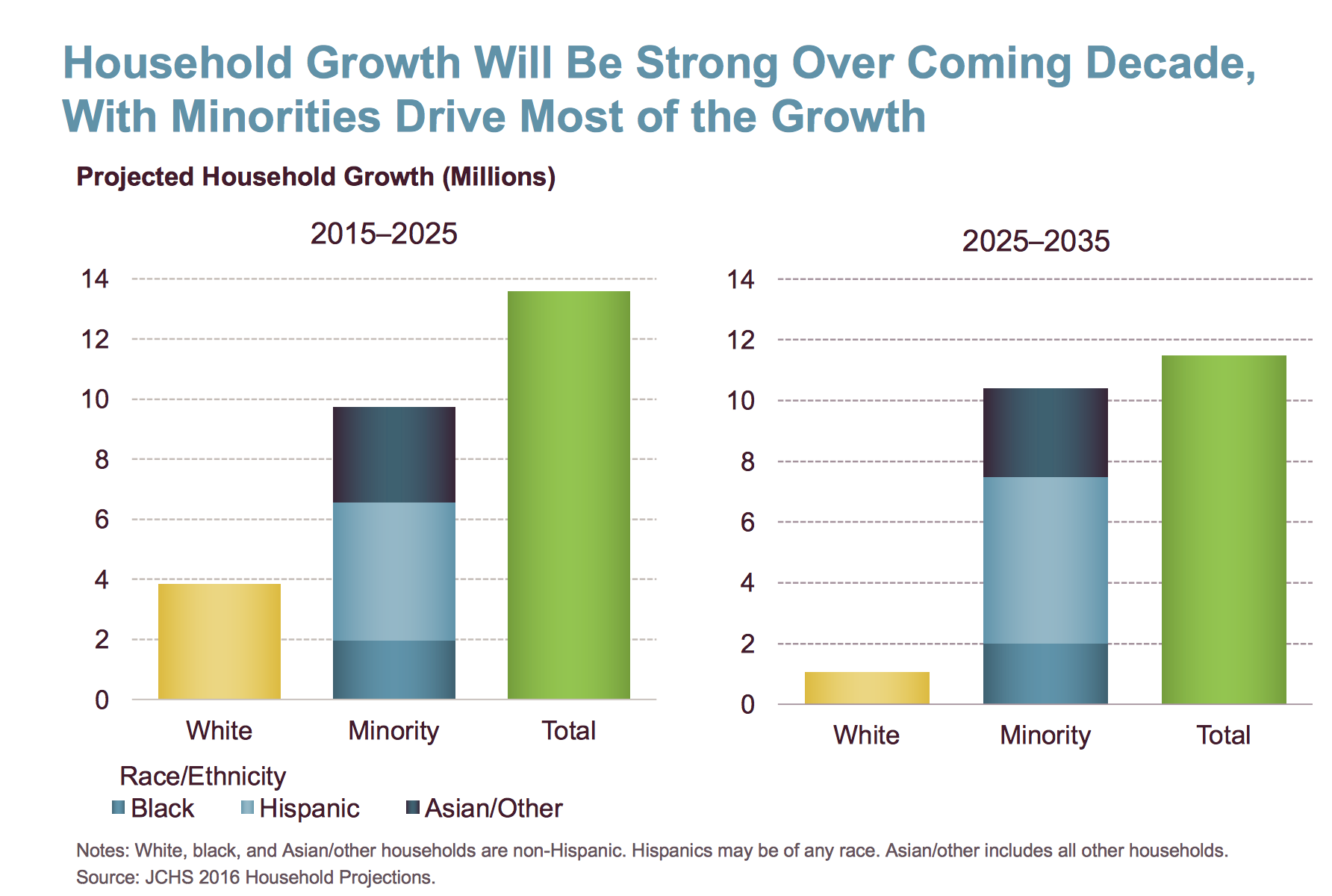
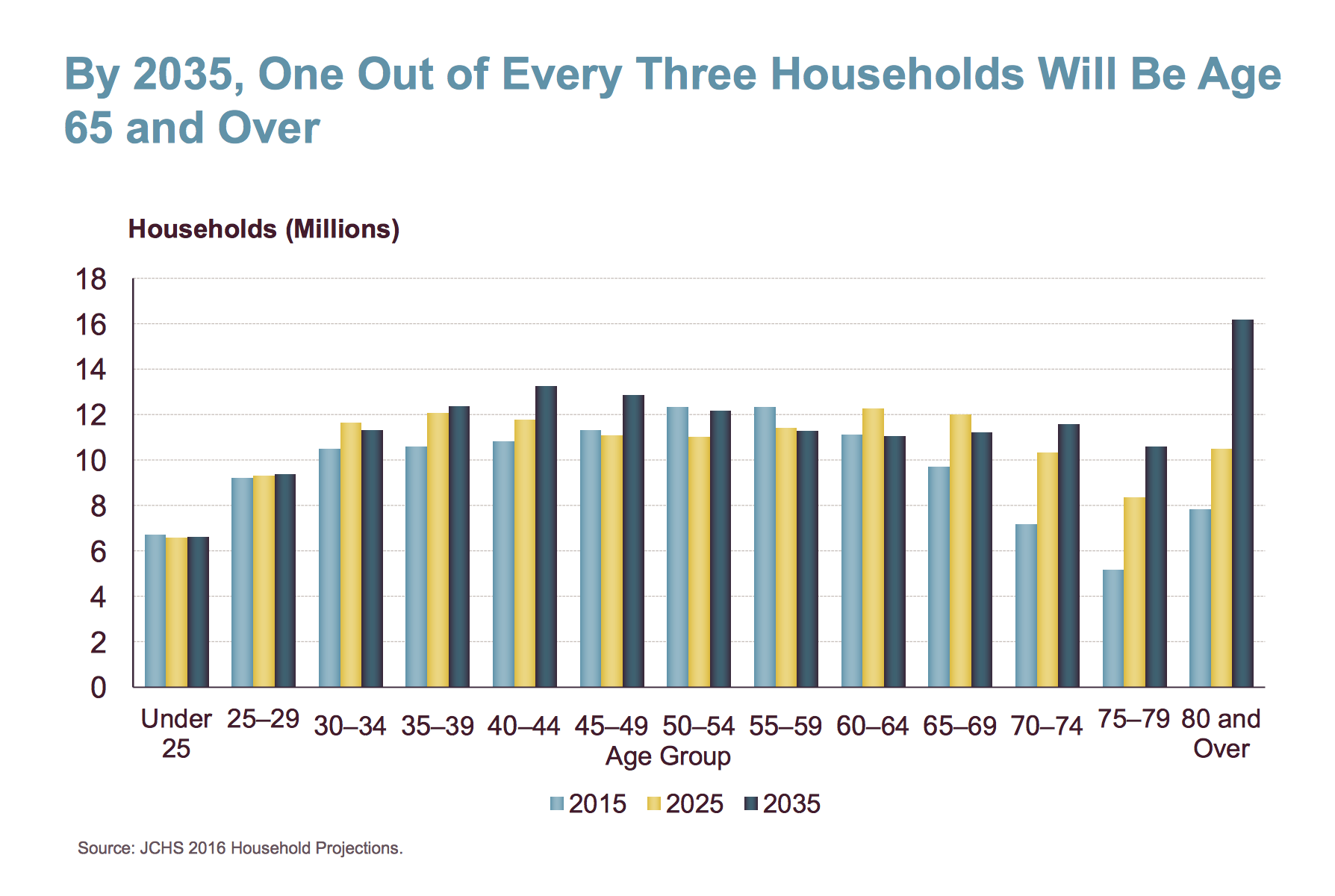
    6) In the coming decades, household growth will be strong, and people of color and seniors will play a major role in shaping the housing market.

    People of color will comprise the bulk of household growth from 2015 to 2035 — and one-third of households will be age 65 and over by 2035. In the face of these demographic changes, Herbert said the housing sector must consider whether the housing market works for people of color, and how we can provide housing with services for seniors.
    A panel discussion including Nick Place of Bridgewater Bank, Chris Zuspann of Frerich’s Construction, and Deidre Schmidt of CommonBond Communities followed Herbert’s presentation. Zuspann asserted that to respond successfully to the trends highlighted by Herbert, construction firms, developers, bankers, and other players in the affordable housing sector must take a collaborative approach. “We’re all yoked together in one way or another,” Zuspann said.
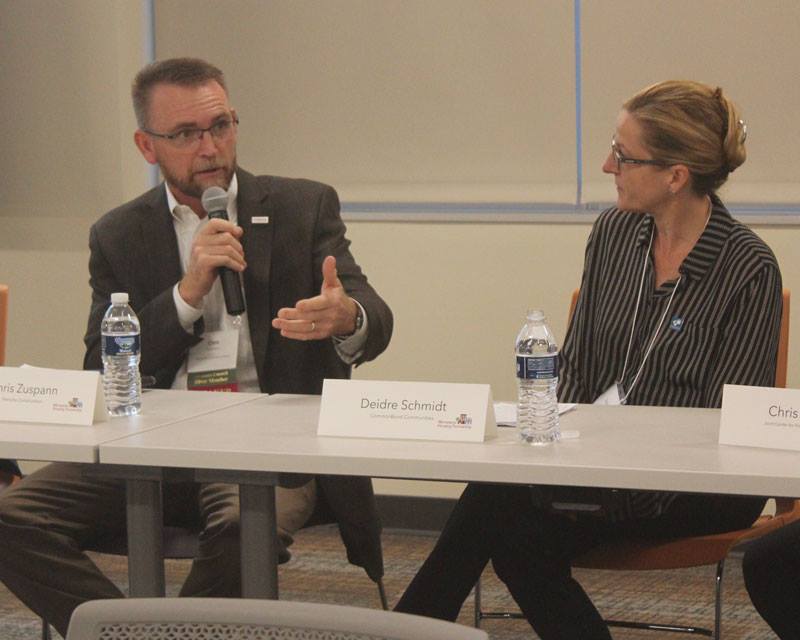
    Panelists Chris Zuspann (left) and Deidre Schmidt (right)

    Herbert added that because housing market problems have developed over time as a result of complex factors, solutions must be numerous and varied.“This is a problem that has many roots and took many years to get to this point,” Herbert said. “There’s no silver bullet solution.”

    Herbert said that communities must consider closing the gap between housing costs and income by

    • subsidizing housing,
    • bolstering local and state contributions to housing as federal investments decrease,
    • increasing efficiency in the development and construction process by revising building and zoning codes and by utilizing creative design,
    • shifting the development focus from luxury rentals and expensive homes to more simple-yet-decent dwellings,
    • preserving existing affordable housing.

    Anne Mavity, Executive Director of Minnesota Housing Partnership, reminded attendees that the trends Herbert elucidated have an immediate, tangible impact on people and entire communities. She called upon Investors Council members and community leaders to translate information from researchers like Herbert into to effective action.

    “The external world is looking to us in this room to help figure this out,” said Mavity. “There’s an urgency to this work — it’s not just academic.”

    See slides from Herbert’s presentation here and photos from the event here.

    Make sure you’re part of these engaging conversations. Join the Investors Council today!

  • Investors Council Recap: Cities Step up for Affordable Housing

    On May 17, Investors Council members and guests convened to discuss how cities are stepping up to support affordable housing development. Nearly 100 attendees learned about regional trends and progress made by the cities of Woodbury, Minnetonka, and Edina.

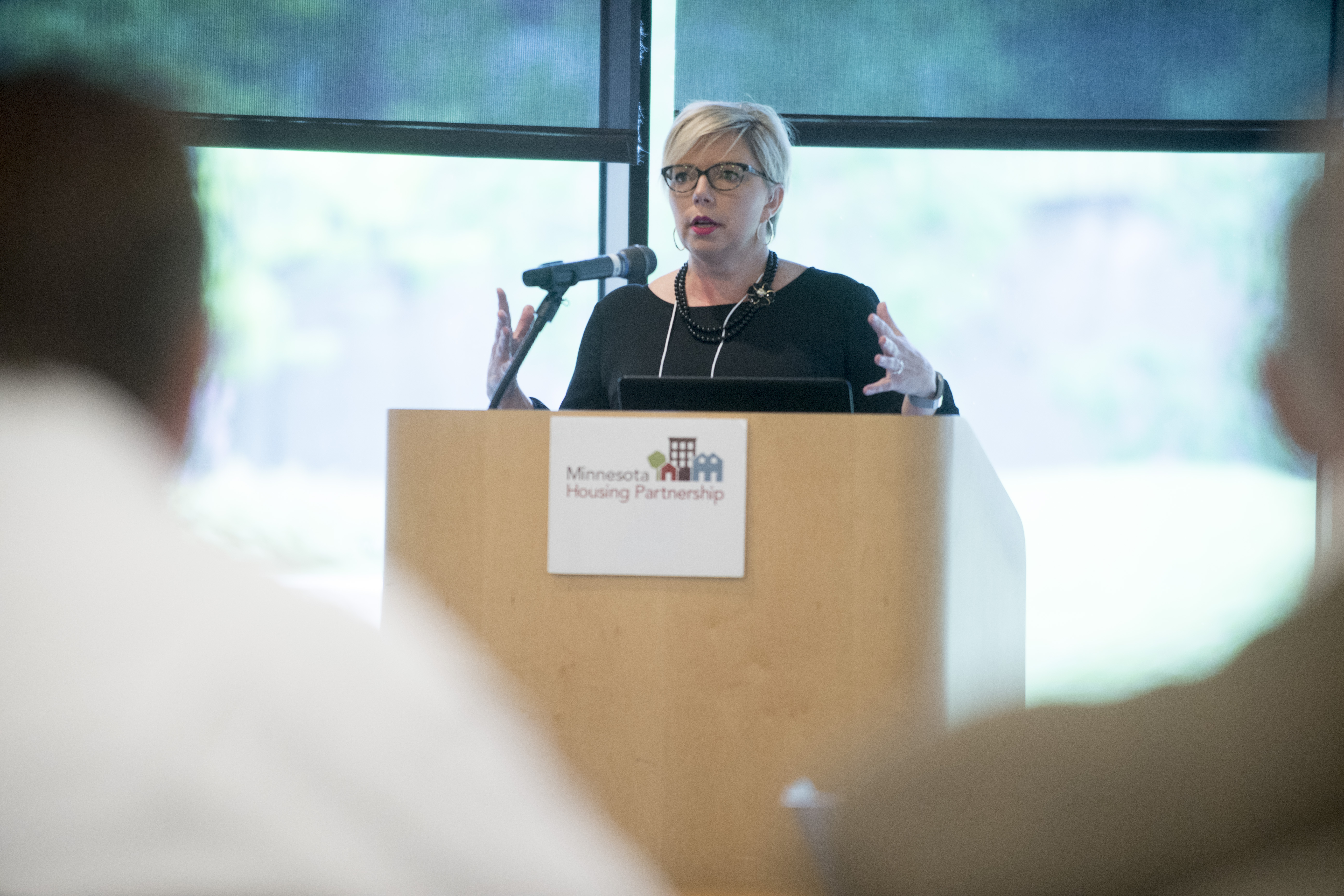
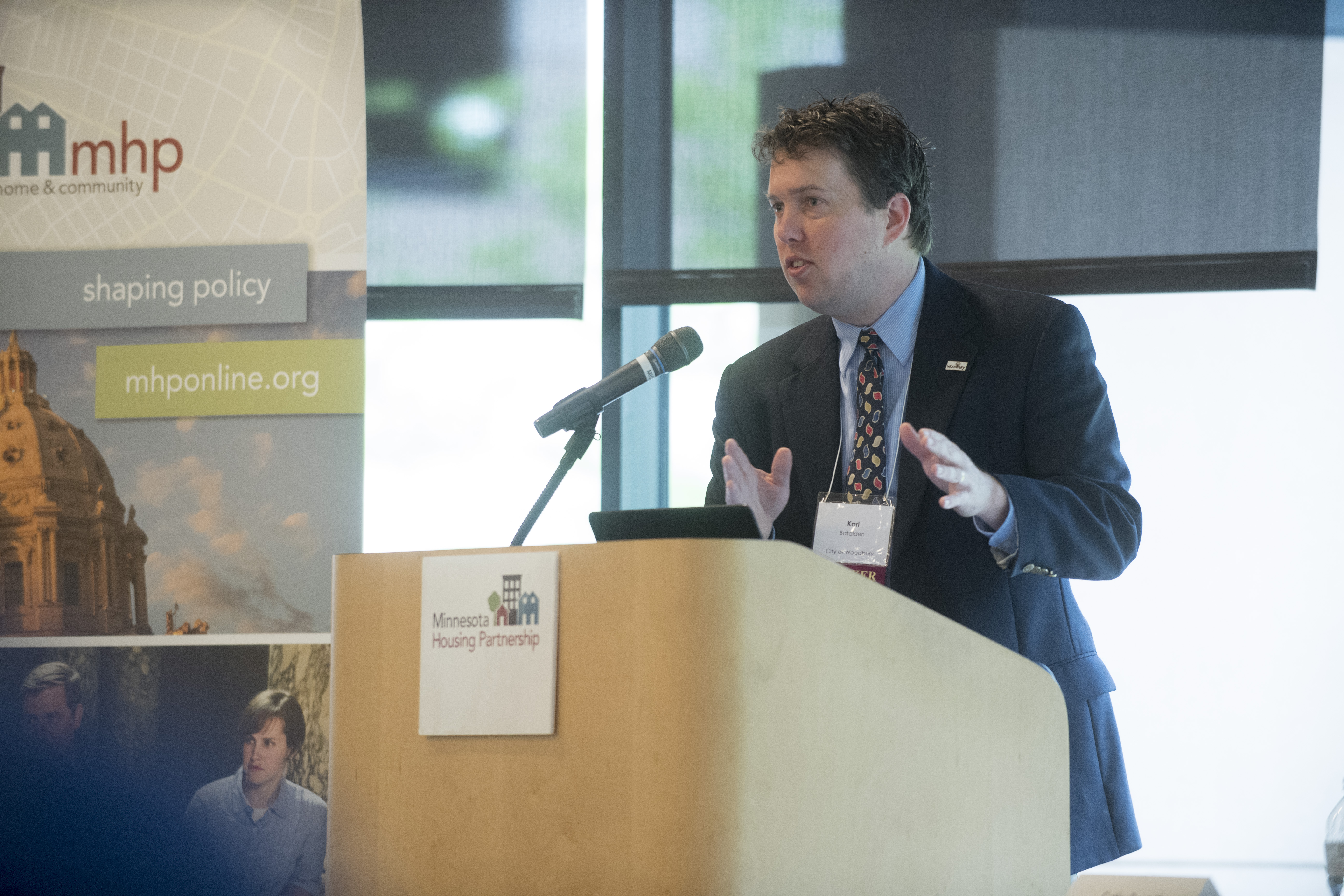
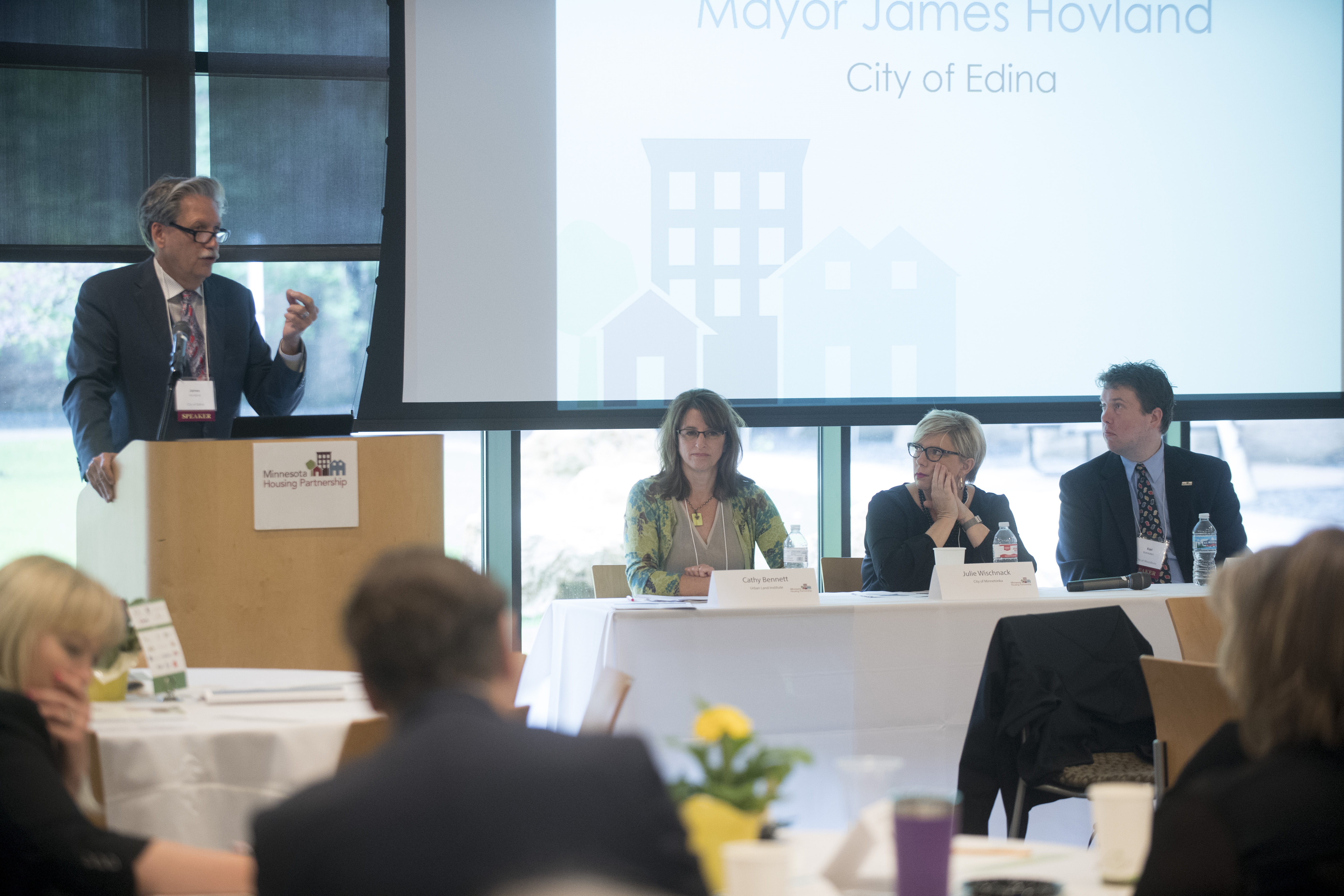
    Cathy Bennett of the Urban Land Institute of Minnesota (ULI MN) and the Regional Council of Mayors kicked off the event with a regional overview (pictured far right). A panel discussion followed with insight from (pictured from left) Julie Wischnack, Community Development Director in Minnetonka; Karl Batalden, Housing and Economic Development Coordinator in Woodbury; and Jim Hovland, Mayor of Edina.

    Bennett explained that more and more cities are realizing that the creation of quality affordable housing is “critical to the economic competitiveness of the region.”

    According to Bennett, the Metropolitan Council estimates that 20 communities in the Twin Cities metro region have implemented affordable housing policies, many of which are triggered by financing mechanisms. For example, Minneapolis utilizes public finance, city subsidy, mixed income, and housing assistance policies, along with density bonus and planned unit development measures, to create affordable housing.

    Cathy Bennett of the Urban Land Institute of Minnesota (ULI MN)

    From her perspective, Bennett suggested “the number one thing a city can do [to support affordable housing development] is declare that affordable housing is important to them.” Cities can do this by making a commitment to affordable housing in their comprehensive plans and by implementing an affordable housing policy. According to Batalden, this “belt and suspenders” approach is important because it sets up a broad vision, while creating a mechanism that holds cities accountable to their goals. It’s also important to create a policy that cities can amended as they adjust their strategy.

    Wischnack said that Minnetonka is making an effort to visibly and effectively prioritize affordable housing development in the community. “I suppose [Minnetonka] doesn’t scream affordable housing,” she said. “We’re trying to change that perception.”

    According to Wischnack, Minnetonka has been making progress toward the creation of affordable housing for decades. Thirty years ago, Minnetonka started the region’s first community land trust, “Homes Within Reach.” Since then, the city has utilized approaches like planned unit development to create affordable senior housing and is currently exploring new strategies such as tax increment pooling.

    Julie Wischnack, Community Development Director in Minnetonka

    Batalden explained that, in Woodbury, affordable housing has been part of the land use plan since the late 1970s. “We’ve wanted to have a diversity of housing stock since day one,” Batalden said. Like Minnetonka, Woodbury has also utilized planned unit development to develop affordable housing along with density transfers and density bonuses. “Density is worth money, and if we can add density to a project, that can help us close the gap,” Batalden added.

    All three panelists conveyed that support for affordable housing development looks different in each community. Wischnack said that in Minnetonka, stigma around affordable housing among community members continues to be a major hurdle to development. On the upside, the Minnetonka city council has expressed strong support for affordable housing.

    Batalden emphasized that design is key to countering the “not in my backyard” attitude of some community members. “When you take the time to design [a project] well, that NIMBY-ism falls apart,” Batalden suggested.

    Karl Batalden, Housing and Economic Development Coordinator in Woodbury

    Mayor Hovland said that right now in Edina, support for affordable housing is strong. In 2015, Edina passed an affordable housing policy, and last year, residents rallied around the recently opened 66 West development, 39 units of housing for formerly homeless youth. However, to address the need for affordable housing in Edina, the city first had to realize that they possessed the tools to make developments happen.

    “We’d wring our hands and look at our property values and wonder how we’re going to do this,” Hovland said.

    (At podium) Edina Mayor, Jim Hovland

    Edina is now looking to create a tax increment financing district around Southdale Mall that will generate six to $10 million in revenue for affordable housing over the lifetime of the district. “Our community is right behind us,” Hovland said. “We’re not getting any pushback on these affordable housing goals. It’s a fabric for a town that you want.”

    MHP hosts three exclusive Investors Council breakfasts each year. The next Investors Council event, an advocacy happy hour, will take place this June. Join the Investors Council today to be part of these timely discussions! Click here to see more photos of the event. For additional information on how cities can step up to advance affordable housing, check out ULI MN’s online platform, Housing Counts, which provides access to data, toolkits, and more.

    Photos by Scott Streble

  • Investors Council Recap: State Policy Breakfast

    On February 14, more than 100 housing industry leaders and advocates convened at MHP’s latest Investors Council breakfast to discuss prospects for housing policy at the state legislature during the 2017 legislative session.
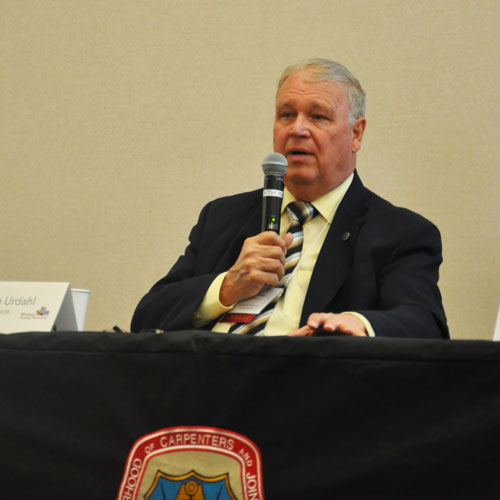
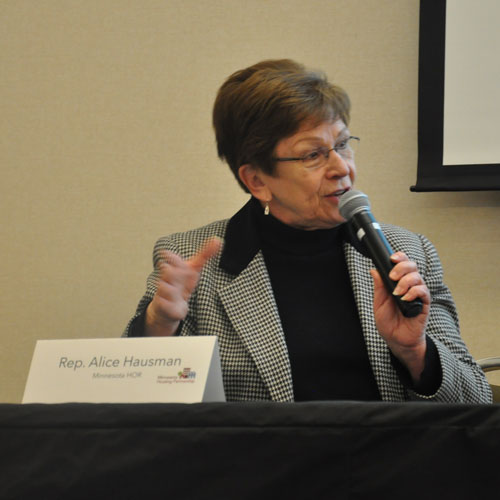
    MHP welcomed four panelists — Rep. Dean Urdahl (R), Rep. Alice Hausman (DFL — pictured right), Sen. Bill Weber (R), and Minnesota Housing Commissioner Mary Tingerthal — who shared their insight on the need for affordable housing and how we can get the resources required to provide safe, stable homes for more Minnesotans.

    Beacon Hill: A shining example

    Housing developer Skip Duchesneau of D.W. Jones kicked off the event with a presentation on the impact of affordable housing investments in Greater Minnesota. Duchesneau highlighted the Beacon Hill housing complex — 48 units of affordable workforce and supportive housing located in Grand Rapids, Minnesota.

    Duchesneau explained that the success of the Beacon Hill project was due, in large part, to the collaboration and vision of a variety of stakeholders from county and state corrections to housing and mental health services. The team responsible for the project convened to undergo training and receive guidance through MHP’s Housing Institute in 2013. With dedication and 41 team meetings, the group broke down silos between their respective organizations to successfully house more than 120 people.

    Beyond strong partnerships and perseverance, however, Duchesneau emphasized that bonding was fundamental to completing the project. “If it was not for Housing Infrastructure Bonds, Beacon Hill would not exist today,” Duchesneau said.

    Bonding: An urgent need

    Bonding was a major topic of conversation in the panel discussion following Duchesneau’s presentation. Although 2016 was a bonding year for Minnesota, legislators failed to pass a bill. Because bonds are a critical resource for housing and other infrastructure development around the state, the pressure is on for the 2017 legislature to make bonding happen. The Senate Capital Investment Committee has already heard a bonding bill (SF 210) that would provide $35 million in Housing Infrastructure Bonds and $10 million in General Obligation bonds. Committee Chair Sen. David Senjem (R) has made it clear that he’d like to pass a bill early in session.

    Bonding is proceeding more slowly in House of Representatives, however. Rep. Urdahl (pictured right) chairs the House Capital Investment Committee, which is the committee that will hear bonding requests. During the panel discussion, Rep. Urdahl said that passing a bonding bill is a priority for his committee, though he could not give a definitive timeline. “It is my intention that a bill will be done as soon as possible,” Rep. Urdahl said. “There are different definitions of possible. Therein lies the problem.”
    Rep. Alice Hausman, lead DFL member on the Capital Investment Committee, explained that bonding bills become harder to pass when individual entities seek funding from the legislature independently. She acknowledged that, in the 2017 session, many entities have a good argument for legislators. No bonding bill last session means that a number of projects are at risk of losing the 2017 construction season. However, the more entities that take this approach, the more difficult it is to pass a bonding bill. A legislator loses the incentive to vote for a bonding bill when critical infrastructure projects in their district have already secured funding.

    Rep. Hausman said that to pass a bonding bill in the 2017 session, legislators and advocates must work to keep projects packaged together and to ensure that all regions are treated fairly.

    Rep. Urdahl pointed out that, when it comes to passing a bonding bill, legislators must take a broad view. “You have to vote for what you think is good for the whole state,” Rep. Urdahl said.

    Rep. Hausman said that the House has a dangerous habit of using large bills — such as the bonding bill — as leverage. “[That’s] when we make mistakes and run out of time,” Hausman said. “If we pass [the bonding bill] early, we get the public’s vote.”

    Affordable housing: An issue across Minnesota

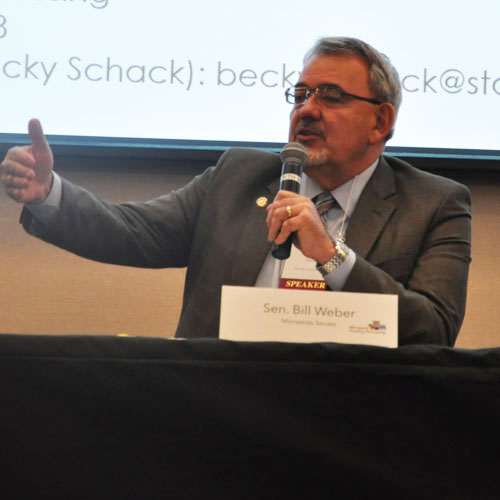
    Senator Weber (pictured right) and Commissioner Tingerthal both underscored the growing need for affordable housing across Minnesota. Senator Weber — who also works as a real estate appraiser and broker in Luverne, Minnesota — emphasized the shortage of housing in his district. In a town of 4,700, less than 20 homes are on the market and rental housing is also scarce. And Weber said he understands that the need for housing goes beyond Luverne.
    “We recognize that need in urban Minnesota, too,” Weber said. “It’s our goal to address all of the [housing] needs across Minnesota.”

    Tingerthal provided a rundown of the impact of Minnesota Housing programs, which help to house hundreds of families across the state each year. Tingerthal highlighted Minnesota Housing’s workforce housing and homeownership programs along with the Family Homelessness Prevention and Assistance Program (FHPAP), which supports efforts to end and prevent homelessness all 87 Minnesota counties. Despite all that Minnesota Housing does to house Minnesotans, Tingerthal explained that there is a large gap between resources for housing and the need for housing.

    “Both our appropriations dollars and our proposal for bonding are sorely needed,” Tingerthal said. “We have two times the number of solid [housing development] proposals than we can actually fund.”

    Advocating for housing at the legislature

    In the question and answer session following the panel, MHP Executive Director, Chip Halbach, pointed out that less than half of one percent of the state budget goes to Minnesota Housing for housing programs. Halbach asked the panelists how advocates can help legislators better understand housing programs and the need for additional affordable housing resources.

    Rep. Hausman responded that, to a legislator unfamiliar with housing, the $100 million bonding request might sound ambitious. For this reason, Hausman emphasized the need for affordable housing industry leaders and advocates to “tell the stories of housing dilemmas in your communities.”

    Rep. Urdahl emphasized the important role constituents play in educating their legislators. “Never assume that your legislator knows anything,” Urdahl said.

    By the conclusion of the event, 50 event attendees had agreed to take steps to educate legislators and advocate for housing by heading to the capitol with the MHP policy team, writing a letter to the editor, or providing support for advocacy in some other manner.

    MHP hosts three exclusive Investors Council breakfasts each year. The next breakfast will take place in May. Join the Investors Council today to be part of these timely discussions! Click here to see more photos of the event.


  • Investors Council Recap: Vouchers in the New Housing Market

    On November 9th, nearly 100 housing developers and advocates convened at MHP’s latest Investors Council breakfast to discuss the challenges facing housing choice voucher (HCV) holders and to consider how housing industry leaders might work together to address those challenges.
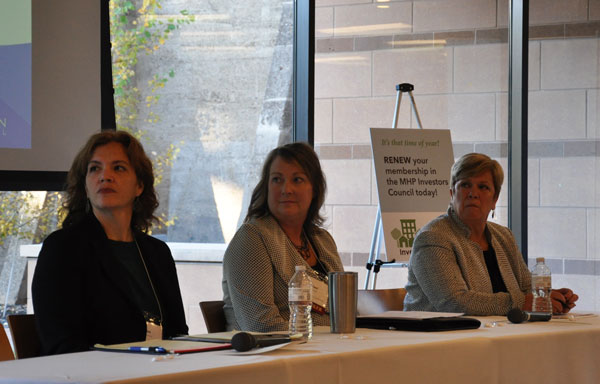
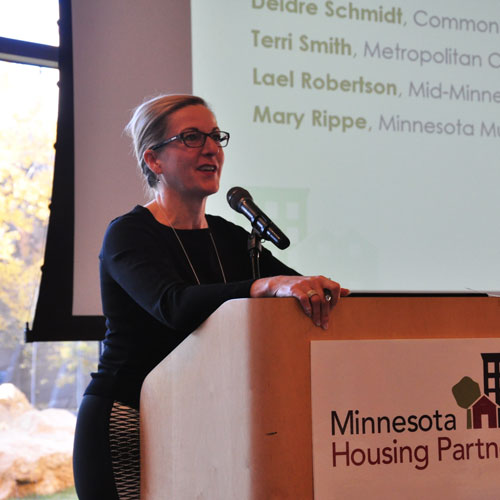
    MHP welcomed four panelists, Jessica Deegan of the Minnesota Housing Finance Agency, Lael Robertson of Minnesota Legal Aid’s Housing Discrimination Law Project, Terri Smith of Metropolitan Council HRA, and Mary Rippe of Minnesota Multi Housing Association. The panelists provided insight into a range of perspectives — from the voucher holders themselves, to their landlords, to the entities that administer vouchers. Deidre Schmidt of CommonBond Communities (pictured right) moderated the conversation.

    Who holds Housing Choice Vouchers and what do they offer?

    According to Lael Robertson of the Housing Discrimination Law Project, housing choice vouchers are intended, as the name implies, to expand housing choice for low income households. Unlike other publicly subsidized housing options for low-income families, which are confined to a fixed location, housing choice vouchers allow low-income individuals to rent any eligible privately owned unit in the region to which their voucher applies. This allows families to find a unit that best fits its needs.

    According to a survey conducted by the Housing Discrimination Law Project, voucher holders want a home that’s safe, close to family and natural spaces, and cared for by a respectful landlord. As Robertson (pictured right) pointed out, half of voucher households include children, one third have at least one member with a disability, and 17 percent include at least one elderly individual. Voucher holders typically contribute 30 to 40 percent of their income toward rent, while federal dollars cover the remaining cost.  

    Panelists from left: Lael Robertson, Terri Smith and Mary Rippe

    Robertson explained that for many of her clients, “vouchers are life changing.” Vouchers allow families to choose a place that feels like home — whether that means living closer to work, social networks, or in an area that provides better access to services. In addition, vouchers can provide families with access to high opportunity areas. Studies such as the 2016 Moving to Opportunity Experiment show that parents given the chance to move to a lower-poverty area with the help of an voucher, see improved futures for their children. Children who participated in the study and moved before turning 13 were more likely to attend college and to live in lower-poverty areas as adults. Their overall lifetime earnings increased by more than $300,000, demonstrating that vouchers can play an important role in breaking poverty cycles.

    A Shortage of Affordable Rental Units

    Because voucher offer such a significant opportunity Robertson and her colleagues call them “golden tickets.” But these “golden tickets” are hard to get and can be nearly as challenging to use.

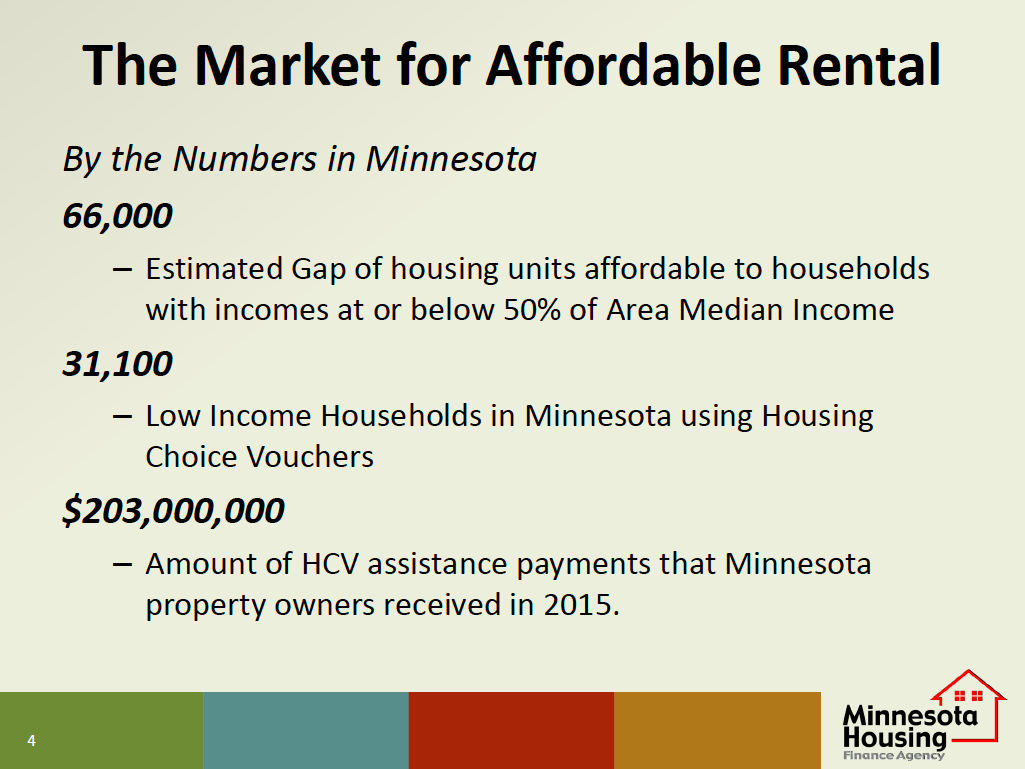
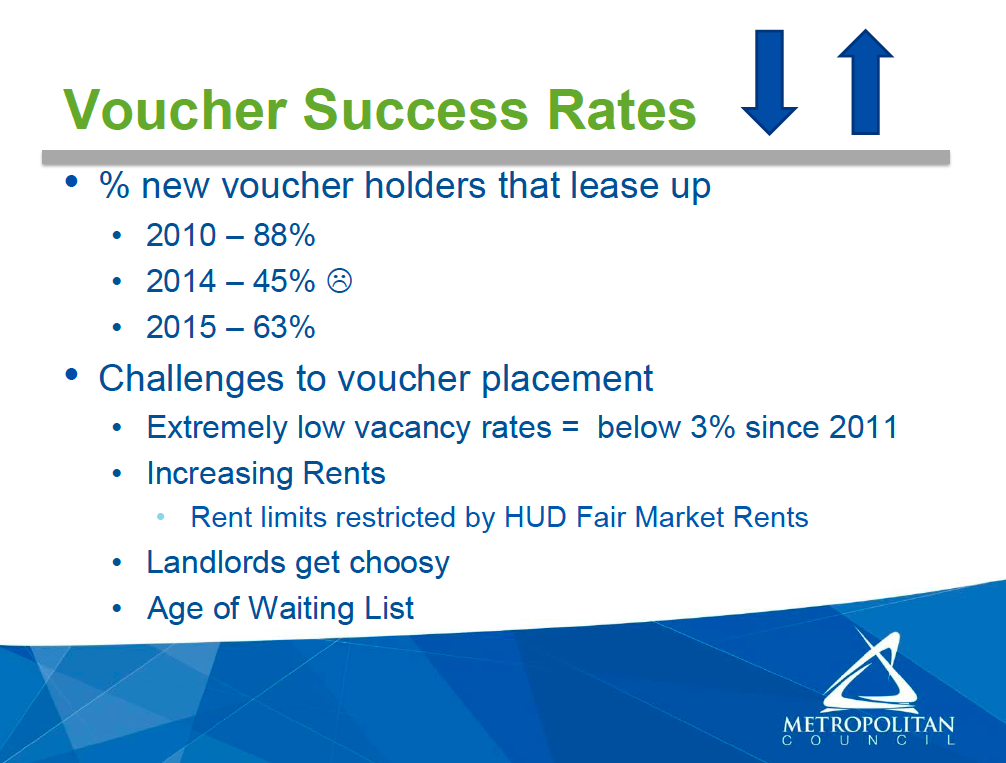
    Jessica Deegan of the Minnesota Housing Finance Agency provided an overview of the market for affordable rentals in the Twin Cities, noting that demand greatly exceeds supply. Declining renter incomes, a growing demand for luxury rentals, low vacancy rates, and a loss of unsubsidized affordable units have created an increasingly competitive rental market. That’s led to an estimated gap of 66,000 housing units affordable to households with incomes at or below 50 percent of area median income.

    From Jessica Deegan’s presentation — download slides here.

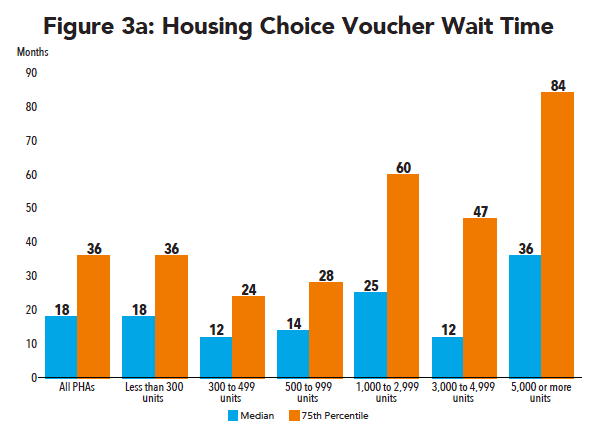
    Demand for the vouchers themselves also exceeds supply. Deegan referenced a report released last month by the National Low Income Housing Coalition based on a nationwide sample of 320 Public Housing Authorities. It found that the median time spent on voucher waiting lists is 1.5 years, and a quarter of those lists have wait times of three years or more.

    From National Low Income Housing Coalition report

    The high demand for vouchers and the shortage of affordable rentals are linked. Because low-income households in the current market are struggling to find affordable units, some seek assistance. Given so many households facing the same challenges, vouchers are in high demand. According to Terri Smith of the Metropolitan Council Housing and Redevelopment Authority (Metro HRA) — the largest administrator of housing choice vouchers in the Twin Cities area — all of its 6,500 vouchers are currently in use and 50 turn over each month.

    If a household manages to secure a voucher, they must look to a limited pool of eligible rentals to find a property that accepts vouchers and that meets federal program requirements. If a voucher holder fails to find such a property in 60 days (unless granted an extension by the local housing authority), they lose out on the federal rental assistance guaranteed to them by their voucher. According to Smith, voucher holders served by Metro HRA have six months to find a suitable unit, a time limit recently extended from 120 days.

    From Terri Smith presentation — download slides here.

    Smith and her colleagues work hard to “put the ‘choice’ in Housing Choice Voucher,” she said. To be eligible for participation in the HCV program, HRAs require that rents charged by property owners fall within 90 to 110 percent of fair market rent (FMR) as determined by HUD. Smith explained that the HRA is setting higher limits to expand the pool of eligible properties — and therefore choice — for voucher holders. The Metro HRA also created the Community Choice program — a partnership between Metro HRA, voucher holders, and property owners — that ultimately assists families in gaining access to higher opportunity areas. The program provides guidance to families on how to be successful renters and support for landlords, including damage deposits upon signing and assurance of timely HRA rent payments.

    Challenges Faced by Property Owners

    Property owners participating or considering participation in the voucher program face challenges, as well. Deegan noted that participation requires additional knowledge and paperwork, such as collecting two rent payments, and ensuring that properties pass stringent housing quality inspections. In addition, some property owners are wary of the program due to concerns about renter accountability.

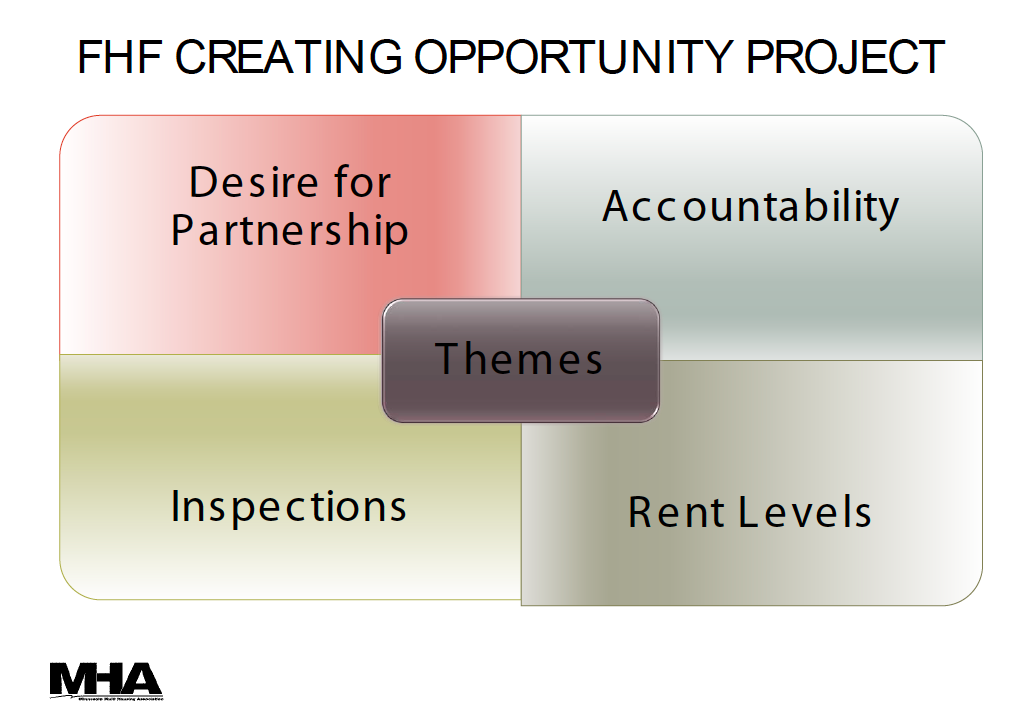
    Mary Rippe of the Multi Housing Association (MHA), which provides resources for multifamily housing owners, explained that organizations like MHA are working to understand how to make the program easier to use and how to incentivize property owner participation. To delve deeper into property owner perceptions, Rippe referenced a report released by the Family Housing Fund: the Owners/Managers Creating Opportunity Project.

    From Mary Rippe presentation — download slides here.

    Property owners who participated in the project were keen to see the voucher program succeed. They pointed to a need for effective partnerships between owners and the Public Housing Authorities (PHA) that administer voucher programs, and suggested programmatic changes that would make participation more attractive to owners. For example, PHAs could provide property owners with inspection requirements before inspections occur and cut down on the frequency of inspections of properties that consistently meet requirements. Property owners also discussed the possibility of “exception rents,” which would allow households to rent properties from owners willing to accept vouchers in areas where rent is slightly higher than the fair market rent determined by HUD.

    Federal Policy Changes

    Deegan concluded her presentation with a round-up of new federal legislation and administrative changes, including:

    • With bipartisan support, Congress passed the Housing Opportunity through Modernization Act of 2016, which helps make inspection requirements more flexible for property owners.
    • In 2016, Senators Cantwell (D-WA) and Hatch (R-UT) introduced the Affordable Housing Credit Improvement Act (S. 3237) to increase accessibility of financing for affordable housing development.
    • In 2015, Rep. Keith Ellison (D-MN) introduced the Common Sense Housing Investment Act (H.R. 1662), which would address the shortage of affordable rentals through reforms to the mortgage interest tax deduction.

    Deegan also pointed to several administrative changes such as the tenant protection voucher notice, fair housing activities such as criminal screening and the Violence Against Women Act, and a proposed rule relating to Small Area Fair Market Rents.

    Click here to see photos from the event, and join the Investors Councils to be part of these timely discussions in the future!  

  • ‘Local control for a local issue’ – Affordable Housing Trust Funds in rural communities

    Guest blog by: Randal Hemmerlin, Executive Director at Red Wing Housing and Redevelopment Authority

    Randal HemmerlinIt is no longer much of a secret that a housing shortage exists throughout Minnesota. The State’s population continues to grow as business is growing its workforce. So much so, that places like Red Wing show a rental vacancy rate of 0.9 % overall and 0.0% in affordable housing in 2014.  Complicating this further, the annual new construction of Single Family owner occupied housing in Red Wing is not near the levels of construction as in the 1990s or early 2000s.  The result is that 6,600 people commute into Red Wing to work each day and seniors have few options as to where they may like to move to from their single family house.

    Other communities in Minnesota report similar findings. 

    One idea that came in 2015 that the City of Red Wing HRA is using to promote new housing or rehabbing existing housing was the establishment of an Affordable housing Trust Fund (AHTF). An AHTF is not a new concept and has been used in Minnesota before by cities such as Minneapolis. It is not common, however, to see AHTFs in rural communities.  Organizations such as Minnesota Housing Partnership and Greater Minnesota Housing Fund would like to see that to change so that the AHTF is one more source of funding that can be used in housing. Since all housing needs are local, it makes sense that local jurisdictions have a stake in the matter financially and an AHTF would allow that to happen.

    In 2015, the Red Wing City Council authorized the HRA Tax Levy to be increased to its maximum statutory limit with the difference going into the AHTF. This was about $97,000 for the fund.  The HRA is working to find other sources to increase that AHTF, such as employer contributions and foundation donations.

    Throughout the state, it is estimated that we have $34 million in unused HRA Tax levies that could be used to create AHTFs.

    To increase the chances of AHTFs being created statewide, a matching state fund could be developed to match the local dollars 1 to 1, or even 3 to 1. Another idea is that Minnesota Housing or DEED housing fund applications that come from jurisdictions with an AHTF would receive a priority over applications from jurisdictions that do not have an AHTF.

    A local AHTF could also decentralize the funding of housing. Right now, funds come mainly from St. Paul to fund housing. Local control for a local issue should carry well with the local jurisdictions.

    With the housing shortage being so critical in our communities and the pressure for funding sources so great, an AHTF may be just the ticket that a local community can use to increase its housing supply.

    Randal Hemmerlin, Executive Director Red Wing HRA

  • New Energy for Renewables in Affordable Housing

    Renewable energy, especially solar, is of great interest to affordable housing developers from both a financial sustainability and mission perspective. However, effective practices and financing systems are still emerging in Minnesota.

    In May, the MHP Investors Council hosted a breakfast discussion focusing on alternative energy sources for affordable housing. Minnesota Housing Commissioner Mary Tingerthal moderated a thoughtful discussion about current projects, challenges in implementation, and the future of alternative energy in multifamily housing on both a statewide and national level. Panelists included Michael Bodaken from National Housing Trust, Gina Ciganik from Aeon, and Vihar Sheth from US Bancorp Community Development Corporation. More than 80 additional leaders representing the Investors Council and its guests, from all sectors of the affordable housing industry, participated in the event. 

    Panelist perspectives

    Michael Bodaken discussed the topic from both a national policy and on-the-ground practice perspective: As part of the Energy Efficiency for All coalition, he works with utilities to implement energy efficiency programs and improve energy investments in affordable housing. The opportunity is massive: By 2025, the coalition projects that utilities will spend $15.6 billion each year in energy efficiency investments in buildings (up from $7.2 billion in 2011). The National Housing Trust has made investments totaling $2.5 million in solar thermal and photovoltaic systems for six properties in its multifamily affordable housing portfolio; in the next five years alone, this is projected to save $1.2 million and prevent the release of 330 metric tons of greenhouse gases. Bodaken also noted that alternative energy is one of the biggest opportunities developers have to reduce costs and carbon output. The largest controllable variable operating cost in affordable housing is the cost of energy and utilities.  Reducing these costs through retrofits or the use of less costly renewables helps keep housing affordable over a longer period of time. 

    Gina Ciganik gave context for the challenges of using alternative energy in Minnesota. On average, Minneapolis has a 130º swing in temperatures between summer and winter—greater than most other metropolitan areas in the U.S. Our systems are strained through sub-zero temperatures, snow, heat, and humidity. This extreme climate variation means that Minnesota housing developers may not be able to adopt models from projects located in milder climates. 

    This graph (featured in Ciganik's presentation) shows the wide annual temperature fluctuation (130 degrees F) in Minneapolis compared to other metropolitan areas.

    Ciganik emphasized that before considering photovoltaic (PV) or other renewable energy strategies, the first order of business is to create buildings that significantly conserve energy, and water.  Solar and other clean energy strategies are less effective in poorly designed buildings with high energy use intensities (EUI).

    Vihar Sheth provided an investor’s perspective on the data needed to make the case to tax credit investors to underwrite renewable energy investments. In part, the challenge is in underwriting savings that accrue directly to tenants, rather than to owners. One innovative approach Sheth noted is to incorporate energy costs into rent (with no net effect on residents’ pocketbooks) so that the savings can be more directly underwritten at the project level and incorporated into lower cost projections for the building. 

    Future prospects for alternative energy in Minnesota 

    Ciganik’s comments were grounded in Aeon’s experience attempting, with partner Hope Community, to achieve net zero energy at their upcoming “The Rose” project at Franklin Avenue and Portland Avenue in Minneapolis.  The Rose is designed to be incredibly energy efficient—operating at just 20-30% of the regional average baseline for energy usage—and to use renewable sources as much as possible for the energy it does consume. After exploring a number of other options for incorporating renewable energy in the project, the developers are now pursuing a Community Solar Garden through a partnership with consulting group Eutectics. 

    Ciganik also noted that resident engagement is critical in energy efficiency. Developments can be LEED certified and use alternative energy, but if tenants do not engage in sustainable practices, developments can still consume a lot of energy and may not reach efficiency goals. Energy efficiency can also be a selling point to residents and contribute to a sense of pride and community. 

    Sheth said that states with the most alternative energy in housing right now have tax credits or some form of stable funding program in place. The panelists agreed that Minnesota’s current lottery system for solar incentives was not workable with affordable housing programs; community solar gardens provide a more predictable resource and seem to have more potential for serving this need.

    In the open discussion that followed the panelists’ comments, many audience members had good news to share. Dominium highlighted its use of hydropower at its new Pillsbury A-Mill development, the St. Paul Public Housing Authority shared the news that its community solar garden initiative for high-rise properties is projected to save over $4 million for the agency, and Northcountry Cooperative Foundation is hoping to implement community solar to reduce costs for resident-owned manufactured home park cooperatives. 


    To learn more about the MHP Investors Council, and the conversation described here, visit https://mhp.sdho.dev/about/investors-council/events