

• Adaptive Reuse in International Falls could see first multifamily development in a generation

    Adaptive Reuse in International Falls could see first multifamily development in a generation

    Housing is hard to find right now in the Borderland, but the reuse of the Alexander-Baker building in International Falls will provide 30 units of affordable housing in the community, and preserve a building with rich history. 

    “The evidence was there — almost 40 years’ worth. Unless our community made it happen, we knew no one else would do it for us and we knew our community couldn’t suffer through another 6 years with a zero percent vacancy rate,” said Isaac Meyer of KOOTASCA Community Action referencing the Census Bureau’s American Community Survey. “Plain and simple: this project will provide housing for our community, our neighbors, and our families, and it will be here and be affordable for the long-term.”

    International Falls and the surrounding communities haven’t seen new rental housing development in a generation — almost 40 years. And that’s a huge problem for the area’s potential new workers. 

    People have been turning down jobs. In fact, the International Falls Journal has recounted several stories of workers considering a move to the area, but they couldn’t find a home. 

    Even if folks can find a place to live, they’re still feeling the pinch because few renting options mean higher rents. Currently, 51 percent of renters in Koochiching County, and 42 percent of renters in Itasca County are experiencing cost burden, according to Minnesota Housing Partnership’s State of the State’s Housing report. Cost burden means people sacrifice food, medicine, and education in order to make the rent.

    New housing will help bring rents down, and provide more options for housing. 

    The historic Alexander Baker building was a former school and has remained a landmark in International Falls for more than 100 years. The 30 affordable housing units will be created from the old classrooms.

    KOOTASCA Community Action and Community Housing Development Corporation, with assistance from Minnesota Housing Partnership, have submitted an application to the Minnesota Housing Finance Authority to secure funding to complete the project. The decision on that funding will be announced later this year. 

    “We’re hopeful that MHFA will approve the project,” said Ward Merrill, Executive Director of Citizens for Backus/AB. “Especially given the huge level of support we have received from the community.”

    For more information about the Alexander-Baker reuse project, visit backusab.org. Learn more about MHP’s Strengthening Rural Communities program here. 
  • MHP releases Local Housing Trust Fund Manual for Minnesota

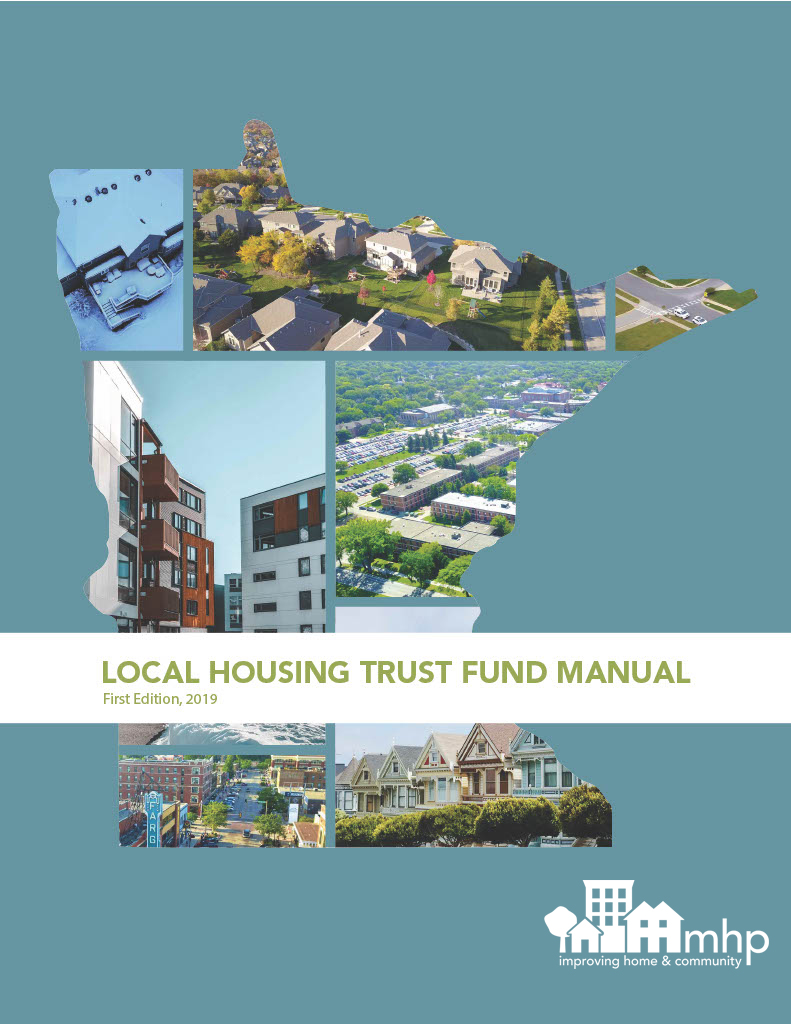
    St. Paul, MN (July 30, 2019) — Today, Minnesota Housing Partnership is announcing the release of its Local Housing Trust Fund Manual for Minnesota. Local Housing Trust Funds are established by a local government by dedicating local public revenue for housing. With 80 pages of references, case studies and explainers, the Local Housing Trust Fund Manual for Minnesota provides an in-depth discussion of key decisions local communities will make to establish a Local Housing Trust Fund (LHTF) — from creating priorities to choosing revenue sources.

    When it comes to housing, Goodhue County Commissioner Brad Anderson‘s view is, “Not doing anything is not an option.” That’s why he and other local leaders established a housing trust fund in Goodhue County as a resource to creatively address evolving local needs. Minnesota Housing Partnership released this manual to help other Minnesota communities do the same.

    “Local communities aren’t going to let Minnesota’s affordable housing shortage hold them back any longer,” said Anne Mavity, Executive Director. “They’re ready to innovate and take action. By creating a Local Housing Trust Fund, communities can implement programs that meet their unique needs and leverage the resources they need to thrive.”

    A consistent, flexible resource, housing trust funds can pool public and private investments. On average nationwide, city trust funds leverage an additional $6 in public and private funding for every dollar invested. Minneapolis’ trust fund, established in 2003, leverages $9 for every dollar invested. 

    Red Wing has already helped six families become homeowners by providing zero-interest homebuyer assistance loans through their trust fund — and they’re poised to help seven more. Established in 2015, Red Wing invests $100,000 annually into their fund. Through Tax Increment Financing, the city will soon invest up to an additional $100,000 annually for 25 years.

    St. Paul established a trust fund last year, with a one-time $10 million investment and annual $2 million investments totalling over $71 million. “We are committed to ensuring all of our residents can participate in our city’s prosperity,” said Saint Paul Mayor Melvin Carter.  “Our Affordable Housing Trust Fund advances this vision by supporting safe, secure, and affordable housing solutions in every neighborhood.”

    To Commissioner Anderson, Goodhue County’s housing trust fund signals that leaders and community members are taking action to help the county realize its potential to thrive. “Our investments say to businesses, individuals, and families, ‘This is the place you should be,’” Anderson said.

    MHP’s Local Housing Trust Fund Manual for Minnesota is a resource that communities of any size can use. It takes lessons learned by cities and counties and combines them with in-depth discussions of current best practices. For more information or to download the Local Housing Trust Fund Manual for Minnesota, visit https://mhp.sdho.dev/local-housing-trust-fund-manual-for-minnesota/.

  • Real impact of #TaxReform: Homes for MN families and homeless seniors at risk

    Last month, working families in Princeton, homeless seniors in Minneapolis and Minnesota residents across the state got hope for a better future when the Minnesota Housing Finance Agency (MHFA) announced its latest round of funding to create and preserve more than 1,800 affordable housing opportunities throughout the state.
    Now, nearly 800 of those homes are at risk — because of a tax reform bill that could cripple the development of affordable housing in Minnesota and across the nation.

    Over the past 10 years alone, nearly $2 billion in private activity bonds have supported the construction of more than 15,000 affordable rental units across the state. But the tax reform bill introduced in the U.S. House of Representative last week eliminates that vital tool. If signed into law, the bill could effectively kill projects like West Birch Estates in Princeton and Minnehaha Commons in Minneapolis, leaving hundreds of families out in the cold and millions of dollars of economic development untapped.

    Please take action TODAY!

    Alliance Housing has been working for more than five years to secure a site and financing for Minnehaha Commons to house the growing number of very low income seniors who are homeless. “The federal tax bill would delay this project further, while need continues to increase and the cost of NOT housing them does, as well,” says Barbara Jeanetta, Executive Director of Alliance Housing.

    In Princeton, West Birch Estates would also be forced back to the drawing board rather than moving toward breaking ground. “The impact of removing the 4% tax credit program would be detrimental to all communities, especially rural communities that do not have a lot of other resources,” says Deanna Hemmesch, Executive Director of Central MN Housing Partnership. “We need to keep the 4% tax credit program as a way for communities to help address their growing housing need.”

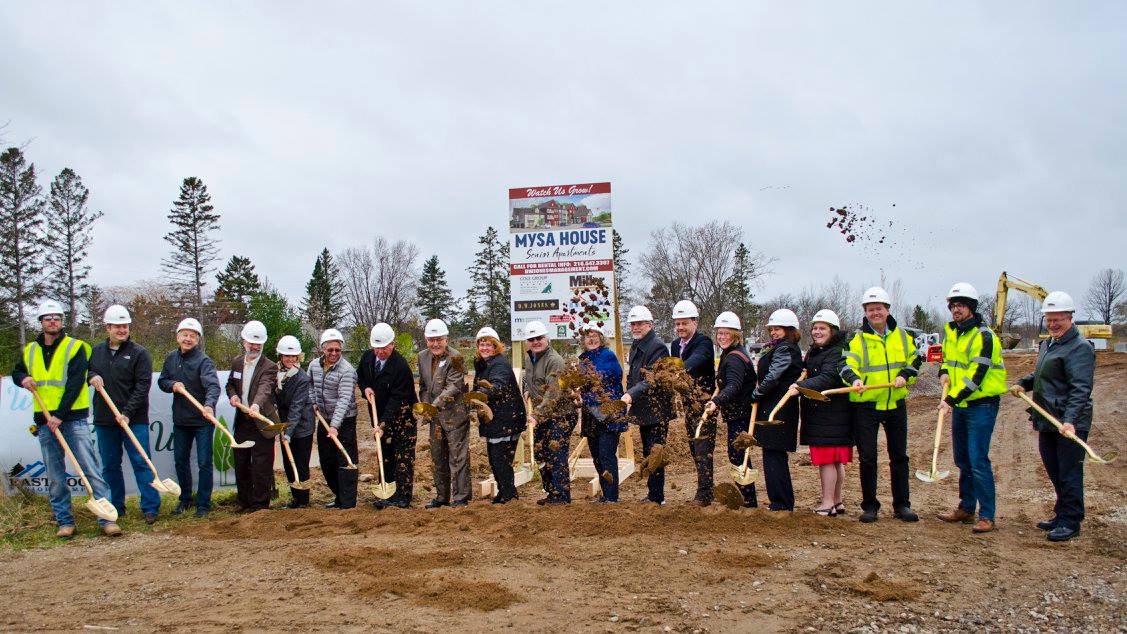
    Just a few weeks ago, MHP celebrated the groundbreaking of Mysa House in Mora, a project that will provide homes for two dozen seniors — many of whom have been on housing waiting lists for years. If passed in its current form, tax reform would make future developments like Mysa House virtually impossible.

    See more photos of the Mysa House ground breaking here!

    “Mysa House was funded with 4% tax credits and private activity bonds and would not have happened without these tools,” says Skip Duchesneau, President of D.W. Jones, the developer for Mysa House. “Without private activity bonds the current bill will hinder our economic development, and stop needed infrastructure investments of cities and towns in Minnesota as well as further plunge the United States into an affordable housing crisis.”

    The proposed changes by Congress will also impact state investments in affordable housing. MHFA uses Housing Infrastructure Bonds (HIB) in place of or in addition to traditional tax-exempt bonds to provide eligibility for 4% credits. Under the proposed changes, HIBs will no longer make a project eligible for 4% credits. As a result, projects will need to find new sources of equity. Because equity sources are already extremely scarce, the proposed changes will make it nearly impossible to use HIB to preserve existing federally subsidized housing without other agency funding. Preserving existing federally subsidized housing is essential to maintaining our affordable housing stock and retaining existing federal investments in Minnesota.

    Other provisions in the tax reform bill that would deepen the affordable housing crisis, include:

    • Eliminating the Historic Tax Credit that has been used to renovate more than 40,000 structures and leveraged $117 billion in private investment over the past 25 years.
    • Proposing sensible changes to the mortgage interest deduction — but directing the benefits to billionaires and corporations rather than redirect savings back into affordable housing.
    • Reducing the corporate tax rate without modifications to the Housing Tax Credit, which will likely negatively impact the value of the 9% Low Income Housing Tax Credit (LIHTC). Novogradac & Co. estimates the net result will be $1.2 billion fewer dollars in equity annually.
    • The proposed use of an alternative inflation measure that will decrease inflation adjustments in LIHTC allocations and, over 10 years, result in the loss of 8,200 affordable rental homes, according to Novogradac & Co. analysis.

    Stay updated by following us on Twitter and by subscribing to MHP publications.

  • Pulitzer Prize winner to highlight impact of evictions in the Twin Cities

    In 2016 alone, nearly 9,000 evictions were filed in Hennepin and Ramsey counties — propelling thousands of families into crisis. This week, Pulitzer Prize winner Dr. Matthew Desmond, author of Evicted: Poverty and Profit in the American City, will join local advocates and leaders to shine a spotlight on this often overlooked housing crisis — and what we can do about it in the Twin Cities.
    As the Princeton professor emphasizes in his nationally recognized research on evictions, poverty, and homelessness: “Without a home, everything else falls apart.” In the Twin Cities, more than 85,000 families pay more than half of their monthly income on rent, making it virtually impossible to pay the rent and meet daily needs, like food, medicine and transportation. Perhaps more than any other issue, that widespread instability in housing undermines the current and future vitality of the Twin Cities region.

    “The heartbreaking stories captured in Dr. Desmond’s book are nearly identical to the families we serve here in Minneapolis,” said Barbara Jeanetta, Executive Director of Alliance Housing, a nonprofit housing developer and manager in Minneapolis. “We know the tremendous barriers low-income families face in finding housing in the Twin Cities, often because they have a past eviction filing on their record. But we also know those same families are responsible tenants and key contributors to the community when they have the stability of safe, dignified housing.”

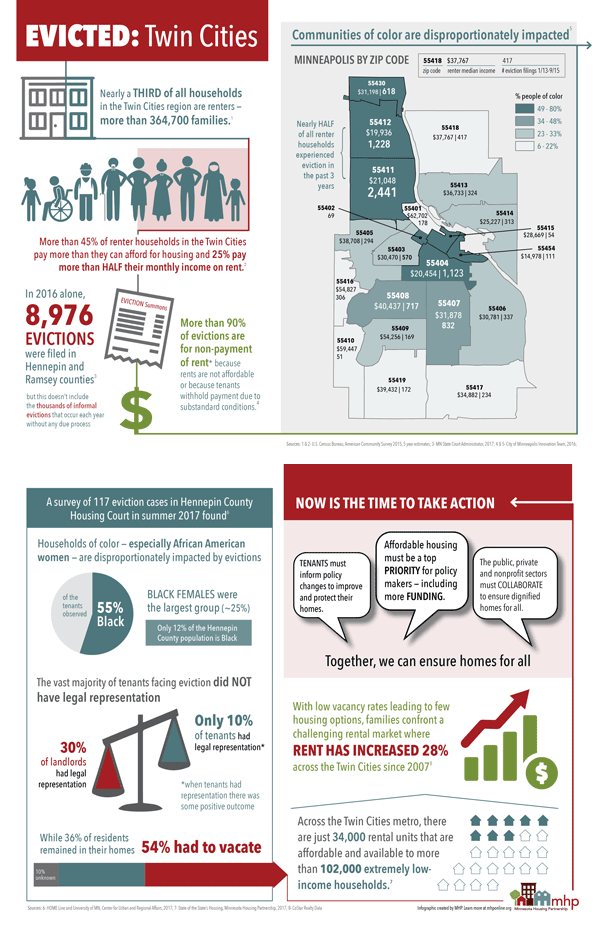
    New research released this week from the University of Minnesota’s Center for Urban and Regional Affairs (CURA) and HOME Line reveals the disproportionate impact evictions have on communities of color. A 2016 study from the City of Minneapolis found that nearly half of renter households in North Minneapolis had experienced an eviction in the past three years — and more than 90% of those evictions were due to non-payment of rent. A survey conducted by CURA and HOME Line this summer found that Black tenants — especially Black women — were the largest group facing evictions, only 10% of tenants had legal representation in court and the majority were forced to vacate their homes.

    Click here to download the infographic as a PDF

    “National data suggests that Black women lead all other women in labor force participation rates, are most likely to work for poverty-level wages, and retire with an average of $100 of wealth,” said Dr. Brittany Lewis, Research Associate at the Center for Urban and Regional Affairs. “These lived realities are compounded by the fact that Black women are most likely to be the sole household earners raising small children. Stagnant incomes and welfare stipends, combined with higher housing costs are disproportionately impacting low-income Black women’s ability to maintain stable and affordable housing.”

    And the epidemic of evictions isn’t simply a housing issue; there’s growing recognition among leaders in the business, education and health sectors that these challenges compromise the vitality of the region. “As health professionals, we see and experience everyday how people’s health is impacted by their home and community environment,” said Connie White Delaney dean of the University of Minnesota School of Nursing. “Dr. Desmond’s scholarly work, and accessible writing shines a bright light on how unstable housing affects an individual’s ability to thrive.”  

    Inspired by momentum nationwide and with a broad and growing local coalition, now is the time to take action. “Together, we have the power to make change,” said Anne Mavity, Executive Director of the Minnesota Housing Partnership. “Our hope is that Dr. Desmond’s expertise and passion will be just the first chapter of an active effort to increase the supply of affordable housing in the Twin Cities; work toward policy changes informed by tenants and landlords; and create accountable dialogue among ALL stakeholders — from government agencies to advocacy organizations to private landlords — to ensure homes for all here in the Twin Cities.”

    Tickets are still available for “A Conversation with Matt Desmond” on Friday, October 20, at 1 p.m. at the Northrop at the University of Minnesota. Tickets are sold out but media is invited to attend a presentation from Matthew Desmond and a response panel of local experts at Augsburg University’s Foss Center on Saturday, October 21, at 7 p.m.

    Learn more and read stories from local residents impacted by evictions and advocates working to address the issue in the Evicted book club, created by Aeon, a local housing nonprofit and sponsor of Desmond’s visit.

    Desmond’s visit is co-hosted by Alliance Housing, Minnesota Housing Partnership and the University of Minnesota’s School of Nursing and sponsored by Aeon, CommonBond Communities, Minnesota Coalition for the Homeless and Twin Cities Habitat for Humanity.

  • Sequestration Impacts Hit Home

    Sequestration, automatic across-the-board cuts to federal defense and non-defense discretionary spending, was meant to be a disincentive for political gridlock.  However, it apparently did not serve its intended purpose as federal lawmakers were not able to agree on a deficit reduction package by the March 1st deadline.

    Though advocates hoped Congress would craft an alternative deficit reduction package when it recently took up the 2013 budget bill, on March 21, 2013, Congress passed a 2013 budget bill that reaffirms sequestration. Needless to say, this is bad news for housing and the impacts of sequestration are already being felt in Minnesota. A federal and state summary follows, along with a call for advocates to make their voices heard in light of the devastating cuts.

    National Impacts

    HUD and USDA Rural Housing programs will both be cut by 5.1%.  Since there are only seven months left of the 2013 fiscal year; it actually amounts to a 9% cut until October 1, 2013.

    HUD estimates that nationwide 125,000 households will lose their Section 8 vouchers and become homeless; 100,000 people will lose homeless assistance and be back on the streets; and 7,300 households served by the Housing Opportunities for Persons with AIDS Program (HOPWA) will lose assistance and be at risk of homelessness. Public housing agencies, already experiencing a severe need for housing repairs and maintenance, will be forced to continue housing tenants in substandard, or even risky, conditions.

    Other affected programs include HOME, which will stifle development of new affordable rental and homeownership units and cause many to lose their jobs; and the Community Development Block Grant (CDGB), which will eliminate funding for many community development activities.

    Minnesota impacts

    Based on estimates provided by the Center of Budget and Policy Priorities, in Minnesota alone, $2,344,999 will be cut from CDBG; $671,532 will be cut from the HOME program; $895,894 will be cut from Native American Housing Grants; $3,685,610 will be cut from public housing; $1,395,964 will be cut in homeless assistance; $59,508 will be cut in HOPWA; and 1,584 households will lose their Section 8 vouchers.

    These estimates may not be far off, as local sequestration impacts are already being felt across Minnesota:

    • Duluth HRA anticipates a 6% reduction to their administration fee to run the Section 8 program; this means that they will be receiving about 69% of their cost to administer the program. They will have to use their local property tax levy to make up the difference.
    • St. Paul PHA says that they have stopped reissuing vouchers to families on the Section 8 waiting list. If a current voucher holder leaves the program, the PHA will retain the voucher to conserve cash. They still will issue vouchers to tenants moving out of rental housing where there are project based vouchers, as required by law.

    What does the 2013 budget bill mean for these HUD programs?

    In the final 2013 budget bill passed on March 21, funding for some important housing and homeless programs was increased above the 2012 level, including Homeless Assistance Grants, which received an additional $132 million and the Public Housing Operating Fund, which received an additional $300 million. This additional funding will somewhat alleviate the impacts of sequestration in the 2013 fiscal year for a couple of HUD programs.  The Public Housing Operating Fund, however, is still severely underfunded, even with the additional $300 million.

    What next

    Important housing and homeless programs will continually be cut indiscriminately each year until Congress can replace sequestration with an alternative deficit reduction package.  The House passed a 2014 budget resolution on March 21st that would have been even more devastating than sequestration, but it was squarely rejected by the Senate.  This means that there is still time to craft a fair 2014 budget resolution.

    Contact your Members of Congress today and ask them to cancel sequestration and support legislation that contains fair, targeted spending cuts and revenue increases. The message shared by housing advocates across the country should be: protect our housing and homeless programs; balancing our budget should not be done on the backs of the middle and low-income families in our nation.

    Be sure to share stories of people who will be affected, whether yourself or people you work with.